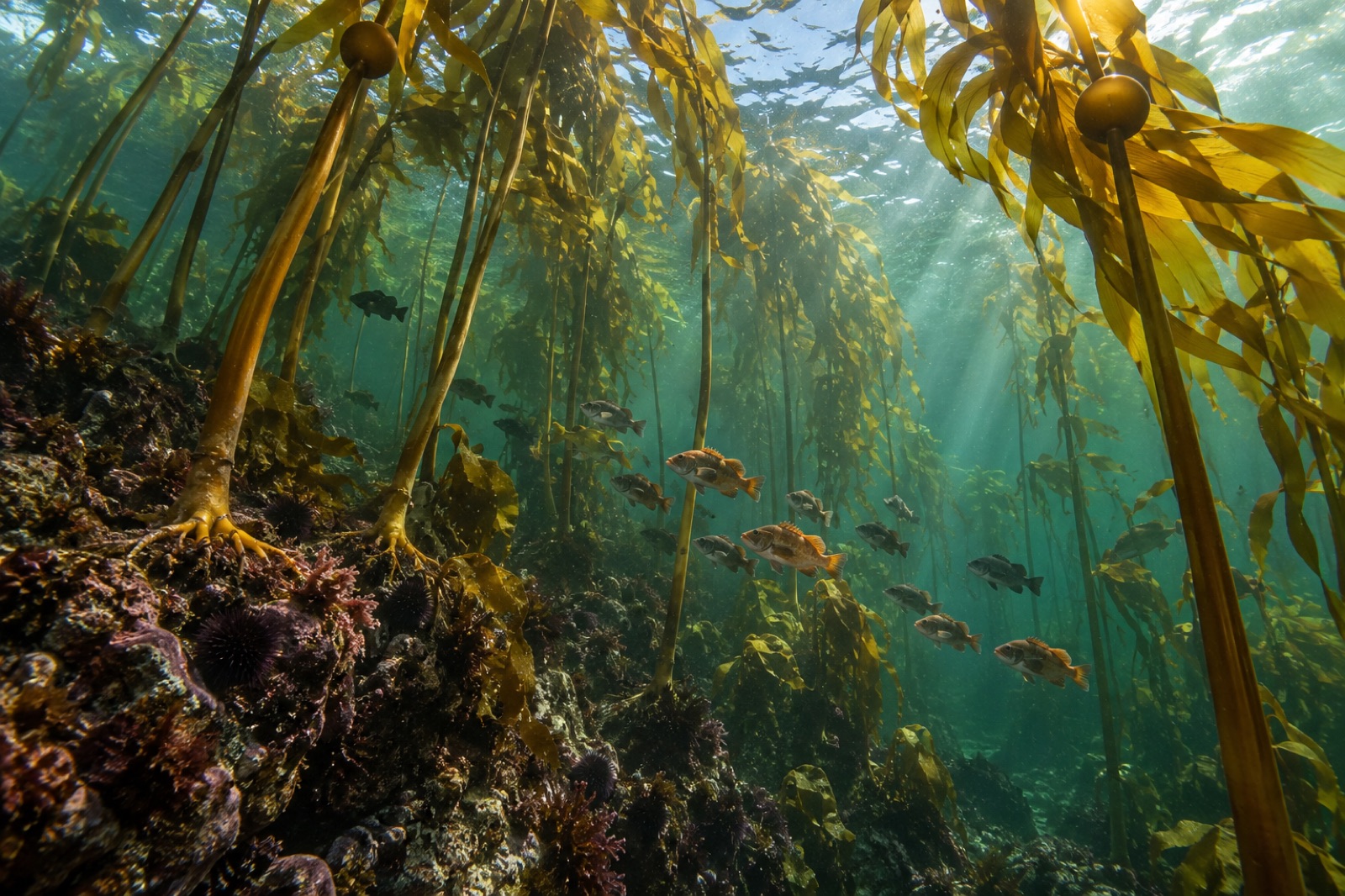
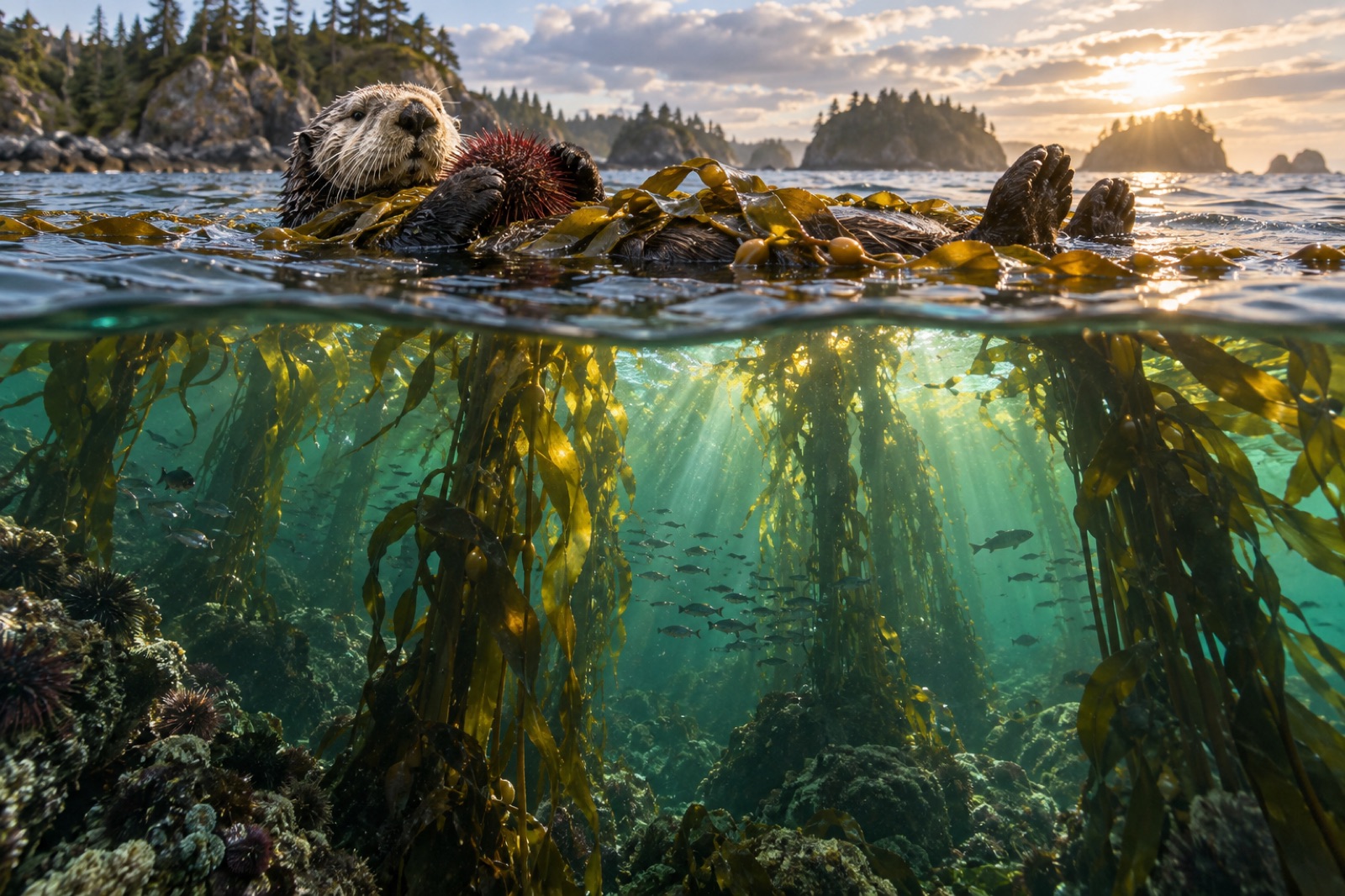
Every March, Sitka Sound becomes one of the great natural spectacles in the Pacific: Pacific herring arrive by the tens of thousands of tonnes and cast their adhesive eggs across the kelp, eelgrass and suspended hemlock branches of the inner sound, turning the water milky and drawing humpback whales, Steller sea lions, eagles and seabirds into a weeks-long feeding event. It is, at its root, a kelp story — and also a human one: the Tlingit people of Sheet'ká Kwáan have harvested herring eggs on kelp here for millennia, and their stewardship is woven through every part of how this shore works today. This guide covers the ecosystems, the seasons, and how to visit one of the Inside Passage's most alive places.
The shape of the sound
Sitka sits on the outer (Pacific) side of Baranof Island, at the western edge of the Alexander Archipelago — the thousand-island maze that forms Southeast Alaska's Inside Passage. Where most Inside Passage towns face protected channels, Sitka Sound opens westward to the Gulf of Alaska itself, softened by a ragged arc of islands and skerries. Mount Edgecumbe, a low volcanic cone on Kruzof Island, stands across the sound like a smaller Fuji, snow-capped above a rainforest sea.
The water here is a blend: cold Pacific inflow mixing with glacial freshwater from the mainland fjords, every tide stirring it through the island passes. The result is productive, green-tinted water — rarely clear, endlessly fed. Kelp lines nearly every rocky shore, on a scale from the kayak-height fringing beds of the inner islands to the deeper reefs of the outer coast. Behind Sitka, the Tongass National Forest — the largest remaining temperate rainforest on Earth, part of the same greater ecosystem as Haida Gwaii to the south — drops straight to the waterline, so that kelp forest and spruce forest trade nutrients across the tide line.
The kelp itself
Southeast Alaska's kelp community is cold-water northern stock:
- Bull kelp (Nereocystis luetkeana) is the canopy-former on the more exposed reefs, its single giant bulb and 20-metre fronds marking the strongest current areas. Our bull kelp species profile covers the biology.
- Giant kelp (Macrocystis pyrifera) — the cathedral-builder of California — reaches its practical northern limit in this region, with stands recorded around Sitka Sound; where it occurs, it forms the most structured habitat in the ecosystem.
- Sugar kelp (Saccharina latissima), ribbon kelp (Alaria), split kelp (Laminaria spp.) and a dozen red and brown understory algae fill in beneath the canopy, on the boulders, and in the tidepools.
- On the reef floor live the animals that made this coast famous: rockfish, lingcod, wolf eels, giant Pacific octopus, sea stars, and more urchins than anyone will ever count.
Sea otters play the keystone role here that they do across the north Pacific: with otters at healthy densities, urchin grazing stays restrained and the kelp stands. This is the classic three-level drama — otters, urchins, kelp — that our piece on trophic cascades in kelp forests lays out fully. Sitka Sound's forests are, presently, on the right side of it.
The herring event: spring's great surge
To understand Sitka's kelp you have to understand its herring, because the two are bound together at the level of spawning substrate.
Pacific herring are small, silvery, oily — and profoundly important, transferring energy from plankton to almost everything bigger. Each spring, shoals mass inside Sitka Sound and spawn synchronously: females lay billions of adhesive eggs onto kelp fronds, eelgrass blades and deliberately suspended hemlock branches; males turn the shallows white with milt. The spawn coats the kelp in a shimmering layer the colour of pearl.
What follows is one of North America's top wildlife events. Humpback whales bubble-net feed on the shoals, corralling herring with curtains of bubbles. Steller sea lions catch them at the surface. Bald eagles darken the shoreline spruce — Sitka's eagle census in spring runs into the hundreds — and surf scoters, gulls and cormorants fill in the water column and air. The feeding event lasts from March into April and concentrates a season's worth of ocean productivity into a few weeks in a few bays.
The other harvest is older. Tlingit families of Sheet'ká Kwáan have collected herring eggs from kelp and submerged hemlock boughs for thousands of years — the eggs are a cultural keystone food, dried or eaten fresh, and the subsistence harvest continues today alongside tribal research and monitoring. It is one of the clearest examples anywhere of Indigenous management of a marine resource at a multi-millennial scale, and it frames the modern controversy: a commercial sac-roe fishery, which harvests spawning females for the egg skeins sold to Japan, operates in the same sound, with annual arguments over quota set against herring abundance, Tlingit rights and the food web itself. The Sitka Tribe of Alaska has been at the centre of that debate — a genuine contemporary test case for co-management of a kelp-linked fishery.
The working sound: mariculture and tourism
Beyond herring, Sitka Sound's modern economy is tentatively re-embracing the seaweed itself. Southeast Alaska has become one of America's most promising kelp-farming regions: cold, clean, deep water; existing boat infrastructure; and state regulators treating mariculture as blue-economy future rather than industrial past. Oyster and kelp farms now operate around the archipelago, with Sitka a hub for the supply chain and the research — the Sitka Sound Science Center runs a hatchery and research program on the waterfront. Kelp farming here is still small — dozens of farms, not hundreds — but the trajectory matters: a region deciding the kelp is worth growing, not just taking. Our piece on regenerative ocean farming sketches the model.
The other modern boom is above the surface. Sitka receives hundreds of thousands of cruise visitors a year, many of whom will never see the kelp at all — a tension the town negotiates openly. The sound rewards the traveller who slows down.
Visiting Sitka: a field guide
Sitka is best in spring for the spawn, but worth travelling to in any season.
- For the herring spectacle (March–April): boat-based wildlife tours run out of Crescent Harbor daily during the spawn; you will see whales working shoals and sea lions at the surface. Stay far off the commercial fishery work boats — the fishery has exclusion zones.
- For kelp above the water: sea kayaking is the insider's way in. Guided paddles run from June through September through the inner islands; you will paddle over bull kelp fronds, watch otters at work, and raft up in kelp-cleared bays. Guided trips handle the weather judgement Sitka demands.
- For kelp under the water: a more specialist option — as with much of Alaska, Sitka has drysuit snorkeling operators who will take competent cold-water snorkelers into shallow kelp beds. Our cold-water diving essentials piece is a genuine prerequisite, not a courtesy.
- On foot: Sitka National Historical Park's intertidal shores show the tide-line community at ankle depth; Halibut Point Recreation Area has Sitka's best shore-rock snorkel-pool habitat; St. Lazaria Island, a bird-studded volcanic islet off the sound's mouth, is bookable by charter and one of Alaska's great seabird stops.
- With Tlingit culture: the Sheet'ká Kwáan Naa Kahídí community house, the Sitka Tribe of Alaska's program work and local Indigenous-led tours are the way to understand that the kelp here is a relationship, not a view.
Responsible wildlife watching matters: whales have legal distance requirements, and our guide to watching sea otters responsibly carries directly over to Sitka's marine mammal waters.
Key takeaways
- Sitka Sound is a kelp-water ecosystem: bull kelp canopy, giant kelp at its northern range edge, sugar kelp understory, on a Pacific-Gulf of Alaska boundary coast.
- The spring herring spawn on kelp is one of North America's great natural spectacles, drawing humpback whales, sea lions, eagles and seabirds into a weeks-long feeding event.
- Tlingit stewardship of herring eggs on kelp and hemlock branches runs millennia deep and continues; the modern sac-roe fishery makes herring management a live Indigenous-rights and food-web debate.
- Sea otters keep urchins in check and the kelp standing; the trophic cascade here is healthy and visible on its outer reefs.
- Southeast Alaska is emerging as a kelp-farming region, with Sitka's hatchery, boats and cold water positioning it at the front of America's algae economy.
FAQ
When is the herring spawn in Sitka?
Typically March into April, timed within a window of a few weeks each year depending on water temperature and stock. Wildlife tours run throughout the event; the peak whale activity tends to follow the spawn by days.
Can you see sea otters in Sitka Sound?
Yes — otters are common on the outer islands and reefs. Because of their normal kelp-canopy behaviour, they are often easiest to watch from a kayak or a slow boat with some distance; the watching-otters-responsibly rules apply fully.
Is there giant kelp in Alaska?
A little. Giant kelp (Macrocystis pyrifera), the California cathedral-kelp, reaches its documented northern extent in Southeast Alaska; stands occur around parts of Sitka Sound. Dominant canopy kelp through most of the region is bull kelp.
Can you eat seaweed from Sitka's shore?
Some intertidal species are traditionally harvested locally, but Sitka is a living ecosystem inside a contemporary food-web debate; harvest can also be regulated and customary-use-sensitive. The respectful route is guided: Indigenous-led forage tours and the science centre's programs teach you what to take and what to leave.
Is the herring fishery controversial?
Openly so. The commercial sac-roe fishery harvests spawning females for their eggs, and its annually set quota is contested by the Sitka Tribe of Alaska and subsistence users on abundance and cultural-rights grounds. Visiting the sound is, unusually, a chance to see Indigenous co-management of a marine resource being actively negotiated.