There is a moment, on the ferry across Hecate Strait from Prince Rupert, when the mainland sinks behind you and the blue line of Haida Gwaii rises ahead — and you understand that you are no longer travelling along a coast but out to one. Haida Gwaii ("Islands of the People" in the Haida language) sits around ninety kilometres off northern British Columbia: 150-plus islands across roughly 250 kilometres of latitude, formerly called the Queen Charlotte Islands, the waters around them some of the wildest, most kelp-rich, most culturally layered coastline in the North Pacific. This is the atlas entry for an archipelago that scientific literature keeps calling exceptional — and that Haida law has understood as a homeland for at least thirteen thousand years.
The setting: continental edge kelp
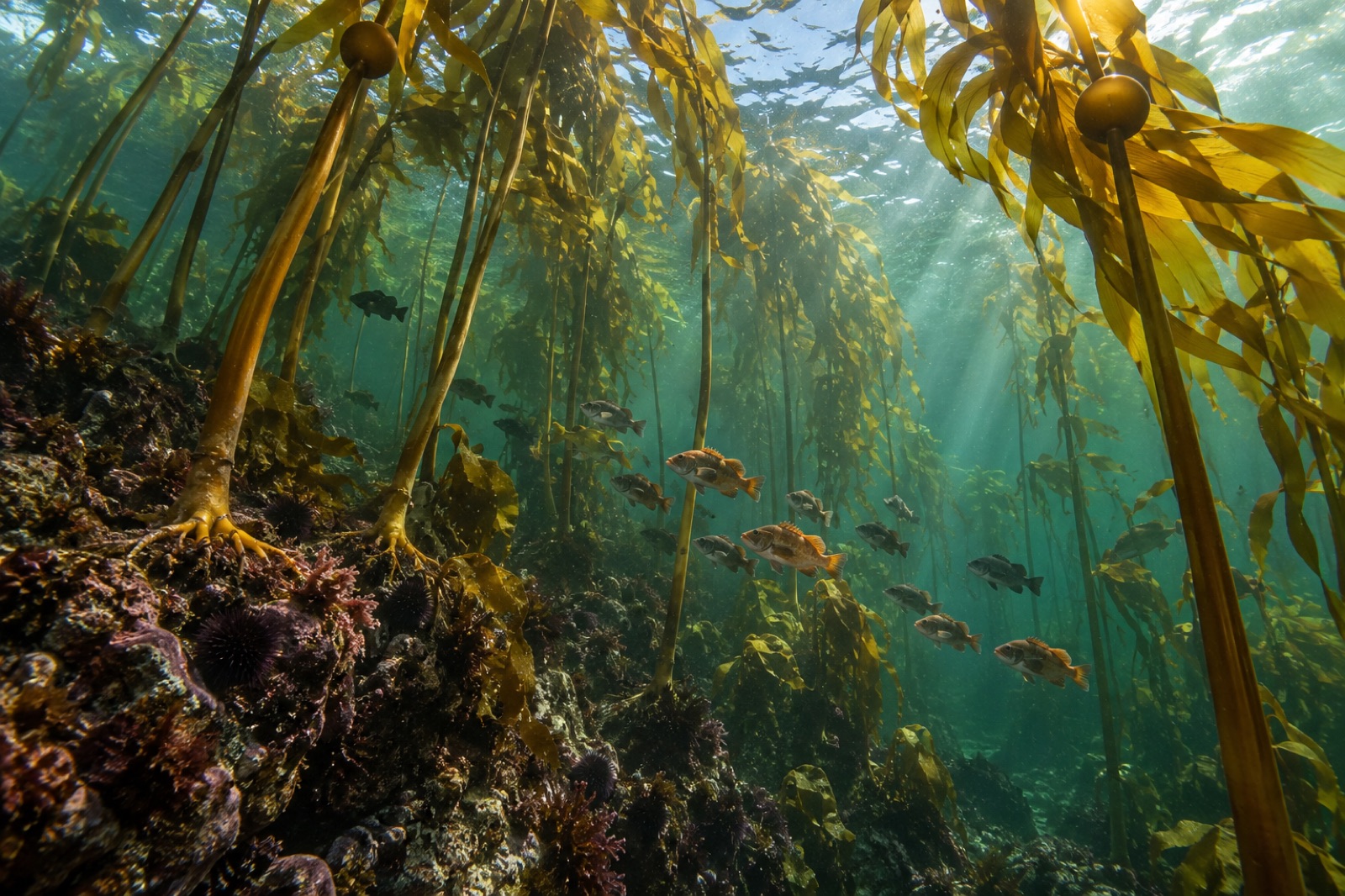
Haida Gwaii lies at the outer edge of the continental shelf, the lee side of nothing. The east coast faces shallow, stormy Hecate Strait; the west coast faces the open Pacific, with swell arriving unimpeded from Japan. That asymmetry defines the kelp. East-facing shores carry bull kelp beds and lush mixed brown-algal reefs in moderately sheltered water — the fjord-indented inlets of Skidegate, Cumshewa and Selwyn. The exposed west coast of the two large islands (Graham and Moresby) is open-ocean kelp forest with a capital F: giant kelp and bull kelp over surge-swept bedrock, in water that can run clearer here than almost anywhere else on the Canadian Pacific.
Oceanographically the archipelago sits in a sweet spot. The Haida Eddies — enormous, persistent eddies spun off the shelf by winter storms — trap and recirculate nutrient-rich water over the continental margin west of the islands, helping drive one of the higher-productivity pockets in the entire Northeast Pacific. The herring that still spawn along east-facing kelp fringes each spring draw in whales, salmon, seabirds and people for the most concentrated ecological event of the coast's year.
A record of land and sea
Haida Gwaii's human record is unusually deep. Kilgii Gwaay, an archaeological site on the islands' south end, has produced evidence of maritime use dating back more than 10,000 years, when sea levels were lower and the archipelago was bigger. Through the millennia since, the Haida developed one of the great ocean-canoe cultures — red-cedar voyaging canoes capable of open-sea crossings and, by historic times, villages whose totem poles and longhouses lined every strait worth fishing.
The catastrophe is also part of the record. Smallpox and other epidemics in the nineteenth century collapsed Haida population from tens of thousands to under a thousand within a few decades; surviving villages were consolidated at Skidegate and Old Massett. Yet continuity held. Language, clan law and knowledge of sea and shore passed through the survivors, and the twentieth century ended with a renaissance: the 1985 Lyell Island standoff that halted logging, the 1993 agreement creating Gwaii Haanas, and the 2010 reconciliation protocol that formally recognised Haida title and governance over the archipelago's land and sea.
Gwaii Haanas: co-management on an epic scale
The southern third of Moresby Island and the scattering of islands south of it form Gwaii Haanas National Park Reserve, National Marine Conservation Area Reserve and Haida Heritage Site — one of the largest and most comprehensively co-managed protected areas on Earth, governed jointly by the Council of the Haida Nation and the Government of Canada through the Archipelago Management Board. No logging. No industrial fishing in the marine area. Haida Gwaii Watchmen, the Haida-staffed guardian programme, look after cultural sites and guide all visitors.
Underwater, Gwaii Haanas is the archipelago's ecological reference condition. The kelp forests here — giant and bull kelp over granite and basalt, under herring-rich upwelled water — carry the fuller food web the rest of the archipelago is rebuilding toward: rockfish in several species, giant Pacific octopus, wolf eel, Steller sea lions at their haulouts, tufted puffins and ancient murrelets overhead. Gwaii Haanas also holds SG̱ang Gwaay (Ninstints), the Haida village site at the archipelago's far south whose mortuary and memorial poles still stand facing the sea — a UNESCO World Heritage Site and arguably the most moving place on the entire Northwest Coast.
The kelp forest ecology — written differently here
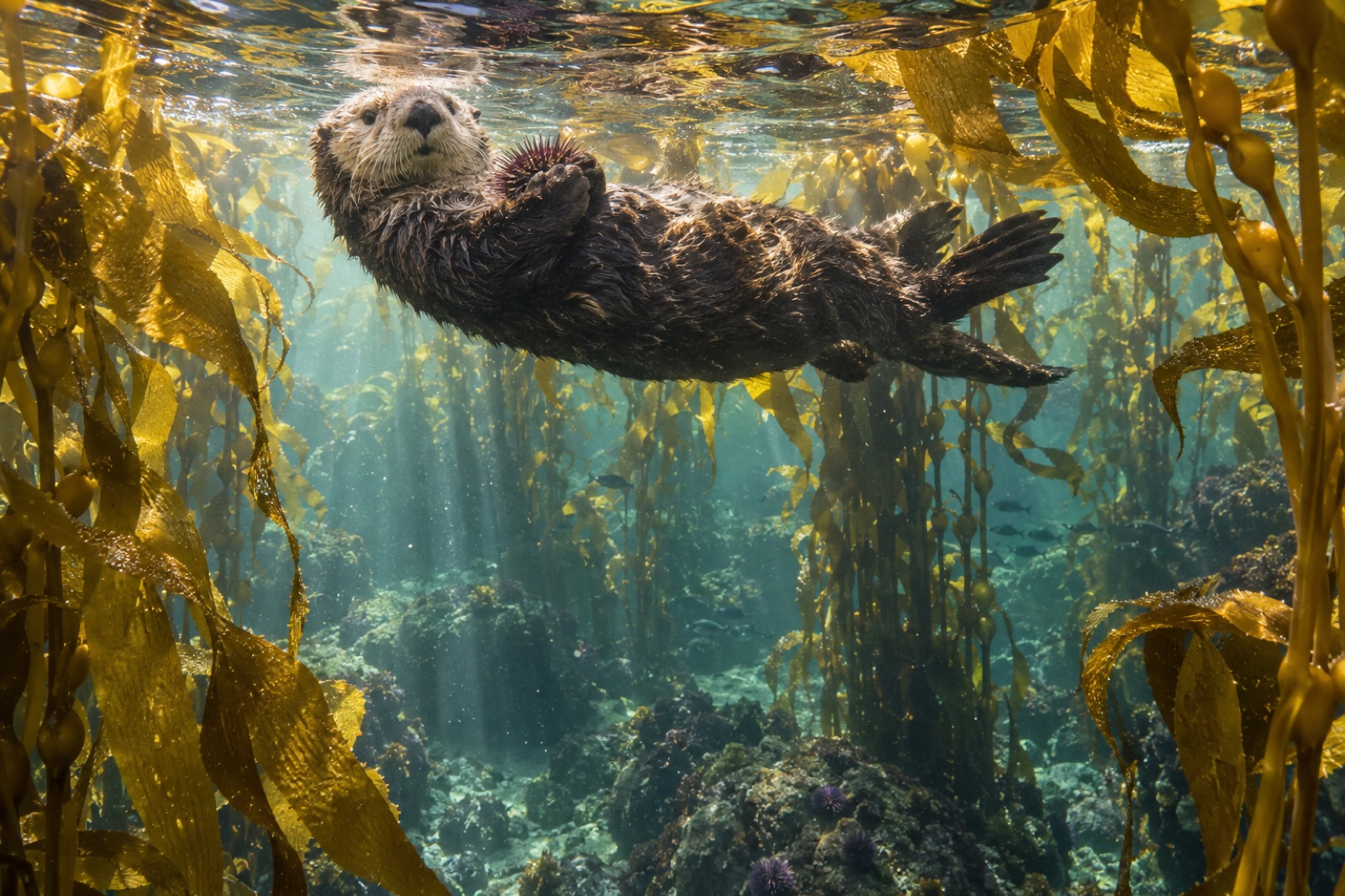
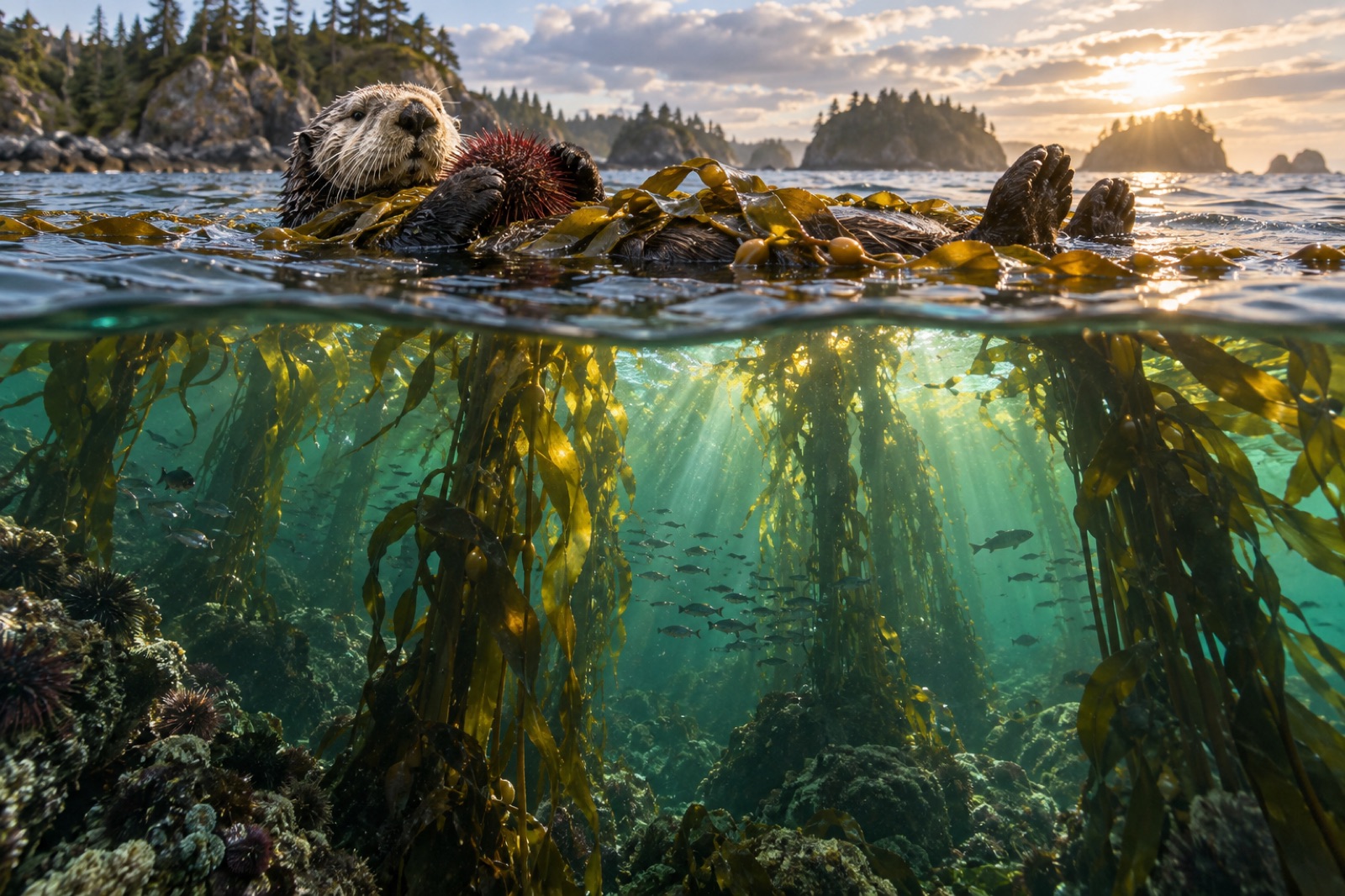
Haida Gwaii's kelp ecology is distinct from the classic Aleutian narrative. Sea otters, the classic keystone that holds forests elsewhere, were extirpated here in the nineteenth-century fur trade and have never naturally returned; the reefs have lived for two centuries in an otter-absent state. Yet they are not classic urchin barrens. Haida Gwaii's kelp persists under a different balance: heavy wave disturbance that limits urchin dominance on exposed coast, subsidised by a grazing cast (including the black rockfish and the enormous red sea urchin fishery of the north coast) that keeps herbivore pressure distributed rather than concentrated.
That makes the archipelago a live experiment: what does a kelp forest look like when its putative keystone predator has been missing for 150 years but the physical regime remains harsh? The answer is a forest that works — productive, biodiverse, fished — but differently structured. Urchin biomass runs high; urchin gonads (uni) are a commercial fishery; kelp beds fluctuate more with storm and temperature years than under otter control. eDNA-based monitoring and long-term diver surveys through Pacific partners are slowly assembling the baseline that will let scientists say whether the arrangement is stable or transitional.
Two more pressures sit on top. Warming water is beginning to reach the archipelago's cold-water species; marine heatwave events that used to stop farther south now touch Haida Gwaii's surface layers. And the herring — the keystone forage fish that glue the coastal food web together — are managed under a treaty-recognised Haida closure against commercial roe fisheries, one of the clearest cases in Canada of Indigenous law explicitly protecting the base of the web.
Visiting: logistics and attitude
Haida Gwaii is reachable — daily flights to Sandspit or Massett, a BC Ferries run from Prince Rupert to Skidegate — but it asks more of a visitor than most coasts. Gwaii Haanas is accessible only by boat or floatplane, and every visitor must attend a Watchmen-led orientation and travel under Haida law. Independent dive charters are limited; most diving here is scientific or expeditionary, and cold-water experience is a hard prerequisite. Kayak expeditions into Gwaii Haanas are the archipelago's classic wilderness commitment, run out of small Haida-owned operators in spring and summer.
People who make the trip describe a specific sensation that no other kelp coast quite matches: the sense of being in a functioning Indigenous territory where the water is not scenery but jurisdiction. Permission matters; the Watchmen's briefings are not tourist theatre but the operation of a government. If your interest in kelp runs toward the question of how restoration can be structured as a partnership — not a project imposed on a place — Haida Gwaii is the archipelago to study. Tidewright's own community partnership model and our field-notes series (see our week with the Kudjela Rangers) borrow directly from the Haida co-management template: Indigenous law first, science in service, monitoring owned by the people whose country it is.
Key takeaways
- Haida Gwaii is a 150-island archipelago off northern BC, Haida homeland for at least 13,000 years, co-governed today under Haida title and Canadian law.
- Its kelp coasts split sharply: sheltered east-side bull kelp and herring bays, and exposed west-side giant kelp forest facing open Pacific swell.
- Sea otters have been absent since the fur trade, yet kelp persists — making the archipelago a natural experiment in how forests hold together under a different ecological balance.
- Gwaii Haanas, the southern third of the archipelago, is one of the largest land-and-sea co-managed protected areas in the world, and SG̱ang Gwaay is a UNESCO site.
- Haida stewardship — linguistically, legally and practically — is not a feature of the kelp story here; it is the frame through which the entire coast is governed.
FAQ
How do you visit Haida Gwaii?
Fly Air Canada or Pacific Coastal to Sandspit (Moresby Island) or Massett (Graham Island), or take the BC Ferries crossing from Prince Rupert to Skidegate. Book ferries and lodging well ahead for summer. Gwaii Haanas trips require an operator or independent registration, orientation with the Haida Watchmen, and a functioning small-craft plan; most visitors go with licensed Haida-owned tour operators.
Is Haida Gwaii good for diving?
Spectacular and very demanding. Water is cold year-round, weather is serious, and dive infrastructure is minimal. There are no regular tourist dive boats; access is by expedition, research vessel or specially arranged charter. Divers with genuine cold-water, self-sufficient experience can arrange expeditions through specialist British Columbia operators — and should treat this as advanced diving, not a step up from a tropical resort.
What is SG̱ang Gwaay?
SG̱ang Gwaay (formerly Ninstints) is a Haida village site at the southern tip of the archipelago whose standing poles — mortuary and memorial poles carved in the nineteenth century — make it one of the most important Indigenous heritage sites in North America and a UNESCO World Heritage Site. Visited only with Haida Watchmen guidance, it sits at the centre of Gwaii Haanas and gives the kelp-coast story its human depth.
Are there sea otters in Haida Gwaii?
Not currently as a self-sustaining population. Otters were hunted out in the fur trade and have not re-colonised; occasional sightings occur, and reintroduction is periodically discussed, but the coast today is managed as otter-absent. That absence structures the kelp ecology — urchins are abundant, a commercial urchin fishery operates, and kelp health depends on wave disturbance and balanced herbivory rather than otter predation.
Why is Haida co-management considered a model?
Because it is comprehensive, old and still functioning. Since 1993 the Haida Nation and Canada have jointly governed Gwaii Haanas through a consensus decision body; since 2010 the Kunst'aa guu–Kunst'aayah Reconciliation Protocol has extended Haida decision-making across the whole archipelago. Projects that would otherwise battle through consultative friction instead proceed under Haida law from the outset — faster where approved, impossible where not, and transparent either way.