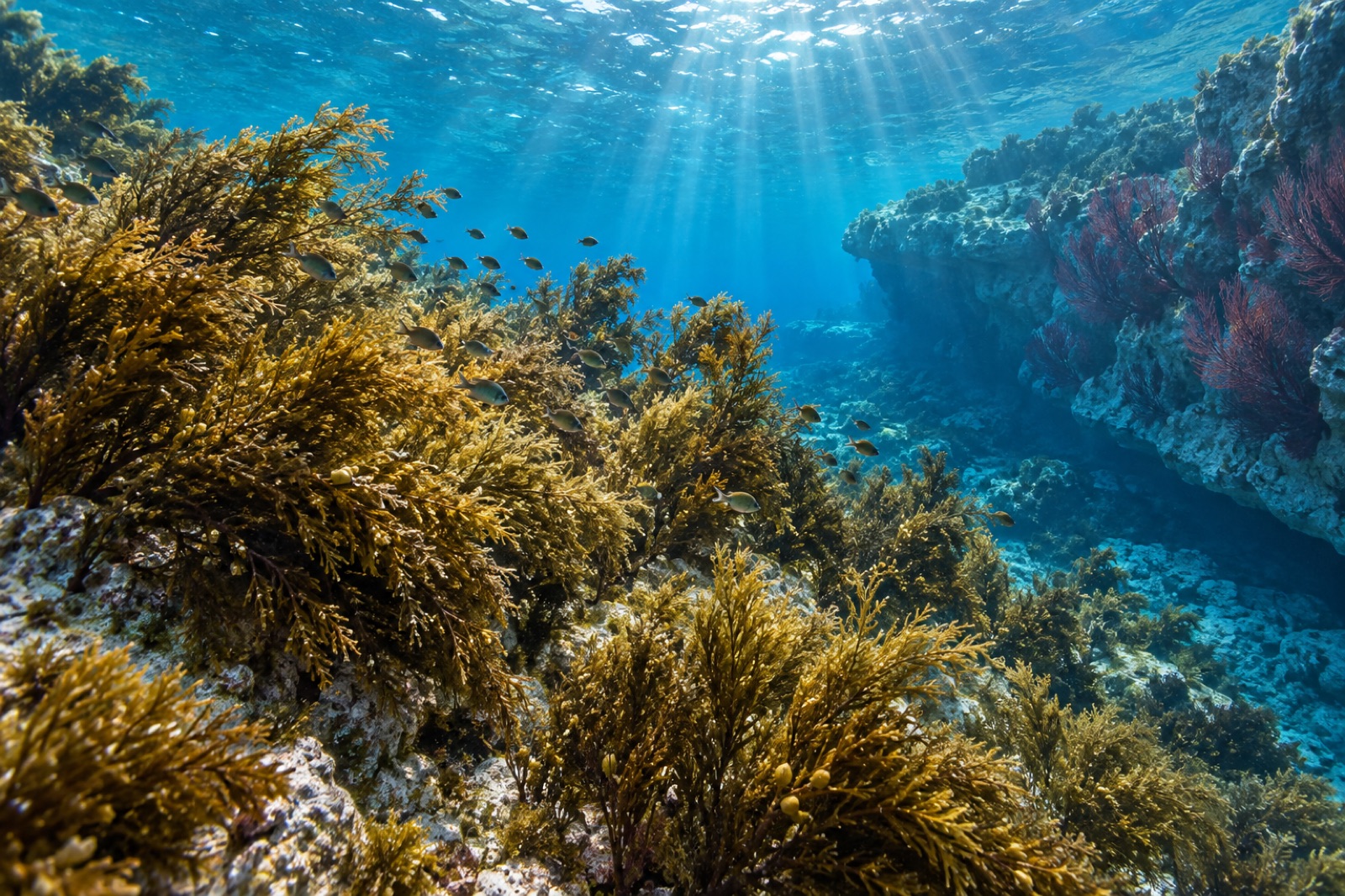
The Mediterranean has almost no true kelp — no Macrocystis, no Laminaria. What it has instead, at its best, is something every temperate-ocean diver will recognise the moment they descend: golden-brown canopies of branched algae towering over shaded understory, fish hanging in the gaps, light dropping through fronds in moving columns. These are the forests of the Cystoseira group, and Sicily — ringed by three seas and a crown of volcanic islands — holds some of the finest left in the basin. This guide maps where the forests stand, why they are struggling, and how to see them while they do.
Why Sicily, of all Mediterranean coasts
Sicily sits at the crossroads of the Mediterranean: the Tyrrhenian to the north, the narrow strait of Messina to the east, and the open southern basin between it and North Africa. The island's coast alternates between the raw basalt of Etna's flows, the soft-tuff shelves of the Aeolian arc, and limestone platforms on the west. Every shore type the Mediterranean offers is compressed into one island group.
Crucially, the seas around Sicily are clear. Cystoseira species are light-hungry; where visibility runs 20–30 metres, the canopy keeps photosynthesising deeper than in the murkier Adriatic, and the forests hold on. In deep, transparent water around the outer islets, some species bed down at 40 metres and beyond — a vertical reach most Mediterranean coasts have lost to turbidity, sediment and coastal shading.
The volcanic crowns: Aeolian Islands
North of Messina the Aeolian archipelago — Lipari, Vulcano, Stromboli, Panarea, Salina, Filicudi, Alicudi — rises straight out of a kilometre-deep basin. Underwater, the same lava flows continue as rugged reef, pocked with fumaroles venting champagne streams of carbon dioxide bubbles off Vulcano. In the 1980s and 90s, survey divers described some of the Mediterranean's most spectacular Cystoseira beds on these reefs: stands of Ericaria and Gongolaria species (the genera into which the old Cystoseira umbrella has been re-split) waving like miniature oaks over volcanic rubble.
The forests there are dynamic. Stromboli erupts; landslides and lahars redraw reefs in a season; and the islands' summer tourist pressure loads the nearshore with sediment and moorings. The deep, outer rock — the seamounts below snorkelling range — acts as a refugium.
The Egadi Islands: Italy's largest marine reserve
West of Trapani, the Egadi archipelago — Favignana, Levanzo, Marettimo — sits inside Italy's largest marine protected area. Marettimo, a humpbacked limestone crag with peaks over 600 metres, shelters genuinely dense stands: Cystoseira forests shading caves and walls, and providing the nursery habitat for the dusky grouper and amberjack that bring divers out from Favignana's dive centres. Volunteers with the reserve continue to map canopy extent and fish for the signatures of recovery. The Egadi's protection is imperfect — artisanal fishing continues around its inner zones — but the canopy is measurably better than at comparable unprotected coasts, the kind of natural experiment that underpins the case for marine protected areas everywhere.
Ustica and the north coast
Ustica, the basalt cap of an eroded volcano northwest of Palermo, was Italy's first marine protected area, gazetted in 1986. Its east-side reserves hold rocky platforms where the Cystoseira canopy closes over fields of sponges, and its posture — no anchoring, one trail-guided route for snorkellers, Rangers guarding the site — is a model other Mediterranean reserves now copy. West of Ustica the forest thins into sediment bottom; east, capes alternate bed and boulder for fifty kilometres toward Cefalù.
What these forests are — and what is taking them down
The Cystoseira group are fucoid brown algae, kin to the northern rockweeds rather than the kelps, but ecologically they play the kelp role — structure-generating, tide-height-frame-holding primary habitat. Our Cystoseira species profile details the group across its two dozen Mediterranean species; the sister guide to the Dalmatian karst coast covers the other great stronghold.
Three pressures define their Sicilian decline:
Warming water. Mediterranean surface temperatures are rising roughly three times the global ocean average, and the basin has been raked by marine heatwaves since 2005. Deep-living Cystoseira species, evolved for cold layering, are running out of depth. As a group they are now locally or regionally extinct along shorelines where their beds were documented for centuries — the kind of wholesale restructuring no temperate kelp coast has yet seen at that scale.
Herbivory. The sea bream Sarpa salpa and the purple urchin Paracentrotus lividus — of the genuine Mediterranean barren-makers — clear canopy holdfasts quickly where fishers deplete their predators, following the same trophic-cascade logic as the better-known Pacific systems.
The land. Coastal roads, harbours, beach-sand nourishment and runoff-shadowed bays cut the light and flush sediment onto reefs. Cystoseira recruits poorly onto dusty rock.
Seeing the forests
Best season: May to early July and September–October, before northerly autumn seas and after peak summer boat density. Water clarity peaks in early summer before plankton blooms haze the shallows.
Where to start:
- Egadi (Favignana base): day boats run to Marettimo's east-side reserve coves; snorkel trips visit canopy in 3–8 metres.
- Ustica: the reserve's guided snorkel routes ride above shallow canopy; east-side dives reach it in 5–15 metres on lava pinnacles.
- Aeolians (Lipari): Pumice-strewn reefs between Lipari and Panarea; deeper sites off Filicudi for experienced divers.
- Plemmirio, Syracuse: an Ionian-case reserve on the island's southeast corner whose shallow platforms recover canopy quickly when left alone.
What to look for: the branched, air-bladed fronds with the canopy lying flat when the sea is long; dusky damselfish territories at the canopy base; the pale rim of encrusting coralline algae where urchin grazing meets living algal reef — the same pink cement that recruits kelp forests on cold coasts.
Restoration, and what Sicily teaches the temperate world
Sicilian universities and NGOs now run some of the Mediterranean's most diligent Cystoseira resurrection work: collecting fertile tips, growing juveniles inshore, outplanting them onto cleared rock. Survival is modest — juveniles are grazed, buried or cooked — but recovery has been demonstrated at the scale of coves.
Tidewright does not operate in the Mediterranean; our vessels and hatcheries are tuned for cold-water kelp. But the grammar of restoration is shared: local genetics matter (see how we apply that in our own Holdfast nurseries), the barren must be treated as well as the canopy, and success is measured in years of outplanting, monitoring and adaptation, not ribbon-cut plantings. Sicily shows what happens if no one acts for fifty years — and what, with patience, a cove can hold again.
Key takeaways
- Sicily's "kelp" are the branched Cystoseira group; they occupy the same ecological role as true kelp and are among the Mediterranean's most threatened habitats.
- The Egadi marine reserve, Ustica and parts of the Aeolians preserve the island's best remaining canopy; visit through licensed operators from May–June or September–October.
- Warming, herbivorous fish and urchins, and coastal sediment control the forests' fate; deep-water outer reefs are critical refugia.
- Mediterranean declines show what irreversible forest loss looks like — and cove-scale restoration is already proving that reversal is possible.
FAQ
Does Sicily have real kelp forests?
No — the Mediterranean is too warm for the true kelps. Sicily's near equivalents are the Cystoseira group of fucoid brown algae, which form similar three-dimensional canopies over shallow reefs and fill the same nursery, shelter and carbon roles.
Where is the best snorkelling over Cystoseira canopy in Sicily?
The Egadi Islands at Marettimo and Ustica marine reserve are the most reliably clear, protected sites with canopy shallow enough to see from the surface. Book with dive centres on Favignana or Ustica that hold reserve permits.
Why are the Aeolian Islands important for algae?
The Aeolian reefs combine volcanic relief, fast currents and clear, deep water — a natural template for Cystoseira habitat. The CO₂-suffused vents off Vulcano also make the islands a natural laboratory for ocean-acidification research.
Can I dive the Cystoseira forests from shore?
Yes at Ustica and in the Plemmirio reserve south of Syracuse; both have shallow platforms reachable from shore on calm days. Marettimo and the Aeolians generally require boats.
Is anything being done about warming in Mediterranean forests?
Direct climate mitigation is beyond any coast's own power; what science is doing is buying resilience — mapping refugia, protecting predators, outplanting juveniles and trialing assisted-adaptation approaches from more southerly stock, the same dilemmas facing kelp coasts everywhere.