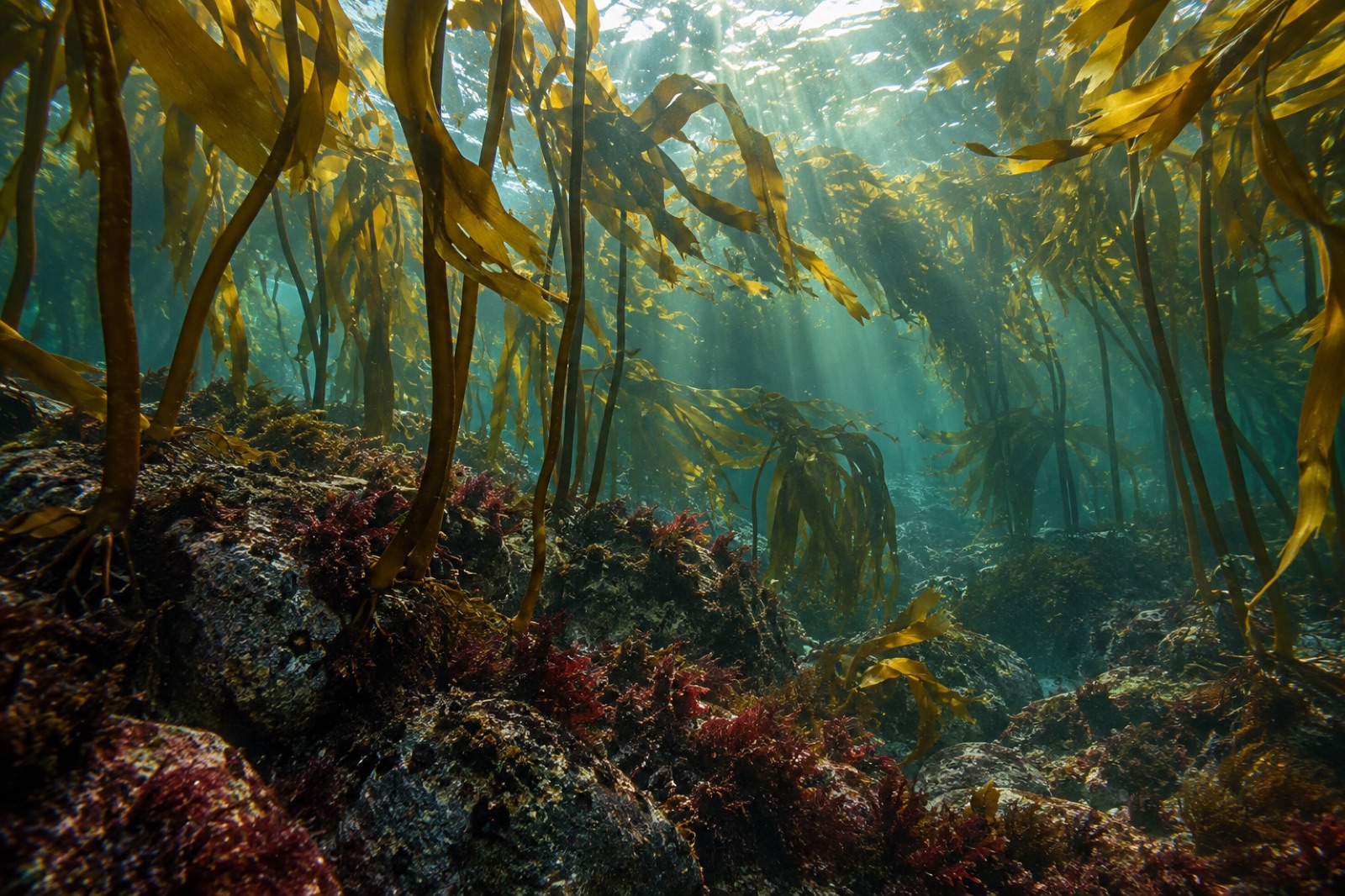
Run a finger 1,400 kilometres west of Lisbon across the Atlantic and it lands on nine volcanic humps rising out of four kilometres of open ocean: the Azores. These islands are famous topside for hydrangeas, crater lakes and whale watching — and underwater for something this atlas needs to handle honestly: the Azores do not have true kelp. They are too warm, too far south of the boreal kelp line, for the great laminarian forests. What they have instead is their own warm-temperate seaweed forest, built from different genera on volcanic rock, and it teaches a useful lesson about what a seaweed forest is and is not.
Where the kelp line runs out
The boreal kelp forest belt — oarweed, tangle kelp, sugar kelp and their kin — reaches south through the British Isles and Brittany and down the Portuguese mainland, thinning as summer water warms (see our guides to Brittany and the Portuguese kelp coast). The Azores sit well past that line, in water that runs roughly 16°C in late winter to 24°C in late summer. Isolated by 1,500 kilometres of warm ocean from the nearest laminarian forest, the islands never carried a true kelp canopy.
So the atlas note is careful: if you arrive in the Azores expecting a Macrocystis forest you will not find one. What you will find is a different kind of seaweed forest — and it is worth understanding both on its own terms and for what it says about where kelp can and cannot go.
The Azorean seaweed forest
The forest builder here is the warm-temperate brown-algal guild — fucoids of the Cystoseira sensu lato group (now split into several genera by modern taxonomy) — along with dense turf algae, red and green understory, and the busy encrusting life of volcanic rock. Where conditions are right, Cystoseira-type canopies form dense, metre-tall stands that do much of what kelp does: three-dimensional structure, primary production, habitat, sediment baffling, carbon uptake. Where conditions are wrong — storm-striped rock, heavy graze, nutrient-poor summer water — the forest thins to turf, and the difference maps the microgeography of the coast.
Life in and around these stands is mid-Atlantic distinctive. The Azores sit at a biogeographic mixing point, and their reefs carry species shared with Portugal, the Mediterranean and the Caribbean in different ratios: dusky groupers, Azores chromis, Mediterranean morays, ornate wrasse, parrotfish, and — at the intertidal hinge — the limpets the islands are famous for.
Limpets: the lapas economy
Two endemic Azorean limpets — the larger Patella candei and the smaller Patella aspera (locally lapa brava) — are the signature living harvest of the islands. Lapas are grilled with garlic and served across the archipelago; they are also among the most instructive small-scale fisheries in the Atlantic, because they are managed openly and co-governed with local knowledge. Both species were driven to local scarcity by unregulated picking in the twentieth century; both are now under size limits, seasonal closures and island-by-island management, with the local fishery organised around hand-picking by licensed collectors working the surf line.
From a kelp-atlas perspective the limpets matter because they teach the same lesson the kelp forests do further north: intertidal grazers are the forest's management. Over-graze the rock and turf collapses to crust; manage the graze and the algal mosaic holds. On islands where the visible seaweed canopy is lambasted by winter storm, the intertidal graze regime is half the story of what a given headland will wear in spring.
The volcanic reef as habitat
The reef structure under the forest is entirely volcanic: basalt flows, lava tubes, arch and cave systems, black-sand ledges and seamount pinnacles. It is superb habitat — complex, horizontal, crevice-rich — and it carries a different weight of life than the continental shelf. Deepwater species come shallow around the islands because there is little shelf to buffer the drop-off; the blue and sperm whales that make the Azores a world whale-watching destination are working the same shelf-break that mobulas, and occasionally marlin and tuna, work from the pelagic side.
The shallow reefs support the flagship dive species the Azores are known for: the dusky grouper, fully protected and now comfortably common again around the marine reserves; the Azores chromis, schooling over every rock slope; and at the offshore pinnacles — Formigas, Dollabarat — mobula rays in summer aggregations that are among the Atlantic's most reliable pelagic encounters.
Diving the islands
The Azores are a serious mid-ocean dive destination, more Atlantic-islander than kelp-coast: warm-temperate water (16–24°C seasonally), visibility often 20–40 metres offshore, and a strong menu:
- Santa Maria — the warmest, southernmost island, with the most "Atlantic-Caribbean" feel: caves, pelagic visits and the Formigas islets.
- Pico and Faial — the central group: Princess Alice Bank (a seamount reaching to about 35 metres, famous for schooling mobulas), lava caves and sheltered coastal reefs.
- São Miguel — the largest island, with the widest operator base and good coastal diving.
- Flores — the westernmost: clearer water still, caves, and a sense of being at the Atlantic's rim.
Kit and planning differ from the cold-kelp north: a 5–7 mm wetsuit or light drysuit in season, no drysuit-essential planning, and boat-based access for most of the notable sites. Our explore hub covers the temperate-water craft; the dive centres on São Miguel and Pico are the practical rugged starting point.
What the Azores tell this atlas
Every region in this guide is, in part, an argument about what kelp means. The Azores argue the negative case well: a coast where the ocean is warm enough, isolated enough and storm-lashed enough that the kelp bodyplan never took hold, yet where a warm-temperate seaweed forest still builds structure, holds carbon, raises fish and supports a managed harvest culture. When the future ocean warms, the coasts of Brittany and Portugal will move toward the Azorean regime; the Azores are the atlas's window into what a warmer seaweed forest looks like when it is healthy.
The parallel concerns are the same as everywhere: marine heatwave years pressing the warm edge still further, the integrity of the limpet co-management, the siting of ports throughout a young volcanic seascape — and the yawning gap between what we know about the Azorean intertidal (studied for a century by the islands' own universities) and the deep seamount reefs beyond. Where kelp cannot live, the rest of the seaweed world still needs its stewards.
Key takeaways
- The Azores lie too warm for true kelp; their seaweed forests are built by Cystoseira-group fucoids and a rich warm-temperate guild on volcanic rock.
- Two endemic limpets — lapas — anchor a small, well-managed hand-harvest fishery that is a model of intertidal co-governance.
- Volcanic structure, weak shelf and seamount proximity give the islands deepwater life in shallow water: groupers, chromis, mobulas, whales.
- Diving is warm-temperate mid-Atlantic, 16–24°C, with 20–40-metre visibility offshore and boat-based access to the best sites.
- The islands are the atlas's window into what a warmer healthy seaweed coast looks like — the regime Portugal and Brittany will move toward as the ocean warms.
FAQ
Do the Azores have kelp?
Not true laminarian kelp — the water is too warm and too isolated from the boreal kelp belt. The shallow subtidal is forested instead by warm-temperate fucoid browns (Cystoseira relatives), forming dense stands up to about a metre that fill much of the kelp functional role.
What are lapas?
Lapas are the Azorean limpets — especially the larger Patella candei and the smaller Patella aspera — harvested by licensed hand-pickers at the surf line and grilled across the islands. Both are managed by size limits, seasons and local rules, and are the islands' signature seafood.
When is the best season to dive the Azores?
June through October brings the warmest water (18–24°C), the calmest seas and the mobula ray aggregations at Princess Alice Bank. Water temperature, and the fog patterns, vary island by island.
Why are there whales around the Azores?
The islands rise steeply from deep ocean with little shelf, so the productive shelf-break habitat that whales feed over is close to shore. Sperm whales are resident; blue, fin and other baleen whales pass through on migration.
Are the seaweed forests changing with climate?
The islands' reefs are already warm-temperate, and marine heatwave years test the Cystoseira-type canopies at their upper tolerance. The region is a reference point for how southern European coasts will reorganise — and a site where managing the graze fishery well is itself conservation.