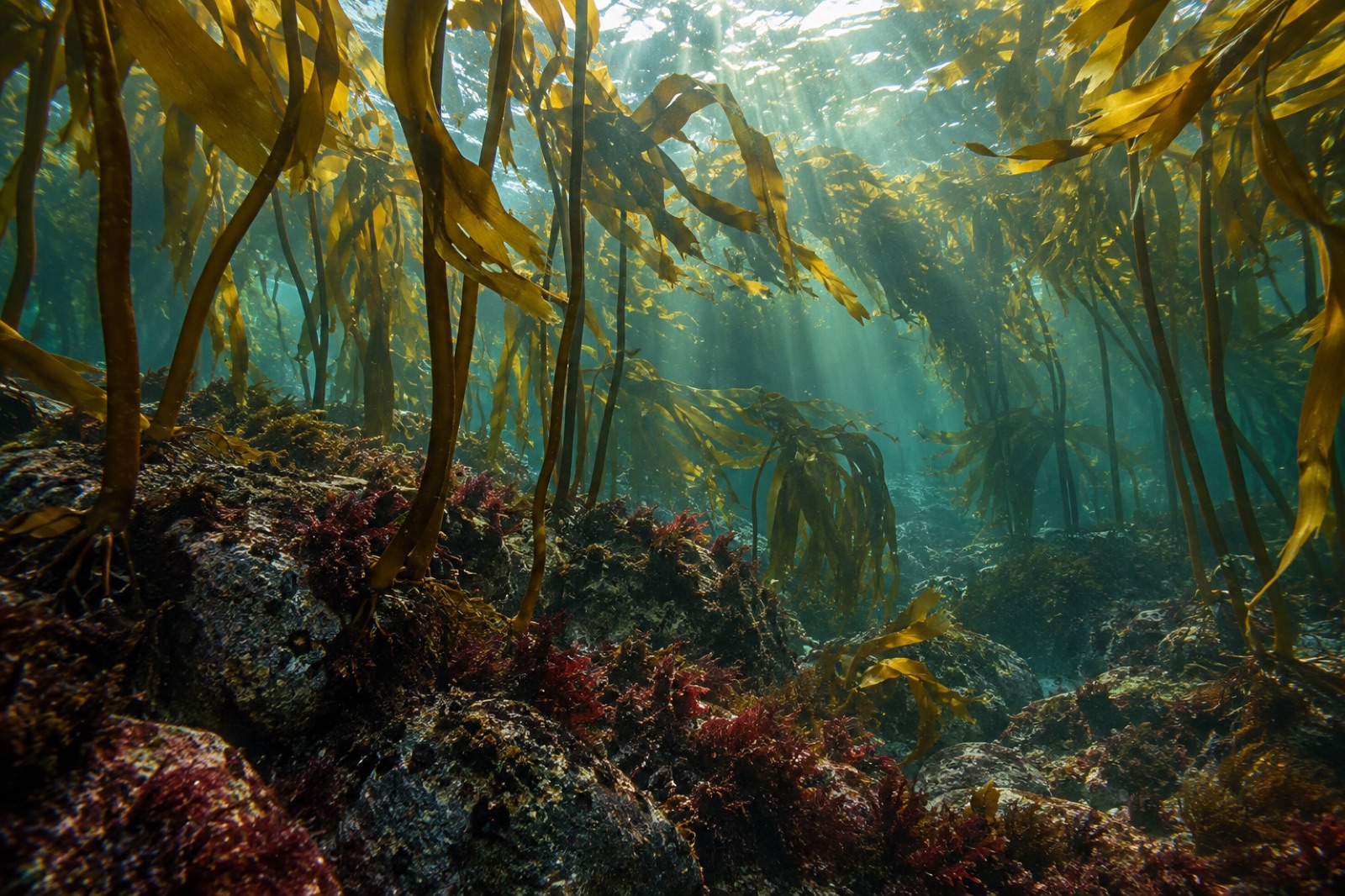
Drive the Wild Atlantic Way — the 2,600-kilometre coastal route that threads from Cork to Donegal — and you follow, without knowing it, one of Europe's great kelp coasts. Beneath the famous cliff edges and drumlin bays of Mayo, Galway and Kerry lie underwater forests built by some of the most wave-exposed habitat on the continent, tended for centuries by people who read seaweed the way farmers read weather. This guide covers the kelp itself, the astonishing fire-and-ash economy it once funded, the modern fight over who may cut it, and where to see a living Irish kelp forest for yourself.
A coastline built out of weather
Western Ireland fronts the North Atlantic with almost nothing in the way. Between Mayo and the Canaries there is open water, and the prevailing westerlies stack swell onto these cliffs for thousands of kilometres before it arrives. That makes the west coast of Ireland among the most wave-exposed shores in Europe — an environment that punishes anything without a grip and rewards, spectacularly, the seaweeds that have one.
The geography breaks into three working parts. Donegal and Mayo, high in the northwest, get the rawest water: Achill Island's reefs face unbroken fetch, while Clew Bay — a drowned drumlin field of more than a hundred small islands out of Westport — shelters calmer arms with scalloped, kelp-fringed halos. Connemara and Galway hold the middle: clear water, granite reefs, and the long fingers of Ballynakill and Killary (Ireland's fjord) where sheltered bays carry different seaweed communities thirty minutes' drive from open Atlantic storm-coast. Kerry and west Cork take the south, where the Skellig coast and the long sea-loughs — the Kenmare River, Bantry Bay — soften slowly toward Brittany's ocean regime.
Sea-surface temperature runs roughly 9 to 15°C across the year: never tropical, but Atlantic-warm enough, thanks to the North Atlantic Current, that Ireland's kelp line includes a few species at their northern worldwide limit and keeps going strong through winter.
The forest beneath the cliffs
Irish kelp assemblages are rich for the north-east Atlantic, and they layer distinctly by depth and exposure.
- Cuvie or tangle kelp (Laminaria hyperborea — see our tangle kelp species profile) forms the main subtidal forest on exposed reefs, its rough stipes colonised by red algae and its canopy persisting for years. It dominates from a few metres down to 30 metres or more where water clarity allows.
- Oarweed (Laminaria digitata — species profile), its blade split into tapering fingers, crowds the upper subtidal, foresting the first few metres below the lowest tide.
- Sugar kelp (Saccharina latissima — species profile) holds the sheltered bays: Clew Bay's inner arms, Connemara's loughs and Killary Harbour, in long ribbons over silted rock.
- Alaria (Alaria esculenta, dabberlocks) hugs the outermost points where wave-beaten rocks are exposed at low water.
- Sea spaghetti (Himanthalia elongata) fringes the mid-shore in button-and-noodle drifts, and in the understory, on stipes and rock, dulse (Palmaria palmata — species profile) grows as an epiphyte on the kelp itself.
In the clearest bays of Connemara and Donegal, the kelp forest floor also holds maerl beds — carpets of unattributed free-living coralline algae, among the most biodiverse seabed habitats in the north-east Atlantic, and among the slowest to recover from damage.
Fire and ash: two centuries of kelp money
From the early 1700s into the nineteenth century, the west of Ireland ran on winter-cut, summer-burned seaweed in a way that is genuinely hard to picture now.
The ash economy rises
Harvesters cut wrack and kelp, dried it in stone-walled hanks, and burned it in shallow pit fires to make kelp ash — a grey, glassy cake rich in soda and potash that fed the glass, soap and, later, iodine industries. The work was brutal, seasonal, and paid. Across the islands and peninsulas — the Arans, the Blaskets, the shores of Donegal and Connemara — kelp-burning was livelihood enough to be written into leases, land disputes and folklore. Ruined kelp-ash kilns still stipple old maps and, in places, the shore itself.
The collapse, and what the wrack became
It ended fast. Industrial soda chemistry and, later, cheaper sources of potash and iodine gutted the ash trade in the first half of the nineteenth century, and the kelp economy collapsed into memory, place-names and famine-era hunger. What survived was a quieter, more sustainable art of use: wrack hauled up from the storm line and mixed with sand and manure to build soil — the famous lazy-bed strips of Connemara and Aran owe much of their turf brown to gathered seaweed — and, everywhere, the right of the shore: an understanding that the tide's edge belongs, informally, to those who work it.
The touching modern exception is the revival of the seaweed bath — hot seawater steeped with fresh wrack, once rural medicine, now again a west-coast ritual in towns like Strandhill in Sligo — and a small skilled trade in hand-cut edible seaweed.
The modern question: who may cut the forest?
Ireland never fully resolved who owns the shore. Much of the west coast kelp fringe sits within ancient seaweed-gathering rights attached to commonage and foreshore, and this matters profoundly, because in the 2010s proposals to mechanically harvest kelp at scale — notably in Bantry Bay — collided with these rights and with a fierce, ultimately national, argument about what kelp is for. Campaigners, artists, fishers and businesses argued that a kelp forest is habitat, wave protection, nursery and coast-holding infrastructure, not standing crop. Proposals were withdrawn and the Oireachtas (Ireland's parliament) began work on licensing law for seaweed harvest that keeps the question of mechanical cutting unresolved — which is, in itself, a statement of values.
The tradition that never died is small and soft-footed: hand harvest of dulse, carrageen moss, sea spaghetti and oarweed, cut high so the holdfast survives, dried by wind and used in kitchens, baths and cosmetics. It is the model most working coastlines say they want — and it accords with the harvest principle Tidewright applies on its own farms: take the blade, never the forest.
Wildlife in a forest of surge
West-coast kelp forest is loud, cold and full of life. Grey seals haul out on the Blaskets and Inishkeas and glide through the kelp fringe like weather; harbour seals work the sheltered bays. In season, basking sharks sieve the plankton bloom off Mayo and Kerry, with common dolphins and minke whales over the same water. Underwater, down the kelp holdfast cities: ballan and cuckoo wrasse, pollack and saithe shoreward over the reef, squat lobsters in the cracks, jewel anemones in gaudy crusts on shaded stipe, and on the open forest edge — perhaps the coast's most characterful near-shore resident — the Eurasian otter, which fishes the kelp line even through winter storms.
Warming at Europe's edge
Ireland's kelp is not failing, but it is being tested. The North Atlantic marine heatwave of June 2023 — one of the most intense on record for the region — pushed surface waters around the coast into uncharted warmth, the kind of event explored in our explainer on marine heatwaves. Direct kelp losses in Ireland have so far been local — stripped canopy here, invasives gaining there — but the direction of travel is plain, and warm-water competitors are watching: the Asian kelp Undaria (wakame), a global traveller, was first recorded in Irish harbours within the past decade.
What Ireland has, that many coastlines don't, is options: still-cool water, huge habitat extent, an active citizen-science community, and a rural population that literally grew up managing the tide line.
Where to see Irish kelp today
You can meet this coast's kelp without a dive tank.
- Achill Island, Mayo: walk the reef at low spring tide below Keem Bay; the oarweed and dabberlocks zone is right at your boots. Kayakable in calm conditions.
- Clew Bay, Mayo: sea-kayak among the drumlin islands; sugar kelp beds in the arms, seals throughout. Guided trips from Westport.
- The Burren shore, Clare/Galway: Black Head and Flaggy Shore for wave-cut shore ecology; startling clarity on still days.
- Roundstone and Mannin Bay, Connemara: maerl and sugar kelp in glassy water — bring a mask on a windless day.
- Kenmare River and Skellig coast, Kerry: the southern end, where kelp forest meets seal colony.
If you do get in the water, treat it as the cold Atlantic it is: our guide to snorkelling safety on cold kelp coasts is the right starting point.
Key takeaways
- Western Ireland holds some of Europe's most wave-exposed kelp forest, built mainly from cuvie, oarweed and, in the bays, sugar kelp — one of the richest and least-damaged kelp coastlines left in the north-east Atlantic.
- Kelp ash — burned seaweed cake for glass, soap and iodine — bankrolled the west coast for more than a century before cheap industrial chemistry collapsed the trade in the mid-1800s.
- Older, gentler uses survived: seaweed-built soil on the west's small fields, hand-cut dulse and carrageen, and the revived seaweed bath.
- A 2010s fight over proposals for mechanical kelp harvesting — settled, for now, in favour of the forest — made kelp a national policy question and left large-scale cutting effectively off the table.
- Record North Atlantic heat (notably the June 2023 marine heatwave) is Ireland's kelp warning shot; the coast still has abundance, options and community power to act early.
FAQ
Is Ireland's kelp dying off?
Not wholesale. Unlike parts of southern Europe or Tasmania, Ireland's kelp forests remain broadly intact, and many bays hold abundant growth. The pressures — marine heat, invasive seaweeds, occasional mechanical-harvest proposals — are real but early. The honest summary is that Ireland still has the luxury of protecting something that largely exists.
What seaweed does Ireland actually eat?
A long list, but the working handful is: dulse (dried and eaten as a snack, or cooked), carrageen moss (the setting agent in the classic Irish dessert pudding), sea spaghetti and oarweed/kombu-like laminaria for broths and salads. Our edible seaweeds field guide covers identification and kitchen use.
Can you snorkel or dive in Irish kelp forest?
Yes, but on its terms. Water runs 9–15°C — a hooded wetsuit or drysuit, a calm day and a sheltered site (the clewing arms of Killary or Mannin Bay) are the realistic entry. Outer reef kelp on Achill or the Blaskets is genuinely advanced, swell-exposed work. For most visitors, a mask on a still day over a sheltered kelp bed, or a kayak above one, is the perfect first encounter.
What happened to the kelp-ash industry?
It was priced out. Kelp ash supplied soda and potash for glass, soap and later iodine through the eighteenth and early nineteenth centuries, supporting communities across the west. Industrial soda processes and cheaper mined and shore sources destroyed the market within a few decades, and the trade collapsed — leaving kilns, leases and coastal memory in its place and prompting seaweed's long second life as soil food and household harvest.
Who is allowed to harvest seaweed in Ireland?
The details are genuinely complicated — ancient gathering rights, foreshore ownership and licensing all overlap, and national seaweed-licensing law has been in development for years. The practical rule of thumb visitors should follow is: hand-gather small amounts of loose, cast seaweed from public shores, never cut a holdfast, and always yield to local practice — the shore knows its harvesters.