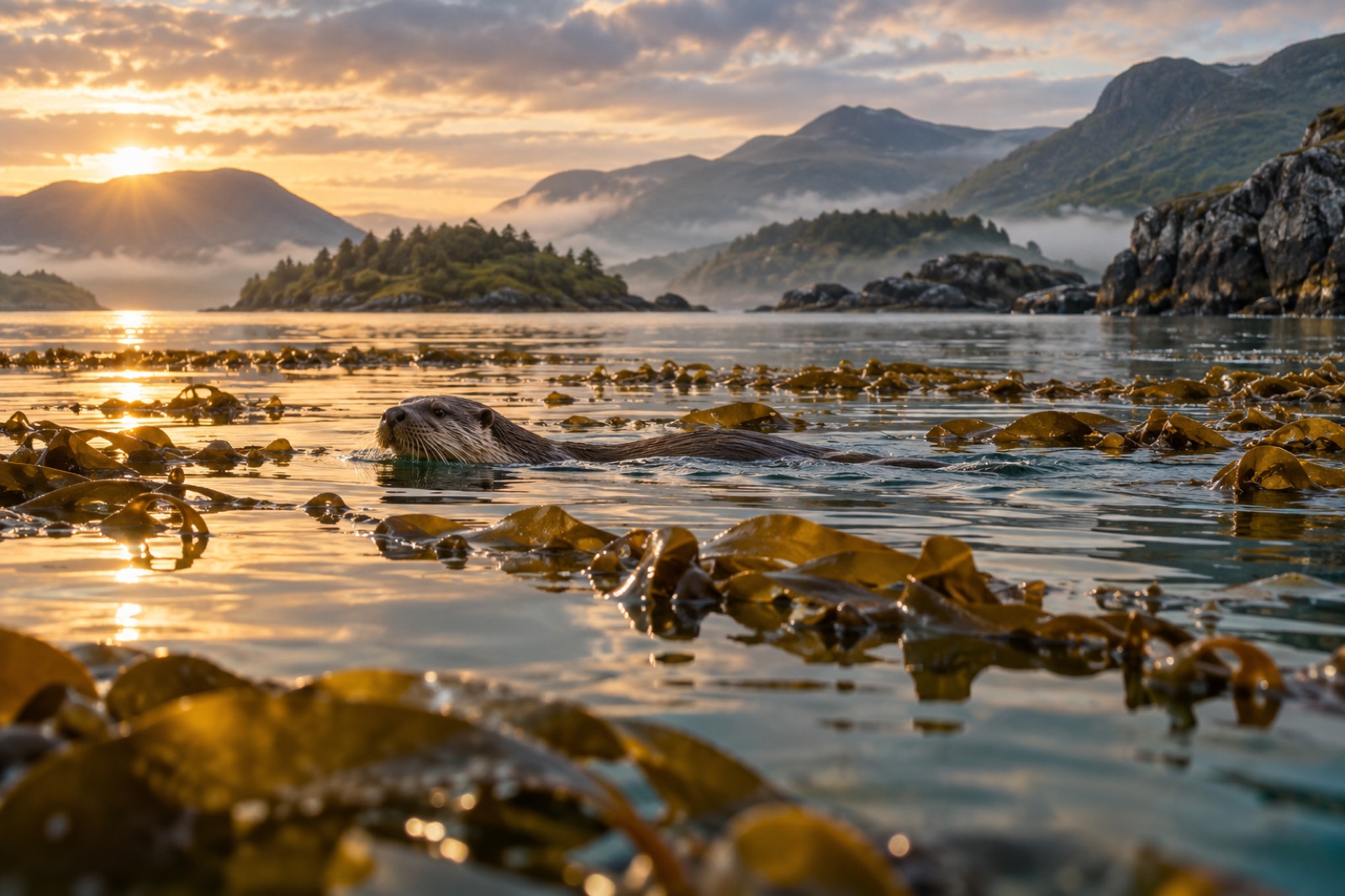
Most kelp coasts make you earn the forest: swell, white water, a long boat ride out to the reef. The Inner Hebrides work the other way. Between the islands of Mull, Skye, Jura, Colonsay and their neighbours, the glacier-carved coastline folds the ocean into long, sheltered sea lochs — and kelp grows from the tide line to the deep basin in water calm enough to study from a paddleboard. Add otters that fish the weed in daylight, eagles over the loch heads and basking sharks just offshore, and this is arguably the most watchable kelp coast in Europe. This guide covers what the loch forests are, where to see them, and the wildlife that works their edges.
Why the Inner Hebrides shelter a kelp coast
The geology does the work. The last ice sheets scoured western Scotland into deep troughs and buried mountain blocks; as the seas rose, salt water flooded the glens and poured between the islands. The result is a coastline of extraordinary length — the Hebrides hold a large share of all of Scotland's shore — composed of sheltered basins, narrow sounds and short, violent tide races where the flood squeezes between headlands.
Three things follow for kelp:
- Cold, oceanic water, gently mixed. Loch-surface temperatures run from roughly 7°C in late winter to 14–15°C at the end of summer — inside the comfort zone of the northern laminarians for the whole year. Tidal exchange keeps the water moving and the nutrients circulating even in the most enclosed upper reaches.
- Hard bottom everywhere. Glacially scoured basalt and schist, boulder slopes and bedrock reefs give kelp exactly what it needs to grip. Where a loch's floor goes muddy, the forest stops — you can trace its limits from the shore.
- Shelter with fetch-controlled exposure. A single bay can hold mirror-calm upper-loch kelp and a surge-swept reef of winged kelp at its mouth, which is why the full species zonation repeats at every scale.
For the wider story of this coast — the kelp-burning era, the industry debates and the full regional picture — see our atlas of Scotland's west coast.
Reading the loch: the kelp zonation
You can read an Inner Hebridean loch from a kayak without getting wet more than once:
- The wrack belt. Upper shore: channelled, spiral and bladder wracks in dense brown bands. Not true kelps, but they build the nursery — juvenile fish work their flooded canopies at high water.
- The oarweed fringe. At low-water springs, oarweed (Laminaria digitata) appears in a heaving golden slick, its split blades sawing in the wavelets. This is the loch's most productive single band.
- The sugar kelp and dabberlocks mid-zone. Sugar kelp in the shallows; winged kelp (dabberlocks) taking over where swell sneaks in at the loch mouth.
- The tangle kelp forest. Below the low-tide line, Laminaria hyperborea raises its winter-stiff stipes through ten metres of water, holdfasts crowded with anemones, sponges and squat lobsters. This is the true submerged forest — the one divers come for.
- The maerl floor. In the clearest sounds, slow-growing coralline red algae form violet gravel beds below the kelp. Maerl is among the rarest habitats in Britain; the famous "coral beaches" north of Dunvegan on Skye are drifts of maerl fragments, not coral at all.
Mull: otter water
If the Inner Hebrides have a capital of kelp-watching, it is Loch na Keal, the great sea loch that cuts deep into western Mull. The otters here are Lutra lutra — the Eurasian river otter, living saltwater lives — and they are the coast's defining sighting. They hunt the kelp margins at low tide, working the oarweed fringe for rocklings, butterfish and crabs, hauling out onto the weed ridges to eat. Watch from the shore road with binoculars, keep still and quiet, and a good autumn morning can give you a mother and cubs rolling in the slick.
Above them: white-tailed eagles, reintroduced to Scotland and now breeding around Mull's lochs, quartering the tideline from the cliff ledges. Common (harbour seals) and grey seals haul on the skerries. Below them, Tobermory Bay and the Sound of Mull offer the most accessible diving in the archipelago — piers and rocky slopes where the tangle kelp starts in metres of water, and wrecks sitting in the gloom beneath it.
Skye: basalc teeth and sheltered raases
Skye gives you the two ends of the kelp spectrum in one island. In the west, Loch Dunvegan and Loch Bracadale hold sheltered kelp in emerald water, seals on the outside skerries and the maerl beaches at Claigan chalking the shoreline white. The famous "coral beaches" are worth the walk precisely because they are not coral: they are drifts of shattered maerl, the skeleton weed of the subtidal, and the living parent beds lie just offshore under the kelp fringe.
At the island's exposed corners — Elgol, where Loch Scavaig opens toward the Cuillin, and the tide-swept points of the south — the forest is a storm-adapted wall of dabberlocks and low-clinging kelps, everything engineered to lean. The contrast with the calm loch heads, a forty-minute drive away, is a field lesson in exposure zonation.
The tide races: Corryvreckan and the sounds
Between the islands, the Atlantic squeeze produces some of the strongest currents in Britain. The Gulf of Corryvreckan, between Jura and Scarba, runs at up to around 8.5 knots on big springs and spins the famous whirlpool off Scarba's west point — one of the largest standing whirlpools in the world. These races are not kelp-free zones: on the submerged reefs below, Laminaria hyperborea grows in current-adapted stands, blades streaming like flags in wind, filtering a new parcel of ocean every second.
Tide-race kelp is some of the most productive habitat on this coast, and it is also doing quiet coastal work: a kelp canopy strips energy from moving water. We covered the physics in how kelp forests calm the sea.
The big animals of the kelp edge
The Sea of the Hebrides — the broad channel between the inner islands and the Outer Hebrides chain, with Coll and Tiree at its heart — is one of the world's best places to see basking sharks. In summer these plankton-feeding giants, second only to whale sharks in size, nose along the tide lines where fronts concentrate their prey, often within sight of the kelp fringe. Minke whales work the same lane. The area is now within a dedicated Marine Protected Area, partly in recognition of the sharks.
Smaller wonders reward the patient: flame shell beds (Limaria hians), where dozens of scallop-like bivalves weave themselves into reef mats, have been found in Loch Sunart and Loch Carron under the kelp belt. The whole web, from maerl to eagle, hangs off the forest structure of the lochs.
Visiting: when, where and how to look
- Season. May to September for light, calmer seas and the sharks; autumn for otters at their most visible and golden kelp against red bracken. Winter diving is superb where sheltered, but days are short.
- From shore. Low-water springs on Loch na Keal, the Claigan coral beaches, and the headlands of the Ross of Mull. Bring binoculars; watch quietly from above the weed line to avoid pushing otters off their feeding grounds.
- In the water. Snorkel the sheltered bays on a rising tide; dive the Sound of Mull and Tobermory with local operators. Water stays cold year-round — a drysuit or a good 7mm wetsuit is not optional. Our guide to cold-water diving essentials covers the gear and the mindset honestly.
- From a paddle. Sea kayaks are the tool of choice here: the loch-forest zonation described above unfolds from the cockpit, and kayaks can drift the edge of a race where no boat should park.
The lochs' very calmness is the caveat. Sheltered water gathers what the land sheds, and the quiet that lets you watch an otter for an hour is the same quiet that local communities are working to keep honest — from sewage outfalls to fish-farm siting. Watch the forest closely and it repays you; treat it as scenery only and you will miss that it is, fundamentally, a seascape under care.
Key takeaways
- The Inner Hebrides' drowned glacial landscape gives kelp rare conditions: cold water, hard bottom and deep shelter, so full forests grow a few metres from the shore road.
- Read a loch from shore to depth: wracks, oarweed, sugar kelp and dabberlocks, then the tangle kelp forest, with maerl beds in the clearest sounds.
- Loch na Keal on Mull is the coast's otter-watching capital; Skye's "coral beaches" at Claigan are maerl, not coral.
- The tide races — Corryvreckan above all — hold current-adapted kelp forests and funnel plankton that draws basking sharks and minke whales to the Sea of the Hebrides.
- Go May–September for light and wildlife; snorkel or dive with proper cold-water exposure protection; watch otters from a distance and let them fish.
FAQ
Are the otters on Mull sea otters?
No. This is a common mix-up. Mull's otters are Eurasian otters (Lutra lutra), a freshwater-and-coast species that fishes the kelp margins and then must wash the salt from its coat — which is why they are often seen rolling at stream mouths. True sea otters (Enhydra lutris) are a North Pacific species and the keystone of kelp forests from the Aleutians to California; they do not occur in Europe.
Can you snorkel or dive the kelp forests of the Inner Hebrides?
Yes, and the sheltered lochs make it some of the most approachable temperate kelp diving in Europe. The Sound of Mull and Tobermory Bay offer shore and boat dives where the tangle kelp forest starts in shallow water. Summer water reaches about 14–15°C; winter drops toward 7°C, so a drysuit or thick wetsuit and hood are essential. Tide races like Corryvreckan are for experienced boat skippers at slack water only — not swimmers.
What is the best base for seeing kelp, otters and eagles?
Tobermory on Mull is the practical choice: dive operators, boat trips and road access to Loch na Keal in one small harbour town. On Skye, Dunvegan gives access to the coral beaches and the western lochs. Book wildlife boat trips in advance in July and August.
When can you see basking sharks near the kelp forests?
June to early September, around Coll, Tiree and the Sea of the Hebrides. The sharks follow plankton concentrations along tidal fronts, so sightings cluster on calm days after settled weather. Several licensed operators run low-wake shark-watching trips; keep to operators who follow the Scottish wildlife-watching code.