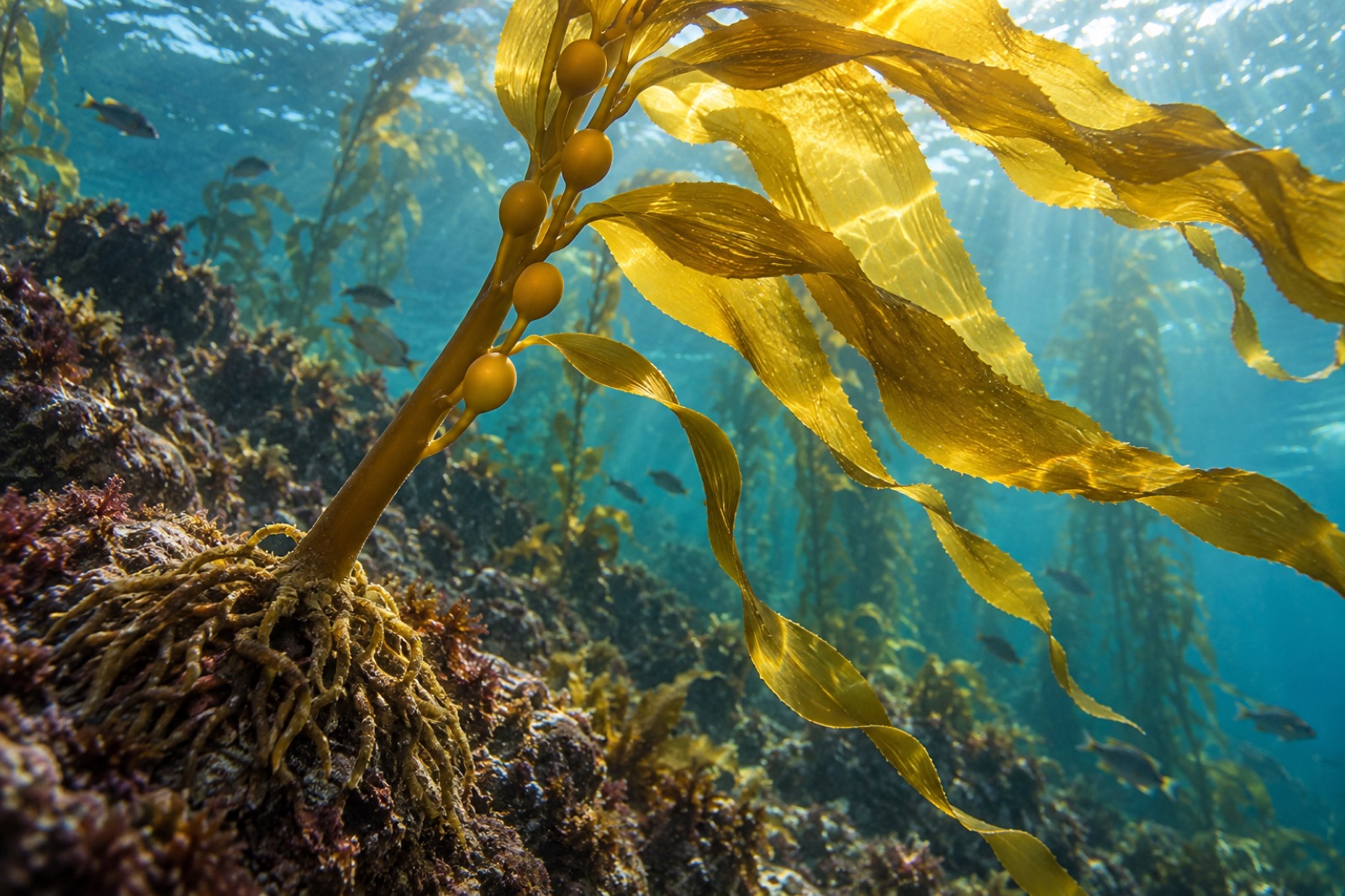
The Mediterranean has no kelp forests in the strict sense — the true kelps, the laminarians, barely reach past Gibraltar. And yet for thousands of years the rocky Mediterranean shallows held something functionally identical and, by daylight, arguably more beautiful: dense forests of Cystoseira and its kin, brown canopy algae a metre tall, waving in the green light over rock, sheltering fish nurseries and urchin beds and octopus dens. Classic Mediterranean reef isn't bare stone and seagrass; it was, and in protected pockets still is, a fucoid forest. Losing it turns out to be one of the defining conservation stories of that sea.
Fast facts
|
|
| Name |
Cystoseira sensu lato — now split into genera including Cystoseira, Ericaria and Gongolaria |
| Common names |
No settled vernacular; divers just say "Cystoseira forest" |
| Group |
Brown algae (Phaeophyceae), order Fucales — canopy-forming fucoids |
| Form |
Perennial bushes 0.2–1+ m tall, seasonally shed branches, often with small air bladders |
| Habitat |
Rocky reefs, typically from the shallow subtidal to about 40 m depending on species |
| Range |
Mediterranean and adjacent Atlantic; the Mediterranean is the group's world centre of diversity |
| Status |
Multiple species listed in the Barcelona Convention's protected-annex; widespread decline documented across the basin |
Meet the canopy of the warm closed sea
Walk a protected Mediterranean shore — a Croatian island lee, a Corsican marine reserve, a Menorcan cove — and put your face underwater with a mask. Where the rock is clean and the protection real, the shallows are forested: brown-gold bushes in tiers, each plant anchored by a perennial crusty base, holding a crown of fine branches. In spring those crowns fruitle and silt the water with new growth; in late summer parts of the canopy self-prune, dropping weight the way deciduous trees drop leaves.
The taxonomy is a moving fence. What everyone called Cystoseira turned out, under DNA scrutiny, to be several lineage-groups, and many flagship species have been rehoused — into Ericaria, Gongolaria, and other reinstated old names. The Pacific's chain bladder kelp, now Stephanocystis, took the same journey, as our chain bladder kelp profile explains. For ecology the names matter less than the shared design: perennial base, seasonal canopy, near-zero dispersal.
Why these forests mattered
Canopy is habitat. A metre of brown crown over rock creates a third dimension in a sea that is mostly flat: sheltering juvenile fish (the Mediterranean's sea breams and wrasses recruit hard into Cystoseira stands), shading a distinct understory of coralline algae and sponges, carrying epiphyte and grazer communities of their own. Where the canopy goes, the community simplifies — ends of dives that were once a city's worth of streets become a car park.
They also mattered to water and rock: forests slowed flow, trapped less sediment than bare rock would allow to settle on it, fixed and recycled nutrients in place. The broad accounting of these services is the subject of kelp ecosystem services; the Cystoseira case shows the services are not kelp-dependent — any large, persistent canopy alga delivers them.
How you lose a forest in a generation
The decline isn't one story; it's the same plot with several villains, and the fucoid life cycle is what makes it tragic.
Fucoids reproduce directly on the big plant and release heavy propagules that settle within metres of the parent — no drifting spore clouds, as the kelp life cycle comparison makes vivid. Dispersal is generational and local. So when a stand dies, nothing rains in from the next bay. It either regrows from survivors or it doesn't come back at all.
Layer on the pressures:
- Sediment and poor water from coastal construction, dredging and rivers bury the low-relief rock and the new recruits that try to settle — the slow strangle of coastal eutrophication and silt.
- Overgrazing: where fish predators (sea breams above all) were fished out, sea urchins multiplied, and urchin fronts can mow young canopy algae to crusts — the same trophic cascade logic as kelp barrens.
- Heat: Mediterranean marine heatwaves have grown longer and harsher, and shallow stands sit directly in the warm lens.
- Physical loss: anchors, trampling, marina and port works — coastal squeeze applied to algae nobody thought to map until it was leaving.
The result, across much of the urbanised northern Mediterranean, is archipelago loss: forests survive as islands in reserves and remote coasts, separated by dead substrate their propagules cannot cross.
The restoration problem — and why it's being solved by hand
Because natural recolonisation barely happens, Mediterranean scientists have become some of the world's most advanced practitioners of hands-on canopy restoration: growing Cystoseira-group juveniles in mesocosms, outplanting them on cleaned rock inside marine protected areas where grazing is controlled, and — crucially — protecting the adults that remain as seed donors. Survival rates in published trials have moved from dire to merely hard, which in restoration terms is progress.
Two lessons carry well beyond the Mediterranean. First, donor protection beats donor replacement: a surviving adult forest is a self-funding nursery. Second, life cycle is destiny — the techniques that work on spore-dispersing laminarians, covered in our kelp restoration methods overview, don't transfer naively to fucoids. You don't seed a reef with spores and wait; you raise juveniles and plant them, more forestry than farming. Tidewright's own nursery thinking in the Holdfast programme takes the same lesson to heart: match technique to life cycle, and genetics to place, every time.
Seeing it for yourself
If you want the real thing, go protected: the marine reserves of Croatia's Adriatic islands, Corsica's Scandola and Bonifacio, the Columbretes off Spain, pockets of Greece and Sardinia. Shallow, sunlit, and in season (late spring is peak crown), it's one of the world's great un-technical snorkels — a warm-water forest that most beach visitors swim over without ever knowing it had a name, or that it was nearly gone.
Key takeaways
- Cystoseira sensu lato — canopy fucoids now split across several genera — are the Mediterranean's kelp-forest equivalent.
- Perennial bases with seasonal crowns; reproduction is direct and propagules barely disperse, so lost stands don't recolonise naturally.
- Decline is compounding: silt and eutrophication, urchin overgrazing after predator loss, marine heatwaves, and direct habitat loss.
- Restoration is hands-on forestry: lab-raised juveniles outplanted inside protected, grazer-managed sites, with surviving adult stands guarded as donors.
- Best remaining forests sit inside the basin's south-western and Adriatic marine reserves.
FAQ
Is Cystoseira a kelp?
No — it's a fucoid, the same order as the Atlantic rockweeds. But functionally it plays the kelp's role: large canopy-forming brown alga, engineering habitat in three dimensions. The Mediterranean simply fields a different squad in the same position.
Why don't lost forests just grow back?
Dispersal range. Fucoid eggs settle within metres of the parent plant, so a stand can't reseed from a distant healthy population the way spore-releasing kelps — even short-ranged ones — sometimes can. Remove the stand and the substrate stays empty on human timescales.
Where is it protected?
All Cystoseira-group forest species of the Mediterranean are listed under the Barcelona Convention's protocol on specially protected areas, obliging Mediterranean states to protect them. In practice, protection is strongest inside the basin's flagship marine reserves.
Can you eat it?
It's not a culinary species — tough, tannic, and far too valuable as habitat. The Mediterranean's table seaweeds are mostly green and red algae; leave the brown canopy in the water.
Is anything like this happening elsewhere?
Closely parallel cases include the restoration of crayweed (Phyllospora, another fucoid) on the Sydney coast, where outplanted adults reseeded reefs within years — proof that fucoid forests, though poor dispersers, can be re-established when the cause of loss has been fixed.