Encyclopedia8 min read
Giant Kelp (Macrocystis pyrifera): Species Profile
Giant kelp is the fastest-growing organism on Earth and the architect of undersea forests. Learn its biology, life cycle, range and why it matters.
Dr. Theo Nakamura ·
Cystoseira osmundacea — chain bladder kelp — strings pearl-like floats along California's subtidal rocks. Identification, biology, and why it's no true kelp.
Dive the rocky reefs off southern California or the Channel Islands and, below the giant kelp, you'll find a second architecture working at waist height: bushy brown plants a metre or two tall, every branchlet strung with neat rows of smooth, air-filled beads, like ropes of black pearls half-sunk in the tissue. That's chain bladder kelp — Cystoseira osmundacea in the books most divers grew up with, Stephanocystis osmundacea on modern labels. It's the most charismatic understory alga on the coast, the first thing after the kelp itself that new California divers learn to name, and, taxonomic trivia aside, an honest structural engineer of the reef.
| Scientific name | Stephanocystis osmundacea (syn. Cystoseira osmundacea) |
| Common names | Chain bladder kelp, bladder chain kelp |
| Group | Brown algae (Phaeophyceae), order Fucales — a fucoid, not a true kelp |
| Size | 1–2 m tall; forking branches with chains of small spherical pneumatocysts (floats) |
| Habitat | Low intertidal to about 20 m, on rock, in moderate exposure |
| Range | Eastern Pacific: roughly northern California to Baja California, most abundant south of Point Conception |
| Growth | Perennial holdfast and basal tissue; seasonal canopy regrowth |
The name lies politely. The true kelps — giant kelp, bull kelp, the laminarians — run the alternation-of-generations life cycle in which a microscopic gametophyte stage stands between the big plant and its spores, the whole dance described in our kelp life cycle explainer. Chain bladder kelp belongs to the Fucales, the rockweed order, which dispenses with all that: the visible plant produces eggs and sperm directly, the fertilised egg develops straight into a new plant, and there is no small generation at all.
That distinction has real consequences. Laminarian kelps can dust a reef with spores that drift and settle; fucoids release heavy fertilised eggs that fall close to the parent. Dispersal is short-range, populations are local, and a lost patch of chain bladder kelp doesn't recolonise from the next bay over on spore winds. This is the same biogeographical tightness that defined the restoration challenge for Sydney's lost crayweed — another fucoid — on the Sydney coast, and that shapes how we think about kelp forest succession on reefs where both orders co-occur.
Three features make chain bladder kelp easy to identify after one dive:
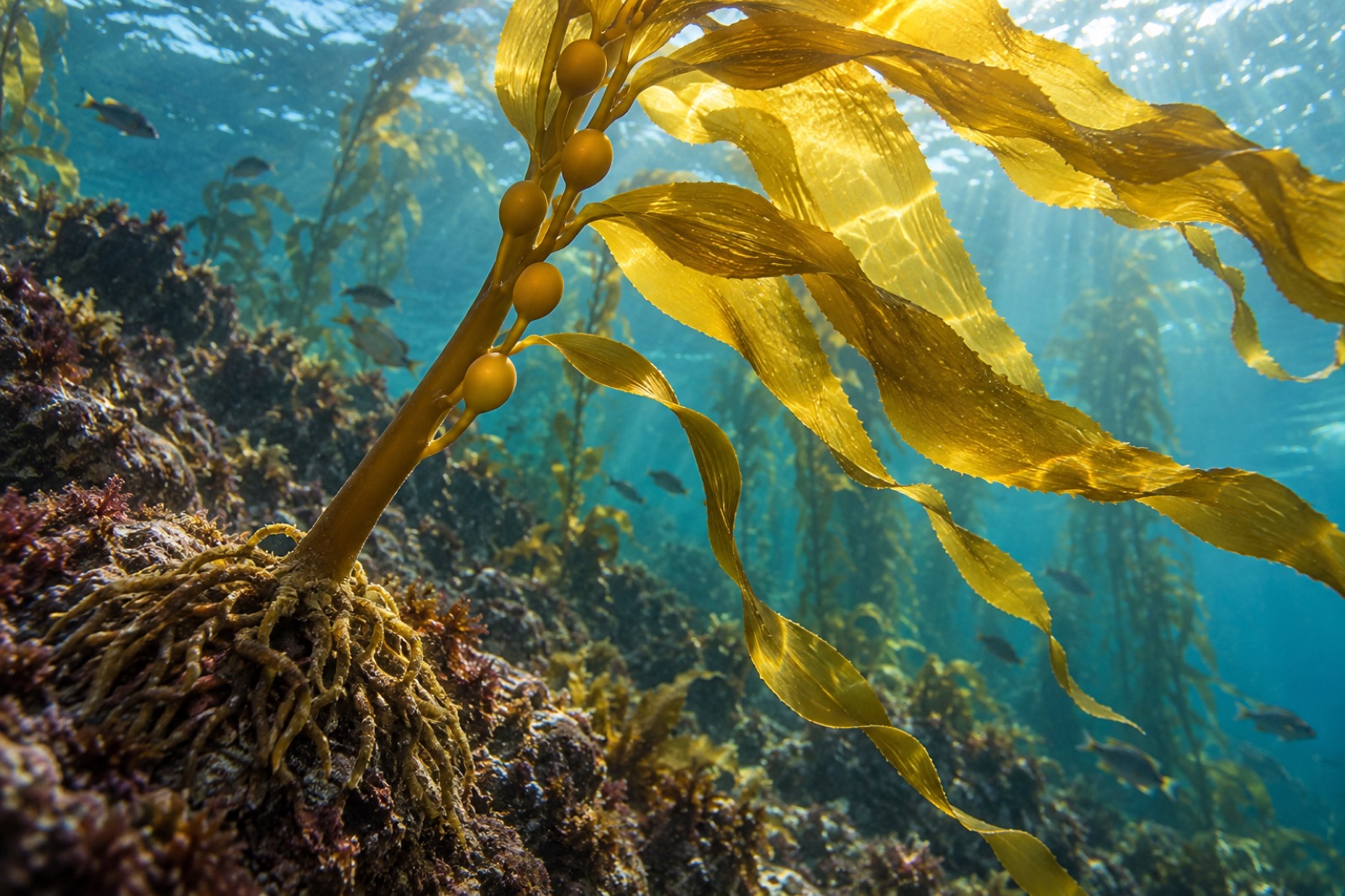
The beads. Rows of small, smooth, spherical floats — pneumatocysts a few millimetres across — run along the branchlets like necklaces. They're reservoirs of air (mostly nitrogen and oxygen, as in all brown algal floats) that lift the crown toward the light. No other California alga strings its floats this way; giant kelp's single big pear-shaped float per blade is a different grammar entirely.
The crown. The plant rises from a crusty, perennial holdfast-and-base, and in the growing season produces an upright, forking crown a metre or two tall — a true understory tree under the giant kelp's overstory. On the giant kelp forests of the Channel Islands and Point Loma, it routinely forms the densest mid-storey on the reef.
The season. In winter and early spring the crown dies back substantially; the perennial base carries the plant through, resprouting with lengthening days. You're diving the same plant, different season's haircut.
A chain bladder kelp bed is real estate. The branching crown carries a heavy load of small life — epiphytes on kelp in the broadest sense: hydroid fur, bryozoan crusts, tufted red algae — and with them the grazers and ambush predators that structure the mid-water reef. Juvenile rockfish, kelp bass and perch work its layers the way warblers work a hedge; kelpfish and giant kelpfish (Heterostichus) hunt along its fringes; senoritas pick parasites and epiphyte grazers off anyone who holds still long enough.
The plant also engineers the light field. Under giant kelp and chain bladder kelp together, the reef floor is shaded in two storeys, and what grows beneath — coralline pavement, turf, juveniles of everything — reflects that double canopy. Ecologists call this canopy-understory structure, and second-storey species like Stephanocystis fill a niche that a single-canopy forest can't: the analysis of kelp as an ecosystem engineer covers the general principle.
Why floats at all, for a plant growing in a couple of fathoms? Because even a metre matters. Each bead lifts growing tissue into brighter, clearer water and holds photosynthetic surface off the sedimented floor — the same engineering that runs all the way up to giant kelp's thirty-metre climb. Buoyancy is flotation engineering with gas instead of stipe stiffness; fucoids and kelps arrived at it independently, and chain bladder kelp does it with conspicuous flair.
Chain bladder kelp likes the middle conditions: rock with enough swell to keep silt off, but less hammer than the outer reefs where feather boa kelp and the surf specialists live; shallower and brighter than the deep elk kelp fringe. South of Point Conception it is a defining member of the warm-temperate reef community; north of it the species thins quickly into the colder flora.
That southern bias makes it one of the coast's thermal indicators. In marine heatwave years — the pattern examined in our marine heatwave overview — shallow southern reefs lose canopy broadly, and chain bladder kelp stands recede with the kelp itself; in cool La Niña runs, crowns rebound from their perennial bases with admirable speed. The holdfast strategy buys resilience: the plant can afford to lose the canopy and regrow, which is exactly the insurance policy a warming coastline demands. Whether that resilience has limits under repeated heat events is one of the genuinely open questions in California reef monitoring — and one reason long-term plots of the kind described in why long-term monitoring matters keep being worth their funding.
The species is not considered at risk, but its pressures are the standard Californian suite: urchin outbreaks can overgraze juveniles in disturbed forests, sediment from coastal runoff silts the low-relief rock it favours, and warming water pushes at its physiology. The most persistent factor is structural — chain bladder kelp needs hard, moderately clean rock within photic range, and that habitat is exactly what coastal engineering and sedimentation quietly remove. It also can't relocate: as a fucoid with poor dispersal, local losses are local. Protect the habitat, and the perennial bases do the rest.
The big Cystoseira genus of the older literature has been broken up — mostly along lines confirmed by DNA work — and the eastern Pacific species moved into Stephanocystis. Older field guides and dive briefings still say Cystoseira osmundacea; they're the same plant. Our Mediterranean Cystoseira profile covers what happened to its namesake genus.
Different order, different life cycle, different geometry. Giant kelp is a laminarian with a microscopic gametophyte stage and blade-by-blade floats on stipes climbing tens of metres; chain bladder kelp is a fucoid reproducing directly on the big plant, with bead-chains on a metre-scale bushy crown.
Rocky reef in moderate surge at roughly 3–20 m, anywhere from about Point Conception south into Baja — heavily on the Channel Islands and the La Jolla–Point Loma reefs. Look for the beaded branches in the understory under or beside giant kelp.
Urchins graze young plants and drift fronds; sea hare relatives and some fish browse it. As with most brown algae, chemical defences (phlorotannins) keep it from being anyone's first choice, but the drift and decomposing canopy feeds the detrital food web heavily.
Technically it's a brown alga and not known to be toxic, but it's tough, tannic, and far more valuable standing as canopy than on a plate — and local regulations in its heartland strongly restrict taking subtidal algae. Admire it underwater; cook something else.
Giant kelp is the fastest-growing organism on Earth and the architect of undersea forests. Learn its biology, life cycle, range and why it matters.
Dr. Theo Nakamura ·
Feather boa kelp streams from Pacific rocks in long, lacy straps, and shelters its own miniature rainforest of life. How to identify, where it grows, what eats it.
Dr. Theo Nakamura ·
Elk kelp grows deep, in clear water, with a single antlered float the size of a grapefruit. The deep edge kelp of the Channel Islands and Baja — biology and status.
Dr. Theo Nakamura ·