Encyclopedia8 min read
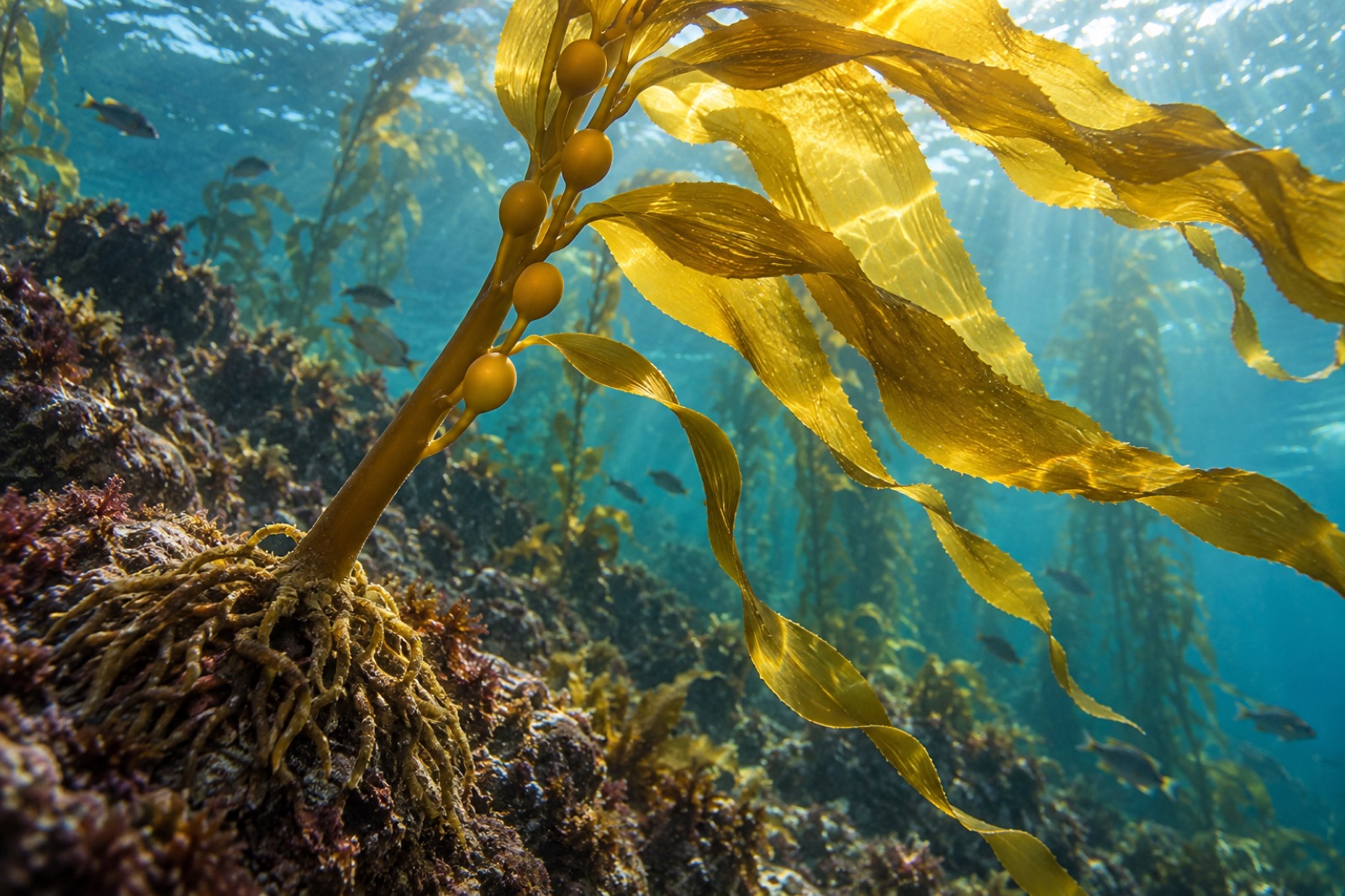
Giant Kelp (Macrocystis pyrifera): Species Profile
Giant kelp is the fastest-growing organism on Earth and the architect of undersea forests. Learn its biology, life cycle, range and why it matters.
Dr. Theo Nakamura ·
The giant kelpfish changes colour to vanish among kelp blades. Identification, camouflage, behaviour and life cycle of this Southern California clinid.
Run your eyes along a golden blade of giant kelp and you may notice that one of the blades has eyes. The giant kelpfish, Heterostichus rostratus, is the kelp forest's most thoroughgoing impostor — a long, compressed, blade-shaped fish that not only lives among the fronds but dresses as them, shifting its colour to match whatever kelp it happens to be hiding in. It is common from Central California to Baja, beloved of patient macro photographers, and completely invisible to anyone in a hurry.
Despite the name it is not a monster: the "giant" is relative to its small clinid relatives. A big kelpfish still only reaches about 60 cm, and most of the individuals you'll meet on a dive are leaf-slim residents half that length.
The kelpfish belongs to the family Clinidae — the klipfishes or weedfishes — and is the only member of its genus. Everything about the body says blade:
The most common confusion species in southern California are other clinids (the kelp, striped and island kelpfish), which are smaller, stockier and usually more obviously patterned. If it looks exactly like a kelp frond with fins and exceeds 20 cm, it's the giant kelpfish.
Giant kelpfish range from around British Columbia down the western American coast into Baja California, Mexico, but they are overwhelmingly a Southern Californian animal — the core of their world is the giant kelp belt from Point Conception to the Channel Islands and the Baja peninsula. Any diver familiar with California's kelp forests has been looked at by one without knowing it.
Three kinds of cover suit them, in order of classic association: giant kelp itself, where they hang in the canopy and midwater fronds; feather boa kelp and other bushy understory browns lower on the reef; and eelgrass beds, where the green morphs dominate. Depth is typically shallow — a few metres down to around 25 m.
Site fidelity is strong. A kelpfish's home is often a single kelp plant or patch of understory, held for months. When storms strip the canopy, residents move to remaining cover and adopt the new decor, which produces the odd sight of a brown fish blushing green over the following week.
Colour matching in the kelpfish is physiological colour change — redistribution of pigment within chromatophore cells in the skin, under hormonal and neural control — not the instant, pixel-by-pixel display of an octopus. It's slow theatre: hours to days, not milliseconds. But the result is arguably more complete. A kelpfish matched to its background doesn't just match hue; it carries the blade's striped shading, its posture, and its sway. When surge moves the forest, kelpfish rock passively with the fronds rather than swimming against the motion. Good camouflage is as much behaviour as colour — the fish commits to the bit.
The disguise works in both directions of the food web. As a prey animal, the kelpfish is hunted by kelp bass, larger rockfish and diving birds, and invisibility is its first defence. As a predator, stillness among the blades lets it ambush the small crustaceans that graze on kelp surfaces.
Look at a kelp blade as the kelpfish does and it is a stocked pasture. The surface of a giant kelp frond teems with an encrusting, crawling community — amphipods, isopods, caprellid skeleton shrimp, small worms, larval snails. Kelpfish cruise this surface or hang beside it, darting out to pluck individual crustaceans with that tweezer-like snout. They also take small fishes — gobies, juvenile surfperch, young señoritas — when the opportunity presents, and they'll nip tubes off polychaete worms and pick plankton from passing water when it's thick.
They are in turn an important prey item, transferring kelp-surface production up into the kelp forest's predators — kelp bass hunt them methodically, and they're on the menu for California sea lions, cormorants and ospreys working the canopy edge. As mid-storey plankton-and-crustacean specialists they occupy a similar guild position to the señorita wrasse, but executed with stealth rather than busywater flight.
Spawning runs through spring into early summer in Southern California, warming months when the kelp is lengthening and plankton is rich. The female lays a neat, adhesive egg mass directly onto the surface of a kelp frond — the eggs standing in a coherent patch like a tuft of velvet, brown, amber or olive. The male then does the work of parenthood: he guards the egg mass, fanning it and driving away anything that comes browsing, from small fish to inquisitive divers' camera lenses. Guarding males are the kelpfish most often noticed by divers, because defence requires the one thing camouflage forbids — holding position in the open.
The larvae hatch and drift in the plankton for weeks before settling out as miniature, already compresssed replicas, and the young settle into shallow cover where they grow up within metres of where they were laid. Juveniles are bolder in colour than adults, washed in yellows and reds, and are often found in the understory where light is dappled and predators must search a complex geometry.
Giant kelpfish are not targeted by fisheries and are not a conservation concern in themselves. What they are is a canary for canopy extent: a fish so thoroughly welded to kelp architecture that its local abundance tracks the condition of the forest above it. Marine heatwaves that strip Southern California's kelp — the 2014–16 warm-water event did so severely in places — remove the kelpfish's world with it, and recovery of the fish follows the return of living fronds, not the calendar. In that sense every kelpfish is an indirect marginal note on thermal stress in the forest, and one of the many reasons restoration focuses on getting blades back in the water column quickly.
Because it is the giant of its family: most clinids are five-to-fifteen-centimetre cryptics, while Heterostichus can top 60 cm. It is not a large fish in absolute terms — but for a weedfish, it's a titan.
Hours to days, not seconds. Unlike an octopus, the kelpfish shifts slowly via pigment redistribution in skin cells, and the transformation is tied to the background it sits on. A fish transplanted from brown kelp to red algae will blush over several days; moved to green eelgrass, it greens.
Never. The most a guarding male will do is hold his ground near an egg mass and posture. They have no venom, no defensive spines, and their entire strategy is to be mistaken for salad.
Any healthy Southern California kelp forest, in calm shallow water (3–12 m) with dense fronds. Monterey northwards is marginal; Point Conception southwards to Baja is the heartland. Look mid-canopy in stillness.
No — greenlings (Hexagrammos species) are a different family entirely (Hexagrammidae): perch-like bottom fish with a totally different shape and lifestyle. The shared "kelp" name just marks shared habitat. The kelpfish's misleading outline and colour-changing habit make it unmistakable once seen.
Giant kelp is the fastest-growing organism on Earth and the architect of undersea forests. Learn its biology, life cycle, range and why it matters.
Dr. Theo Nakamura ·
Kelp bass — calico bass to the anglers who love them — are the signature sportfish of the kelp canopy. Biology, slow growth, sex change and sustainable fishing.
Dr. Mara Ellison ·
The señorita is a small California wrasse that runs cleaning stations, swarms in glittering schools and buries itself in sand at night. Meet the kelp forest's hygienist.
Dr. Theo Nakamura ·