It doesn't look like a limpet. The classic limpet is a bare cone glued to clean rock; the giant keyhole limpet (Megathura crenulata) arrives wrapped in its own skin — a thick, leathery mantle, slate-black or mottled grey-brown, that flows up over the shell and hides it completely. What you see on a southern California reef, tucked into a ledge or cruising across the rock at dusk, is a soft dome the size of your fist with a single neat hole at its peak. That hole is the keyhole, and it is the limpet's chimney, plumbing and signature all at once. Here is what this extraordinary snail is, how to find it, and why its blue blood became one of the most valuable reagents in medicine.
Fast facts
|
|
| Scientific name |
Megathura crenulata |
| Group |
A true limpet — a marine snail (gastropod) of family Fissurellidae, the keyhole limpets |
| Common names |
Giant keyhole limpet, giant volcano limpet |
| Size |
Commonly 5–10 cm of shell; large individuals exceed 13 cm |
| Depth range |
Lower intertidal to roughly 30 m; commonest subtidally on rocky reefs and ledges |
| Distribution |
Southern California to Baja California — Point Conception southward is its stronghold |
| Diet |
Omnivorous grazer: algae, detritus, and — unusually for a limpet — colonial tunicates and other encrusting animals |
| Notable traits |
Mantle completely covers the shell; blood is blue (haemocyanin) and the source of the biomedical reagent KLH |
The keyhole and the cloak
Two features identify this animal instantly:
- The keyhole. All members of the family carry an opening at or near the apex of the shell — the slot in old keyplates that gives the group its name. In Megathura it sits at the very top like the crater of a small volcano. Water drawn in beneath the shell edges flows across the gills and exits through the keyhole, carrying wastes away from the animal's own face — tidy plumbing for an animal that spends its life face-down in its food.
- The mantle cloak. In most limpets the mantle is a thin skirt around the shell's edge. In the giant keyhole limpet it extends up and over the entire shell, often meeting at the keyhole, so the living animal hides its own armour. Shrink back the cloak (disturb the animal sharply, which you shouldn't do) and the shell beneath is pale, weathered, oval-conical — the conical cap of an ordinary limpet, seen only when its owner chooses.
Colour varies: many animals are near-black; others are mottled grey and tan or wear radiating streaks. The foot, visible from below or when the limpet is relaxed and creeping, is typically a striking orange-yellow — a flash of unexpected colour when one is upended in a crevice.
What it eats: a limpet that eats meat
Limpets as a group are algae-grazers, rasping the rock with a radula. The giant keyhole limpet honours that tradition but does not stop there. Gut-content and feeding studies show a genuinely omnivorous animal: benthic diatoms and macroalgal films, drift fragments and detritus, and — famously — colonial tunicates and other encrusting invertebrates, which it crops with apparent relish. Little else on the reef eats tough-shelled tunicate mats; the keyhole limpet does, and in doing so performs a subtle service to the kelp forest's real-estate market, clearing settlement space on the crowded rock. It is a gardener that prunes both the weeds and, occasionally, the fenceposts.
This places it in an interesting niche in the kelp forest food web: a mid-level omnivore converting both algal productivity and sessile animal biomass into limpet, and then — by way of octopuses, sea stars and large crabs — into everyone else.
The blue blood: KLH and medicine
If you have heard of Megathura crenulata outside diving circles, it is probably because of KLH — keyhole limpet haemocyanin. Like many molluscs, this limpet carries oxygen not with iron-based haemoglobin but with copper-based haemocyanin, which turns its blood a pale blue. KLH is enormous, proteinaceous and, to a mammalian immune system, spectacularly foreign — which makes it one of the most potent immune-stimulating carrier proteins known. Immunologists have used KLH for decades as a carrier molecule in vaccines and as a probe of immune function; it appears in experimental cancer immunotherapies and vaccine research pipelines.
Early demand for KLH was met by collecting wild limpets and bleeding them for their haemolymph — a pressure that, combined with the animal's naturally modest range, raised real concern through the late twentieth century. The modern industry has shifted substantially toward aquaculture and more humane extraction, but the story stands as a useful parable: a reef animal can be economically invisible until the day a laboratory finds a use for its blood, and then its abundance suddenly matters. It is one of the stranger and more concrete examples of why kelp forest biodiversity is worth more standing than harvested, in the most literal accounting sense.
Growing up a keyhole
The giant keyhole limpet spawns by broadcasting sperm and eggs into the water column, with fertilisation external — the ancestral molluscan approach. Larvae develop in the plankton before settling onto hard substrate as tiny, keyholed limplets. Growth to full size takes years, and large animals are old by invertebrate standards.
Movement is slow and loafing; a limpet may hold a resting scar on a favoured ledge for days between feeding excursions, then cruise a small home range at night, rasping as it goes. The niche it occupies — crevices, ledges, boulder tops in the kelp understory — sits squarely in the lower zones described in our look at subtidal zonation, sharing space with gumboot chitons, warty sea cucumbers and the smaller limpets it outsizes by an order of magnitude.
Predators and defences
An adult Megathura is not an easy meal. The foot's suction is powerful; the shell is heavy; and the mantle cloak denies a predator any easy grip on the apex. When harassed, the limpet can clamp down with the classic limpet death-grip, and no shell opening offers an entry point except the keyhole itself, some centimetres above any probing tentacle.
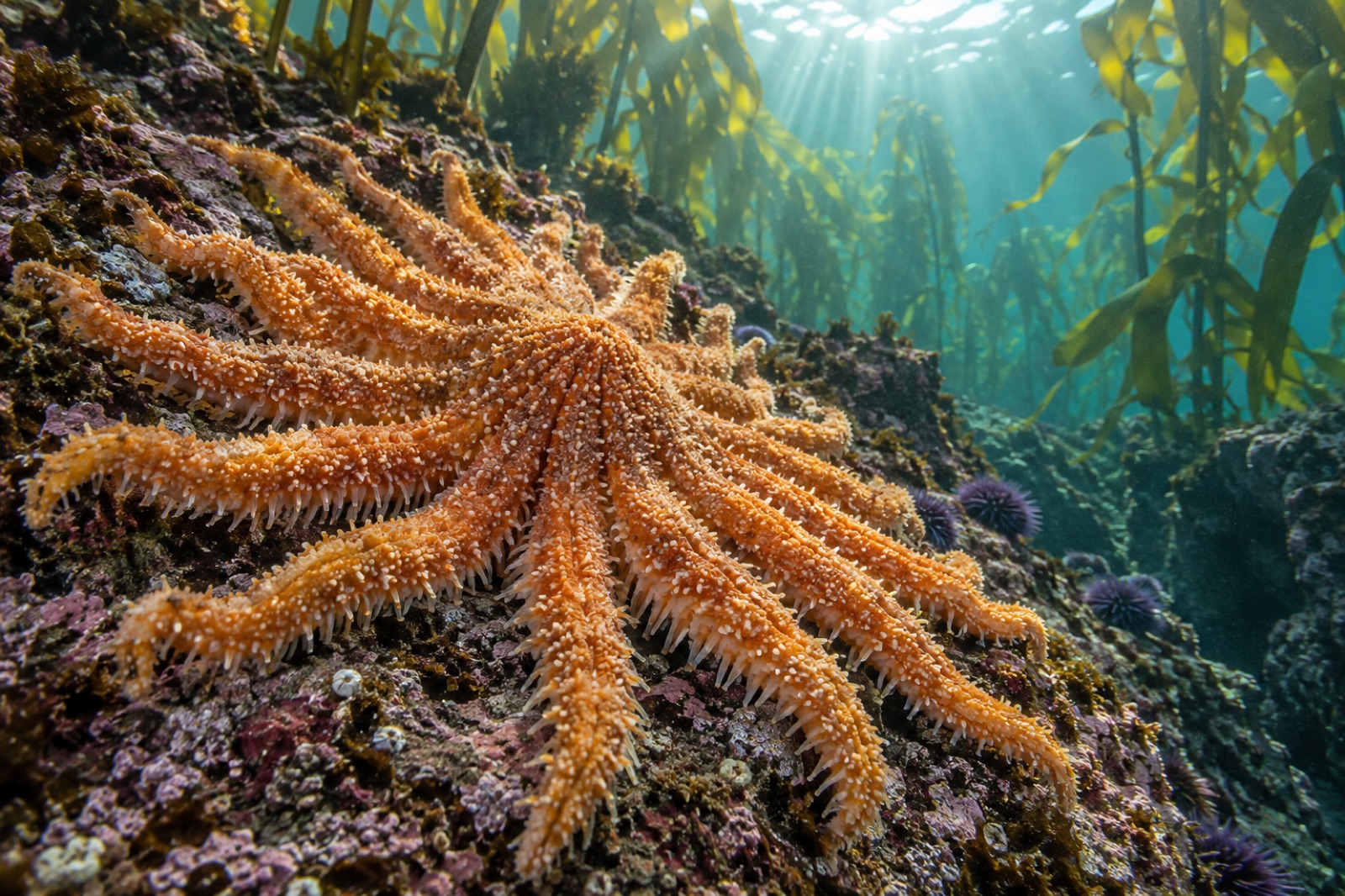
Even so, it is eaten. Giant Pacific octopuses are the chief specialists, pulling limpets from rock with their arms or drilling shell middens you can find around a den. Large sea stars — including, in the years when they were still common on southern California reefs, sunflower sea stars — will work a limpet loose by persistence. Divers occasionally find abandoned keyhole limpet shells re-inhabited by hermit crabs, the shell's neat apex hole still visible: the reef recycling its architecture.
Status and where to find one
Megathura crenulata is not listed as threatened, and on suitable southern California reefs it remains reasonably common — though never abundant in the way of an urchin or a barnacle. The historical KLH collection pressure, its limited range (essentially one biogeographic province), and the warm-water squeeze on southern California kelp forests documented in our marine heatwaves explainer all argue for a leave-it-in-place attitude. There is no recreational fishery for it; admire it where it sits.
To see one, dive the rocky reefs and wrecks of southern California and the Channel Islands in the 5–25 metre band, looking under ledges, along crevice walls and on the tops of big boulders near kelp. Night sharply improves the odds: the limpets emerge to graze after dark, and a torch beam catches the smooth dark dome where the day showed you only rock — the same pattern our night diving guide describes for so many of this reef's hidden residents. Casino Point on Catalina is as reliable a place as any to meet one in its first few metres of depth.
Key takeaways
- The giant keyhole limpet (Megathura crenulata) is a southern-California-to-Baja limpet whose leathery mantle cloaks its entire shell; the apical keyhole is its exhalant chimney.
- Identify it by size (fist-sized and up), the complete mantle cover with a single apical hole, and — from below — a bright orange-yellow foot.
- Unlike most limpets it is a true omnivore, cutting algae, detritus and colonial tunicates — a small but distinctive player in reef-space ecology.
- Its blue, copper-based blood is the source of KLH, for decades one of immunology's key carrier proteins; early demand drove wild-harvest pressure that has since shifted toward aquaculture.
- It is a long-lived, slow, nocturnal grazer defended by suction, shell and the baffling mantle cloak — look under ledges by night from Point Conception south.
FAQ
Why does the giant keyhole limpet have a hole in its shell?
It's the exhalant opening for the animal's breathing and plumbing system. Water drawn in under the shell edges flows over the gills and exits through the apical hole, carrying carbon dioxide and wastes away from the head. All keyhole limpets (family Fissurellidae) share the design; Megathura is simply the largest and most dramatically cloaked member on the west coast of North America.
Is it true that the limpet's blood is blue?
Yes — its haemolymph uses haemocyanin, a copper-based oxygen carrier, rather than the iron-based haemoglobin of vertebrates. Deoxygenated it is nearly colourless; oxygenated it is a clear sky blue. This is common across molluscs, but the giant keyhole limpet's haemocyanin happens to be an exceptionally strong immune stimulant in mammals, which is why it became the KLH of medical research.
Can I collect a giant keyhole limpet?
There is no normal recreational fishery for it in California, and the ethical answer is no: the species is long-lived, has a restricted range, and carries a history of biomedical collection pressure. It is also poor eating by comparison with the abalone it resembles in build. Photograph it in place — the empty shells that occasionally wash up are the only ones you should take home, and even they may be claimed by hermit crabs.
What is the difference between a keyhole limpet and an abalone?
They are both top-shaped marine snails, and early naturalists indeed placed them near each other. The differences are clear up close: an abalone's shell is a flattened ear with a row of respiratory pores along one edge, its mantle does not cover the shell, and its broad foot is exposed; the keyhole limpet's shell is a simple cone with a single apical hole, and normally you never see the shell at all beneath its mantle. Abalone are also strict herbivores; the keyhole limpet is an omnivore.
When are giant keyhole limpets easiest to see?
After dark, on rocky reefs in the 5–25 metre range from Point Conception to Baja. By day most hold still under ledges or in crevices; by night they emerge onto open rock to graze. Southern California's kelp forest reefs — particularly around the Channel Islands and Catalina — are the dependable ground.