Encyclopedia8 min read
Warty Sea Cucumber: The Reef's Recycling System
Apostichopus parvimensis vacuums detritus off California reefs day and night, cycling nutrients for the whole kelp forest. Biology, defences and the fishery.
Dr. Theo Nakamura ·
Apostichopus californicus, the biggest sea cucumber on the Pacific coast, recycles kelp forest sediment from Alaska to California. Biology, defences, fishery.
When it flees, the ocean floor's biggest, slowest animal does something unforgettable: it rears up on its tail like a startled cobra and writhes away across the sediment in fast, sinuous waves — about as dramatic as an animal that eats dirt can possibly be. The giant red sea cucumber (Apostichopus californicus, long known as Parastichopus californicus) is the heavyweight of North America's Pacific sea cucumbers, a russet-red, knobbly cylinder up to half a metre long, working the cold sediment in the shadow of the kelp from Alaska to California. It is also an ecological engine hiding in plain sight: the reef's sediment processor, a key recycler in the kelp forest's nutrient economy — and, increasingly, a fishery target. Here is its full working life.
| Scientific name | Apostichopus californicus (formerly Parastichopus californicus) |
| Group | A sea cucumber — echinoderm class Holothuroidea, family Stichopodidae |
| Common names | Giant red sea cucumber, giant California sea cucumber, California sea cucumber |
| Size | Commonly 25–40 cm extended; largest individuals approach 50 cm and over 2 kg — the largest sea cucumber on the Pacific coast of North America |
| Depth range | Low intertidal to roughly 90 m; densest subtidally on sediment among and beside rocky reef |
| Distribution | Eastern Pacific: southeastern Alaska to at least central California; commonest from British Columbia to northern California |
| Diet | Deposit feeder — passes surface sediment through its gut and strips off the organic film: kelp fragments, faecal pellets, dead plankton, bacteria |
| Defences | Escape-rearing and writhing from sea stars; full-body evisceration (expelling its gut) as a last resort, with complete regeneration afterwards |
On a northern Pacific reef, the identification is easy because nothing else is the same shape at the same size. Look for a heavy, soft cylinder on the sediment — rust-red to dark reddish-brown above, paler below — its upper surface fortified with large conical papillae, fleshy pointed bumps in crowded rows. Around the head is a ring of twenty branched feeding tentacles, mopping the sediment like a tree's branches slow-motion combing the ground.
Two checks sharpen the ID. First, geography: south of roughly Monterey, the role of "big sediment cucumber" passes to the smaller, black-warted warty sea cucumber, and north of that line the giant red is the animal you are looking at. Second, condition: because it eviscerates (see below), you will occasionally find individuals that look oddly slim or slack — regenerating animals whose body wall has not yet plumped back to full engineering spec.
What the giant red eats is, from a fish's point of view, not food at all: the film of organic matter coating sand and silt grains. The feeding tentacles rake and sweep the sediment surface, each one stuffing itself into the mouth in turn; the gut strips out the bacterial film, kelp detritus, and micro-fauna, and the cleaned mineral fraction exits at the back as tidy castings. A single giant red can process well over a kilogram of dry sediment in a day, and where they aggregate — and they do aggregate, in herds of dozens on good ground — the effect is measurable at the scale of the reef.
The reef cares about this more than it cares about almost anything else on the bottom. Kelp forests export enormous quantities of production as falling fragments and drift — the pathway we trace in the detritus pathways of kelp forests — and that material has to be either processed or buried. The giant red is the processor: it intercepts the detritus rain at its landing point, converts kelp's stored nitrogen and phosphorus back into forms the water column can use, and oxygenates the top layer of sediment by ceaselessly turning it. Biologists call this bioturbation; a gardener would call it turning the compost. In the kelp forest food web, it is the bottom rung that holds the rest — the return pipe that keeps the nutrient cycle circular instead of sending it all down the drain of permanent burial.
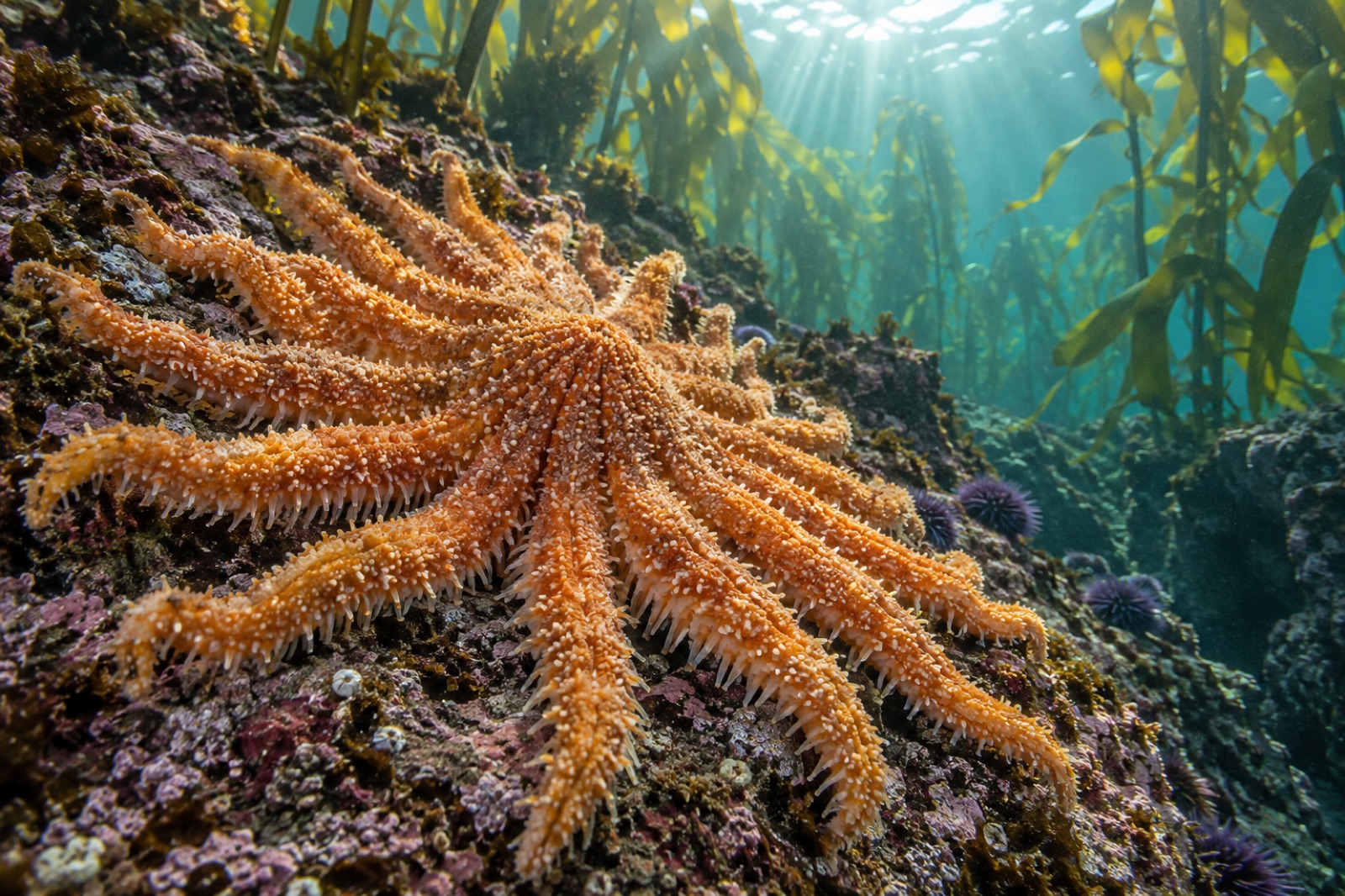
The giant red's main enemy is one of the reef's monsters: the sunflower sea star, a metre-wide predator with a taste for soft-bodied prey. And because a cucumber cannot outrun a starfish, it has evolved something better: detection and denial. Contact with a sunflower star — even the starfish's chemical signature in the water — triggers the famous escape response. The cucumber anchors its rear, rears its front end vertically off the sediment, and then throws its whole body into violent lateral waves, undulating away across the bottom at a pace it never otherwise attempts. Divers who have staged the encounter describe it as among the most absurd and wonderful sights on the reef: the slowest animal in the forest, sprinting.
When that fails, the animal commits the act for which sea cucumbers are (unfairly) famous: evisceration. The body wall ruptures at a built-in weak point and the gut, respiratory trees and gonads are explosively expelled at the attacker — a mass of sticky, mildly noxious viscera that buys escape at a terrible price. The cucumber then crawls off, seals the wound, and silently regrows the entire set of lost organs over the following weeks. The regenerative biology of this — a gut rebuilt from scratch, month after month if need be — remains one of the most astonishing feats of any large animal's toolkit, and the fact that the animal will do it seasonally, at a feeding-season boundary, shows that what looks like panic is in fact a mature, budgeted physiological strategy.
Giant reds spawn in summer, releasing eggs and sperm into open water; the larvae drift for weeks in the plankton before dropping out and settling onto suitable sediment — the same lottery of dispersal we describe in how kelp travels and in larval dispersal. Growth is slow. The animals are long-lived — a large individual may be decades old — and their populations accordingly take the world at geological pace: recruited rarely, enjoyed briefly, remembered long. That life history — long-lived, slow, sedentary, delicious — is precisely the profile that fisheries collides with hardest.
The giant red supports dive fisheries from Alaska to California, its muscle bands dried into trepang (bêche-de-mer) for export to Asian markets where it is prized above almost any other Pacific species. The fishery is a study in contrasts: Alaska's is tightly managed — rotational harvest, low quotas, decades of stock assessment — and is considered among the best-run cucumber fisheries in the world; further south the history is thinner and the scores more mixed. The species is abundant where protected — the big Pacific Northwest marine protected areas — and has been visibly thinned where worked hard. There is no IUCN alarm bell over it yet, but the trajectory of global sea cucumber fisheries — one species after another discovered, consumed, and then studied post-collapse — is grimly familiar enough that the phrase "management first, fishery second" has become the principle anyone working with this animal repeats like a creed.
Nobody fells a forest by removing its vacuum cleaners — but nobody keeps a forest healthy without them either. The giant red sea cucumber is not a keystone in the otter-style dramatic sense; it is a keystone process made flesh, the animal form of the sentence "the reef must clean up after itself." Its abundance in a survey transect — something Tidewright's monitoring teams log alongside urchin density and kelp cover as part of Canopy Ledger benthic scores — is simultaneously a sign of detritus flowing well and a resource now keenly sought. Where we work with fishing communities on the northern Pacific coasts, the giant red is one of the species around which the compact of sustainable reef use gets most real, fastest. You can meet the rest of the bottom crew in the encyclopedia.
The rearing-and-writhing display is an escape response to sea stars — particularly the sunflower star, its main predator. Contact, or even just the chemical signature of a starfish in the water, flips the animal from sedentary deposit-feeder into the fastest-moving state it can achieve. It is profoundly undignified, utterly effective, and one of the best underwater sightings on the Pacific coast.
Yes — astonishingly, this is normal life for a sea cucumber. After evisceration the animal seals the wound and regenerates the full digestive tract, respiratory trees and gonads over subsequent weeks. The regenerative mechanisms are a live research subject in cell and developmental biology — one adult animal can rebuild organs that took a lifetime to grow the first time.
It has no IUCN Red List alarm status yet. Populations remain robust in much of Alaska and British Columbia, especially inside marine protected areas, but have been thinned by fishing elsewhere. It is a species where "currently fine" and "could go the way of other fished cucumbers" are both true depending on the management of the next decade — the reason protocol-first fisheries management is now the rule.
Range and looks. The giant red (Apostichopus californicus) lives from Alaska to central California; the warty (A. parvimensis) takes over to the south. The giant red is smoother and redder, with larger conical papillae; the warty is browner with irregular black-tipped warts. Both are big sediment-vacuuming deposit feeders on the kelp coast — cousins managing the same job on either side of a line near Point Conception.
On exceptional low tides in the Pacific Northwest, yes — giant reds occasionally sit in intertidal shallows accessible from shore. Subtidal, they are among the most commonly seen large invertebrates on cold-water dives around Vancouver Island and Puget Sound: look on the sediment patches between rock in 10–25 m. Move slowly, stay off the bottom, and you will likely be ignored in favour of the sediment, which is as it should be. See our beginner's guide to kelp forest diving for how to dive this coast well.
Apostichopus parvimensis vacuums detritus off California reefs day and night, cycling nutrients for the whole kelp forest. Biology, defences and the fishery.
Dr. Theo Nakamura ·
The sunflower sea star was the kelp forest's great urchin hunter. Wasting disease erased billions of them — and the consequences reshaped coastlines.
Dr. Mara Ellison ·
The red sea urchin can live a century, grows to dinner-plate size, and feeds the uni trade. Meet the kelp forest's most venerable grazer — and its fishery.
Dr. Theo Nakamura ·