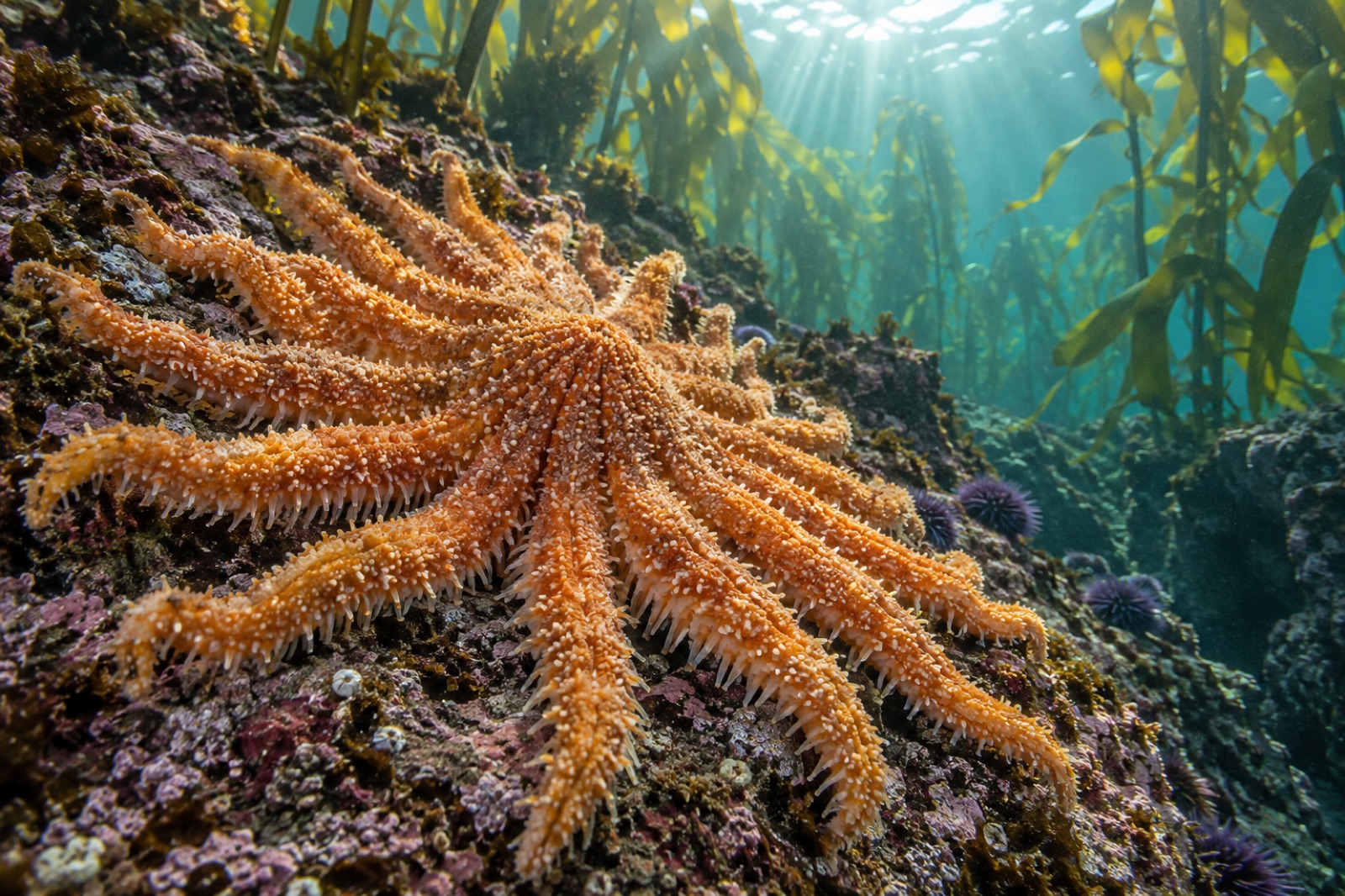
Nobody plans a dive around a sea cucumber, and that's a problem — for the reef, not the diver. The warty sea cucumber (Apostichopus parvimensis, formerly Parastichopus parvimensis) is one of the most important animals in the southern California kelp forest, and one of the least looked at. It is not glamorous. It does not shine, dart or pose. It lies on the sediment in the shadow of the kelp, brown and stubbled with black-tipped warts, and it eats the reef's leftovers: the rain of kelp fragments, faeces, plankton corpses and organic silt that would otherwise simply pile up and rot. In return it turns that detritus into clean sediment, circulating nutrients, and — incidentally — one of the more sought-after seafoods on the Pacific coast. This is the quiet janitor, and here is what it does.
Fast facts
|
|
| Scientific name |
Apostichopus parvimensis (formerly Parastichopus parvimensis) |
| Group |
A sea cucumber — an echinoderm of class Holothuroidea, family Stichopodidae |
| Common names |
Warty sea cucumber, California sea cucumber |
| Size |
Commonly 20–30 cm fully extended; reaches up to 40 cm |
| Depth range |
Low intertidal to roughly 30 m (occasional to 45+ m); commonest on subtidal sand-rock interfaces in kelp forests |
| Distribution |
Monterey Bay, California, to Baja California and the Gulf of California |
| Diet |
Deposit feeder — ingests surface sediment and detritus, digests the organic fraction, excretes the cleaned mineral grains |
| Notable traits |
Black-tipped "warts" (conical papillae); remarkable ability to aestivate — shrinking and fasting through southern California's lean months; sticky Cuvierian tubules as a last defence |
Recognising a warty sea cucumber
No other southern California animal quite matches it. Look for a big — forearm-length — soft sausage of a body, brown to reddish-brown, its back bristling with irregular conical papillae tipped in black (the "warts" of the name). Around one end is a ring of branched, bushy feeding tentacles, often extended in a fan when the animal is actively grazing. It sits in the open on patches of sediment among rock, usually in the dim shadow-filtered light of the kelp understory, and it is almost always still or moving at imperceptible pace.
Two Californian relatives help calibrate the identification. The giant California sea cucumber (Parastichopus californicus) is smoother, larger and redder, its papillae small and unpointed, and it belongs to colder water from roughly Monterey northward — on a northern California reef the big "sea cucumber" you see is usually that one, and the warty belongs further south. The warty warty, black-tipped version you encounter in the Channel Islands and along the southern California mainland is Apostichopus parvimensis. As with all underwater IDs, knowing the geography answers the question faster than any field mark. Have a look at our guide to subtidal zonation for how these animals distribute across the reef's depth bands.
What it does all day: the reef's recycling system
The warty sea cucumber is a deposit feeder, and the description is literal: it sweeps the sediment surface with its ring of sticky feeding tentacles, folding them one at a time into its mouth to strip off the adhered organic film — kelp fragments ground to meal, faecal pellets, dead plankton, bacteria — and passing the cleaned mineral grains straight through. A single animal ingests and processes its own mass in sediment on a regular rhythm. Work from many coasts puts the collective throughput of a healthy sea cucumber population at the scale of tonnes of sediment per hectare per year: these are industrial-scale bioturbators, municipalities of one.
Why the reef cares is explained in detail in our look at the detritus pathways of kelp forests: kelp production that isn't eaten alive in the canopy falls as drift and fragments onto the sediment, where it is either processed or locked away anoxically. Sea cucumbers are the principal processors at the sediment surface over most of the southern California reef. By eating the detritus, they return nitrogen, phosphorus and micronutrients to the water column in forms the kelp itself can re-use; by churning and oxygenating the upper sediment layer, they keep the whole benthic floor respiring. The "recycling system" of the title is not a metaphor. In the kelp forest food web, the sea cucumber is the recycling plant that closes the loop.
The vanishing trick: aestivation
The warty sea cucumber has one of the strangest life-history habits of any large Californian animal: aestivation, a warm-season shutdown. In the late summer and autumn, when warm, low-nutrient water blankets the southern California kelp forests and detritus production dips, the cucumber ceases feeding, empties and partially dissolves its own gut, retracts its tentacles, shrinks to a leathery fraction of its feeding size, and lies inert in a crevice — sometimes for months. Come the winter resumption of upwelling and production, the animal re-grows its digestive tract and returns to work.
This is not a curiosity but an ecological calibration: the animal's whole physiology is tuned to the seasonal pulse of the kelp forest. On a warming coast, the lean season lengthens; whether and how the warty can stretch its aestivation is one of the genuinely open and quietly worrying questions that come out of the marine-heatwave record summarised in our decade review.
Defences: slime, tubules, and the ultimate sacrifice
Sea cucumbers are the soft-bodied members of a spiny family, and they compensate with chemistry and some frankly spectacular misdirection. The warty's body wall is tough, laced with microscopic calcareous ossicles, and exudes a sticky, mildly toxic mucus. Hard-pressed, it can discharge its Cuvierian tubules — fine adhesive threads extruded from the anus that entangle and bitterly discourage an attacker — and, in extremity, eviscerate: rupturing its own body wall to expel a mass of gut and viscera at the predator, then crawling away on musculature alone to regrow the lost organs over the following weeks. Autotomy as a defence is an echinoderm family tradition (see the sunflower star's arm-shedding in our sunflower sea star profile), but the sea cucumber's version — voluntarily blowing its own guts out the back — is the most committed in the phylum.
True predators are few: large sea stars, some large gastropods, and octopuses will take them, but the biggest and most consequential modern predator is the human fishery.
A fishery on the janitor
The warty sea cucumber is fished commercially — diver-collected — in southern California and Baja California, processed into trepang / bêche-de-mer for export to Asian seafood markets, where it commands real money for its texture. The fishery grew substantially from the late twentieth century, and it sits uncomfortably on the animal's ecological role: the kelp forest's chief sediment recycler, removed in tonne quantities by hand, one diver bag at a time. California has responded with management — permits, size and season rules, and research toward better stock assessment — but the fundamental tension remains, as it does on every coast where a slow, sedentary, easily collected ecological engineer turns out to be delicious. The pattern it belongs to is part of why the urchin barrens story is a warning rather than a history lesson: you can remove a reef's slow, unglamorous workers in a decade, and only find out afterwards what they were holding in place.
Status and where to see one
Apostichopus parvimensis has no global conservation listing and remains common through much of southern California, but the fishery pressure and its warming-fuelled lengthening of the aestivation season are both current and real. Admire it where it sits.
To see one, dive or snorkel the rocky-sediment mosaic of the southern California kelp forests — the Channel Islands are the classic ground — looking on patches of sand among rock in the 5–20 metre band, in the low shadow of the canopy. They are day and night active (see our night diving in kelp for what the reef does after dark), big, still and unmistakable; the trick is only to actually look at them. Which is, arguably, the smallest change and the biggest upgrade a diver in this forest can make.
Key takeaways
- The warty sea cucumber (Apostichopus parvimensis) is a large, black-warted deposit feeder of southern California's kelp forests, commonest around the Channel Islands.
- Identification: forearm-length brown sausage body, irregular black-tipped conical papillae, branched feeding tentacles at the head end, on sediment patches among rock.
- It is an industrial-scale bioturbator — ingesting and cleaning reef sediment, returning nutrients to the water column, and oxygenating the benthic floor.
- It aestivates through the lean warm months — ceasing feeding, partially dissolving its gut and shrinking in place — in a rhythm tuned to the kelp forest's pulse.
- Defence runs from sticky mucus and ossicles through adhesive Cuvierian tubules to full self-evisceration and re-growth: echinoderm commitment.
- It is fished commercially for the Asian trepang market, on a reef where it is also the chief recycler — a tension that management is still learning to resolve.
FAQ
Are warty sea cucumbers dangerous?
Not at all — no spines that break skin, no venom aimed at you. The Cuvierian tubules it can extrude are sticky and mildly irritating to predators, and handling one may leave you with an adhesive mess on your gloves, but it will not hurt you. The consideration runs the other way: handling stresses and can injure the animal. Look, photograph, leave it on its sediment.
Why do the papillae have black tips?
The short answer is that nobody knows for certain — this is, after all, a sea cucumber. The conical black-tipped papillae are characteristic of the species and of the family Stichopodidae broadly, and probably serve some mix of hydrodynamic and sensory functions, but no one's pinned it down. They're simply the most reliable field mark of the species in its range.
How do sea cucumbers help the kelp forest?
Through the sediment. A kelp forest rains detritus — fragments, faeces, drifting corpses — onto its floor. Sea cucumbers ingest that detritus, digest the organic fraction and excrete clean grains, recycling nitrogen and phosphorus into forms the kelp can re-absorb and keeping the sea floor oxygenated and respiring. Remove them at scale and the floor's chemistry turns in ways the kelp canopy will eventually feel. The full pathway is in our kelp detritus food web explainer.
Can you eat them?
Yes — they're harvested commercially exactly for that, as trepang or bêche-de-mer, a valued seafood in Asian cuisine for its firm gelatinous texture. The processed product is the cleaned, boiled, dried body wall; the flavour is mild and the texture the point. Given their ecological role and the topic of this profile, we'd suggest the eating remains a commercial fishery's concern, not a diver's snack.
Where is the best place to see warty sea cucumbers?
The rocky-sediment interfaces of the southern California kelp forests, especially the Channel Islands, in the 5–20 metre band. Snorkelers at the accessible coves can see them; divers will find them on almost any sandy patch among rock in the understory. They do not hide, flee or flash — the challenge is only remembering to look at the quietest, most useful animal on the reef.