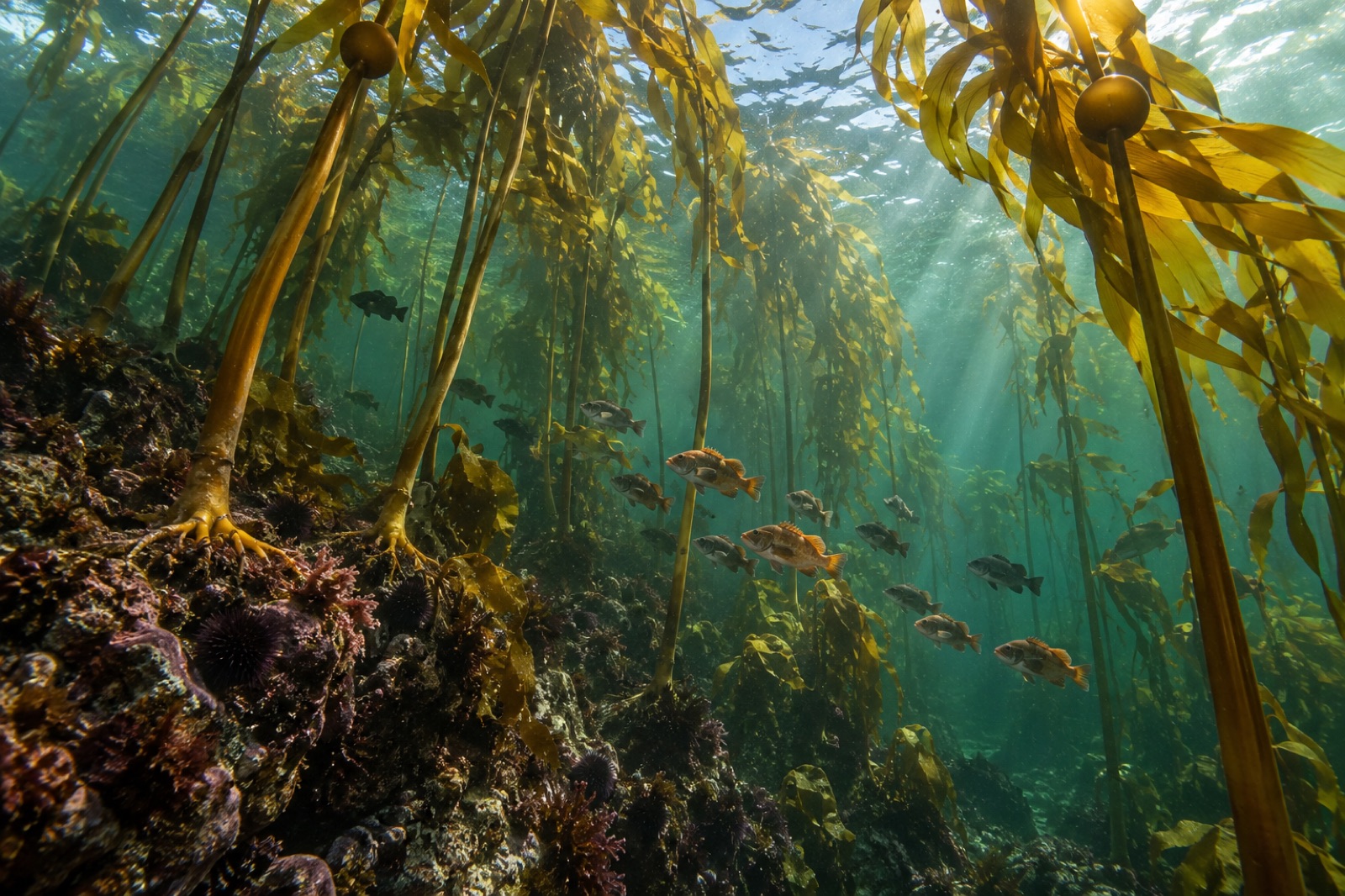
Walk any rocky Pacific beach after a storm and you will find long, flat, ruffled straps of olive-brown kelp streaming from the wrack line — often metres long, edged with fluted blades and studded along the strap with tiny floats. That is feather boa kelp (Egregia menziesii), one of the most easily recognised kelps on the northeast Pacific coast and one of its most quietly important. Where the sea palm lives squat and flexing on the highest surf rock, feather boa kelp owns the zone just below it, growing into long ribbons that host an entire miniature ecosystem of their own.
Fast facts
|
|
| Scientific name |
Egregia menziesii |
| Group |
Brown algae (Phaeophyceae), order Laminariales — a true kelp |
| Length |
Commonly 3–5 m; reported to 15 m in favourable sites |
| Form |
A long flat strap (the rachis) with lateral blades and small floats along its length |
| Habitat |
Low intertidal to shallow subtidal rock, moderate-to-exposed surf |
| Range |
Northeast Pacific, from southeast Alaska to Baja California (the closely related E. laevigata — "leather boa" — in Chile) |
| Life cycle |
Perennial with the standard kelp alternation of generations |
How to identify feather boa kelp
Among Pacific kelps, feather boa is one of the easiest identifications you will ever make:
- A single long flat strap, up to several centimetres wide, running from the holdfast like a ribbon.
- Paired lateral blades along the strap — short, elongated, often ruffled or "fimbriated" — giving the whole thallus a combed, feathery outline.
- Small air bladders (pneumatocysts), egg- to grape-sized, studded along the strap; these lift the fronds toward light and make washed-up pieces instantly recognisable.
- Olive to dark brown colour, darker and glossier than most other beach-cast kelp.
Confusion species are mostly other kelps with ribbon-like straps, but none combines the strap-feathers-bladder combo; the bull kelp washed up on the same beach is a smooth round stipe with a single big float and a tassel of blades — an entirely different silhouette.
Biology of the ribbon
Like all kelps, feather boa kelp runs the two-stage life cycle described in our explainer on the kelp life cycle: the metre-scale, visually obvious sporophyte alternates with a microscopic, filamentous gametophyte in the rock's microhabitat. The strap grows from a holdfast gripping the low intertidal rock and extends toward the light; grazing and wave damage are made good by continual growth, and an undamaged individual can live several years.
The strap is also an energy organ. Like other brown algae, feather boa kelp stores mannitol and laminarin — sugars and sugar-alcohols that are partly what makes kelp so sticky and slippery when beach-cast fronds begin to rot. The lateral blades carry the reproductive sori, releasing clouds of motile spores into the surf for settlement a short distance away.
A floating nursery
What floats in the feather boa's canopy matters as much as the canopy itself. The fronds host an extraordinary epiphyte community: bryozoans lace the blades, tiny crustaceans move through the ruffled edges, nudibranchs hunt bryozoan mats, and juvenile fishes shelter among the straps. Divers who stop and look will find an entire food web on a few metres of kelp — it is among the richest "single-plant" communities in the shallow Pacific. Beach-cast feather boa, similarly, becomes wrack-line habitat for sandhoppers and shore beetles, then food for gulls and surf-zone fish as it breaks down — a recycling story our guide to kelp wave-damping touches on from the physics side.
Where feather boa kelp fits in the kelp coast
Feather boa kelp sits in the middle tier of the Pacific's coastal zonation. Above it, on the highest surf rock, the sea palm holds the splash; alongside it, in suitable habitats, grow other understory kelps; below it, in the subtidal, stand the canopy-forming giants — bull kelp and giant kelp in the north and centre of the range, forests of the sort profiled in our Monterey Bay and Olympic Coast atlas guides.
That middle position makes it a useful indicator when shores change: marine heatwaves that stress the big canopy kelps — see our explainer on marine heatwaves — also show up in feather boa populations, often first as range-edge thinnings on the southern parts of its distribution. Warming is the overall background pressure, and the species' persistent perennial form makes those shifts legible in the shore profile of a diver or a naturalist's notebook.
At restoration sites, feather boa often arrives early among understory recruits once canopy structure is re-established — a detail in the ecological tapestry that Tidewright's Holdfast nursery work pays attention to when thinking about the full community, not just the architect species.
Uses, respectfully
Feather boa kelp is occasionally used as a food — as all kelps it carries the flavour compounds of the brown algae — but it is not a major edible seaweed compared with kombu, bull kelp or wakame, and its leathery texture limits the culinary appeal. Its main "use" today is exactly what it has always done: grow where only kelp can grow, carry an ecosystem on its strap, and give a naturalist at low tide one of the west coast's most satisfying identifications.
If you harvest seaweed for the kitchen, do it where legal, take small amounts, and follow the responsible-sourcing principles we discuss across the farming cluster — the same annual-generation logic that protects sea palms applies to all wild seaweeds.
Key takeaways
- Feather boa kelp is a long, strap-like true kelp of the northeast Pacific low intertidal and shallow subtidal, from Alaska to Baja.
- Identify it by the flat strap with paired feathery blades and small floats studded along it — nothing else on the beach looks quite like it.
- It is a perennial that grows through wave seasons, reproducing via microscopic alternate generations like other kelps.
- Its fronds are a dense habitat of their own — bryozoans, crustaceans, nudibranchs and juvenile fish live in the boa.
- Like all kelp, it is stressed by ocean warming, often thinning first at the southern edge of its range.
FAQ
Is feather boa kelp a plant?
No — it is a brown alga: a kelp, more closely related to other seaweeds than to any land plant. It photosynthesises, but it has no roots, flowers or true leaves; the holdfast grips rock and the strap-and-blade thallus does everything else.
Can you eat feather boa kelp?
Technically yes — it is not toxic — but it is leathery and not a sought-after edible compared with better-known food kelps. If you harvest any wild seaweed, do so only where legal, take fronds rather than holdfasts, and check current local regulations first.
How long does feather boa kelp get?
Typically 3–5 metres from holdfast to tip, with reports to about 15 metres in excellent habitat. Much of the beach-cast material you see in winter is broken or senescing fronds from these lengths.
Where is the best place to see feather boa kelp?
Any moderately exposed rocky shore at low tide along the Pacific Northwest, northern California, or the Channel Islands region. Look in the low intertidal pools and on shallow subtidal rock — the straps tail out from the rock like unspooling ribbon.
Does feather boa kelp indicate anything about ocean health?
Yes — because it is a perennial, moderately warmth-sensitive kelp, changes in its abundance and southern range edge are tracked by scientists and naturalists as part of the broader signal of marine heatwaves and ocean warming on Pacific shores.