Encyclopedia9 min read
A Field Guide to Kelp Forest Nudibranchs
Nudibranchs are the jewels of the kelp forest: shell-less sea slugs in startling colours. Learn the key groups, the star species and how to find them.
Tom Okafor ·
Neobernaya spadicea, the chestnut cowry, is the only cowry native to California — a glossy chestnut shell beneath a blazing orange mantle, grazing the reef by night.
Cowries are tropical animals. They are the glossy, egg-shaped shells of coral lagoons and Indo-Pacific shelves, collected for millennia and used as money from West Africa to the Pacific islands. So the first thing to know about the chestnut cowry (Neobernaya spadicea, long known as Cypraea spadicea) is that it shouldn't really be here — a genuine cowry, glossy shell and all, grazing the chilly kelp forests of southern California. It is the only cowry native to the state, and to see one alive at night, mantle blazing orange around its chestnut shell, is to watch the tropics pay a visit to the temperate reef.
| Scientific name | Neobernaya spadicea (formerly Cypraea spadicea) |
| Group | A cowry — a marine snail of family Cypraeidae |
| Common names | Chestnut cowry |
| Size | Commonly 3–5 cm; large individuals near 7 cm |
| Depth range | Intertidal crevices to roughly 45 m; commonest subtidally on rocky reefs |
| Distribution | Central California (rare north of Monterey) to Baja California; abundant at the Channel Islands |
| Diet | Omnivorous to carnivorous grazer: sponges, tunicates, bryozoans, anemone tissue and other small sessile animals |
| Notable trait | A live animal's bright orange-red, papillate mantle wraps the whole shell — the reason the shell stays so polished |
Find one by day and you will probably see only the shell: oval, domed, with a narrow toothed slit along its underside where the animal lives. The shell's back is a rich, glossy chestnut brown, usually crossed by one or two faint paler bands and dusted with tiny pale speckles, with a white or cream margin. It looks like a piece of polished wood — a finish no other local snail matches, and the visual tell even for beginners.
The trick of the polish is the reason the animal earns its "alarm bell" reputation at night. Cowries keep their shells glossy not by luck but by perpetual abrasion of a sort: the living mantle, a sheet of skin, wraps up and over the entire shell whenever the animal is active, constantly secreting and smoothing the surface. In the chestnut cowry that mantle is an extravagant orange-red, thick with pale-tipped finger-like papillae. An exposed, foraging chestnut cowry at night is one of the most vivid colour statements on the whole California reef — traffic-light orange under a torch beam, moving at a snail's pace. The alarm is an illusion, but the visibility is real.
The chestnut cowry is a climate story in one species. Its centre of abundance even today is southern California's warm-water biogeographic pocket — the region from Point Conception south and around the northern Channel Islands, where Southern California Countercurrent eddies trap comparatively warm water against the coast. North of Point Conception it thins out fast; at Monterey it is a genuine rarity, and beyond that effectively absent. Within its home water, though, it is one of the commonest large snails of the kelp understory.
Because its range hugs that warm pocket, its local comings and goings have tracked warm events for a century — expanding north in warm years and warm decades, retreating when the cold reasserts itself. In that sense the chestnut cowry is a living thermometer for exactly the dynamic described in our El Niño and kelp explainer: warm surface water on the southern California bight pushes the whole warm-water guild — cowries, garibaldi, swell sharks — up the coast, and cool years draw them back south.
Cowries as a family are not plant-grazers of the limpet type; they are slow predators and scavengers of sessile life, and the chestnut cowry is no exception. Its radula rasps and worries at encrusting and fleshy invertebrates — sponges, colonial tunicates, bryozoans, and, often reported, the tissue of small anemones and other soft-bodied animals it can pin. On a daytime reef, scan the undersides of ledges and the shaded overhangs where sponges and tunicates bloom, and that's where the cowries are parked; at night they move out over open rock to feed.
The dietary role mirrors that of the giant keyhole limpet, another unlovely-sounding omnivore of the same understory: these grazers of the sessile-animal guild trim and cycle the sponge-and-tunicate mat that carpets the shaded rock, keeping settlement space turning over. Within the kelp forest food web, they're a quiet conduit, moving encrusting-animal energy up into the mobile tiers that fish, octopuses and lobsters can use.
Chestnut cowries mate internally, and the female then lays a distinctive egg mass: a cluster or short column of pale capsules, cemented to the underside of a rock or ledge, over which she crouches to brood, foot spread protectively across the capsules. Find a sitting cowry that refuses to move for your inspection — don't test it — and it is likely a brooding female. The larvae spend time in the plankton before settlement grows the characteristic larval shell.
The juvenile's shell journey is one of the cowry family's famous transformations. Young cowries carry a thin, typically patterned "juvenile" shell; as the animal matures, the outer lip thickens and rolls inward, the spire disappears from view beneath the last whorl, and the animal deposits the smooth dorsal surface that — tended for life by the mantle — becomes the adult's mirror gloss. A cowry's gloss is thus not a geological accident: it is the effect of the living animal's daily housekeeping.
The shell is the defence: thick, heavy, lacking any exposed spire, and with an aperture its owner can plug almost completely with its own foot. Predictable predators try anyway — giant Pacific octopuses take cowries, leaving them among the tell-tale dropped shells at den mouths, and large crabs will worry at the aperture — but the chestnut cowry's combination of armour and nocturnal habit keeps it a low-yield target. The brilliant mantle, so conspicuous to our eyes under a dive torch, may carry a chemical cost to a mouthing fish; many night-active reef snails defend their soft exposed parts with distasteful secretions.
The chestnut cowry is common within its range and listed by no conservation body, but it is entirely unprotected by any fishery and has a history of shell collecting — basketfuls were taken from the intertidal and shallow subtidal in the mid-twentieth century, and the animal's constraints (one state, one warm pocket, slow reproduction) mean that even incidental collecting pressure is unwelcome. There is no reason to take one: the shell lasts longer — and keeps its gloss better — on a living animal.
To see chestnut cowries, dive the rocky reefs of the Channel Islands or the leeward rocky coasts of mainland southern California, at 5–25 metres, on the undersides of ledges and in crevices by day, and out in the open at night. The Casino Point kelp park on Catalina is famously dependable cowry ground — a daytime check of the dive park's big rock undersides will usually turn up their chestnut backs, and a night dive the mantles in full flare. If you're looking for the single easiest tropical-looking moment in California diving, it is this.
Within their home range they are among the commonest large reef snails — a night dive at the Channel Islands will often log a dozen. But the range itself is small: they are a southern-California-to-Baja species, rare at Monterey, absent further north. Locally abundant, geographically confined — which is why even local collection pressure accumulates.
Because the living animal polishes it, every day of its life. Cowries wrap the shell in a mantle that secretes and constantly smooths the surface; the shell is in effect maintained like a piece of lacquerware. The dull, chipped cowry shells you find in collections are what happens the day the polishing stops.
Dead shells in the drift, away from living animals, are generally acceptable to take in small numbers where local regulations allow — but check local rules, remember that shells in shallow water are wildlife architecture (hermit crabs and small fishes claim them), and never take a shell with an animal in it, however quiet it looks: cowries sitting tight in a crevice are alive.
No — there is no venom apparatus of any kind. The soft mantle may be distasteful to predators, but the animal is harmless to handle. Handle it minimally anyway: like all snorkeling and diving etiquette with slow reef animals, the rule is look, photograph, leave in place.
Dive at night. By day you see the shell tucked into crevices; after dark the animals emerge to feed with the mantle fully extended over the shell. A reliable first spot is the Casino Point dive park on Catalina, where a guided or unguided night dive in the kelp will ordinarily produce chestnut cowries fully in flare. See our night diving in kelp guide for the practical side of after-dark diving.
Nudibranchs are the jewels of the kelp forest: shell-less sea slugs in startling colours. Learn the key groups, the star species and how to find them.
Tom Okafor ·
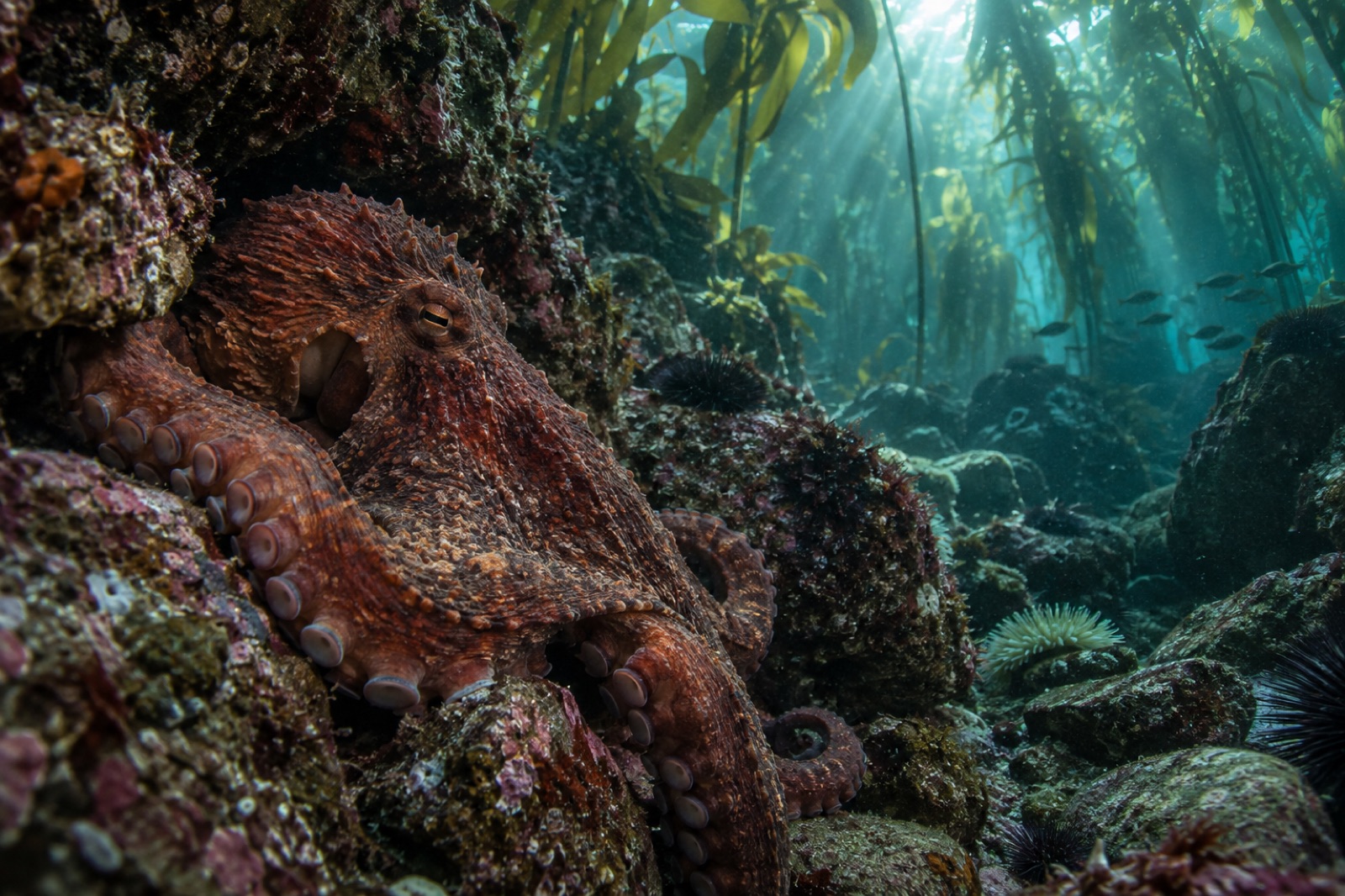
Meet the giant Pacific octopus: the world's largest octopus, a kelp-forest den-dweller with three hearts, blue blood and one shot at motherhood.
Dr. Theo Nakamura ·
Everything you need to dive Casino Point Dive Park on Catalina Island — entry steps, kelp forest routes, garibaldi and giant sea bass, conditions, and getting there.
Tom Okafor ·