Encyclopedia8 min read
Grass Rockfish: The Kelp Bed's Stealth Hunter
Meet the grass rockfish (Sebastes rastrelliger): a shallow-water ambush predator that barely leaves home — and pays for that loyalty when the pressure comes.
Dr. Mara Ellison ·
The canary rockfish went from overfished to rebuilt in fifteen years — one of the US west coast's most instructive fisheries recovery stories.
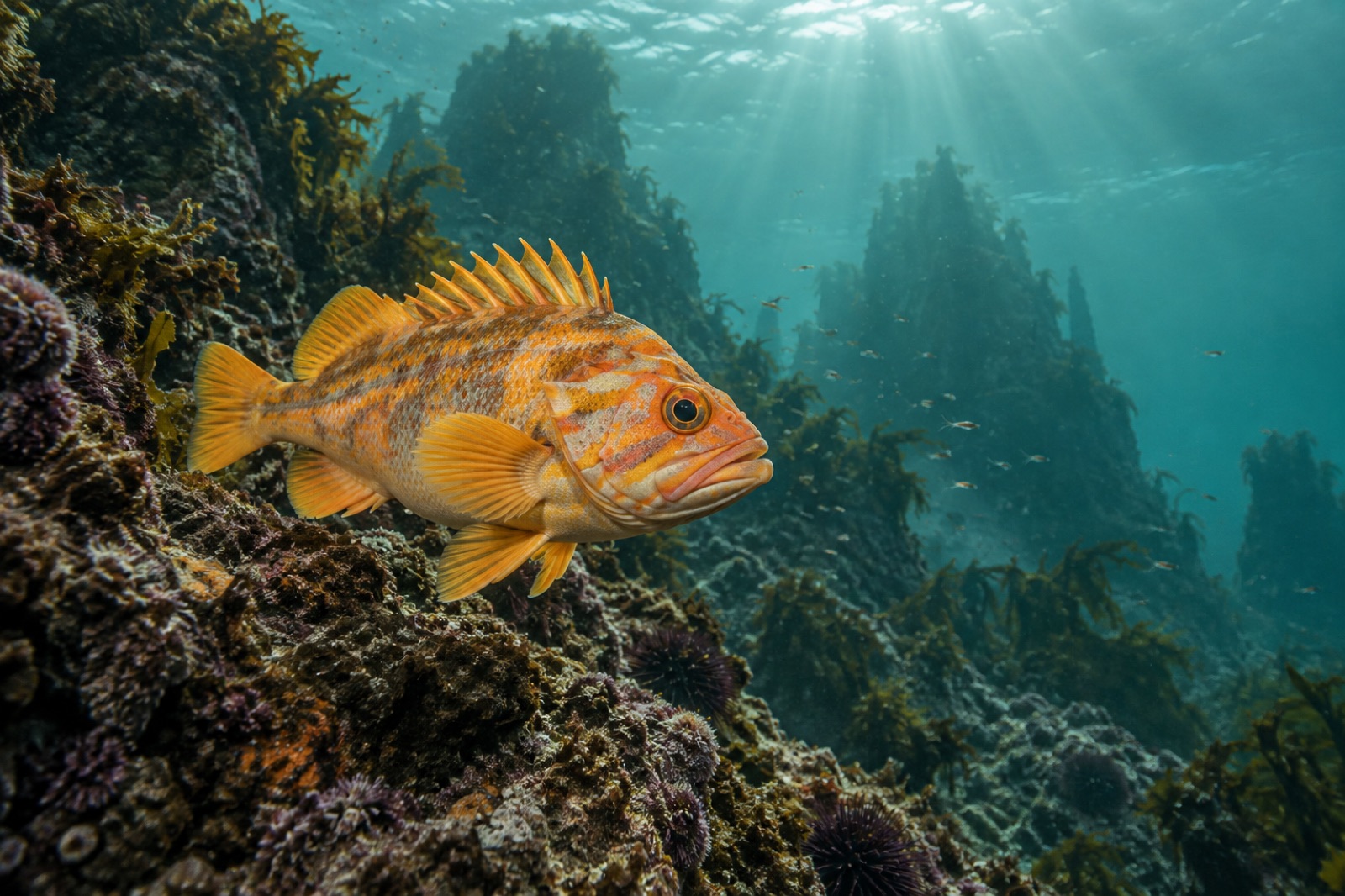
At two hundred metres down, off the continental shelf of the Pacific Northwest, lives a fish that looks like a tropical reef escapee: brilliant orange-yellow flanks, diffuse grey mottling, three bold orange stripes radiating across the head. The canary rockfish (Sebastes pinniger) is among the gaudiest members of the northeast Pacific's biggest fish genus — and, for a stretch of the early 2000s, one of its most embattled. Declared overfished in 2000 after decades of heavy trawl catches, closed off behind some of the strictest catch limits in American fisheries, and officially declared rebuilt by US fishery managers in 2015, it has become a standard case study in what happens when management matches biology — and how long "long" is for a fish that can live for eighty years.
| Scientific name | Sebastes pinniger |
| Group | Scorpaenidae; family Sebastidae rockfishes |
| Size | Commonly to 60 cm; maximum around 76 cm and about 5 kg |
| Lifespan | Very long-lived; fish over 80 years old have been aged |
| Range | Gulf of Alaska to northern Baja California; most abundant off Oregon and Washington |
| Habitat | High-relief rock and boulder fields on the shelf and slope, roughly 50–275 m; adults often deeper; young-of-year settle in shallow, even intertidal, algae |
| Diet | Krill and other planktonic crustaceans, small fishes including anchovies and sand lance |
| Status | Declared overfished in 2000; declared rebuilt in 2015 under a US rebuilding plan |
A canary rockfish is unmistakable among its cousins. Where a vermilion rockfish runs red-brown and a copper rockfish bronze, the canary is flame — a colour pattern that seems absurd for camouflage until you remember that at 150 metres, orange light doesn't exist; down there, this fish is essentially grey. Adults favour rugged, high-relief substrate on the outer shelf: pinnacles, boulder fields, cobble-and-rock ridges — precisely the terrain that historically made them vulnerable, because rugged rock concentrates fish and trawlers know where it is.
The deeper problem was pace. Canary rockfish grow slowly, mature late (often around seven to nine years for females), and then keep going for the better part of a century. Females are live-bearers like all Sebastes: they brood fertilised eggs and release large broods — hundreds of thousands of tiny larvae — in winter, and the larvae ride currents for months. Large, old females are disproportionately fertile, producing more and better-provisioned larvae, a detail that would matter enormously when fishery managers later tried to rebuild the biomass of big mothers. A species constructed like that can support a fishery, but only a patient one, and the mid-century west coast trawl fleet was not patient.
One of the canary rockfish's great surprises is where it starts. Juveniles settle out of the plankton into astonishingly shallow water — kelpy reefs and algal mats in depths snorkellers can reach — where the newly arrived "young-of-year" hover like orange fingernails over the surge grass. Biologists diving shallow reefs from Puget Sound south have long used juvenile canaries as a bellwether of recruitment years. As they grow, they slide downslope, following the reef edge into the depths their parents patrol. That life-history split — shallow nursery, deep adulthood — links the kelp zone and the shelf-slope world in a single species, one reason the canary shows up in this encyclopedia's kelp-forest pages at all.
Through the 1970s and 1980s the west coast foreign and domestic trawl fleets took rockfish, including canaries, at rates the biology couldn't carry. Catch restrictions came late and slowly, and by the late 1990s the assessments were unambiguous: spawning biomass had collapsed. In 2000, NOAA Fisheries formally declared canary rockfish overfished — a legal status under the Magnuson-Stevens Act that triggers a mandatory rebuilding plan.
What followed was economically painful and ecologically decisive. Retention of canary rockfish was effectively prohibited in many fisheries; anything caught incidentally had to be discarded. Because canaries are caught while boats pursue other groundfish, the whole fishery reorganised around avoiding them: area closures, depth restrictions, sector quotas with individual accountability, and eventually a full catch-share system for the trawl fleet in 2011 that gave captains both the incentive and the flexibility to steer clear. Mortality plummeted. Survey data began to show steady year classes surviving into adulthood.
Part of the recovery science was understanding that many discarded canaries were already dead or dying from barotrauma — the expansion of gases in the body when a fish is hauled up through a hundred metres of pressure change. Research into descending devices and better handling improved survival estimates, and, importantly, fishery managers credited improved survivability in the models. It was a reminder that rebuilding plans are ecological documents: they work with larvae, habitats and swim bladders as much as with quotas.
In 2015, NOAA Fisheries announced that canary rockfish biomass had exceeded its rebuilt target — around fifteen years after the overfished declaration, and roughly fifty years ahead of the pessimistic timeline first projected for such a slow species. Post-rebuilding analyses attributed the speed to three working parts: recruitment that turned out better than feared, mortality controls that actually held, and the fleet's spatial avoidance of canary hotspots. The species remains a management touchstone: retention limits crept back up, barotrauma mitigation became standard kit, and the rebuilding arc is now cited internationally whenever managers argue that deep-water, long-lived fish can come back.
The broader lesson connects to kelp-forest thinking. Recovery followed stock structure and habitat, not political lines: shallow nurseries, high-relief adult habitat, and current pathways that carry larvae. The same connectivity logic — protected spawning stock, intact nursery structure, linked habitats — underpins arguments for marine protected areas and for mapping marine connectivity between reefs. A rebuilt canary rockfish is, in part, an argument that ocean ecosystems forgive, given time and room.
Today the story's epilogue is still being written in warming water. Marine heatwaves compress the cold-water habitat northern rockfish evolved for, and the success of twentieth-century rebuilding doesn't guarantee easy going in a twenty-first-century ocean. But canary rockfish proved one thing durable: when science, law and fishermen's experience pull in the same direction, even an eighty-year fish can make it back.
From its colouring: the intense yellow-orange flanks reminded early observers of a canary. At depth, where orange light is filtered out, the fish appears muted grey — the brightness is only visible to us in full-spectrum light.
Yes, in limited numbers. Since rebuilding, retention limits have gradually reopened in both recreational and commercial fisheries, though they remain more conservative than for fast-growing species, and rules vary by state and depth. Barotrauma-reduction tools are now standard advice when releasing any deeper rockfish.
Otolith ageing — reading growth rings in the ear bones — has returned ages past 80 years. Like many rockfish, the oldest, largest females are also the most fecund, which is why rebuilding plans emphasised rebuilding not just biomass but the age structure of the spawning stock.
Adults mostly live too deep for kelp — 50 to 275 metres. But newly settled juveniles appear in shallow kelpy reefs, sometimes in only a few metres of water, so a careful snorkeller on the outer coast can genuinely meet the species. Divers can compare that setting with the adult habitat along the drop-offs described in the Channel Islands atlas profiles.
Three things working together: better-than-expected young recruits entering the population, near-total reductions in fishing mortality once avoidance measures took hold, and management that adapted as the data improved — a rare alignment that let natural longevity work for, rather than against, the rebuilding clock.
Meet the grass rockfish (Sebastes rastrelliger): a shallow-water ambush predator that barely leaves home — and pays for that loyalty when the pressure comes.
Dr. Mara Ellison ·
The China rockfish is a small, blue-black, yellow-speckled reef fish that rarely leaves its crevice. Biology, identification, habits and conservation.
Dr. Mara Ellison ·
The kelp rockfish (Sebastes atrovirens) lives in the kelp canopy itself — a mottled, camouflaged hunter: identification, habitat, life history and where to see it.
Dr. Theo Nakamura ·