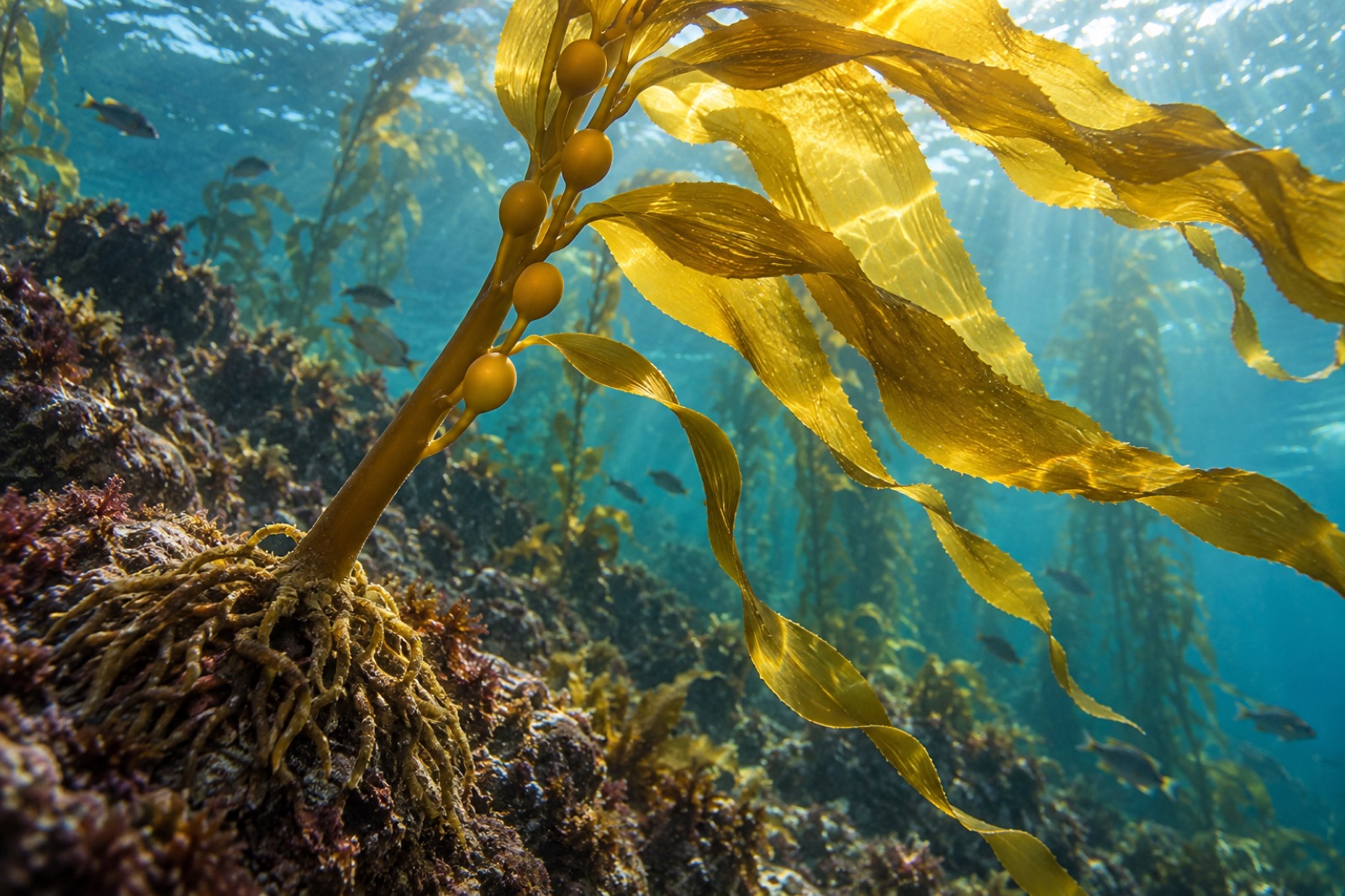
A few hundred metres off the sandstone bluffs of Point Loma, with downtown San Diego's skyline in one direction and the open Pacific in the other, grows one of the most famous seaweed forests in the world. The Point Loma kelp bed — really a chain of beds running from the point itself north toward La Jolla — has been measured, photographed, counted and agonised over for more than seventy years. It has nearly died twice from causes we created, and recovered twice when we changed our behaviour. Few kelp forests anywhere tell the story of the modern ocean more clearly. This guide explains where it is, what happened to it, and how to see it.
Where the forest sits
Point Loma is the high ridge that shelters San Diego Bay from the Pacific. Off its western face, a broad sandstone and claystone reef shelf runs between roughly 8 and 25 metres deep — exactly the light zone that giant kelp, Macrocystis pyrifera, prefers. Cold, nutrient-rich water wells up along the southern California shelf (the mechanics are covered in our explainer on upwelling), and where swell and current rake the shelf, the kelp finds grip on flat reef and cobble.
At its best, the Point Loma system has formed a near-continuous canopy several kilometres long, one of the largest mainland kelp beds south of Point Conception. North of it, the La Jolla beds pick up the baton past the submarine canyon; south of it, giant kelp continues on and off past the Mexican border, a story told in our Baja California guide. Point Conception is the hinge: north of it the coast is reliably cold. South of it — San Diego included — giant kelp lives closer to its thermal edge, which is why this forest feels the climate so sharply.
The most-studied kelp forest on Earth
The claim is defensible. San Diego holds an extraordinary density of oceanographers — Scripps Institution of Oceanography above La Jolla, and a constellation of fisheries and university labs — and the kelp bed is essentially their front garden. Permanent research transects on the Point Loma shelf have been revisited for decades, producing one of the longest continuous records of any kelp forest in existence: frond densities, urchin counts, fish communities, canopy area measured by diver, by aerial photograph and now by satellite (see how in how satellites see kelp).
The late Scripps ecologist Mia Tegner turned the Point Loma bed into a natural laboratory for some of the foundational questions in kelp ecology — not least her landmark experimental work showing what happens when sea urchins are removed from a reef: kelp returns. That experiment, run on this coastline, helped write the modern playbook for urchin-barren reversal described in our guide to urchin barrens.
How the forest nearly died — twice
The sewage decades
Through the middle of the twentieth century, San Diego's raw and poorly treated sewage discharged through the Point Loma outfall directly beneath the kelp beds. The effects were exactly what the science of coastal eutrophication would predict: turbid, particle-rich water cut the light kelp needs; sediment smothered the rock where spores settle; and the forest contracted to a shadow of its former self. A major El Niño in 1957–59 stacked warm, nutrient-poor water on top of the pollution, and by the early 1960s the bed was largely gone.
The recovery is the hopeful part, and it was engineered, not accidental. As wastewater treatment improved and the outfall was extended farther offshore into deeper water in 1963, water clarity over the shelf improved markedly. Within years, kelp was reforesting the reef on its own — spores from remnant patches near La Jolla and from deeper refuges recolonising the shelf. By the 1970s and 80s the canopy stretched along the point again. It remains one of the cleanest demonstrations anywhere that kelp restoration sometimes requires only that we stop the damage.
The heatwave era
The second near-death experience was thermal. The monster El Niños of 1982–84 and 1997–98 stripped the canopy severely (see El Niño and kelp), and each time the bed fought back during the cool La Niña years that followed. The concern now is the baseline: the marine heatwave years of 2014–2016, which brought record-warm water up the whole coast, hit a forest already living near its thermal ceiling. Our review of the heatwave decade puts those years in context; on the Point Loma transects they read as thin years, with southward portions of the bed faring worst.
What has saved the forest repeatedly is the urchin fishery. San Diego's red sea urchin divers — profiled in our red sea urchin species guide — work these same reefs, and by cropping urchins they suppress the grazing pressure that tips damaged beds into barrens. Predator and market together do the work that, in otter country farther north, the trophic cascade does alone.
What lives in it
A healthy season on the Point Loma beds looks like the Southern California textbook: giant kelp canopy shimmering at the surface, garibaldis (California's impossible orange state fish, profiled here) guarding their algae nests on the reef below, schools of kelp bass and halfmoon in the midwater, sheephead patrolling urchin crevices, bat rays in the sand channels, and leopard sharks sliding through the shallows toward La Jolla each summer. California sea lions hunt the edges. At the very tip of the point, below the old lighthouse at Cabrillo National Monument, some of the best-protected rocky intertidal in Southern California survives — protected precisely because the federal monument long restricted access.
How to see it
- Cabrillo National Monument tidepools — at low tide, the intertidal end of the story: surfgrass, anemones, and kelp fronds washed in from the forest offshore. Check the monument's seasonal access windows.
- Boat dives on the beds — San Diego charter boats run the Point Loma kelp regularly; a rugged 7 mm wetsuit or drysuit, and our cold-water dive gear guide, apply. Visibility of 5–15 metres; green-gold light under the canopy.
- Kayaking the La Jolla side — the bed's northern continuation is one of the classic kayak-over-kelp paddles in California, launching from La Jolla Shores over the leopard shark shallows.
- From the water, look back — the forest's urban context is itself the lesson: a metropolis of three million people, and a giant kelp bed in its harbour mouth.
The pressures ahead
Point Loma sits at the warm end of giant kelp's world, which makes it a sentinel. Warming baseline temperatures, more frequent marine heatwaves, and the loss of the sunflower sea star — once the bed's urchin predator — all push in the wrong direction. Restoration thinkers increasingly talk about this coast in terms of genetic rescue and warm-adapted seedstock: exactly the problems Tidewright's fictional Holdfast nursery model — matching seed to site genetics — was invented to dramatise (see the platform overview). The real work on this forest is being done by the Scripps tradition, the California Department of Fish and Wildlife, and the urchin divers who keep the grazers honest.
Key takeaways
- The Point Loma kelp forest, stretching along the shelf off San Diego toward La Jolla, is among the largest and longest-studied giant kelp beds in the world.
- It collapsed under raw sewage in the mid-twentieth century and recovered within years once the outfall moved offshore — one of the great proof cases that removing a stressor can restore a forest.
- El Niño events in 1982–84 and 1997–98, and the 2014–16 heatwave, stripped the canopy repeatedly; the bed recovers in cool years but sits near its thermal limit.
- The local red sea urchin fishery, unusually, helps the forest by cropping the grazers that would otherwise turn stressed beds into barrens.
- You can meet the forest by boat dive, kayak, or at Cabrillo's protected tidepools — a wilderness in sight of a city skyline.
FAQ
How big is the Point Loma kelp forest?
In strong years the Point Loma–La Jolla system has formed a canopy several kilometres long and hundreds of metres wide — historically one of the largest mainland giant kelp beds south of Point Conception. Canopy area swings dramatically with ocean conditions, quadrupling or collapsing within a few years.
Why is the Point Loma kelp forest famous in science?
Because of its research history. Scripps Institution of Oceanography lies just up the coast, permanent study transects on the shelf have been monitored for decades, and foundational experiments on urchins and kelp — including landmark urchin-removal work — were run on this reef.
Did sewage really kill the kelp forest?
Substantially, yes. Mid-century discharges clouded the water and smothered settlement surfaces, and the bed shrank to a remnant by the early 1960s. After treatment improved and the outfall was extended offshore in 1963, water clarity recovered and the kelp reforested largely on its own — a landmark case study in pollution-driven kelp loss and recovery.
Can you dive the Point Loma kelp beds?
Yes — San Diego charter boats dive the beds regularly, and strong shore divers sometimes work the La Jolla end. Expect water of 12–20°C, kelp canopy navigation, sea lions, and superb garibaldi, bass and sheephead life. It is an experienced-diver site: swell, surge and depth all demand comfort.
Is the Point Loma kelp forest threatened today?
Its long-term pressures are warming water, more frequent marine heatwaves and the loss of key urchin predators; its buffers are cool La Niña years, the urchin fishery and southern California's deep scientific attention. It is a forest worth watching precisely because it tells us what the warm edge feels like.