Atlas10 min read
Cook Strait: Kelp in the Middle of New Zealand
Between New Zealand's two islands, ferocious tides mix subtropical and subantarctic water into kelp reefs of rare variety — Wellington to the Marlborough Sounds.
Dr. Mara Ellison ·
Off New Zealand's Tutukaka Coast, the Poor Knights Islands protect the clearest, warmest kelp forests in the country — and fish that belong to a warmer sea entirely.
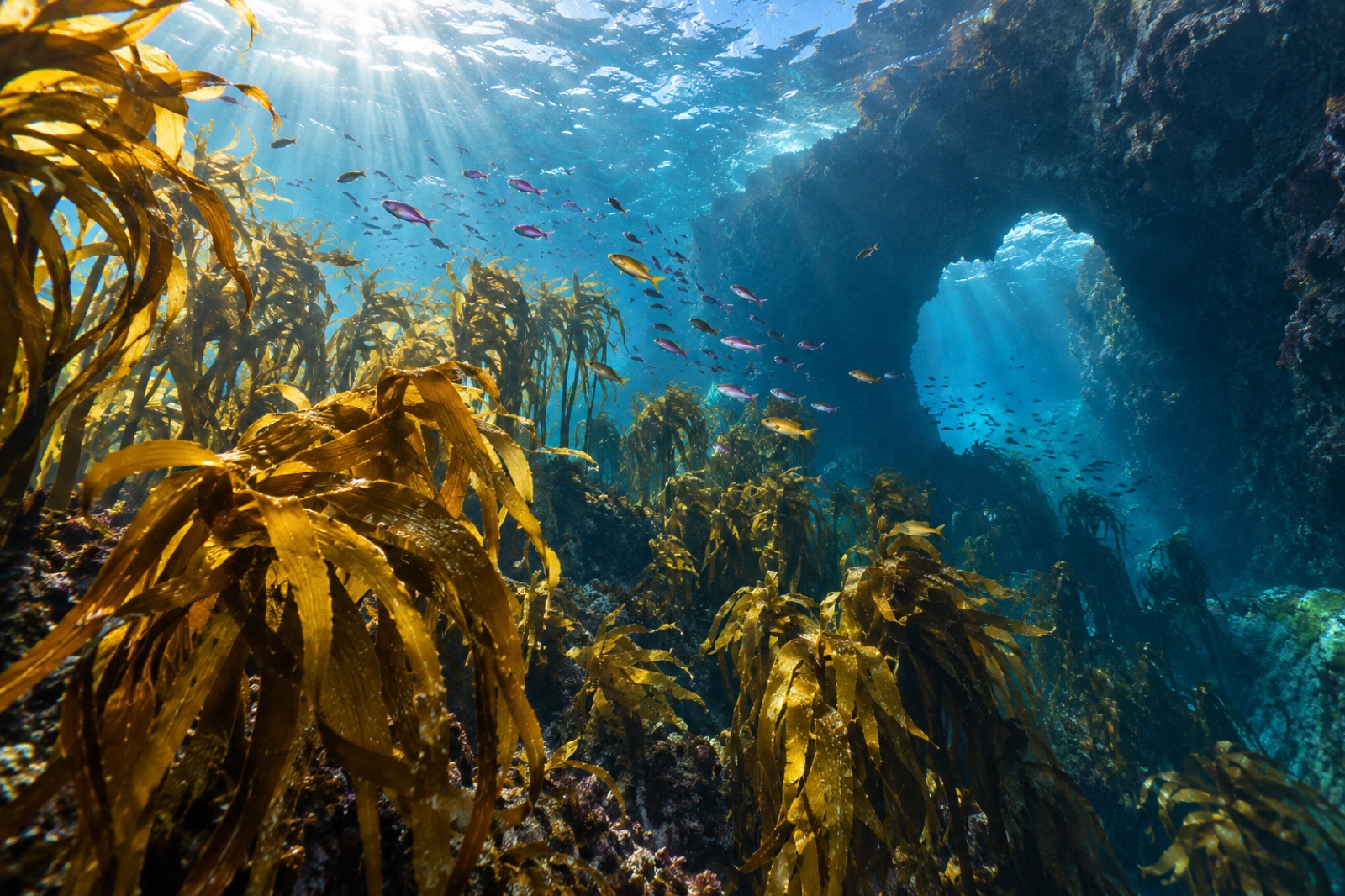
There is a moment, roughly an hour out of Tutukaka Harbour, when the water changes. The green coastal turbidity of the Northland shelf lifts off, and the sea turns a deep, transparent blue that looks borrowed from the tropics. Then the Poor Knights Islands rise up out of it — sheer cliffs of dark volcanic rock, whitened in bands by centuries of seabird colonies, standing in water so clear you can watch the swell breathe on the reef twenty metres below. The main reason people come, though, is not the cliffs. It is what grows beneath them: among the most luxurious kelp forests in New Zealand, wrapped in water warm enough to host fish that have no business being this far south.
The Poor Knights are two small islands — Tawhiti Rahi and Aorangi — plus a scatter of rock stacks, twenty-two kilometres off Northland's east coast and a short hop east of the Tutukaka marina, which runs the dive boats. The islands are the remains of ancient volcanoes, their cliffs and arches carved out over millions of years. A full no-take marine reserve wraps the islands out to sea, protecting one of the Southern Hemisphere's signature dive sites, while the land itself is a strict nature reserve — landing is prohibited, and for good reason, as we'll see.
The engine of the Poor Knights' unusual ecology is a warm boundary current. Subtropical, nutrient-light water streams south along the northeastern coast of the North Island, carrying warmth and — crucially — the larvae and juveniles of tropical and subtropical species. Some larvae find the reefs around the islands each year and settle; many never make it further south than this. The result is a biological sampling of a warmer ocean layered straight over a temperate one. Our explainer on boundary currents describes how these ocean rivers redraw species ranges; the Poor Knights are New Zealand's clearest living demonstration.
The other engine is geology. The volcanic submarine terrain drops and shelves in dramatic steps, with arches, swim-throughs and the great flooded cavern of Rikoriko Cave — one of the largest surveyed sea caves in the world by volume and a place boats can legitimately motor inside. Steady light, warm shelter from southern gales, hard rock at every depth and almost no terrestrial runoff give the reefs pristine growing conditions. Water temperatures swing from roughly fifteen degrees in late winter to the low twenties in high summer — a genuinely mild range for a country where southern reefs shiver through single digits.
Golden kelp (Ecklonia radiata) — the backbone of temperate New Zealand's reefs — grows here in some of its finest form. In the islands' clear water, the light drops further down than anywhere on the coast, and the kelp rides down with it: dense shallow forests under the cliffs thinning into open golden parkland at thirty metres and beyond. Beneath the canopy, a second and third storey of branching brown algae, sponges and cool-water trees crowd the ledges. If you want to understand the layered architecture of the subtidal reef, the Poor Knights are the best single classroom in the country; our explainer on subtidal zonation supplies the vocabulary for what you will see.
Now add the colour. In summer, subtropical visitors move in — species usually associated with waters hundreds of kilometres north. Tiny golden fairy wrasse, butterflyfish, Lord Howe coralfish and other warm-water wanderers flicker above the kelp like stray confetti from the tropics. The resident cast is big too: pink maomao schooling like shoals of living rose petals, blue maomao flashing through the archways, moray eels with jaws wide open in the surge, and boisterous groups of large stingrays that glide the sandy bowl of "Rays Ballroom" near the landing of the main dive fleet. Snapper and trevally patrol the drop-offs, and sharks range through in the blue.
The Poor Knights show what a no-take marine reserve does when it is given the chance to work. Fishing ceased here decades ago, and the reef has filled out accordingly: bigger predators, older fish, thicker kelp. The pattern matters beyond the islands because New Zealand's northern reefs carry the same pressure story told everywhere — where large predators that eat urchins are fished down, kelp beds wear back into grazed rock, as our explainer on urchin barrens describes. Inside the Poor Knights' boundary the grazers have keepers, and the forest stands. For the mechanics of what legal protection buys a reef, our guide to marine protected areas is the right follow-up read.
Above water, the islands are just as fiercely guarded. Both main islands are predator-free and function as botanical and seabird islands: pohutukawa forests, tuatara — the last wild home of these reptiles off a handful of islands — and dense breeding burrows. This is the stronghold of Buller's shearwater, whose blue-grey rails lift off the islands at dusk in their thousands during the breeding season. The rule is absolute: nobody lands, ever, except under research permits; the boats work from moorings and the world of the Poor Knights is observed from the water.
Tutukaka is a small harbour village about thirty minutes' drive from Whangārei, with full-service dive charters running year-round when weather permits. Summer brings the warmest, clearest water and the subtropical fish; winter brings the stingray aggregations and quieter boats. The diving suits confident beginners in the shallow harbour-side sites and advanced divers in the arches and caves; if you are fresh to cold-temperate kelp diving, our beginner's guide to kelp forest diving is a sound checklist for knowing what to ask a charter before you book. Freediving, snorkelling and glass-clear kayaking along the cliffs are all possible, though the reef's real wealth lies below the first few metres.
No. The islands are closed nature reserves: landing is prohibited except under research permit, and visitors experience them from boats on moorings and dive sites. That total protection — of birds, reptiles and endemic plants — is the point.
Kelp forests with tropical fish layered through them, pink and blue maomao shoals, moray eels, stingrays, snapper, schooling trevally and occasional sharks, plus arches and Rikoriko Cave. In summer the subtropical visitors are at their most numerous.
Yes, with a charter. Shallow sites under the cliffs are calm and sheltered; the arches, caves and deeper reefs suit more experienced divers. Book a boat out of Tutukaka and say plainly what your experience is — the skippers will match sites accordingly.
A warm current flowing south past Northland carries larvae and juveniles from subtropical waters. Some settle and grow here each year before winters knock them back; the islands sit on a moving boundary between two marine provinces, which is exactly why they are so biologically rich.
Between New Zealand's two islands, ferocious tides mix subtropical and subantarctic water into kelp reefs of rare variety — Wellington to the Marlborough Sounds.
Dr. Mara Ellison ·
Golden kelp forms the backbone of Australia's Great Southern Reef. Learn to identify Ecklonia radiata and why this habitat-maker is on the move as oceans warm.
Dr. Mara Ellison ·
MPAs, marine reserves, no-take zones explained — how protection levels differ, what the evidence shows, and what MPAs can and can't do for kelp forests.
Dr. Mara Ellison ·