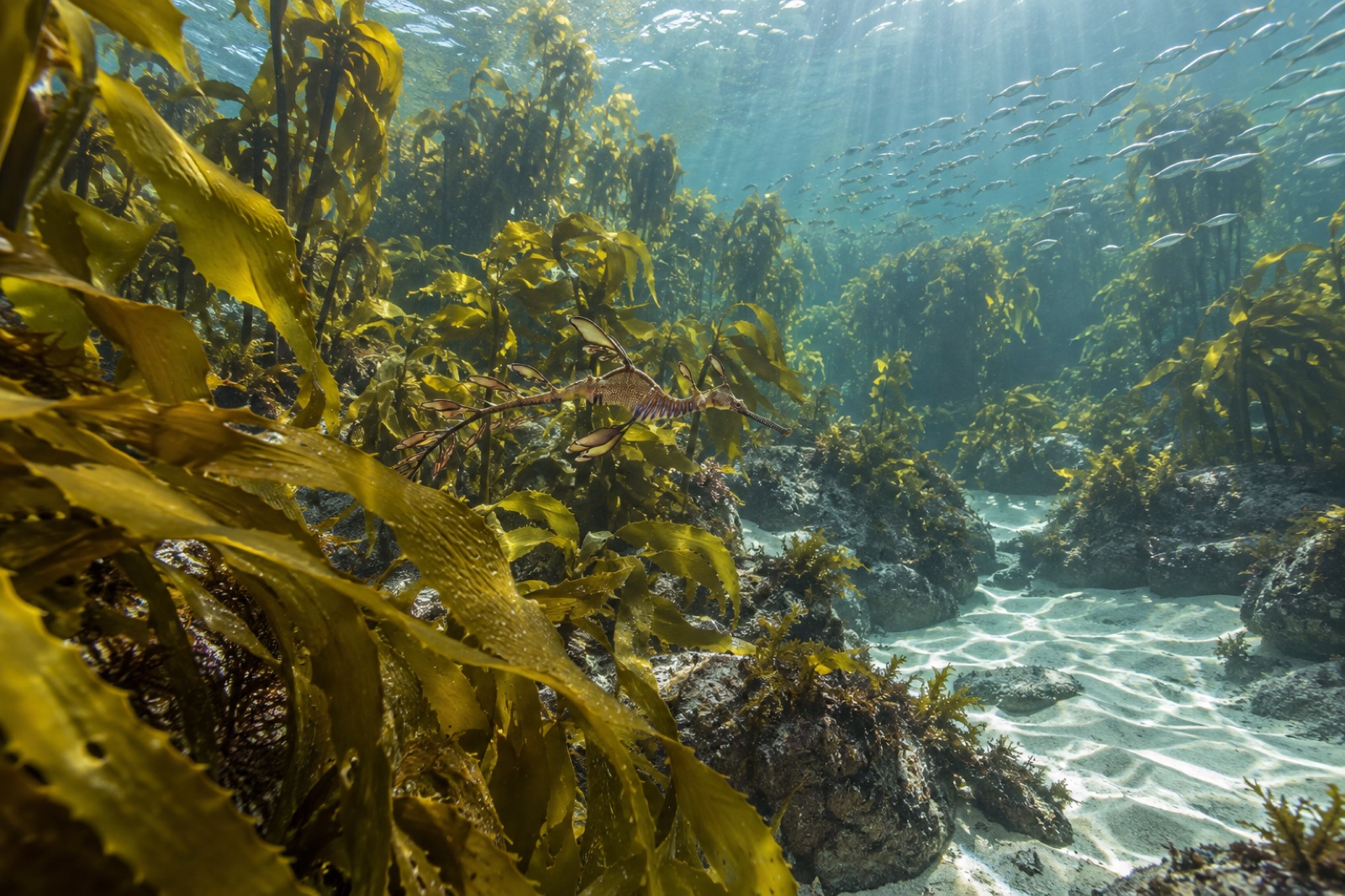
Most travellers crossing western Victoria hug the Great Ocean Road, and they leave having seen only half the coast. West of Warrnambool the road bends inland, the crowds thin, and the shoreline grows wilder: basalt capes, a wind-scoured deep-water port, and a fifty-kilometre sweep of dune-backed beach where golden kelp grows in heavy Southern Ocean swell. This is the Portland–Discovery Bay coast — one of the most ecologically loaded stretches of the Great Southern Reef, and one of the least written about. If you came looking for where Victoria's kelp country begins in earnest, it begins here.
The Bonney upwelling: the engine under everything
Stand on the Cape Nelson lighthouse cliffs in summer and you are looking at one of Australia's great oceanographic events, even though nothing on the surface announces it. Each summer and autumn, persistent south-easterly winds push surface water offshore along this coast, and cold, nutrient-rich deep water rises to replace it: the Bonney upwelling, which runs from roughly Robe in South Australia across to Portland. The mechanics are the same ones we describe in our upwelling explainer — wind, Coriolis, and a sloping shelf conspiring to lift deep water into the light.
The consequences arrive in layers. Nutrients fuel phytoplankton blooms; krill and small fish concentrate; and into that feeding ground come the giants. Portland is one of the few places in Australia where blue whales are a recurring, predictable feature of the summer sea — drawn in to feed on the krill swarms that the upwelling sustains. In winter the same headlands host southern right whales calving just offshore, continuing east toward the famous nursery at Logans Beach near Warrnambool. Few coasts on the continent can claim both whale seasons from the same cliff top.
Portland: a working harbour inside a wild coast
Portland itself is an industrial deep-water port — Victoria's oldest European settlement and still a shipping town of grain silos, aluminium berths and fishing wharves. The harbour breakwaters are worth a snorkeller's honest attention: sheltered rock and pile habitat where the kelp fringe collides with a working waterfront, and where the patient observer finds sponge gardens and the occasional weedy seadragon.
The points of pilgrimage lie just offshore and just west:
- Lawrence Rocks, two jagged fangs a couple of kilometres out, hold the largest of several Australasian gannet colonies on this coast — thousands of birds wheeling above the kelp beds in summer.
- Point Danger, on the outskirts of town, is Australia's only mainland gannet colony — established in the 1990s behind a predator-exclusion fence, a rare case where you can watch a seabird metropolis without a boat.
- The southern rock lobster fishery works the kelp margins all along this shore; southern rock lobster thrive where reef, kelp and upwelled productivity overlap.
Cape Bridgewater and the petrified forest
Twenty minutes west of Portland the coast rears up into Cape Bridgewater — the eroded rim of an ancient volcanic province, its cliffs among the highest in Victoria. Below them, the swell refracts into one of the state's most dramatic surf beaches, and the rock platforms hold dense beds of golden kelp (Ecklonia radiata), the foundational canopy species of this entire coast. The cape's famous "petrified forest" is not fossil wood but rhizoconcretions — dune limestone moulded around ancient vegetation — a reminder that this shoreline has been growing, burying and exhuming life for a very long time.
Offshore, the reef drops quickly into green water where kelp gives way to sponge gardens and, in the Dutton Way to Discovery Bay transition, the heavier, strap-like presence of southern bull kelp on the most exposed bommies.
Discovery Bay: fifty kilometres of wind and wrack
West of the cape the coast relaxes into Discovery Bay — a single immense arc of sand backed by the dunes of Discovery Bay Coastal Park, running all the way to the South Australian border. This is a beach that faces the whole Southern Ocean, and it is one of the great drift-kelp coasts of Australia: every big swell tears fronds and whole plants from the offshore reefs and delivers them to the beach in windows metres deep.
That wrack is not waste. As we detail in our piece on drift kelp and wrack lines, cast kelp is the engine of the sandy-beach food web — feeding amphipods and beetles, which feed shorebirds, and decaying into nutrients that wash back out to feed the reefs. Walk Discovery Bay after an autumn storm and you are walking through the kelp forest's exported wealth. The bay also hides one of Victoria's quiet geological oddities: freshwater springs rising through the seabed in the shallows, a direct seep from the coastal aquifer.
The kelp communities, honestly described
Two clarifications matter for this coast. First, this is not giant kelp (Macrocystis) country — the great drifting forests of Tasmania and eastern Victoria fade west of Wilsons Promontory, and the canopy here belongs to Ecklonia radiata, with crayweed (Phyllospora comosa) on the swell-beaten ledges and bull kelp on the outermost rocks. Second, the forests here are healthy but pressured: eastern Victorian and Tasmanian kelp has suffered badly under marine heatwaves (see our marine heatwaves explainer and the Bass Strait overview), and while western Victoria's upwelling-cooled water has been a relative refuge, it is not a guarantee. Monitoring stretches of this coast — canopy extent, urchin fronts, warm-water incursions — is exactly the kind of long, unglamorous data work we argue for in the value of long-term monitoring.
Visiting well
- When: Summer for blue whales and gannets at full noise; winter for southern right whales and the coast at its most theatrical.
- Where: Cape Nelson and Cape Bridgewater cliff walks for the overview; Point Danger for the gannets; any Discovery Bay access track after a storm for the wrack line spectacle.
- In the water: Sheltered harbour edges suit snorkellers; the open coast is heavy, cold, shark-patrolled swell country — treat it as advanced terrain, and bring real exposure protection year-round.
- Respect the working sea: this is lobster-fishing and shipping water. Give pots, boats and berths a wide berth.
Key takeaways
- The Portland–Discovery Bay coast is western Victoria's kelp heartland, fed by the summer Bonney upwelling — cold, nutrient-rich water that powers everything from phytoplankton to blue whales.
- Canopy here is golden kelp and crayweed, with bull kelp on exposed bommies; this is not giant kelp country.
- Wildlife is exceptional: Australia's only mainland gannet colony, seasonal blue and southern right whales, and a productive southern rock lobster fishery on the kelp margins.
- Discovery Bay is a showcase for the wrack-line economy — storm-cast kelp feeding the beach food web and returning nutrients to the reef.
- Upwelling-cooled water has buffered this coast from the worst marine heatwaves, but monitoring, not luck, is what protects it.
FAQ
Can you really see blue whales from land at Portland?
Yes, in good summers — blue whales feeding on Bonney-upwelling krill have been regularly sighted from the Cape Nelson and Cape Bridgewater cliffs between roughly November and May. Sightings vary year to year with the upwelling's strength; binoculars and patience are essential.
What kelp species grow at Portland?
Golden kelp (Ecklonia radiata) is the dominant canopy former, with crayweed (Phyllospora comosa) on high-energy ledges and southern bull kelp (Durvillaea potatorum-type habitat) on the most exposed outer reefs. Giant kelp does not form forests this far west.
Is there snorkelling or diving?
The Portland harbour fringes offer sheltered snorkelling with kelp, sponge gardens and pier life. Open-coast diving is serious temperate-water diving — heavy swell, 12–16°C water, limited access points — best done with local operators who know the weather windows.
What is the "petrified forest" at Cape Bridgewater?
Limestone formations created when calcium-carbonate-rich dune sand hardened around ancient trees and roots, leaving hollow moulds and casts — not petrified wood, but a cast of a vanished dune forest.
How threatened is this coastline's kelp?
Less hit by recent marine heatwaves than Tasmania and eastern Victoria, thanks to upwelling cooling — but warming, urchin range expansion and nutrient changes are live pressures across the whole Great Southern Reef. Healthy is not the same as safe.