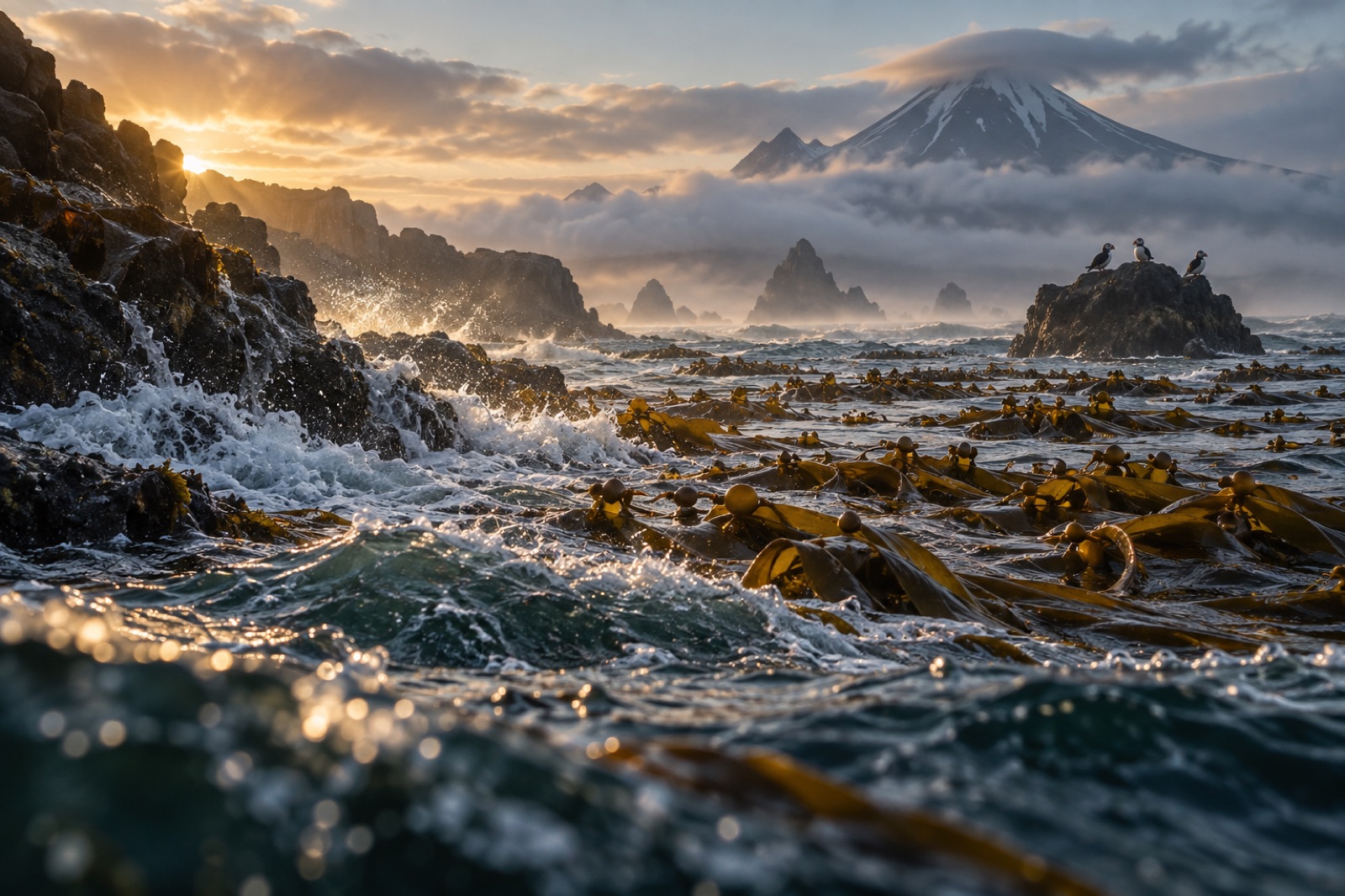
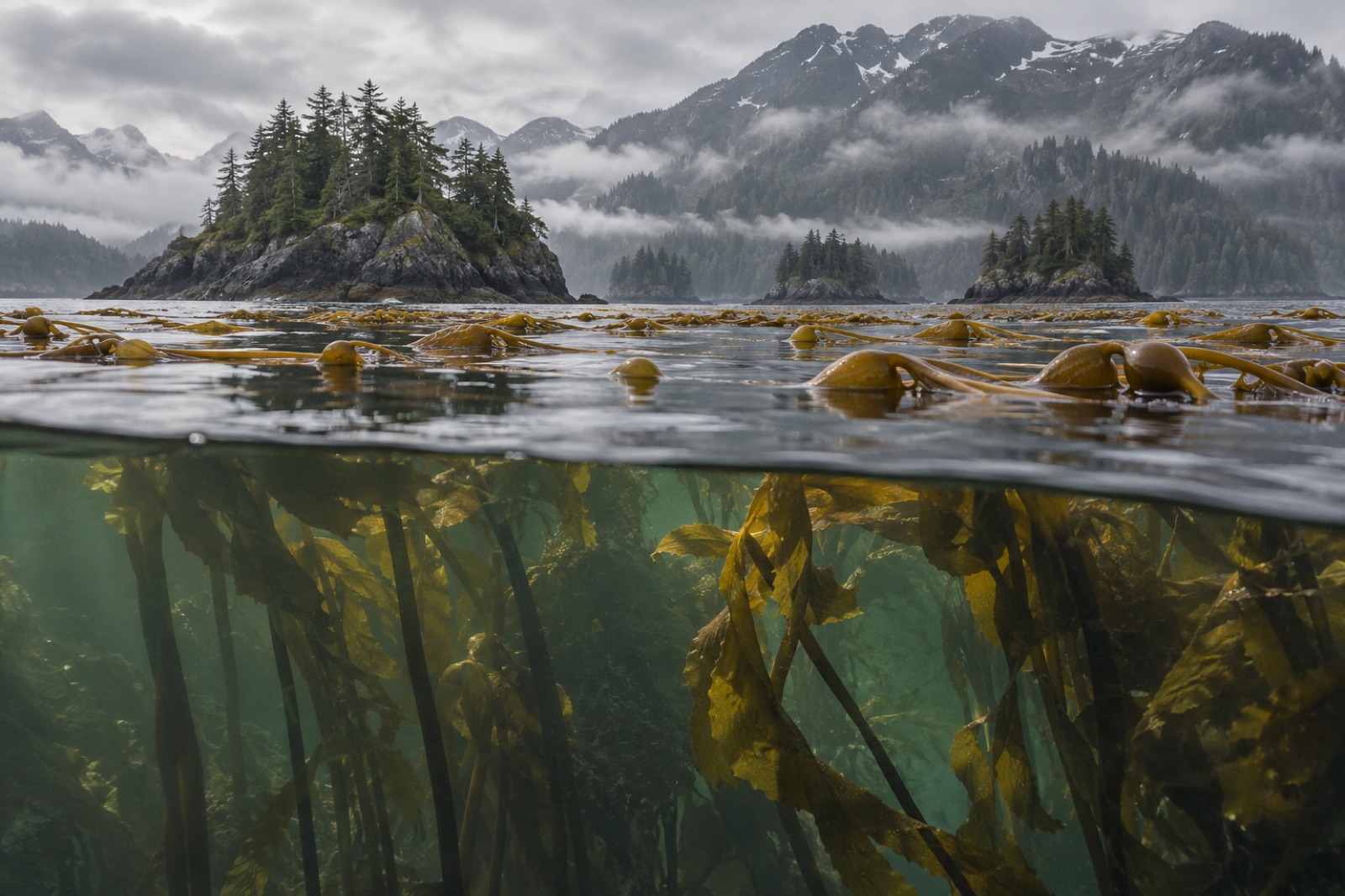
Three hundred miles west of the Alaska mainland, in the geographic middle of the Bering Sea, four small volcanic islands rise from one of the richest continental shelves on Earth. The Pribilof Islands — St. Paul, St. George, and tiny Otter and Walrus — are best known for what crowds their beaches: roughly half the world's northern fur seals, and millions of seabirds nesting on near-vertical cliffs. Beneath the birds and seals, on a cold and poorly-charted subtidal, lies the kelp: patchy, wave-wracked beds at the frontier of where kelp forest science has bothered to look. This is the Bering Sea's own kelp coast, and it is changing fast.
A shelf sea's islands: the geography that makes the biology
The Bering Sea is defined by its geometry. East of a line from the Alaska Peninsula to Russia's coast, the sea is a vast shallow shelf — mostly under 100 metres — that extends hundreds of miles and drives, each winter, the formation and southward march of sea ice. The Pribilofs sit on that shelf, volcanic plugs from another era, near the productive "shelf break" where deep basin meets shoal.
This position gives the islands three oceanographic engines:
- The cold pool — a lens of near-freezing bottom water left behind by the melting ice edge, the engine powering bottom-dwelling fish like walleye pollock that underpin everything.
- Shelf-break currents and fronts — ocean fronts where the green belt rims the rich basin edge; nutrients well up along it and plankton bloom there.
- The Aleutian shadow — the archipelago's passes to the south that connect Pacific water to Bering water, steering drifts of larvae and the whole ocean's conveyor.
The currents that keep the water moving around the Pribilofs are part of the same circulation mapped in ocean gyres explained: subarctic, subpolar, wind-driven, seasonally viv.
The kelp: undersized, under-mapped, and at the ice's edge
Honest atlas-keeping requires honesty: the Pribilofs are not a giant-kelp destination. The islands are young-loose volcanic rock in places, and the subtidal ring alternates between hard reef and shelving sediment. Kelp lives where it can — ribbon kelp (Alaria), sugar-kelp relatives (Saccharina), oarweed-like perennial browns in the deeper clearances, and a fuzz of reds in the shallows. The beds are real but staccato — patches in the lee of points, fringes under cliff lines, occasional richer gardens where rock and current align (light governs the beds' depth).
Two factors cap them. First, ice: in hard winters, drifting Bering pack scours the shallows to bare rock, resetting the subtidal calendar each spring (ice and kelp biology). Second, geography: the shallow shelf means soft sediment is never far, and mobile sand nibbles at kelp's edges.
And yet the kelp matters, because on this shelf, kelp is rare real estate. Rocky reef around these islands functions differently when sewn together with kelp: more vertical relief, more grazing surfaces, more settlement cues, more productive edge. A 10-metre patch of Alaria on a bird-cliff island is habitat infrastructure that the shelf's enormous sandy bottom simply doesn't offer.
The megafauna: a seal city with a seabird ceiling
Summer at the Pribilofs is one of the great wildlife spectacles of the Northern Hemisphere:
- Northern fur seals — the rookery beaches hold the largest aggregations of the species on Earth; the Pribilof population is on the order of half a million animals, with the city's year-round economy (the Unangan community of St. Paul) still historically entangled with the seal's story.
- Seabirds in the millions — St. George alone hosts some of the biggest seabird cliffs in the hemisphere: common murres, thick-billed murres, kittiwakes (including the largely endemic red-legged kittiwake), crested and least auklets, and tufted puffins so habituated at St. Paul's bluffs that visitors photograph them at arms' length.
- Steller sea lions, harbour seals and the seasonal whales of the shelf break.
This biomass is not coincidence: it is subsidized by the shelf's huge production, and the whole system is being rearranged as the sea warms. Hierarchical trophic cascades work here too — pollock, crab, seabirds and seals all wired to the bottom temperature.
The crisis at the bottom: the shrinking cold pool
The Pribilofs are the front line of the Bering Sea's rapid climate reorganization. When winters come without a strong ice edge, the marine heatwave mechanisms take over: the cold pool fails to form, bottom temperatures rise, and cascades follow — crash years of seabird die-offs from starvation have been documented (puffins and murres washing up by the thousand), shifts in pollock and crab distribution, an ice-edge ecosystem rearranging itself underfoot. The rough seas of the "warm Blob" years in the mid-2010s rewrote the shelf's rulebook.
For kelp, warming here cuts awkwardly. Ice scour is kelp's enemy; a warmer, less icy Bering might actually ease its recruitment season — while broadly degrading the whole system's productive engine the kelp ultimately depends on. It is the same double edge the North Atlantic's cold edges hold: at the White Sea and around Svalbard, kelp arguably gains ground from warming, even as the rest of the Arctic system reels. Understanding that edge is why cold-reef mapping — the kind Tidewright's Drifter surveys were built for — starts with the substrate map, the temperature record and the ice history, before anything else.
People on the edge: Unanga\u0302x stewardship and the working islands
The Pribilofs are not wilderness without people. St. Paul is one of the largest Unangan (Aleut) communities in the United States, and St. George has a smaller sister community; both have been reorganizing local governance toward conservation and sustainability over the past decades, including community-led halibut, seabird stewardship and serious marine-debris work — the islands catch an appalling harvest of far-flung fishing gear. The islands sit inside the Alaska Maritime National Wildlife Refuge. Any future kelp science here will have to be done with the communities, not merely around them — the same standard that runs through our thinking on Indigenous and community rights in the blue economy.
Visiting: a long flight to nowhere-ish
Access is by scheduled flight from Anchorage to St. Paul, then small-plane hops or sturdy craft to St. George. There is no dive infrastructure to speak of; the kelp is a research subject, not a tour. Visits are about the surface spectacle — fur seals (viewed strictly from blinds and boardwalks; these are protected animals), bird cliffs, and one of the finest land-based seabird experiences in North America, as covered in our kelp-coast birdwatching primer.
Key takeaways
- The Pribilofs sit mid-shelf in the Bering Sea: volcanic islands near the shelf break, ringed by fronts and (in winter) sea ice.
- Kelp here is patchy and ice-scoured — Alaria, Saccharina and perennial browns on the rocky margins — but ecologically outsized because reef with kelp is rare habitat on a mostly sandy shelf.
- The islands host roughly half the world's northern fur seals and millions of nesting seabirds subsidized by the Bering shelf's production.
- The shrinking cold pool and ice-edge retreat are reorganizing this entire system, with documented seabird starvation events; kelp may edge forward locally even as the wider biome struggles.
- Human use is Unangan-led and conservation-oriented; any work here is with the communities, on refuge land.
FAQ
Is there really kelp in the icy Bering Sea?
Yes — kelp forests run right around the subarctic rim, from the Aleutians to the Kamchatka coast. The Pribilof beds are simply at the ice-edge frontier: scoured hard winters, reset in calm ones, and never yet mapped in detail.
Can you dive the Pribilofs?
There's no commercial diving infrastructure, and logistics/weather/ice risk keep even research diving rare. Wildlife watching here is shore- and boat-based; the underwater ecology is still a frontier for formal science.
Will warming help or hurt the local kelp?
Both, in sequence. Less ice scour could extend the growing window and let beds coalesce; but the system's plankton engine the kelp and the whole food web ultimately sit on is tied to the cold pool, and as that fails, the wider ecology — including nutrients delivered to the islands' reefs — shifts with it.
Why did so many seabirds starve here in recent years?
Warm-water years break the food chain at the phytoplankton-and-forage-fish layers: smaller, leaner prey fish at the wrong times for breeding birds. Mass die-offs of murres and puffins in the mid-2010s warm period were the visible symptom of the bottom-temperature shift.
How do the islands relate to the Aleutian kelp system?
They sit north of the arc, on the Bering side. Currents through the Aleutian passes link them hydrologically, and kelp spores pass too — but ecologically the Pribilofs share the shelf with very different neighbours (pollock, crab, ice) than the Aleutians' otter-urchin-kelp triangle.