Atlas9 min read
Kodiak: Bears Above, Kelp Below on Alaska's Emerald Coast
Brown bears above, sea otters in the kelp below — a guide to the reefs, salmon rivers and cold-water richness of Alaska's Kodiak Archipelago.
Tom Okafor ·
Glacial fjords, returning sea otters and slow kelp regrowth after oil and ice loss — a field guide to Prince William Sound, Alaska's living laboratory.
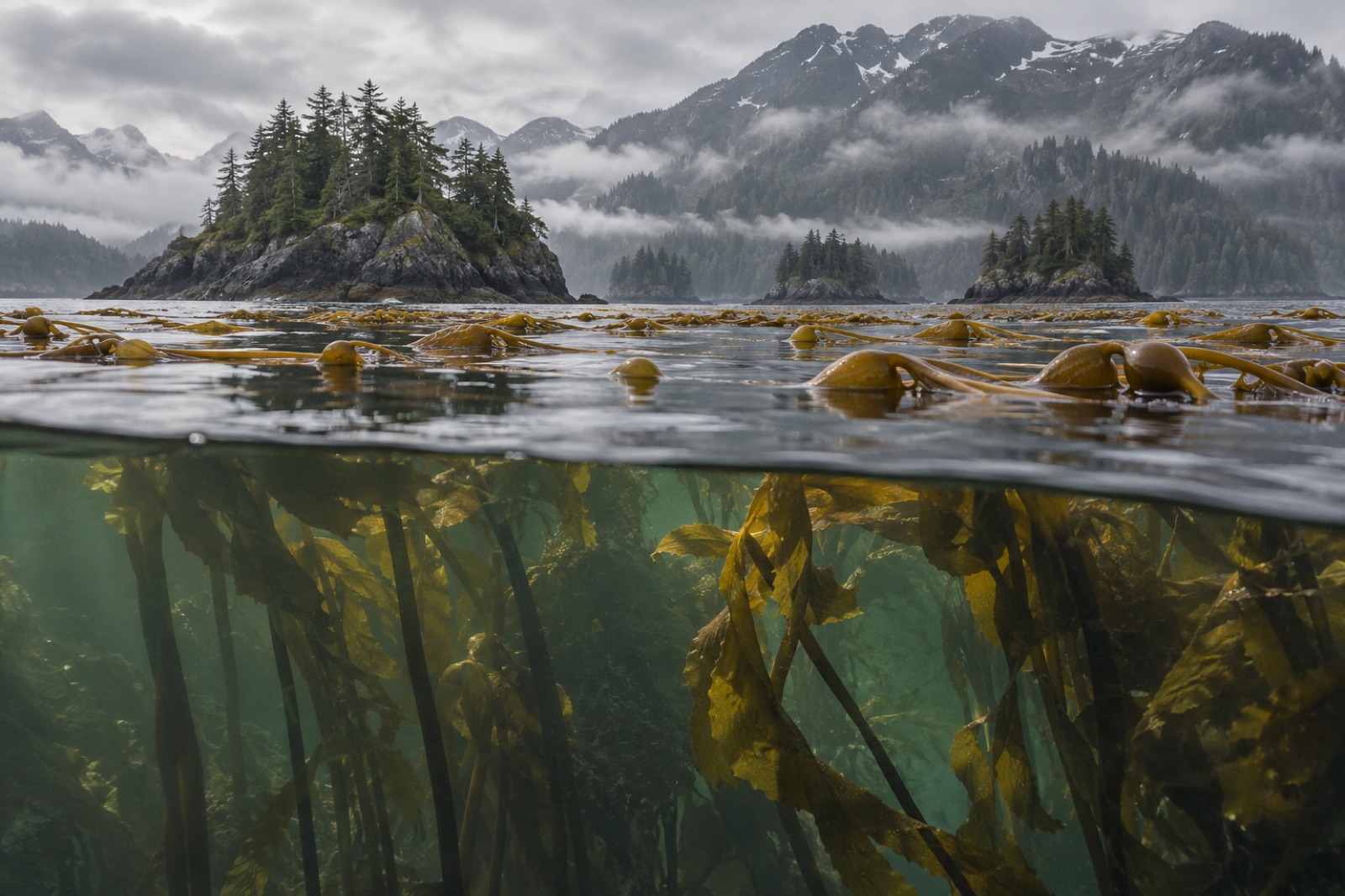
Prince William Sound is the piece of Alaska that best tests our ideas about recovery. This is a glacial sea — 10,000 square kilometres of fjords, islands and tidewater ice tucked behind the Kenai and Chugach mountains — that has absorbed, within living memory, one of the most infamous oil spills in history and a decades-long herring collapse, and that is now watching its glaciers pull back faster than almost anywhere on the continent. And yet the kelp is, in large part, holding. Sea otters work the outer reefs again. Bull kelp raises its amber garlands in passes that were smeared with crude in 1989. This guide covers the ecology of the sound's kelp waters, the story of its damage and repair, and how to see one of the north Pacific's most instructive coasts.
Stand at Whittier or Valdez and you are inside a drowned mountain range. The Chugach mountains plunge straight into the water, their valleys deepened by ice into fjords — College Fjord, Harriman Fjord, Blackstone Bay — that are still being worked by actively retreating tidewater glaciers. Columbia Glacier, one of the fastest-moving and fastest-shrinking tidewater glaciers in the world, has pulled its face back more than 20 kilometres since the early 1980s, calving armadas of ice into Prince William Sound's eastern reaches.
The result is a sea divided into two kinds of water. The inner fjords are stratified and silty — summer melt carries glacial flour that turns the water milky turquoise and starves the depths of light. The outer sound — Montague and Hinchinbrook islands, Green Island, the passages facing the open Gulf of Alaska — is where the real kelp country lies: clear, cold, nutrient-rich Pacific inflow where ocean water and glacial freshwater mix and turn over on enormous tides.
Kelp here is a fringing, depth-limited community, structured by light. Where the water runs clear — the outer islands and the larger passages — rocky substrate carries a classic northern canopy:
On 24 March 1989 the tanker Exxon Valdez grounded on Bligh Reef in the sound's northeastern corner and released roughly eleven million gallons of crude oil. The spill killed kelp-adjacent wildlife at scale — river otters, harbour seals, seabirds in their tens of thousands, and sea otters whose insulated fur was destroyed by oil — and smeared the intertidal hydrocarbons into pockets that have remained under the subsurface of some beaches for decades.
Four years later, in 1993, the sound's herring — for generations the fuel of the spring food web and of local fisheries — collapsed and has never fully returned, a change still argued over between spill aftereffects, disease, ocean conditions and fishery pressure. For a coast whose kelp ecology is so tightly bound to forage fish and to the predators they draw, the herring failure was an ecosystem-scale wound.
Against that bleakness, the sea otter story is the sound's brightest arc and its most kelp-relevant. Sea otters in western Prince William Sound were driven near zero by the spill; their recovery has taken decades, pod by pod, back into the outer reefs where their grazing polices the urchin population and lets the kelp stand. This is the same three-level sea otter–urchin–kelp engine that governs Kodiak's kelp reefs and the Aleutian arc, and the spill made the sound one of the few places on Earth where scientists could watch it from a hard reset. The lesson is general and now well-established: where otters are healthy, kelp persists; remove the otters, and the urchins take the forest down.
Prince William Sound is not a park; it is a working sea. Cordova's harbour still sends a prized fleet to the Copper River salmon and to the sound's hatchery-supported pink and chum runs — the Prince William Sound Aquaculture Corporation's hatcheries release hundreds of millions of fry annually, a program as economically vital as it is ecologically debated. Valdez, at the sound's northeastern head, is the southern terminus of the Trans-Alaska Pipeline, and tanker traffic shares the water with fishing boats, kayaks and whales. Herring, crab and shrimp fisheries have come, shrunk and in some cases closed; mariculture — oysters, kelp — is the current frontier, and the sound's cold, clean water is starting to attract the seaweed aquaculture that Southeast Alaska — Sitka Sound's hatchery coast — has already proven.
Prince William Sound is one of Alaska's most accessible wild places — and still genuinely wild.
Go in May–September for boats, bears and whales; go knowing that the sound's weather is real, and the most instructive way to see it is slowly — by paddle or small boat, letting the kelp forests define the pace. Our broader guide to the region is the Northeast Pacific atlas hub.
Broadly, yes on the outer reefs — bull kelp and understory kelps are standing across most of the archipelago, policed by recovering sea otters. The weaker ground is the inner fjord heads, where glacial melt is changing the light and salt regime, and the sound's long-term trajectory is tied to how much its ice continues to pull back.
Yes — kayaking is the classic access, with operators out of Whittier and Valdez running day trips and multi-day expeditions into the kelp passages. Snorkelling and diving are for experienced cold-water users with a drysuit; visibility can be excellent on the outer passages, but this is Alaska, not Monterey. Our cold-water diving essentials piece is the right primer — and a genuine prerequisite, not a courtesy.
The spill killed otters in the thousands and set the population back decades; studies in the following years tracked slow, pod-by-pod recovery across the western sound, with some sites still lagging. Today otters are a common sight on the outer islands and a daily presence for kayakers — the sound's most visible proof that damage, given time and restraint, can be walked back.
Formally, the spill is a closed legal chapter, but not a closed ecological one. Lingering subsurface oil has been documented beneath some beaches, and the spill's shadow lives on in the herring questions that still shape fisheries here. Visiting today, you'll see a sound that has recovered enormously — and that carries its scars, and its science, openly.
Brown bears above, sea otters in the kelp below — a guide to the reefs, salmon rivers and cold-water richness of Alaska's Kodiak Archipelago.
Tom Okafor ·
Herring spawn on kelp, whales hunt the shoals, and Tlingit stewardship runs millennia deep — a guide to the kelp ecosystems of Sitka Sound, Alaska.
Tom Okafor ·
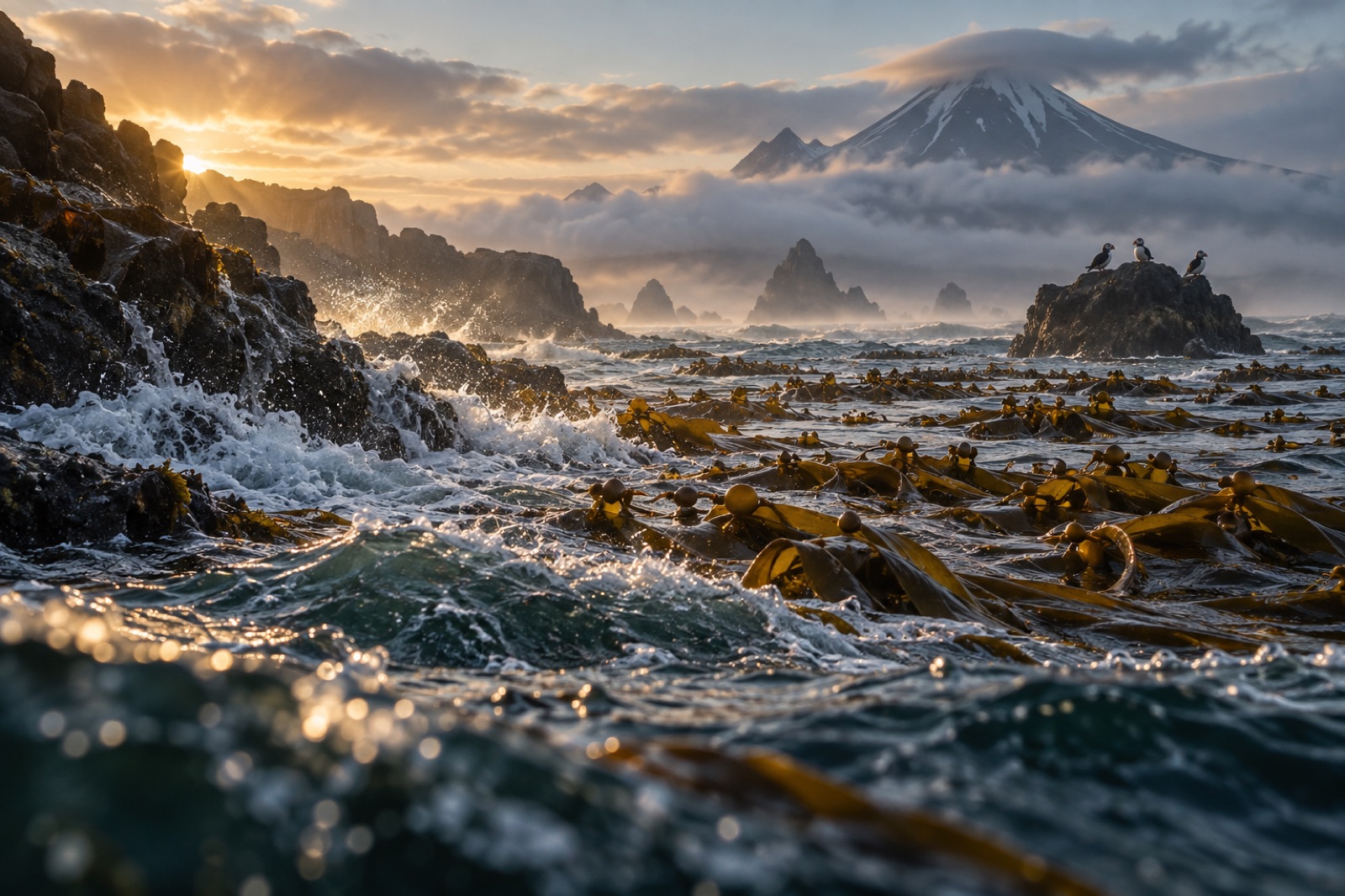
A 1,900-kilometre arc of volcano, fog and kelp strung between Alaska and Siberia — the coastline that taught ecologists how sea otters hold kelp forests together.
Dr. Mara Ellison ·