Atlas8 min read
Prince William Sound: Kelp Recovery in a Fjorded Sea
Glacial fjords, returning sea otters and slow kelp regrowth after oil and ice loss — a field guide to Prince William Sound, Alaska's living laboratory.
Tom Okafor ·
Brown bears above, sea otters in the kelp below — a guide to the reefs, salmon rivers and cold-water richness of Alaska's Kodiak Archipelago.
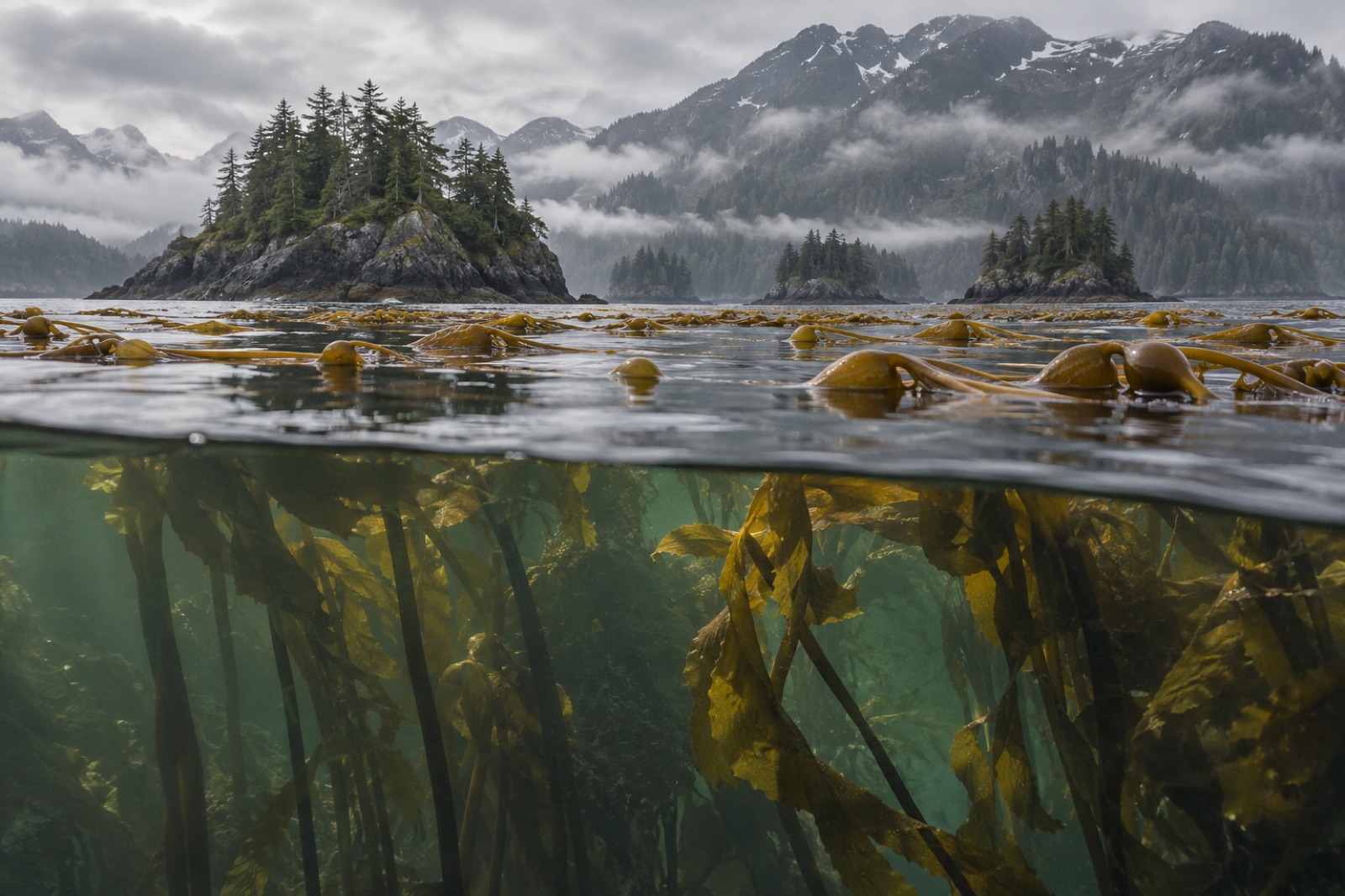
Kodiak is where the Pacific's kelp engine meets Alaska's most concentrated abundance. The archipelago — one large island surrounded by a family of smaller ones, 240 kilometres southwest of Anchorage — carries one of the densest populations of brown bears on Earth along its salmon rivers and some of the healthiest sea otter habitat in Alaska along its reefs. Above the tide line: 3,000-odd of the largest land carnivores on the planet. Below it: cold, dark-green water, bull kelp garlands, and an otter–urchin–kelp balance that is, for now, running in the kelp's favour. This guide covers the reef ecology of the archipelago, the nutrient loop that connects salmon, bears and kelp, and what a visit to Alaska's Emerald Isle actually entails.
Kodiak Island itself is the second-largest island in the United States — a roadless, mountain-backed mass of about 9,300 square kilometres whose Alpine spine catches Pacific weather and wrings it out as rain. Around it lie the smaller islands of the group: Afognak to the north, Raspberry, Shuyak, the Trinity Islands, and a scatter of skerries that mark the seaward edge of the Cook Inlet–Gulf of Alaska boundary. Kodiak town, on the island's northeast corner, is the fleet and community centre; the largest Coast Guard base in the United States operates beside it, and the working docks, canneries and gear sheds tell you immediately that this is a place that lives nature, not packages it.
The archipelago's whole ecology is set by its position. To the west, the Alaska Coastal Current and the Gulf's broad circulation; to the north and east, the deep Gulf; everywhere below, cold, nutrient-rich water that is, until the warming years, among the most productive marine impasto on Earth. The coast's essential drama — laid out for the neighbouring sound in our Prince William Sound guide — plays the same here, at a wilder scale.
Kodiak sits within the northern bull kelp's stronghold. The canopy and understory community across the archipelago's exposed reefs is:
The health of Kodiak's kelp is, so far, a story of an intact predator. Otters hold the urchins below the grazing threshold; the reef bed stays a forest rather than a barren. Compare the Aleutians — where otters thinned, the urchins won — and you'll see how the same engines, run with or without their regulator, produce opposite seascapes. Sea otters are not a side character here; they are the forest's management.
You cannot read Kodiak's kelp without reading its salmon. The archipelago's rivers — the Karluk most famously — carry some of Alaska's great sockeye runs, and every summer the returning fish divide themselves into two ongoing ecological transfers: upstream into the freshwater food web that feeds the bears, and seaward in eggs, fry and carcasses that feed the ocean side. Kodiak's brown bears — a recognised subspecies, among the largest bears alive on Earth — are functionally the archipelago's nutrient-pumps: a bear eats a salmon on a stream bank, leaves half of it in the grass, and deposits the rest as forest fertilizer. The soil's nitrogen isotopes still carry the marine signature in trees hundreds of metres from the streams.
The kelp connection runs the other way. Kelp fringes the estuary mouths where the salmon mass before their run; kelp detritus worms into the invertebrate food web that feeds juvenile fish before they leave for the open ocean; and kelp canopy shelters the nearshore nursery habitat that small salmon, along with herring and sand lance, rely on during their first vulnerable weeks at sea. Kodiak's kelp, salmon and bears are not three attractions; they are one loop.
Kodiak is a working fisheries hub with one of the most instructive fishery histories in the north Pacific. Its king crab — the fishery that made the town famous in the 1970s — collapsed in the early 1980s and has never re-opened at anything like its former scale; the cause is still argued between overfishing, regime shift and groundfish pressure, and the closure remains a standing lesson in how quickly a seemingly inexhaustible shellfish stock can go. What remained is a diversified modern fleet — pollock, cod, halibut, salmon, tanner crab — and, increasingly, an interest in mariculture: shellfish and kelp aquaculture is growing on the archipelago's cold, clean water as a deliberate hedge against single-species dependence — part of the same Alaska-wide sea-farming build-out that Sitka's hatchery coast led.
The human depth goes back much further. The archipelago is Alutiiq / Sugpiaq homeland — thousands of years of continuous sea-country stewardship — and the work of the Alutiiq Museum and the region's tribal corporations anchors Kodiak's modern identity in that continuity. It is glacier, storm and fishery here, but it is also a lived, named, inherited sea country.
Kodiak is genuinely remote and worth approaching with the seriousness that implies.
Kodiak rewards travellers who treat it as a functioning sea country — fleet, bear, kelp, otter, salmon — rather than a scenic backdrop. Our Northeast Pacific atlas hub sits it in its regional company.
A little. Giant kelp's practical northwestern limit sits around Southeast Alaska, with scattered, patchy stands further west in the Kodiak region and the Aleutians. Kodiak's canopy is overwhelmingly built by bull kelp; giant kelp here is a minor character at the edge of its range, not the architect.
Yes — that's Kodiak's speciality. Summer salmon runs concentrate bears at the rivers within a short flight of town; the same brown-water coast carries the kelp beds beneath. No other archipelago of its size puts bear-viewing and kelp-reef kayaking this close together.
Yes, practically. Cold (peak-10 °C), tidal and often low-visibility; drysuit competence and local operator guidance are non-negotiable. That said, the wolf-eel and octopus dives and the sheer forest of bull kelp are among the north Pacific's great dives for those qualified to do them.
Because its sea otters are abundant and its kelp is standing. Alongside the Aleutians' counter-example, Kodiak functions as one of the clearest living demonstrations of the trophic engine that governs the whole North Pacific kelp rim — which makes it a reference site for restoration ecology, not just a destination.
There is no public basis to expect so anytime soon; stocks have been closed or near-closed for decades, and researchers treat the collapse as a regime-scale change rather than a lapsed quota year. The kelp-and-shellfish mariculture build-out is partly the town's answer to that reality.
Filed under
Glacial fjords, returning sea otters and slow kelp regrowth after oil and ice loss — a field guide to Prince William Sound, Alaska's living laboratory.
Tom Okafor ·
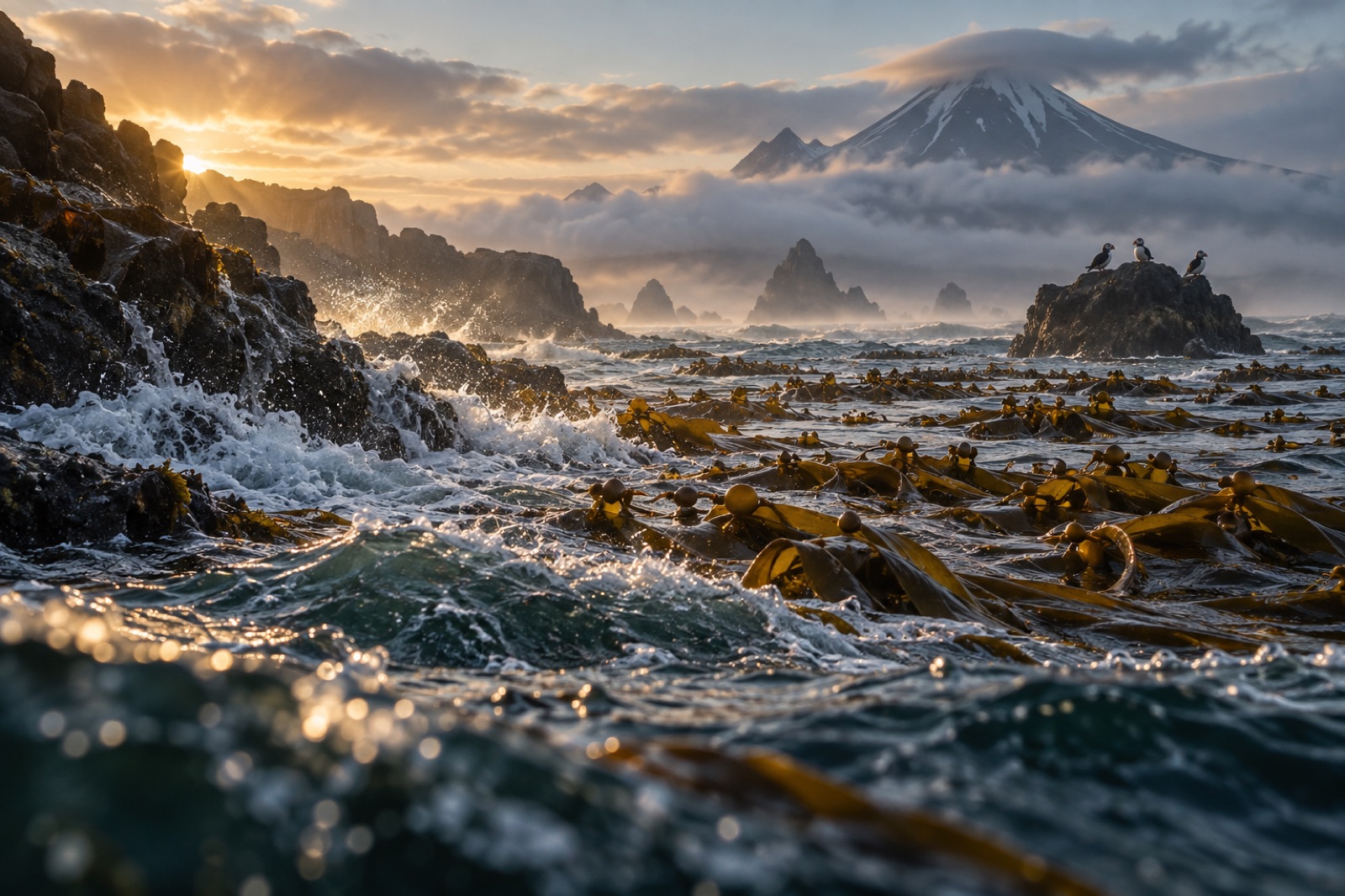
A 1,900-kilometre arc of volcano, fog and kelp strung between Alaska and Siberia — the coastline that taught ecologists how sea otters hold kelp forests together.
Dr. Mara Ellison ·
Herring spawn on kelp, whales hunt the shoals, and Tlingit stewardship runs millennia deep — a guide to the kelp ecosystems of Sitka Sound, Alaska.
Tom Okafor ·