Explore10 min read
Whale Watching on the Kelp Coast: A Watcher's Field Guide
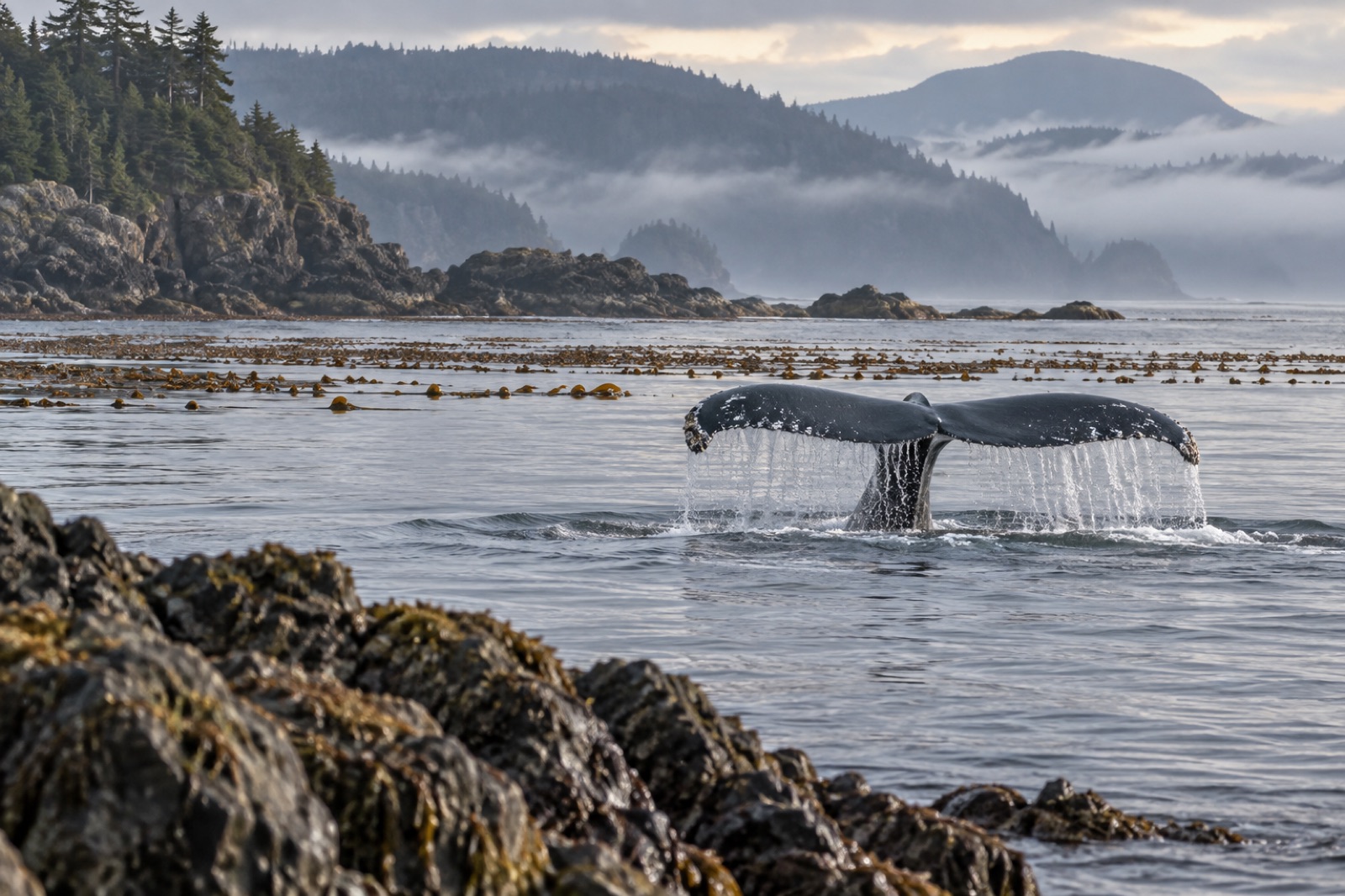
Where and when to watch whales along the world's kelp coasts, how to read blows and behaviour, and the ethics that keep whales calm and watchers welcome.
Tom Okafor ·
Kelp beds concentrate seabirds like nowhere else on the coast. Where to stand, what to bring, and how to identify the divers, dabblers and pirates of the kelp line.
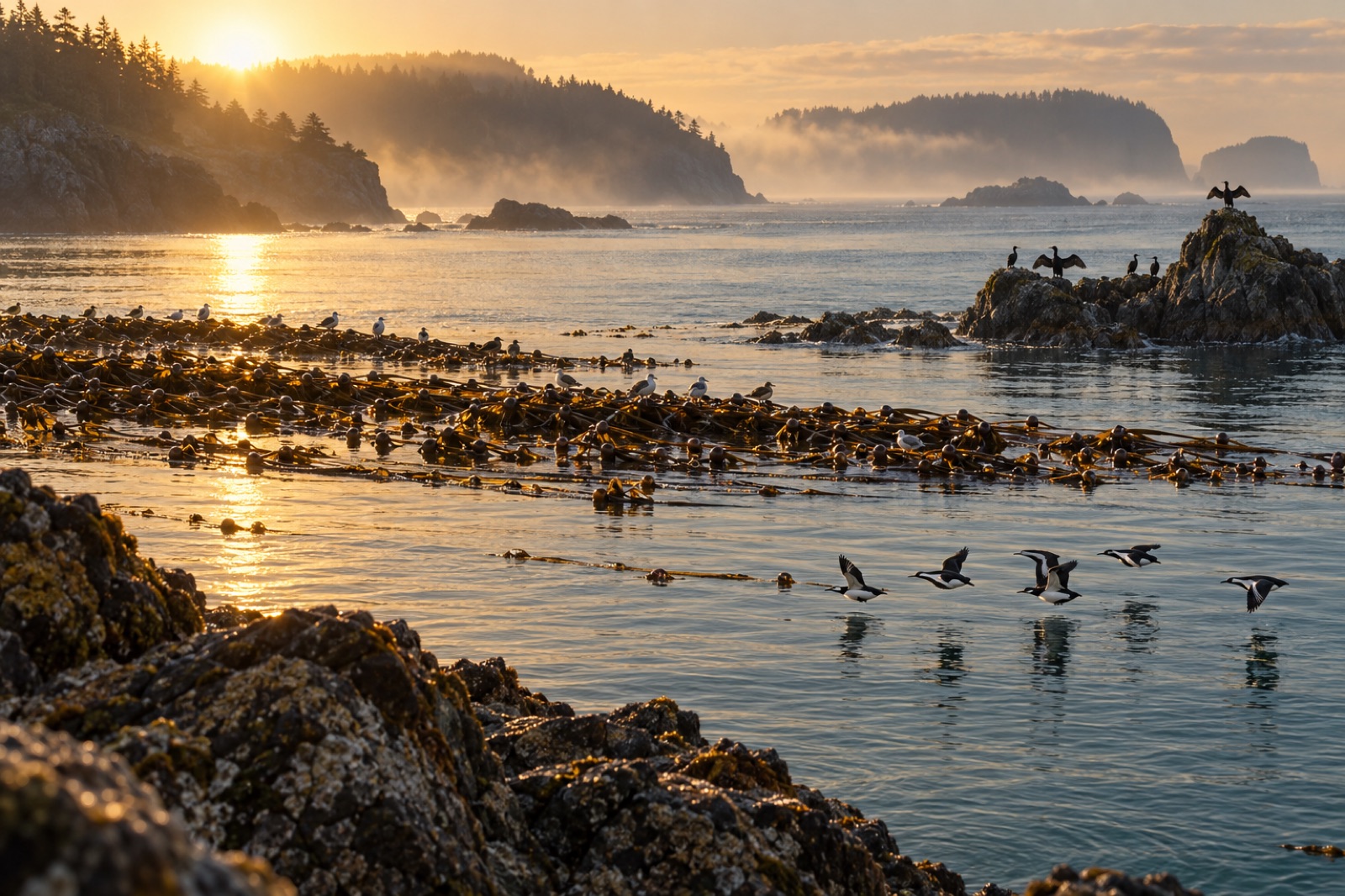
Stand on the right headland at dawn and the kelp forest reveals itself twice: once as dark canopy rafts on the water, and once as the bird traffic stacked above them. Kelp beds are among the most reliable seabird habitat on any cold-water coast — sheltered water, baitfish schooling at the kelp edge, and roosting rafts all in one line. You don't need a boat, a guide or specialist knowledge to start; you need a headland, a pair of binoculars and an hour of stillness. This guide covers where to stand, what to look for, and how to turn silhouettes into names — the same beginner's ethic as our shore whale-watching guide, pointed at the forest's other charismatic megafauna.
Three ecological subsidies meet at the kelp edge:
The practical translation: when you find a kelp bed from shore, you have found the day's feeding and resting circuit. The birds come to it.
Position beats equipment. Choose a headland or elevated rock platform with clear sea room — a point that looks along the kelp line, not straight out to blue water. Sit below the skyline against rock or scrub; a silhouetted standing figure moves birds at 200 metres, a seated one barely registers.
Light matters more than distance. Seabirds in morning light from behind you resolve into species; the same birds against a bright low sun are black cutouts. Plan sessions with the sun at your back — mornings on east-facing coasts, evenings on west-facing ones.
The gear that earns its weight:
The discipline: scan slow arcs near the surface first — most kelp-edge birds are on or under the water, not in the air. Count what's doing nothing; the sitting birds outnumber the flying ones ten to one and teach you the full species list of a place.
Learn the forest's birds by job description and identification gets easy.
Cormorants are the kelp line's utility players. Pelagic cormorants — slim, small-headed, almost snake-necked — thread the canopy for bottom fish. The classic sight: a cormorant perched on a bull kelp float or offshore rock with wings held open to dry, their feathers trading waterproofing for diving efficiency. If a bird is "sunning" on the kelp line, it's a cormorant.
The auks are the kelp coast's flying penguins. Common murres arrow past headlands in low, fast lines; pigeon guillemots — black with white wing-patches and improbably red feet — bob at the kelp edge before vanishing on 30-second dives; and where they breed, tufted puffins commute overhead with brassy bills full of fish-lined-crosswise cargo. Auks fly like they're late: rapid whirring wings, low over the water, no gliding.
Where baitfish shoal, the aerial specialists arrive: terns working the kelp edge on fluttering wings, and on the great oceanic coasts, gannets folding from 20 metres into white spears. A feeding frenzy over a kelp-edge bait ball — shearwaters rafting, terns dipping, maybe a sea lion moving through — is the coast's equivalent of a street market opening.
Gulls and jaegers (skuas) read the same signs you do: follow the feeding birds, steal from the successful. Watching a jaeger harass a tern into dropping its catch is a masterclass in why kelp-edge ecology rewards generalists.
On North Pacific coasts, bald eagles and white-tailed eagles treat the kelp line as a larder shelf — setting off rafts of scoters, snatching fish from the surface, occasionally pirating an osprey. On Lofoten's sheltered sounds or the Haida Gwaii shorelines, an eagle over the kelp is the day's spine-tingler.
Seabirds are the kelp coast's public telemetry. Rafted birds facing into the wind: calm rest. A tight, spinning bait ball with birds piling in: predators (often seals or dolphins) driving from below. All the birds leaving at once in one direction: look for the eagle. Cormorants commuting steadily along the kelp line at dusk: heading to roost — follow their line and you'll find the roost rocks. Learn these patterns and you're reading the forest through its readers; it's the same observational craft divers train in reading the ocean's surface signs.
A quiet kayak puts you inside the system — close enough to watch a guillemot swallow a fish-length of gunnel at the surface. The ethics sharpen with the proximity: drift with the wind rather than paddling at birds; if a resting raft repeatedly lifts, circles and resettles, you're too close and costing them energy they budgeted carefully; never drive birds off roost rocks, and give breeding colonies the full local setback distances. The watch from the water is the watch from the shore, refined: stay low, stay still, let the current write the encounter.
One last beginner's gift: birdwatching over kelp dovetails exactly with shore whale-watching — the same headlands, the same early light, the same patience — and our watcher's field guide to whales on the kelp coast pairs with this piece. At Tidewright, our project teams log seabird activity as a recovery indicator on restored forests: when the canopy rafts come back, the birds are the first auditors to arrive, a point you'll see across our project pages.
8x42 is the classic seawatching format: wide field, bright image, manageable shake. Most kelp-edge birds are close enough that a scope is a bonus, not a requirement — but a spotting scope on a tripod turns distant rafts into countable species lists.
Breeding season, roughly late spring through summer at most colonies, when adults commute between nest cliffs and feeding kelp edges in breeding plumage. Outside it, the auks disperse far offshore and chance sightings replace regular ones.
In most regions they overlap heavily and names vary by country — the practical distinction at the kelp line is between the small, slim pelagic cormorant types and the larger double-crested or great cormorant types: compare neck thickness, bill size and how much "snake" there is to the swimming profile. Posture gives it away: the wing-drying heraldic pose is a cormorant-family trademark.
Skip it on the coast. Playback exists to draw territorial songbirds in cover; seabirds are watched in the open, and at breeding colonies playback can drag birds off nests into gull range. Seawatching needs patience, not audio.
Beautifully: watch first, swim second. An hour on the headland tells you where the kelp line is calmest and where the current runs before you ever pull on a wetsuit — and the birds' bait balls will show you where the fish life peaks, which is where the snorkelling peaks too.
Where and when to watch whales along the world's kelp coasts, how to read blows and behaviour, and the ethics that keep whales calm and watchers welcome.
Tom Okafor ·
Swell height, period and direction decide whether your dive happens. A plain-English guide to reading wave forecasts like a diver, not a surfer.
Tom Okafor ·
How to introduce children to shore snorkelling safely: readiness signs, sheltered sites, kid-sized gear, signals, and the progression that builds confident young ocean people.
Tom Okafor ·