The pelagic cormorant (Urile pelagicus) is the smallest, slimmest cormorant of the North
Pacific — a snake-necked, green-black diver about the size of a small duck, built for
threading the underwater alleys of rocky reefs and kelp beds. If you spend time anywhere
from the Bering Sea south to Baja California, this is the cormorant you are most likely to
find riding a swell line just outside the kelp, holding its pencil-thin bill at a slight
angle to the sky before vanishing below without a splash.
Identification: the thin-billed one
Three cormorant species patrol most of the North American Pacific coast, and learning to
separate them is one of the most satisfying micro-skills in shore birding.
The pelagic cormorant runs about 64–70 centimetres long with a metre of wingspan, dark
glossy plumage with green and violet iridescence, and — the key field mark — a bill so thin
it looks like a straightened paperclip. In breeding plumage it wears two white flank
patches ("saddlebags"), delicate filoplumes on the neck, and vivid scarlet facial skin and
gular pouch. Its long, thin neck gives it a serpentine silhouette on the water.
Brandt's cormorant is bigger and heavier, with a thicker bill, a buffy-blue throat pouch
in season, and a blunt head profile. The double-crested cormorant — the one loudest in
the harbour — has an orange-yellow gular pouch year-round, a hooked bill tip, and a kinked,
thick neck. Rule of thumb on the Pacific coast: small + slim + thin-billed = pelagic.
On the wing, pelagics fly low over the water with rapid, shallow wingbeats, often just
clearing the swell. Unlike the bigger species, a single flick of the wings sends a pelagic
cormorant airborne from flat calm water — useful both for the bird and for the identifier.
Range and habitat
Pelagic cormorants are birds of the cold Pacific rim: the Aleutians and Bering Sea, the
Gulf of Alaska, and south along the coasts of British Columbia, Washington, Oregon and
California to Baja. On the Asian side they range from Kamchatka and the northern Japan
coasts. Despite the name — "pelagic" means open-sea — the species is in fact the most
inshore of the Pacific cormorants, rarely straying far from rocky coastline. It favours
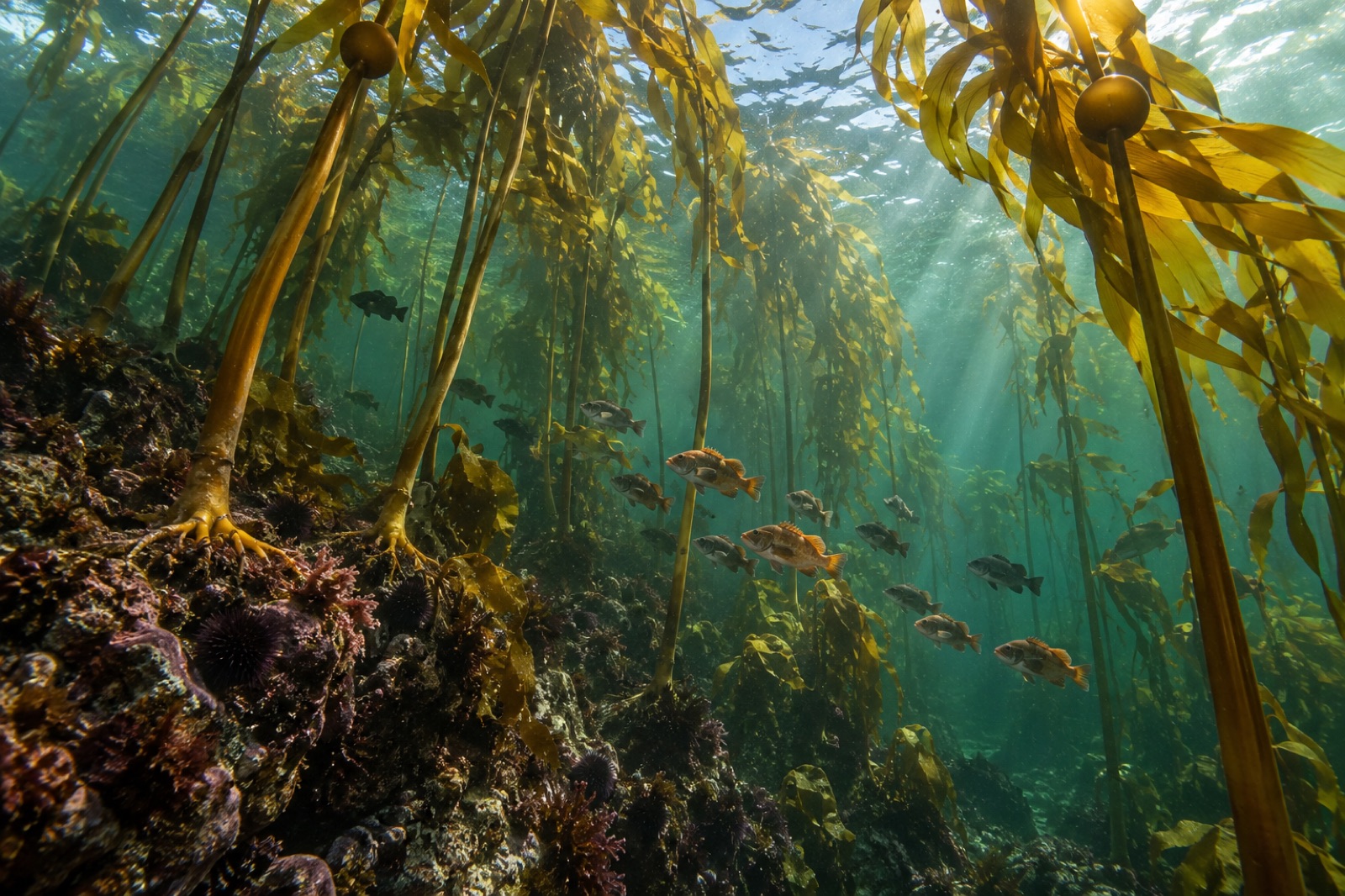
exposed headlands, offshore rocks, and precisely the boulder-studded shallows where
bull kelp forests hold.
Birders on Vancouver Island's west coast
and around Haida Gwaii will find them year-round: solitary
or in loose strings, commuting between feeding reefs at first light, slicing the air a
metre above the kelp line.
How a pelagic cormorant hunts
Cormorants are pursuit divers: they chase fish underwater with powerful webbed feet,
wings held tight against the body as steering surfaces. The pelagic cormorant works close
to the bottom in water typically under 30 metres deep, though it is capable of considerably
deeper dives. Watch one dive and it simply sinks — no leap, no splash — slipping below
surface tension like a submerging periscope.
Its menu is the kelp forest's small fry: gunnels, pricklebacks, sculpins, blennies, small
greenlings and juvenile rockfish, plus shrimp and other crustaceans picked from crevices.
The thin bill is a precision tool for exactly this — nipping fish out of cracks in the reef
rather than grabbing them in open chase. This benthic-foraging habit means pelagic
cormorants are effectively sampling the kelp reef every day of their lives; declines or
shifts in their diet are read by biologists as early signals of change in the reef fish
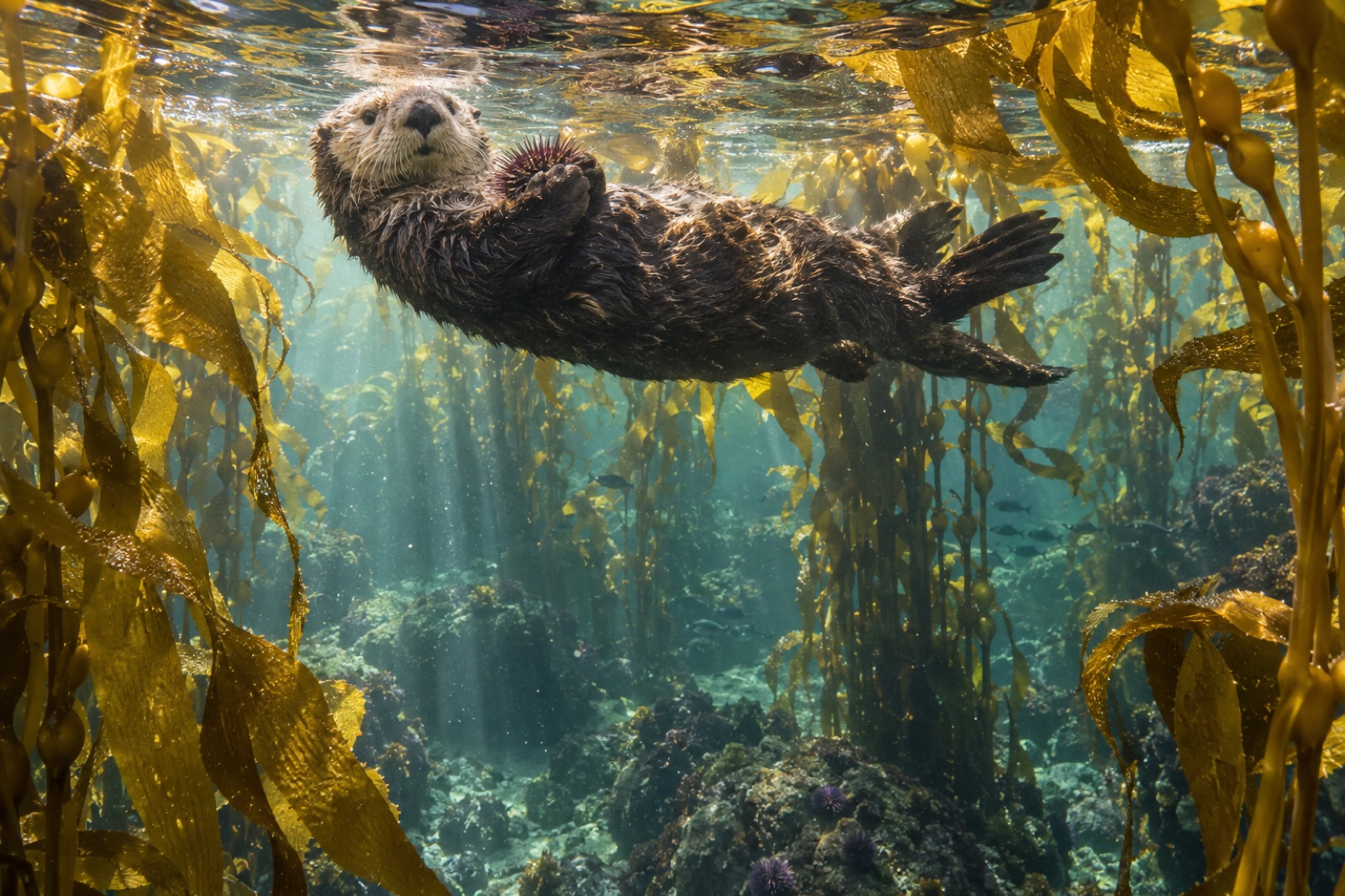
community — the same community the
sea otter reshapes from the urchin side.
The wet-wing ritual
Like all cormorants, pelagics have plumage that is less waterproof than a duck's — a
feature that reduces buoyancy for diving. The price is the famous spread-wing posture:
after a bout of feeding, the bird climbs onto a rock, rail or kelp-washed ledge and holds
its wings open to dry in the wind. On a calm evening at a headland rookery, dozens of
silk-thin silhouettes drying their wings against a sunset is one of the Pacific coast's
quiet spectacles.
Breeding on the cliff edge
Pelagic cormorants nest on the narrowest ledges in the business: sheer sea cliffs, cave
mouths, wave-cut faces of offshore stacks, and increasingly on harbour structures and
bridge beams where the ledge geometry is right. The nest is a compact cylinder of grass,
seaweed and debris, cemented to the rock with the birds' own guano — a masonry technique
that lets a colony occupy cliffs no other seabird would attempt.
Colonies are small compared with the raucous aggregations of
common murres on nearby ledges — a pelagic cormorant
colony might hold a few dozen pairs. Three to five chalky blue eggs are laid in late
spring, incubated by both parents, and the altricial chicks — naked, black, and
spectacularly ugly-cute — fledge after roughly five to six weeks of regurgitated fish soup.
Conservation and what to watch for
Globally the pelagic cormorant is considered a species of Least Concern, but the Pacific's
warm anomalies of the past decade have hammered seabird prey webs, and cormorant numbers
on parts of the coast have fluctuated sharply with marine heatwave years. They are also
vulnerable to entanglement in derelict fishing line, oiling, and disturbance at cliff
colonies by boats and drones crowding nesting ledges.
For the visiting observer, the ethics are simple: watch from the water at a respectful
distance during nesting season (roughly April through August on much of the coast), and
never flush a drying bird — it cannot afford to skip a meal. If you dive the shallows it
hunts, you may occasionally see the underwater end of the operation: a dark arrow of a bird
pumping past the kelp stipes after a gunnel, feet blurring, utterly in its element. It is
one of the best arguments for the wild intricacy of the temperate kelp world — and for why
reefs worth hunting are reefs worth restoring.
Key takeaways
- The pelagic cormorant (Urile pelagicus) is the smallest, thinnest-billed cormorant of
the North Pacific; look for the serpentine neck and white flank patches in season.
- Range runs the cold Pacific rim — Bering Sea and Alaska to Baja California, plus the
Asian coast to northern Japan. Despite the name, it is the most inshore of the Pacific
cormorants.
- It is a pursuit diver hunting small bottom fish — gunnels, sculpins, pricklebacks —
along rocky reefs and kelp beds, usually in water under 30 m deep.
- Nests are guano-cemented cylinders on narrow cliff ledges, in small colonies of a few
dozen pairs.
- Diet makes the species a daily sampler of kelp-reef fish communities — and a sensitive
barometer of marine heatwave impacts on coastal food webs.
FAQ
What's the difference between a pelagic cormorant and a Brandt's cormorant?
Size, bill and face. The pelagic is noticeably smaller, with a thin, straight, pencil-like
bill and a slender snake neck; in breeding plumage it shows white flank patches. Brandt's
is bulkier, thicker-billed, and sports a pale blue-buff throat patch in season, with no
white flanks.
Why do cormorants stand with their wings spread?
Their feathers get wet on purpose — reduced waterproofing cuts buoyancy, which makes diving
easier. After feeding they must dry out in the wind. That spread-wing pose on a rock above
the kelp is a working part of the fishing cycle, not a stretch.
How deep can a pelagic cormorant dive?
Most feeding happens in water shallower than 30 metres, where it picks fish from the reef
floor. Like other cormorants it can go much deeper when needed, but its small size and
crevice-picking hunting style keep its working zone in the kelp-lit shallows.
Where is the best place to see pelagic cormorants?
Almost any exposed rocky headland from Alaska to central Baja California — scan offshore
rocks and cliff faces at first light for slim birds commuting low over the water. British
Columbia's outer coast and the wave-cut stacks of Washington and Oregon are especially
reliable, year-round.
Are pelagic cormorants endangered?
Globally they are listed as Least Concern, but local populations swing hard with ocean
conditions — marine heatwaves that crash small-fish populations hit these inshore hunters
directly. Entanglement in lost fishing gear and disturbance of cliff colonies are the main
preventable pressures.