Explore9 min read
The Beginner's Guide to Kelp Forest Diving
Your first kelp forest dive is easier — and more magical — than you think. Gear, skills, marine life and etiquette for new divers entering the green cathedral.
Tom Okafor ·
Coral reefs and kelp forests are the ocean's two great architecture projects. How the diving compares: colour vs behaviour, warmth vs cold, crowds, seasons and skills.
Part of a learning path
This article is stop 1 of 9 on Into the Canopy — A cold-water diver’s route from first kelp dive to night forest.
Ask a hundred divers to picture the perfect reef and most will conjure coral: turquoise water, 28°C, a kaleidoscope of fish. Ask the same hundred about kelp and you will get shrugs — until you find the one who has dived it, who will start talking about cathedrals and beam-lit green halls and wont stop. Kelp forests and coral reefs are the ocean's two great architecture projects, and they could hardly be more different to dive. One is a sun-drenched tropical city built by animals over millennia; the other is a cold-water forest grown by algae in a single season. Neither is "better." But they reward different temperaments, different skills and different seasons of the year — and understanding the trade honestly will change how you plan your diving life. Here is the full comparison, from someone who loves both.
The difference starts with the builders.
Coral reefs are built by animals — colonial cnidarians secreting calcium carbonate skeletons. A mature reef structure can be thousands of years old, growing perhaps centimetres per year. The architecture is permanent, intricate and three-dimensional in the way of cities: towers, caves, walls, overhangs, each pocket an address for a specialist creature.
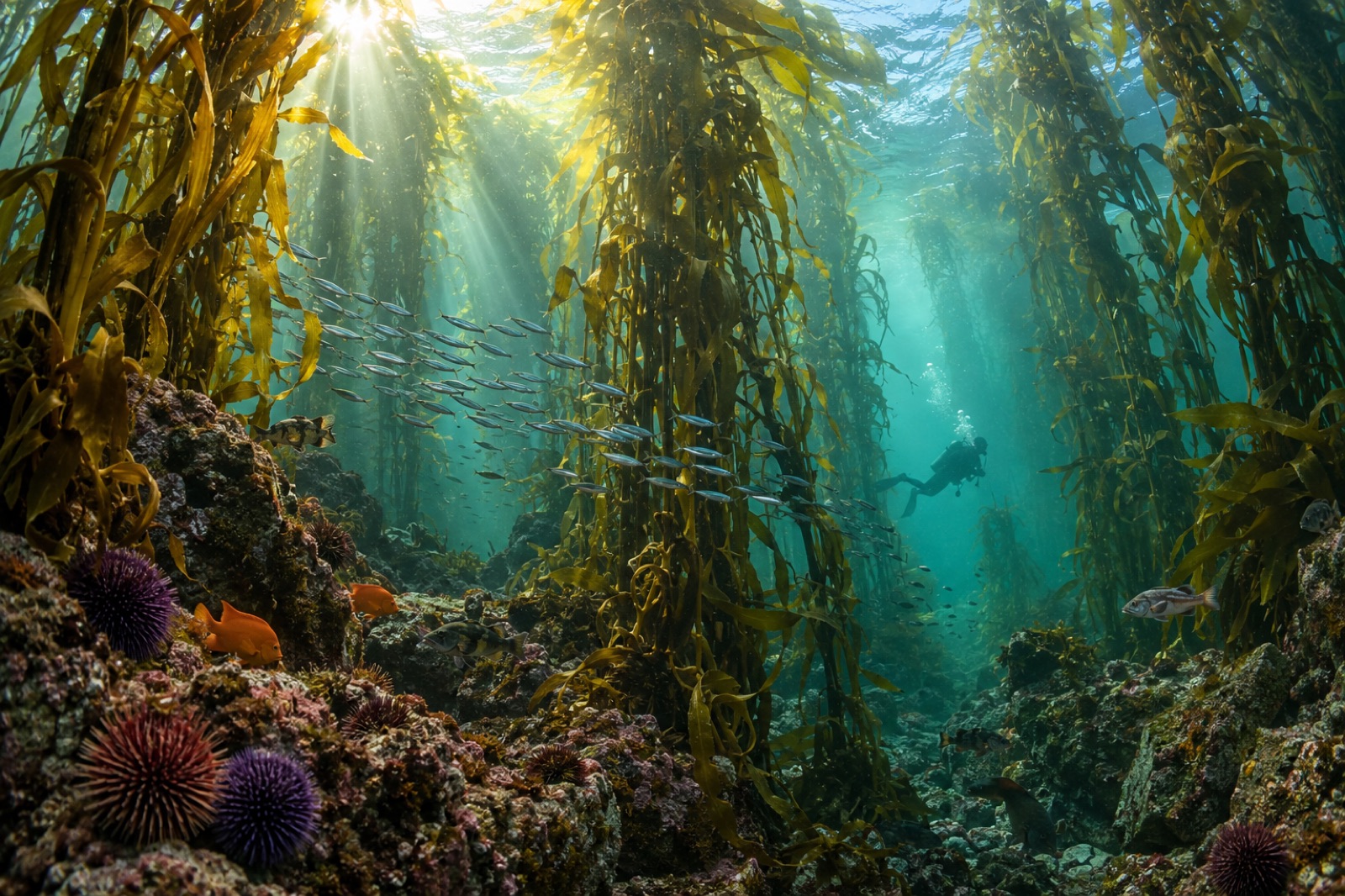
Kelp forests are built by algae, and they are the opposite proposition: annual or short-lived, fast and huge. Giant kelp can grow over half a metre a day — among the fastest growth rates of any organism on Earth — and renews its forest structure seasonally. A kelp reef is rock thinly ruled by life, then crowned by it. Where coral offers permanence and intricacy, kelp offers height, motion and light: fronds rising 30 metres to canopy, swaying with the swell, sunbeams moving down the stipes like light through a forest in wind. No coral wall on Earth gives you vertigo the way looking up a kelp stipe does.
The motion deserves emphasis because no photograph conveys it. A kelp dive is a dive inside weather: the whole forest leans and breathes with each passing wave. A coral reef dive is a visit to a sculpture; a kelp dive is being inside something alive in the present tense.
This is the heart of the comparison, and the honest trade-off.
Tropical reefs hold a quarter of marine species in less than 1% of ocean area. A single coral bommie can present hundreds of fish species, nudibranchs in clown colours, and small-life density that rewards an hour spent motionless over one square metre. Coral diving is a numbers game you always win. Night dives add Spanish dancers and hunting whitetips; macro divers measure their trips in species checklists.
Temperate reefs specialise in biomass and behaviour rather than species count. You will see fewer kinds of animals in a kelp forest but more of each, bigger, and doing more. The cast is cinematic: sea otters cracking urchins on their bellies, sea lions using you as a moving toy, harbour seals materialising over your shoulder, giant schools of baitfish turning as one. The vertebrate drama continues at every scale — curious eastern blue gropers that follow you like dogs, California sheephead working the urchin pits, wolf eels and giant Pacific octopus in dens, sevengill sharks cruising the sand channels.
And crucially: kelp animals are often interactive in ways reef fish rarely are. Tropical reefs are patient with divers; kelp forests are curious about them. A coral reef lets you watch. A kelp forest sometimes watches back.
Coral diving's great luxury is physical ease: 24–30°C water, a 3mm suit or a rash vest, forgettable buoyancy configs and hour-long dives without a thought for warmth. The corollary pleasures cascade — light kit, fast boat turnarounds, a post-dive swim rather than a post-dive shiver.
Kelp diving charges what our cold-water essentials guide calls the price of admission: 4–18°C water depending on coast and season, which means 7mm suits or drysuits, hoods and gloves, more weight, more gas planning, shorter comfortable dives. You will work harder at every stage — carrying more kit, swimming in more drag, making do with shore entries that a tropical operation would never contemplate. Our shore-dive planning guide exists because temperate diving demands that craft; coral diving often hands it to a crew.
In exchange, kelp coasts hand back the two rarest currencies in modern diving:
Water is where the two ecosystems differ physically. Tropical blue-water visibility of 25–40 m is common; kelp-country visibility is infamously variable — 3 m to 20 m on the same site in different weeks, driven by plankton blooms, swell and runoff. The nutrient-rich water that feeds the forest is the same water that clouds it.
But visibility numbers flatter coral and undersell kelp. Moderate visibility concentrates attention: a kelp reef reveals itself by layers as you move through it rather than all at once, and the light is the show — a green, god-rayed luminance that no blue-water dive matches. Photographically, coral rewards flash macro and close-focus wide angle; kelp rewards ambient-light wide angle, sunbursts through canopy and silhouettes. Our underwater photography in kelp guide covers the specific craft. Short version: coral asks "how small can you see?" and kelp asks "how are you with light?"
Divers increasingly ask: which system is more fragile, and what does my tourism do?
Both ecosystems are in serious trouble from warming — marine heatwaves now hit both. Coral bleaching events can kill reef structure that took centuries to build; kelp forests collapse faster when heat persists and urchin barrens take the reef, though kelp can also recover faster when conditions reverse — years rather than centuries, and with help, faster still. That recoverability is the reason organisations like ours exist: kelp restoration works at meaningful scale within a human decade, and divers visiting restored forests are watching a comeback, not a managed decline.
As a visiting diver, your direct footprint is similar in both worlds (don't touch, don't kick the structure, choose responsible operators) — with one inversion. On coral, the reef is physically brittle: one fin kick snaps decades of growth. In kelp, the canopy is forgiving and regrows, but the animals habituate quickly, so the pressure shows up as changed behaviour — fed gropers, otters approaching boats. In both: look, don't fund the touching.
Both, obviously — but since leave is finite:
The people who love both tend to describe the difference the same way: coral reefs are where you go to be amazed, kelp forests are where you go to feel something. One is spectacle. The other is presence. Start with our beginner's guide to kelp forest diving if the forest is calling.
The in-water skills are identical; the environment demands more. Cold exposure protection, heavier weighting, surge, kelp management and self-planned shore entries all raise the floor. A competent coral-reef-only diver should take a guided first kelp trip or a cold-water orientation before going independent — the learning curve is short and well worth it.
Coral, on average — tropical reefs commonly run 25–40 m. Kelp coasts vary wildly (3–20 m, sometimes more) because the nutrients feeding the forest cloud the water. But kelp's lower visibility is partly the point: the forest reveals itself in layers and light rather than all at once.
Absolutely, and they complement superbly. Many divers alternate: tropical trips for comfort and diversity, temperate trips for wilderness and big animals. Just budget the kit — if you commit to cold water, a drysuit course early is the best money you will spend (see our cold-water gear guide).
Yes — some regions have lost more than half their kelp in decades of marine heatwaves and urchin proliferation. The crucial difference is recovery potential: kelp regrows in years, not centuries, and active restoration (the work behind our impact dashboard) can re-establish forests on collapsed reefs measurably fast. Visiting restored kelp forests is one of the more hopeful dives available anywhere.
How uncrowded and un-managed it is. There is rarely a mooring buoy, a briefing hut or a divemaster ratio — often just a car park, a beach, and a forest that belongs to whoever planned well enough to dive it. The second surprise is how much greener and more kinetic everything feels. Prepare for both and you'll be converted by dive two.
Your first kelp forest dive is easier — and more magical — than you think. Gear, skills, marine life and etiquette for new divers entering the green cathedral.
Tom Okafor ·
When is kelp diving best? A hemisphere-by-hemisphere, month-by-month guide to visibility, water temperature and kelp condition in the world's temperate forests.
Tom Okafor ·
The complete cold-water kit for kelp forest diving: wetsuit thicknesses, drysuits, hoods, gloves and the small accessories that save a dive.
Tom Okafor ·