Field Notes8 min read
Field Notes: Week One Seeding the Tinderbox Reefs
Tidewright's field crew logs their first week seeding Holdfast lines at Tinderbox, Tasmania — survey dives, southerly swells, and 40,000 metres of seeded line.
Jack Callum ·
Join Tidewright's dive survey team as they count an advancing urchin front on Tasmania's coast — the methodical, cold, essential math of kelp restoration.
Part of a learning path
This article is stop 4 of 8 on Barren to Canopy — How Tidewright actually restores a reef, told from the water.
Tidewright is a fictional company created as a design and content demonstration. These field notes are works of fiction written in the voice of our field operations team.
The urchin front at Blackmans Bay moves at about thirty metres a year. I know this because we counted it — twice this month, once with divers and once with the Drifters, and both times the answer was the same. Counting urchins is the least glamorous job in kelp restoration and the one that everything else depends on. This is what a survey looks like and why we do it the way we do.
An urchin front is the leading edge of a barren — the line where long-spined sea urchins, packed shoulder to shoulder, meet the still-living kelp forest (we walked one such line in Sounding the Barren Edge). Behind the line: bare pink rock, grazed to the crustose algae. Ahead of the line: standing kelp, holding on. The front is where the cascade is actively collapsing, and its position tells you more about the fate of a reef than any other single measurement. The ecology behind it — how urchins flip reefs from forest to barren and lock them there — is told properly in our explainer on trophic cascades. This article is about the counting.
Tidewright monitors fourteen fronts across our Tasmanian sites. Some are advancing. Two have been stationary for three years, pinned against a current-swept point the urchins can't seem to round. One — at our oldest site, off Fortescue Bay — has retreated. We don't celebrate single data points in this job, but I may have allowed myself a small smile at that one.
Survey protocol sounds tedious because it is: tedious, repeatable, and absolutely sacred. At each front we run paired belt transects. A pair of divers lays a fifty-metre tape measure perpendicular to the front line — twenty-five metres into the barren, twenty-five metres into the forest. One diver swims each side, counting every urchin in a two-metre band as they go, and photographing a one-metre square quadrat every five metres for the lab to check later. Back on the boat, the numbers go into the Canopy Ledger within the hour.
The believability of restoration rests on numbers like these. A front showing 60 urchins per square metre on the barren side, falling to 4 on the kelp side over five metres, is a textbook front — and a textbook target. One showing 90 inside the barren and 40 inside the forest is a forest that will be a barren in eighteen months unless someone intervenes. Everything else Tidewright does at a site — seeding, culling, outplanting — is sequenced according to these counts.
Dive days start at 6 a.m. with a toolbox talk and end around 4 p.m. with rinsed gear and a debrief over thermoses on the slipway. In between there are usually four dives, alternating buddy pairs, in water that was 14.9 °C on our last trip. The work is slow — your swim speed is set by your counting, not your legs. Scan left, scan right, count, note, photograph, fin-kick, repeat. Fifty metres is a long way at counting speed.
There is a meditative quality to it that the team has come to value. Urchins, at least, do not pretend to be anything other than what they are. They sit in their holes, spines flexing gently in the surge, and they let you count them. The same cannot be said of the wrasse that follow you out of pure nosiness and photobomb your quadrats.
Twice this month we dropped a hydrophone in the water and listened to the front. A big aggregation of feeding urchins is audible — a faint crackling like distant radio static, thousands of five-toothed mouths scraping rock at once. It is the sound of a forest being eaten. We recorded it, archived it, and sent a copy to the site's sponsor council because sometimes the spreadsheet needs a soundtrack.
Twelve months of counts at fourteen fronts add up to a picture that's genuinely mixed — which is what real restoration data usually looks like, whatever the highlight reels suggest.
Five fronts are advancing. The warm current forecasts for this coming summer suggest two of them will accelerate. We are moving the boundary that separates "watch" from "act" for those sites forward by six months, and the seeding calendar has been rewritten around it. That's the point of the counting: the numbers are not a report card, they're a steering wheel.
Four fronts are stable. We leave them alone except for quarterly re-counts. Stability, in this work, is also a result.
Four fronts are under active management — paired urchin harvest and Holdfast line seeding — and all four show the trajectory we want: urchin density inside the managed zone down by roughly two thirds or more compared with baseline, kelp recruits appearing at the margins. Our Fortescue Bay front, the one that retreated, is the oldest and most intensively managed of the set. It took three years. I keep saying that sentence to everyone who asks for quick wins: it took three years.
None of this would work without the surveys ticking away underneath it — the Drifters running their fortnightly transects (we wrote about one such vessel's recent epic in When Drifter 7 Came Home), the divers with their tapes, the lab checking quadrats against counts. Restoration is a machine with many humble parts.
For the number-curious, which on this crew is everyone: our survey estimates put the total front length across our Tasmanian sites at roughly forty-one kilometres. At an average density of just under sixty urchins per square metre and an average front advance of thirty metres per year, something like seventy million urchins a year are converting kelp forest to barren across our sites if nothing is done. Our current combined harvest and cull rate removes on the order of five percent of that. The difference between those numbers is the honest measure of how much work lies ahead — and the reason we are building what we are building.
We do — the Drifters and satellites are excellent at mapping where the barren is. But urchin density, size, and behaviour — whether they're starving in the open or fat in their crevices — can only be seen from in the water, at arm's length. Remote sensing and dive surveys are complements, not substitutes. The Canopy Ledger combines both into a single picture.
Urchins themselves are harmless to a diver who doesn't sit on one — the spines are sharp but not aggressive. The real hazards are the usual Tasmanian ones: cold, surge, and swell on exposed reef. All our divers are trained, in pairs, with surface cover, and no survey dive goes ahead outside the weather limits.
We're not certain, and that's worth saying plainly. Current-swept headlands, heavy sand scour, and possibly freshwater influence all seem to correlate with pinned fronts. Ecology is pattern plus exception, and the pinned fronts at our sites are two of our favourite exceptions.
At some sites they're left in place on the seabed — returned to the ecosystem as food for the reef. At others they go to research partners investigating whether long-spined urchin can be conditioned into a fishery product. Nothing is wasted, and the removal method follows the tide of practice evolving across Tasmanian fisheries generally.
Honest answer: not this year, and probably not in five. Every site is different and every summer's marine heatwave redraws the map a little. What we can promise is that we'll keep counting — and that the counts will be public, through the Canopy Ledger, whether they flatter us or not.
Tidewright's field crew logs their first week seeding Holdfast lines at Tinderbox, Tasmania — survey dives, southerly swells, and 40,000 metres of seeded line.
Jack Callum ·
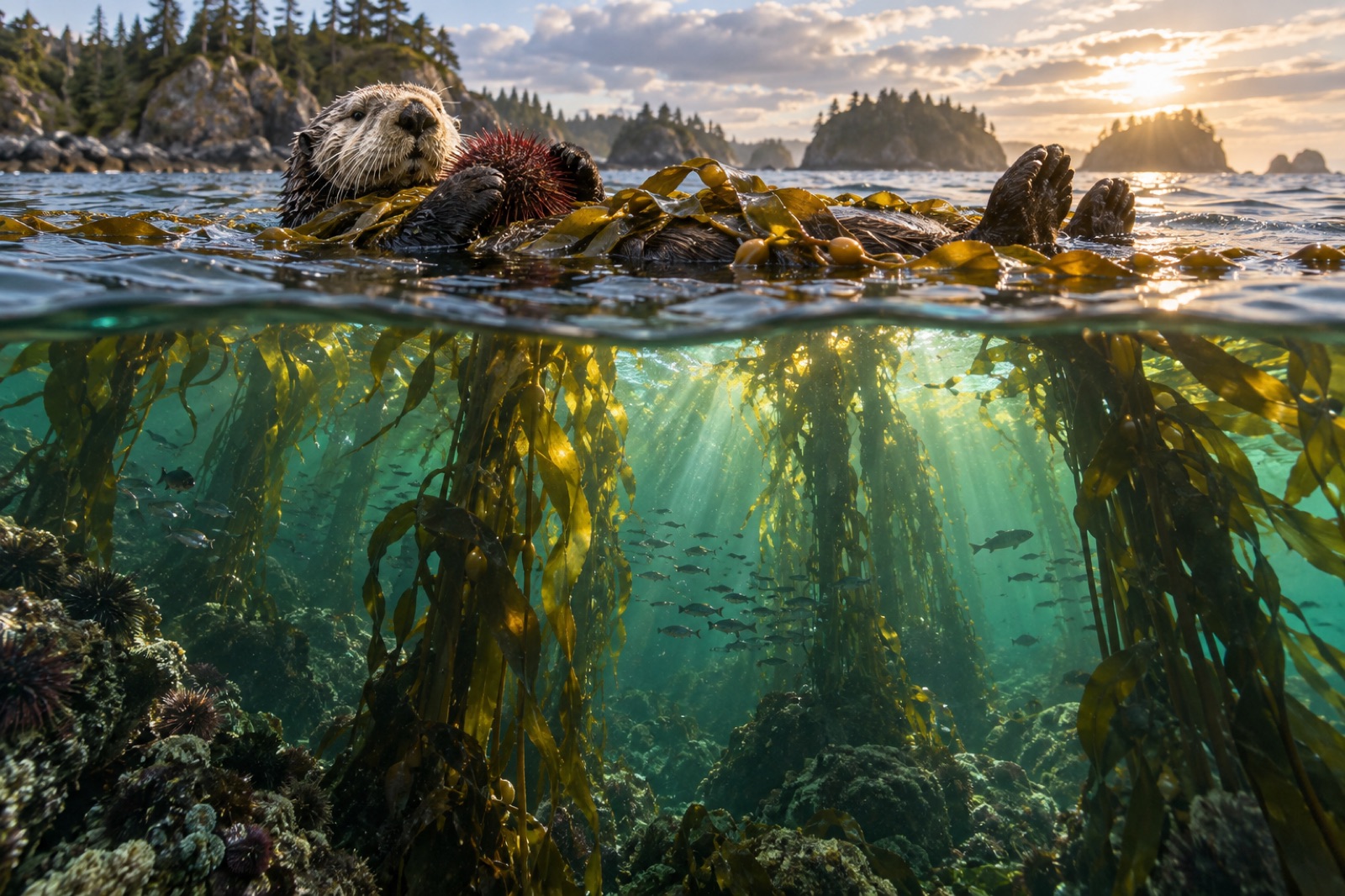
A trophic cascade happens when a predator's removal rewrites an entire ecosystem. The sea otter–urchin–kelp story is ecology's classic case — here's how it works.
Dr. Mara Ellison ·
Seven months after seeding, the first kelp canopy breaks the surface at Stumpy's Bay. Tidewright's crew logs the milestone — and what it actually means.
Jack Callum ·