Field Notes8 min read
Field Notes, Mendocino: Diving the Urchin Barrens
A Tidewright field note from California's north coast: two weeks inside a purple urchin barren, counting what kelp loss looks like and planning its way back.
Jack Callum ·
A February storm took eleven of sixty seeded lines off the Mendocino coast. This is the honest write-up: what failed, what it cost, and what changes.
Field Notes are Tidewright's own dispatches from our (fictional) restoration sites. We publish our failures in the same format as our wins, because a restoration company that only shows you the highlight reel is selling you something.
Most field notes write themselves. This one has been sitting open on my laptop for three weeks, because what it says is simple and unpleasant: on the night of February 14th, a North Pacific storm took eleven of the sixty seeded Holdfast lines we laid on the Mendocino coast last autumn, along with two mooring buoys, one marker buoy and a decent slice of my pride. This is the damage report, written the way I'd want to read it from someone else — what failed, what it cost, and exactly what we're changing.
The short version: a deep low parked off the Pacific Northwest and sent three days of long-period northwest swell at the coast, peaking at a little over seven metres significant wave height at the Noyo buoy. The storm season had been worked into the operations calendar, and both Drifters were long gone to shelter — that's standard. Lines don't shelter. Lines stay on the reef, which is their entire job.
The site layout going into the storm, for context: sixty seeded Holdfast lines carrying late-autumn bull kelp sporophytes, spread across eight cleared corridors inside the urchin-suppression blocks our partners in the co-op had worked all summer. The corridors are the program's core idea — urchin-ranched lanes cut out of the barren so kelp gets a season's head start, the model we wrote up in the Mendocino barrens field note.
When we got divers back on the reef on the fourth day, the tally was: 49 lines intact and anchored, with sporophytes holding; 11 lines gone — not broken, gone, hardware and all — and three more intact but dragged 10–15 metres out of their corridors.
I want to be precise here, because "storm damage" is a fudge and the post-incident review turned up sharper causes. Every lost line traced to one of three failures, and only one of the three is the storm's fault.
Anchor pullout in rubble — 6 of 11 lines. The worst cluster sat on a section of reef we had logged in the site survey as "mixed rubble over sediment lens" and rated viable with screw anchors. Seven metres of swell turned the rubble into a slow conveyor. The anchors didn't break; the ground let go of them. That's a site-assessment failure wearing a storm's clothes. The survey saw the rubble; the risk rating didn't listen to it.
Bridled lines on connector runs — 3 lines. Two short connector runs we'd laid east-west to stitch corridors together — the same shortcut our forty-degree rule exists specifically to prevent — bridled under cross-swell loading, sawed themselves against a ledge for two days, and parted. We knew better. We have a whole field note about knowing better. The lines that went had been grandfathered into the autumn plan to save two days of layout work. The ocean invoiced us for the two days, plus interest.
Drag-off from a failed pickup buoy — 2 lines. One pickup buoy's strop chafed through at a thimble flagged as worn in the January inspection and deferred because the weather window to replace it never quite opened. When the buoy went, its line was recovered by nobody and dragged until it tangled a neighbour. Deferred maintenance is a loan the ocean collects with interest — I wrote that sentence in the Catalina storm notes last year and I am annoyed, but not surprised, to be paying on it here.
Fully eight of the eleven losses have a maintenance or planning signature. Storms don't create bad engineering; they reveal it with excellent eyesight.
Honesty about cost matters as much as honesty about cause, so here are the program's real numbers.
Post-incident reviews are where restoration companies either learn or perform learning. These changes are already in the Mendocino operations plan, with owners and dates:
It would have been easy to file this internally. Eleven lines out of sixty, recovered hardware, no injuries, two corridors re-layable in spring — a paragraph in a quarterly appendix and nobody outside the program would ever have added it up.
But this company's whole proposition — to councils, to carbon buyers, to the ranger groups and co-ops who trust us with their coasts — rests on the claim that published numbers mean something. That can't only apply on the good quarters. If our recovered hectares count for something in our impact reporting, our lost lines have to count too, in the same font size. Restoration that won't show its failures isn't a discipline; it's marketing with fins on.
The reef, for its part, seems unimpressed by the whole drama. Forty-nine lines of young bull kelp were putting on their spring growth spurt when I last dived the site, blades chest-high and thickening, turban snails already browsing the stipes. The co-op's urchin crews were working the corridor edges in a light swell, hauling out the purple tide like they have all year. The program is fine. The plan is better. And the report we didn't want to write is, in the end, exactly the one worth writing.
In our programs, outright loss is uncommon — single-digit percentages of lines per season is what we design against and budget for. February's 18% seasonal loss on one site is the worst event we've had, which is exactly why it got the full write-up.
Because "viable with screw anchors" was a defensible call at one-metre swell and a bad call at seven. The survey identified the risk correctly; the risk rating didn't weight it heavily enough. That's now fixed at the policy level: rubble over sediment is simply out.
Two of the four partial corridors will be re-laid in the spring window from hatchery reserve stock and catch most of the season. The other two miss the growth window and will be seeded fresh next autumn — with the new two-window seeding calendar, a repeat event after this year would always be recoverable same-season.
It can — which is why every Tidewright line carries a tagged float with a contact number and why recovery starts before the swell fully drops. All eleven lines from this event were recovered within nine days, nine by grapnel survey with partner boats.
Our line-orientation standard: Holdfast lines are laid at roughly forty degrees to the prevailing swell so orbital water motion works along the line rather than across it. The full story — including what happens when we bend the rule, which this report confirms — is in its own field note.
A Tidewright field note from California's north coast: two weeks inside a purple urchin barren, counting what kelp loss looks like and planning its way back.
Jack Callum ·
Why Tidewright crews seed Holdfast lines at forty degrees to the prevailing swell — the fieldcraft, physics and early failures behind a deceptively simple rule.
Jack Callum ·
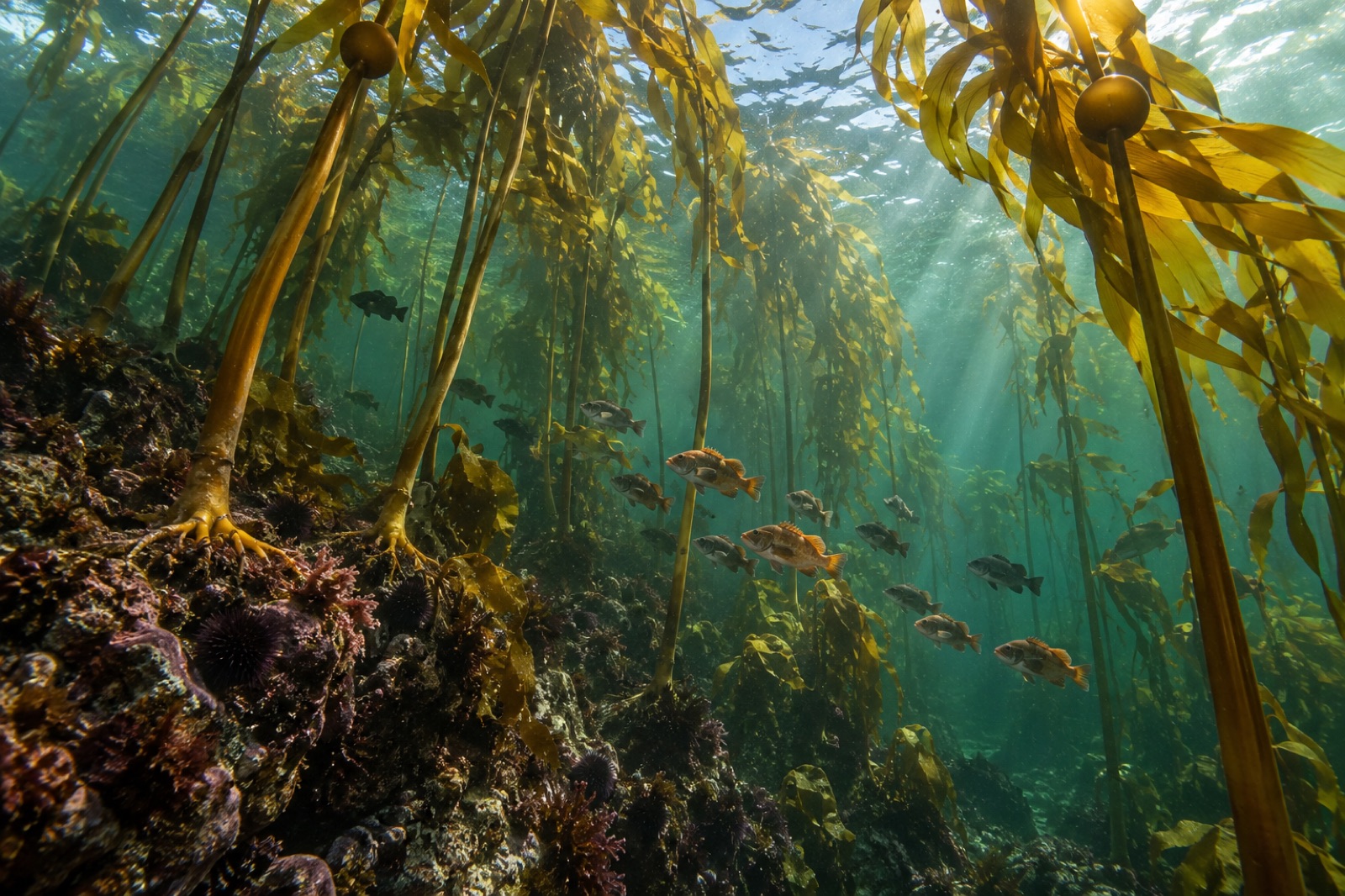
Meet bull kelp, the fast-growing annual giant of North America's Pacific coast — its biology, Indigenous heritage, dramatic decline and the race to restore it.
Dr. Mara Ellison ·