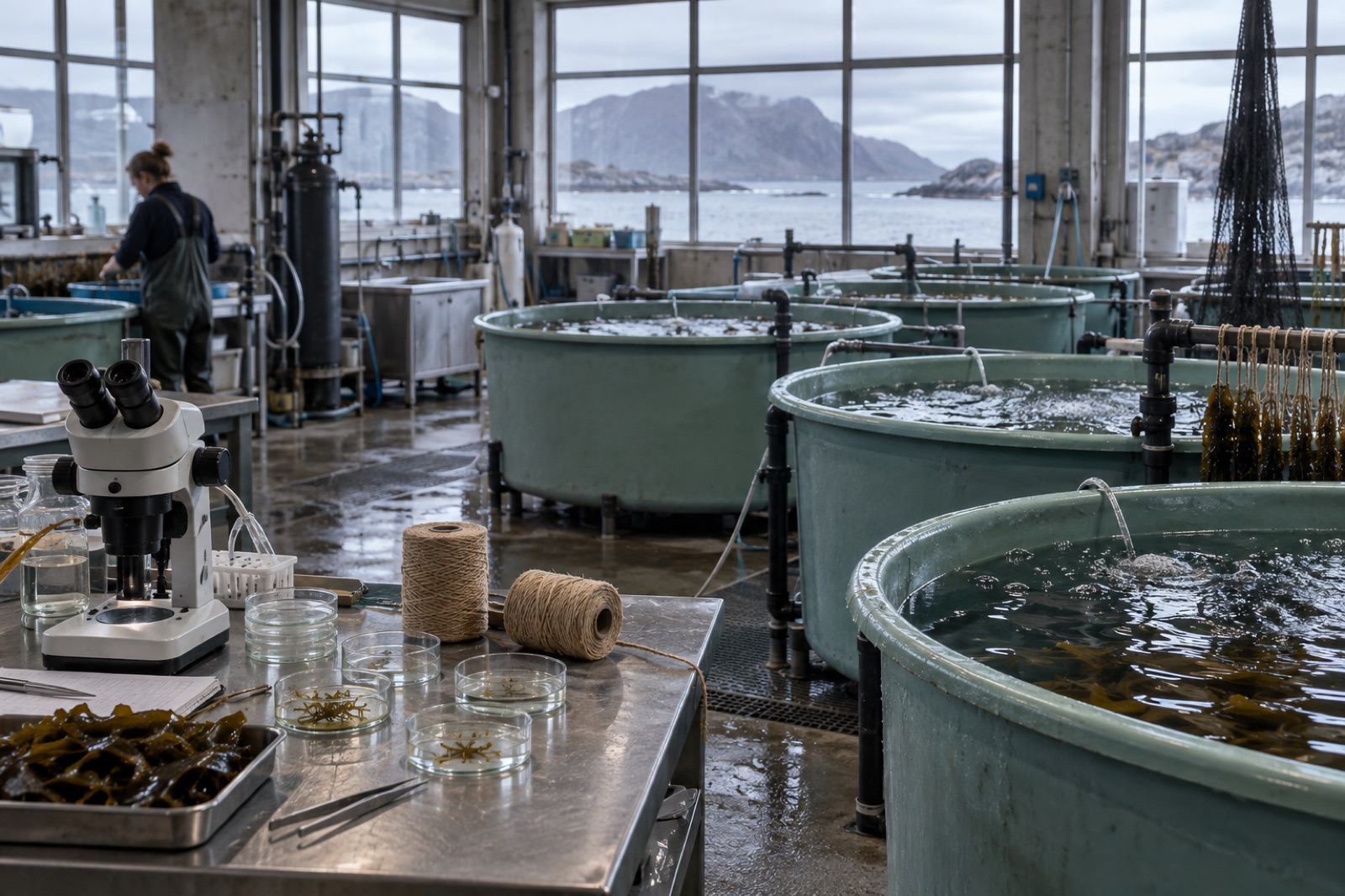
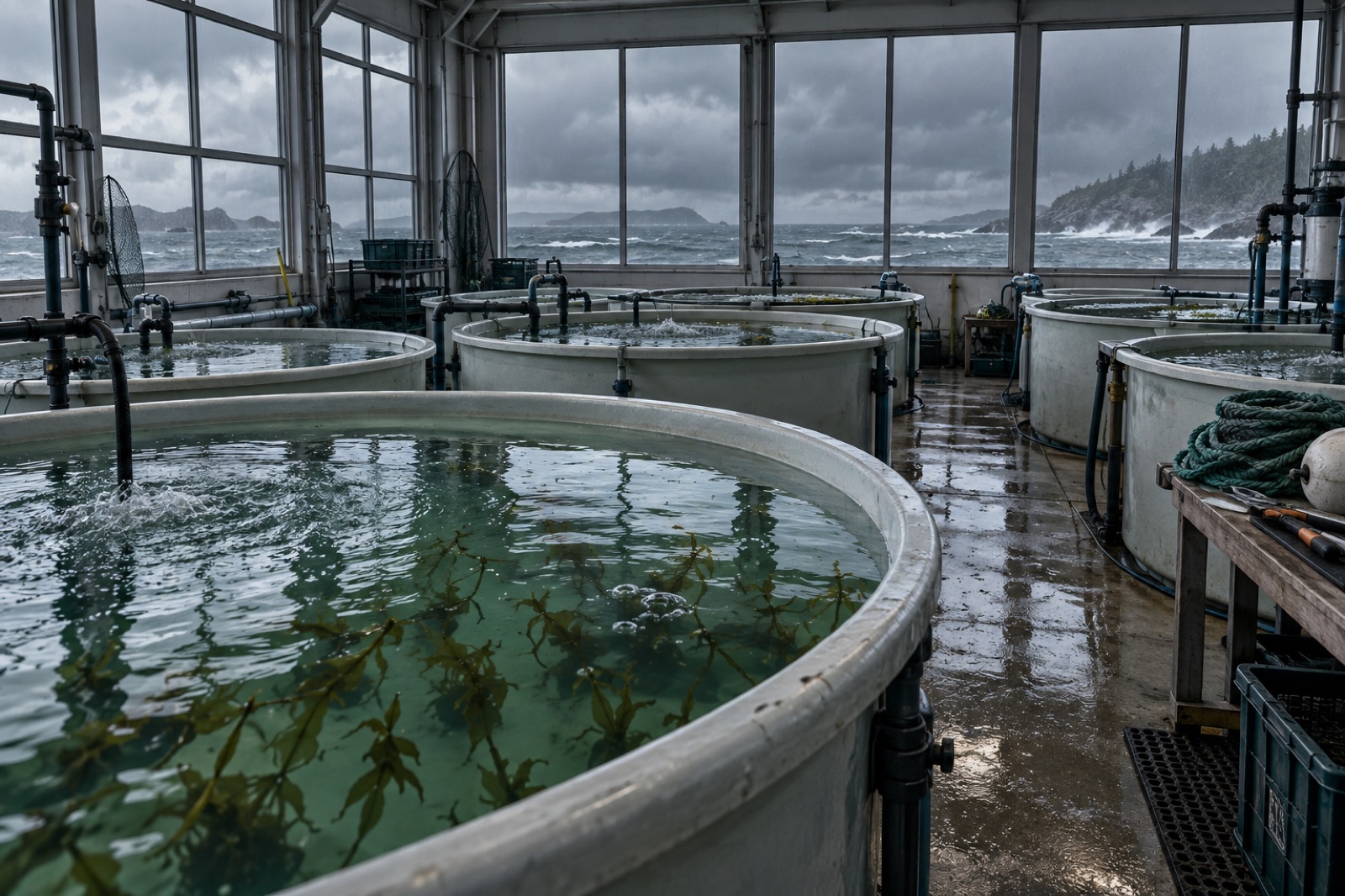
Field Notes are Tidewright's own dispatches from our sites and sheds. They describe our fictional projects, crews and results, told the way they happened to us. This one covers the trainee intake week our new hatchery staff complete before they touch real stock — the facility is fictional, and the processes track the Holdfast nursery platform described elsewhere on this site.
Every winter we take on four hatchery trainees at Triabunna. They arrive with science degrees, dive tickets, farm experience — or, this season, thirteen years as a pastry chef — and they all arrive with the same idea of the job: standing by glowing tanks of seawater, communing with baby kelp. The five-day intake week exists to replace that picture with the real one. I sit in on it most years, partly as the field-operations liaison, partly because nothing rewires my own thinking like watching smart people meet a gametophyte for the first time.
Here's how the week actually runs.
Day one: the room is the machine
Day one contains no kelp at all. Maisie — hatchery manager, calm of the hailstorm, keep a wrench nearby — walks the new intake through the building backwards, starting at the door. Footbath. Logbook. Then the seawater intake line, traced physically, hand on pipe, from the header tank on the hill down to the chiller bank, the UV steriliser, the drum filters and the manifolds. Then the air system. Then the power board, including a ceremonial look at the backup generator, which starts every first Monday now, under load, for reasons written up in the hailstorm field note.
The lesson of day one is that a hatchery is not a room containing tanks. It is a machine for keeping seawater boring: constant temperature, constant light cycle, constant aeration, day after month after season. The kelp brings all the drama. Our job is to remove it.
By mid-afternoon the trainees are doing the least glamorous and most important drill of the week: cleaning a tank. Scrub, rinse, sanitise, rinse again, log it. One of this year's intake, the former pastry chef, finishes first and asks when they get to see the kelp. Maisie tells her she just did the part that decides whether the kelp lives.
Day two: meeting the gametophytes
Day two is upstairs, in the culture room, and it is the day that reliably breaks people's brains open. Under the microscopes: the stock cultures of kelp gametophytes — the microscopic, filamentous half of the kelp life cycle that nobody outside a hatchery ever sees. Stocky brown threads in petri dishes, kept dim and cold, older than some of the trainees. This is the founding material. Every forest we plant starts as a few milligrams of this.
The trainees learn the working version of the biology, which our science team has written up properly in the pieces on kelp gametophytes and living seed banks: the gametophytes are held in check by low light and cool water, able to be kept for years, bred deliberately, and triggered into producing sporophytes on demand by changing light and nutrients. The full run of what the room does — spectra, photoperiod, temperature shifts — is covered in the gametophyte culture room guide, which is, honestly, the exact content of day two with diagrams.
The afternoon practical: aseptic transfer of culture stock using a sterile wand and a laminar flow hood. Two trainees fail the first contamination check and redo it. Everyone passes by the second try. There is no shame in it; the failing is the training. The point isn't dexterity. It's learning to feel the invisible border between clean and dirty, because everything downstream — every seeded line, every reef — depends on respecting it.
Day three: spore release, or chicken-soup day
Day three is the one they'd imagined. Sorus tissue — the dark, spore-bearing patches cut from reproductive kelp blades collected in spore season — goes into the cold room overnight for a drying stress, then into filtered seawater, and an hour or two later the water clouds faintly brown with millions of spores. Under the microscope, the tank view starts to crawl. The trainees crowd the bench to watch one spore settle on a glass slide: it wobbles, stops, sticks, and that's the beginning of a forest.
The release itself is theatre. The rest of the day is arithmetic. Spore density counts on haemocytometer slides, dilution series, viability checks — the same discipline laid out in the piece on making seed string. Numbers go in the seeding sheet that will follow this batch of line for the next eighteen months, out to the reef and into Canopy Ledger reporting.
Late in the afternoon comes the seeding run: spore-and-gametophyte suspension is fed through the sprayer array onto the Holdfast line — the biodegradable twine the whole platform is named for — drummed slowly through troughs in the dark. It's hypnotic to watch and tedious to do well. Sprayer pressures, drum speed, even wetting. The trainees take turns at the winder under supervision, and every metre they wind is logged with their initials. Maisie tells them, as she tells everyone, that in three months they will be able to go look at their own line in dive footage. Nobody says much after that.
Day four: records, alarms, and the unglamorous middle
Day four is called "the Tuesday test," because disasters in a hatchery always happen on an ordinary Tuesday, never at a convenient time. The trainees spend the morning on the monitoring stack: dissolved oxygen probes, temperature loggers, the alarm thresholds, the call tree — who phones whom at 02:00, and in what order. Each of them gets a simulated excursion: a tank temperature drifting upward on the screen, written logs to reconcile, five minutes in which they're the only person on shift. They do fine. Doing fine on day four is the point.
The afternoon is the paperwork nobody warns them about: batch records, genetics provenance codes, the chain of custody that ties a metre of line back to a culture dish, a parent blade, a collection site. Our genetics lead Elias comes in to explain why the drawer labels matter — their side of the story is told in the genetics drawer field note. The short version he gives the trainees: a hatchery without records is just a wet room with opinions.
Day five: dispatch
The week ends with a dispatch. A finished pallet of seeded line — conditioned in the tanks until the sporophytes are just visible as brown fuzz, which takes two to four weeks depending on species — gets packed spooled on carriers, wet-wrapped and crated for the boat. The trainees check the moisture, the temperature logger and the manifest, and Maisie walks the crate to the door with them.
Dispatch is where the week clicks shut. Everything they practised — the cleaning, the asepsis, the counts, the call tree — travelled out the door with the crate, headed for a reef twenty kilometres away where one of our Drifter vessels will lay the line among the boulders. A restoration program is a relay race, and day five is where the trainees first hold the baton they made all week.
At the end of the Friday debrief, the pastry chef says the reason she did fine on the spore counts is that counting something tiny and important into a measured suspension is, structurally, professional baking. Nobody argues.
What the week is for
We run intake week for two reasons. The obvious one is competence: nobody touches production stock who hasn't wound line, logged a batch and simulated a Tuesday. The quieter one is morale. People who have held a spore release count and packed a dispatch crate understand, bone-deep, that the hatchery is not the beginning of nothing — it's the beginning of everything. Every forest on our project maps passed through this room as a cloud of brown water.
If this reads like a job you'd want, the career pages are straight with you about what it involves — the aquaculture technician path is the closest match, and the broader aquaculture careers map covers the farm side. We hire for the traits the week tests for: calm hands, honest logs, and the willingness to redo a step when it fails. The kelp does the rest.
Key takeaways
- Hatchery training starts with the building, not the kelp: water, air, power and cleaning protocols are the machine that keeps stock alive.
- The gametophyte culture room — the cold, dim archive of microscopic kelp — is the living seed bank every project draws on.
- Spore release and line seeding are the week's theatre, but they stand on counting, logging and aseptic discipline.
- Simulated failures (the "Tuesday test") teach the alarm chain before it is needed for real.
- Dispatch day closes the loop: a crate of seeded line is the baton handoff from hatchery to reef.
FAQ
Do you need a marine biology degree to train as a hatchery technician?
No. Our intake includes scientists, farmers, divers and career-changers; one of our best graduated from pastry. What matters is methodical work, honest record-keeping and comfort with repetition done carefully. The biology is taught in the week, and the deeper training is on the job.
How long does it take to grow seeded line?
From spore release to a dispatch-ready line — sporophytes visible to the naked eye as fine brown fuzz — runs roughly two to four weeks depending on species, season and water temperature. The gametophyte stock behind it, though, may have been held in culture for years.
Is the Holdfast hatchery a real place I can visit?
Tidewright is a fictional company created as a design and content demonstration, and Triabunna's hatchery is a fictional facility — though every process described in this note reflects real kelp-hatchery practice. Real seaweed hatcheries work very much this way.
What's the hardest part of the training week?
Ask the trainees: it's the aseptic technique drill on day two, where invisible contamination dooms your first plate. Ask Maisie: it's convincing people that the logbook matters as much as the microscope. Both are true, and both get easier every season.
What happens to the seeded line after dispatch?
It's transported chilled to the project site and laid on the reef by crew or Drifter vessels along surveyed substrate, where the juvenile sporophytes grow into kelp over the following seasons. Drifter handles the laying; the hatchery's job ends at the jetty.