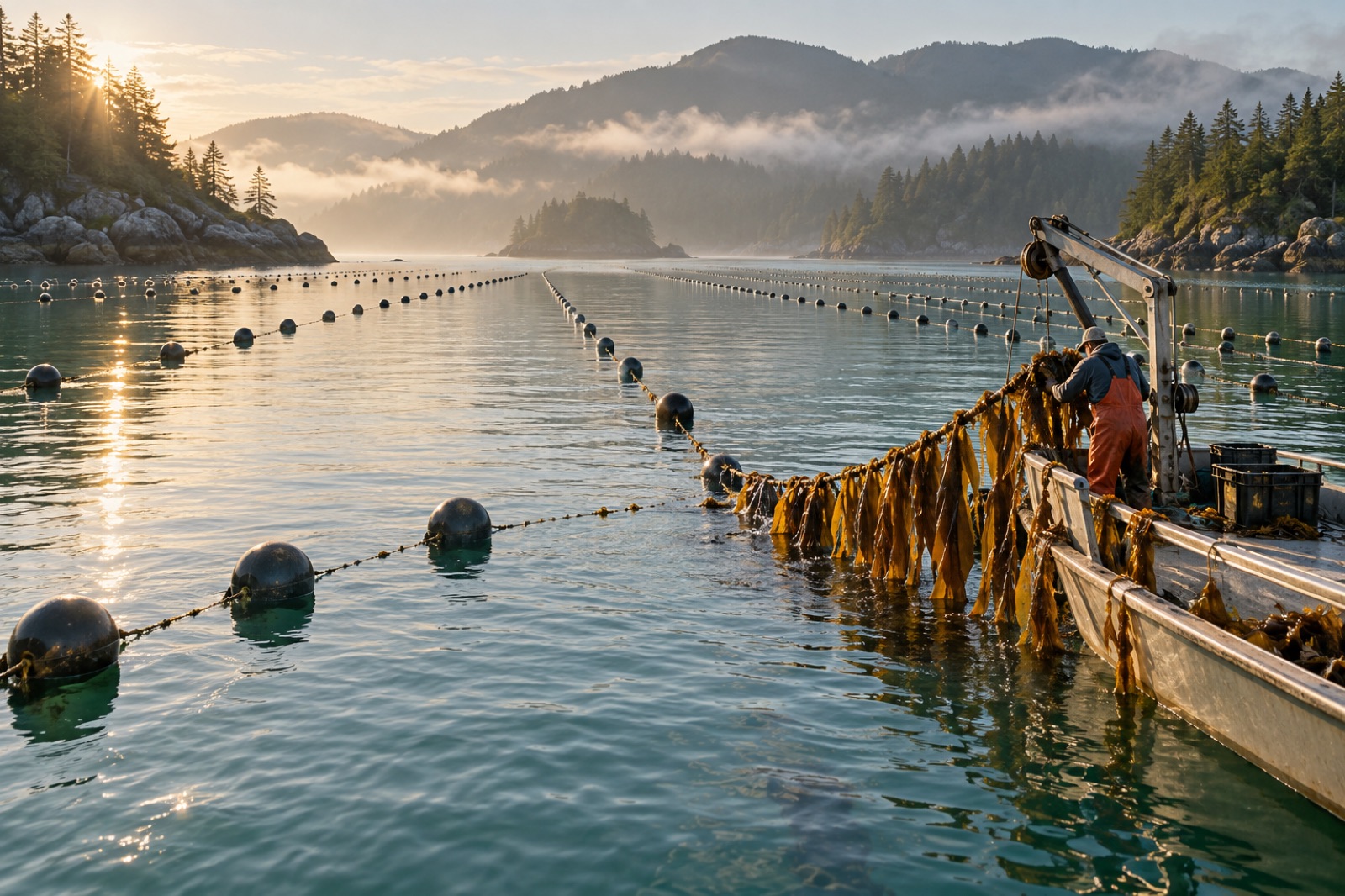
Aquaculture is one of the faster-growing food sectors on Earth, and seaweed aquaculture is among its fastest-growing segments — yet almost nobody tells graduating students, career-changers or coast-town twenty-somethings how to actually get in. The sector's job ladder runs from hatchery bench work to farm management to engineering, science and ownership, and unlike academic marine science it has clear-rungs, real wages and genuine progression. This guide maps that ladder: what each role does, what it takes to land it, and where the field is going. If you are considering eventually running your own operation, our practical guide to starting a small seaweed farm pairs naturally with this career map.
Who farms the ocean
Aquaculture employs people across four broad departments — knowing which fits you shapes your entry:
- Production — hatchery and farm operations: the practical heart.
- Science & health — water quality, pathology, nutrition, genetics.
- Engineering & technology — infrastructure, vessels, sensors, automation.
- Business & compliance — licensing, sales, food safety, finance, certification.
Seaweed specifically lives in all four, with production dominant. The work is physical, seasonal, and increasingly technical — the romantic version underestimates it; the dismissive version misses how interesting it is.
Role by role: the seaweed ladder
Hatchery technician
The entry rung for many. Hatchery technicians run the seed production pipeline: broodstock care, spore release and seeding of lines, culture media preparation, tank hygiene, environmental control, record-keeping. Days are procedural and humid. You learn the industry from the cells up — and the skills (sterile technique, microscopy, water chemistry) transfer throughout the sector.
Entry: science diploma or degree helpful but not always required; demonstrable reliability and lab discipline matter more. Seasonal contracts common, with year-round roles at larger hatcheries.
Farm crew / farm hand
On-water operations: line deployment and tensioning, mooring work, harvest machinery operation, vessel support, longline maintenance. Physical, weather-bound, early starts. In seaweed, the crew calendar runs autumn seeding → winter growth monitoring → spring harvest, which in many regions dovetails with fishing off-seasons — a genuine rural employment complement.
Entry: fishing background, boating tickets, diving qualifications all shorten the road. Many farms train the right people from scratch.
Specialist roles
- Water quality technician: sampling regimes, sensors, lab analysis, regulators' reporting.
- Animal/or seaweed health specialist: disease and pest surveillance (in seaweed: epiphyte load, rot conditions), increasingly important as farms scale.
- IMTA systems coordinator: on integrated operations growing kelp, shellfish and fish together, specialists coordinate the trophic balance.
- Processing technician: drying, milling, blanching, quality control — seaweed's post-harvest wing is its own profession.
Farm manager / operations manager
The pivotal career role: runs people, equipment budgets, licences, harvest scheduling, buyer relationships and safety. Successful managers have usually done crew years; the few who haven't learned humility fast or didn't last. Earnings at this level are genuinely competitive with onshore management roles in many coastal economies.
Engineer, scientist, executive
- Aquaculture engineering — mooring design, mechanisation, vessel systems; design work increasingly dictates farm viability as operations move offshore.
- Research roles — hatchery scientists, selective breeding programs (the genetics behind climate-resilient stock, the philosophy described at Tidewright's fictional Holdfast nursery, is a genuine growth niche), modelling.
- Founder/owner-operator — small seaweed farms remain accessible to owner-operators in ways finfish farms no longer are; the start-up path from crew to owner is one of the sector's continuing gifts.
How to actually get in
The entry strategies that work, in rough order of leverage:
- Start where the industry is. Maine, Alaska and the US Northwest; Norway, Ireland, Brittany; Korea, Japan and China's vast operations; New Zealand's greenshell mussel country; Chile's salmon/kelp axis; emerging hubs in Namibia, Tasmania, Alaska. Geography is destiny in aquaculture.
- Lead with transferable certificates. Boating licences (commercial or recreational-plus), forklift, first aid, food handling, dive quals, truck licence. Crew leads hire certificates and attitude they can verify.
- Take the seasonal job. Off-season sourcing is how permanent resumes get built. Many hatcheries scale staff around seeding windows — apply for the season, perform, get asked back.
- Study if you want the science/engineering tiers. Aquaculture-specific diplomas and degrees, or biology/engineering with aquaculture electives. Hatchery science especially rewards formal training.
- Follow certification sectors. Organic, ASC/MSC and food-safety frameworks create compliance jobs in every producing country — an under-advertised door for non-STEM entrants.
Pay, hours and life
Hatchery and crew roles in Western markets typically start in the general range of agricultural/marine trades — modest-but-viable, with strong regional variation; specialist, manager and engineering tiers step up meaningfully. The seasonality is real: harvest stretches run long days and celebrate hard endings; shoulder seasons allow training, maintenance, and in good employers, development. People who thrive treat seasons as features — the work has rhythm. People who burn out tried to treat it as a nine-to-five.
Where the sector is heading
- Offshore and automation. Exposed-water kelp platforms and automated monitoring are creating hybrid engineering-crew roles.
- Climate-resilient seedstock. Hatchery genetics is becoming core infrastructure; breeding-programme roles will multiply.
- Restoration adjacency. As restoration economies scale (our careers piece on marine ecology traces this), farms increasingly host monitoring, nursery and out-planting work — aquaculture skills applied to regrowing wild forests.
Key takeaways
- Aquaculture offers a real, progressive career ladder: hatchery bench → farm crew → specialist → manager → engineer/scientist/owner.
- Seaweed specifically adds roles in seedstock, processing and IMTA systems — plus off-season alignment with fishing economies.
- Entry rewards certificates and attitude; advancement rewards seasons and literacy in both biology and machines.
- Geography matters enormously — start where the industry already is or the frontier that needs you most.
- The sector's growth lanes are offshore engineering, genetics, and restoration-adjacent work.
FAQ
Do I need a degree to work in aquaculture?
No for production entry; yes for engineering and most science roles. Many farm managers rose without degrees through crew excellence, though formal training in business or aquaculture increasingly helps at management level.
Is seaweed farming seasonal work?
Production has strong seasons (autumn seeding, spring harvest in temperate regions), but hatcheries, processing, sales and maintenance fill calendar year-round at larger operations. Smaller farms often blend with fishing or other work.
What's the best first move with no experience?
Apply for seasonal crew or hatchery-season roles in a producing region, armed with any boating, diving, or food-handling credentials you can acquire cheaply in advance. One good season rewrites the resume.
Are there remote or desk roles in aquaculture?
Increasingly: monitoring centres, data analysis, compliance, sales and agronomy-style advisory all have desk or hybrid formats. The industry's sensorisation (ocean-tech careers covers the trend) is pulling desk roles shoreward.
Is it a good industry for women?
Historically male-heavy, but changing as hatchery science, processing, and management diversify; several producer regions now run explicit recruitment and training programs for women entrants — a trend to actively research in any region you target.