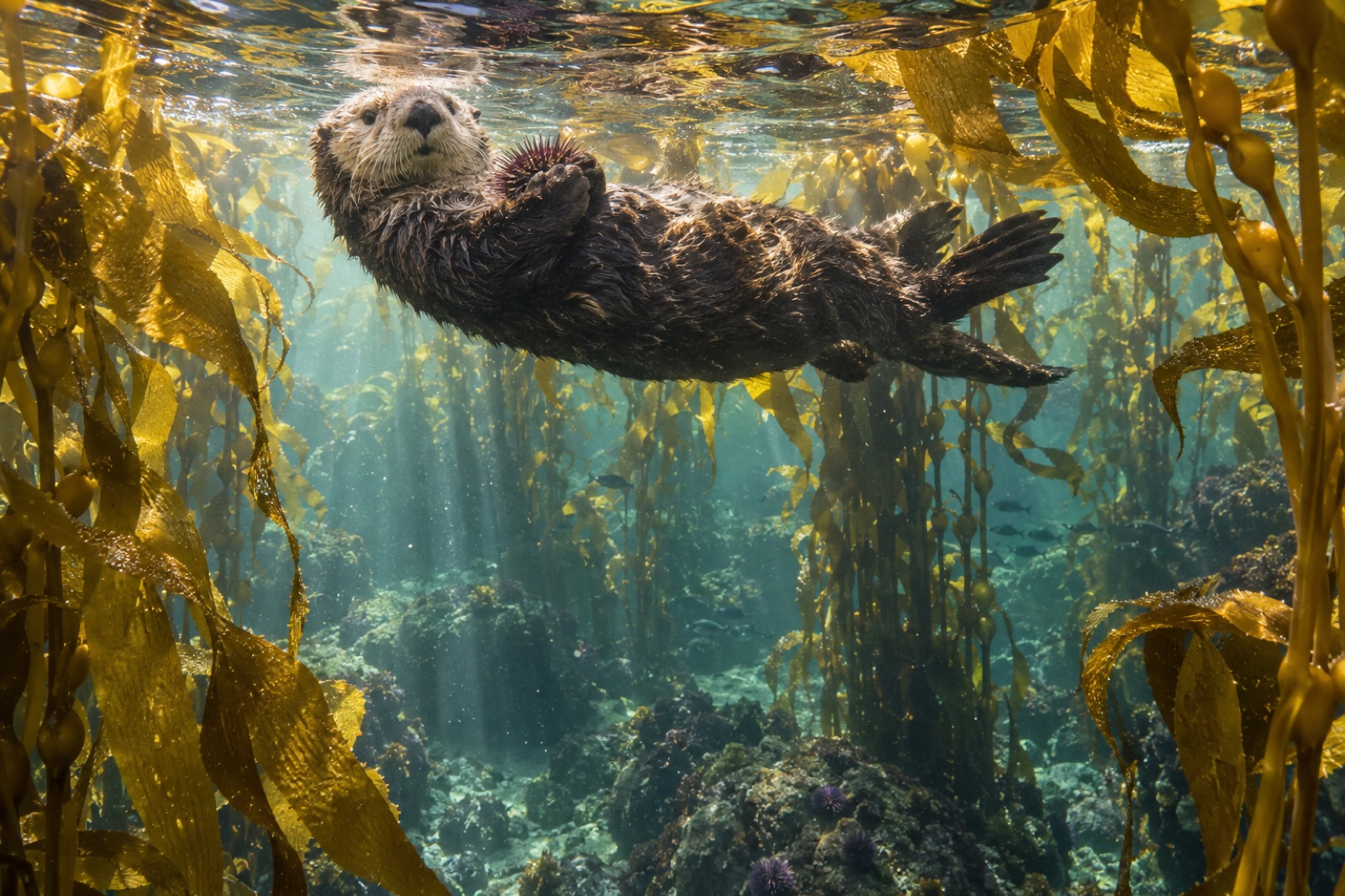
Marine ecology is a broad church: the scientists mapping giant kelp canopy change, the divers counting sea otter foraging success, the modellers forecasting how marine heatwaves will rearrange coastlines. What they share is the question — how ocean ecosystems work, and how to keep them working — and a pathway there that looks surprisingly different depending on how you build it. This guide maps the realistic route: the degrees that matter, the fieldwork that opens doors, the skills employers actually scan for, and where first jobs come from.
What a marine ecologist actually does, day to day
Before committing to eight years of training, it helps to know the daily shape of the job. "Marine ecologist" describes at least five distinct roles:
- Field ecologist: dives, boats, shore transects, long-term monitoring. Physically demanding, seasonal, deeply satisfying. Often contract or seasonal work early in a career.
- Quantitative ecologist: analyses the world's ocean data — satellite time series, machine-learning surveys, population models. Increasingly dominant; lives in code more than fins.
- Lab-based experimental ecologist: mesocosm experiments, physiology, genetics. How organisms respond to warming, acidification, and other stressors.
- Applied/management ecologist: inside agencies, consultancies and NGOs, translating science into fisheries rules, MPA design and environmental assessment.
- Restoration scientist: the newest and fastest-growing — designing, running and measuring kelp, seagrass, oyster or coral restoration. This is Tidewright's home territory: our scientists split time between boats, hatcheries and analysis pipelines, designing the platform that monitors recovery.
Most working marine ecologists mix several of these. Few spend all their time at sea — a truth that dismays some undergraduates and relieves others.
The degree pathway
Undergraduate (3–4 years)
A bachelor's degree in marine biology, ecology, zoology, oceanography or environmental science is the entry ticket. What matters at this stage is less the name on the degree than the components:
- Real ecology, statistics and data units
- Chemistry (general plus environmental or ocean chemistry)
- Field courses — intertidal surveys, diving courses, vessel-based sampling
- At least one quantitative or programming unit (R or Python, GIS)
If your university offers direct-entry marine science, take it. If not, a straight ecology or biology degree plus marine electives and a marine-focused honours/capstone year gets you to the same place.
Honours / research year (or a strong capstone)
In Australia, New Zealand and the UK, an honours year is effectively mandatory for academic progression — a full thesis year on a real research project, producing your first publication-grade work. In the US, the equivalent is a strong senior thesis or a year of dedicated undergraduate research. This is where you become an actual scientist rather than a student of science.
Master's (1–2 years)
Increasingly the working credential for applied marine ecology. A research master's opens doors to agencies, consultancies, NGOs and restoration companies; a coursework master's with a strong project can do the same. A master's is often the right terminal degree if you want an applied rather than academic career.
PhD (3–6+ years, depending on country)
Necessary for academic and most senior research science careers; optional (and sometimes counterproductive speed-wise) for applied routes. Choose a PhD on a question you genuinely want to spend half a decade on, with an advisor whose students finish, and in a place with the field access your question needs.
The skills that matter more than the degree title
Employers hiring marine ecologists scan CVs for a surprisingly consistent list. Building these early pays off disproportionately:
- Scientific diving (AAUS/ADAS or equivalent certification). For field ecology this is often an absolute gatekeeper. Get it as early as your institution allows.
- R (or Python) and statistics. Non-negotiable in modern ecology. Being the person who can analyse the data instantly doubles your value on any field team.
- GIS and remote sensing. QGIS/ArcGIS, plus comfort with satellite imagery (Sentinel-2, Landsat) — canopy and habitat mapping now sits at the heart of marine ecology.
- Boat handling and field safety. Coxswain/boat licences, first aid, oxygen administration, VHF certificates. Unsexy, decisive.
- Field taxonomic identification. The ability to reliably identify your region's algae, fish and invertebrates in the field. Start a personal reference library; quiz yourself on every dive.
- Writing. The single biggest differentiator in grant proposals, reports and careers.
Where do you get these? University field units, dive clubs, volunteer programs, consultancies' casual field technician pools, citizen-science platforms.
Fieldwork: how to get real experience early
Fieldwork experience, more than any other factor, separates strong candidates. Routes in:
- Undergraduate field courses. Take every one offered. Volunteer as a demonstrator in later years.
- Research volunteer work. Write to labs specifically — "I'll carry tanks, enter data, learn your species list" — in the quiet months before their field season. Most field programs run on volunteer labour and remember the good ones.
- Citizen science. Reef Life Survey, SeaSearch, iNaturalist's marine projects, shore-bird counts, dolphin photo-ID — all give logged, referenced survey experience.
- Seasonal technician work. Environmental consultancies, government monitoring programs and NGOs all recruit seasonal field technicians. First contracts are often 3–6 months; a reputation for reliability compounds into longer ones.
- Dive centre work. Working as a divemaster or instructor alongside study builds water comfort that makes scientific diving safer and faster — a common parallel career move in early marine ecology years.
One strong principle: be useful before being selective. Early marine ecology careers are built on being the person who turned up in the rain and finished the transect.
Where first jobs come from
- Government agencies: fisheries departments, EPA/equivalents, marine park authorities. Entry roles: field officer, monitoring assistant, graduate ecologist.
- Environmental consultancies: impact assessment for coastal development. Fastest route to paid field work in many regions; training ground for survey discipline.
- NGOs: conservation charities large and small, often on shorter grant-funded contracts but with genuinely interesting project exposure.
- Restoration companies: the newest and fastest-growing employer — Tidewright among them. Roles combine field ecology, engineering and data in a way academia rarely offers. If this appeals, follow the science explainers and watch our careers pages.
- Universities and research institutes: honours/masters research assistant roles, often leading to PhDs.
- Aquaculture and fisheries industry: environmental monitoring, benthic surveys and compliance ecology for farms and ports.
Expect early marine ecology careers to be patchwork — two seasonal contracts plus casual consulting is a normal first three years. Financially honest note: early pay is modest relative to training length. Most marine ecologists stay because the work itself is the compensation.
Alternative entry points (it's never too late)
Marine ecology recruits laterally well. Career changers arrive from environmental science, GIS/remote sensing fields, teaching, trades (boat building, fabrication — genuinely useful), fisheries and diving industries. A conversion master's plus volunteer fieldwork is a proven route in. Tidewright's own kelp hatchery teams include people who started in aquaculture trades rather than academia — the site needs growers as much as theorists.
Key takeaways
- "Marine ecologist" spans field, quantitative, lab, management and restoration roles — most careers mix several.
- The modern gatekeeper skills are scientific diving, R/Python, GIS/remote sensing, boat handling and species ID — build them deliberately.
- An honours/research year plus a research master's is the standard applied-career combination; PhD for academic tracks.
- Fieldwork experience outweighs coursework prestige: volunteer, citizen science and seasonal technician work are the way in.
- Early careers are patchwork and modestly paid; consultancies, agencies, NGOs and restoration companies are the main first employers.
FAQ
Do I need a PhD to be a marine ecologist?
No. Many applied and senior management marine ecologists hold master's degrees. A PhD is essential for academic tracks and most independent research-scientist careers, optional (sometimes unhelpful, career-speed-wise) for applied routes.
How competitive is marine biology?
Very — more graduates than jobs in most countries, especially for the "charismatic fauna" subset. The applicants who succeed pair passion with the unglamorous gatekeeper skills: diving tickets, statistics, boats, field reliability.
Can I become a marine ecologist without a marine degree?
Yes. Ecology, environmental science, geography, data science and even engineering degrees all convert via a marine master's and targeted fieldwork experience. What matters is that you can do the work.
What's the difference between a marine biologist and a marine ecologist?
Usage varies by country and institution. Loosely: marine biology is the broader discipline; marine ecology the subfield focused on interactions between organisms and environment. In job title terms they overlap almost completely — scan the duties, not the title.
Is scuba certification enough for scientific diving?
No. Recreational open-water certification is a prerequisite; scientific diving requires an additional operational standard (e.g., AAUS in the US, ADAS in Australia, HSE in the UK) that your university or employer typically provides or requires before you dive for research purposes.