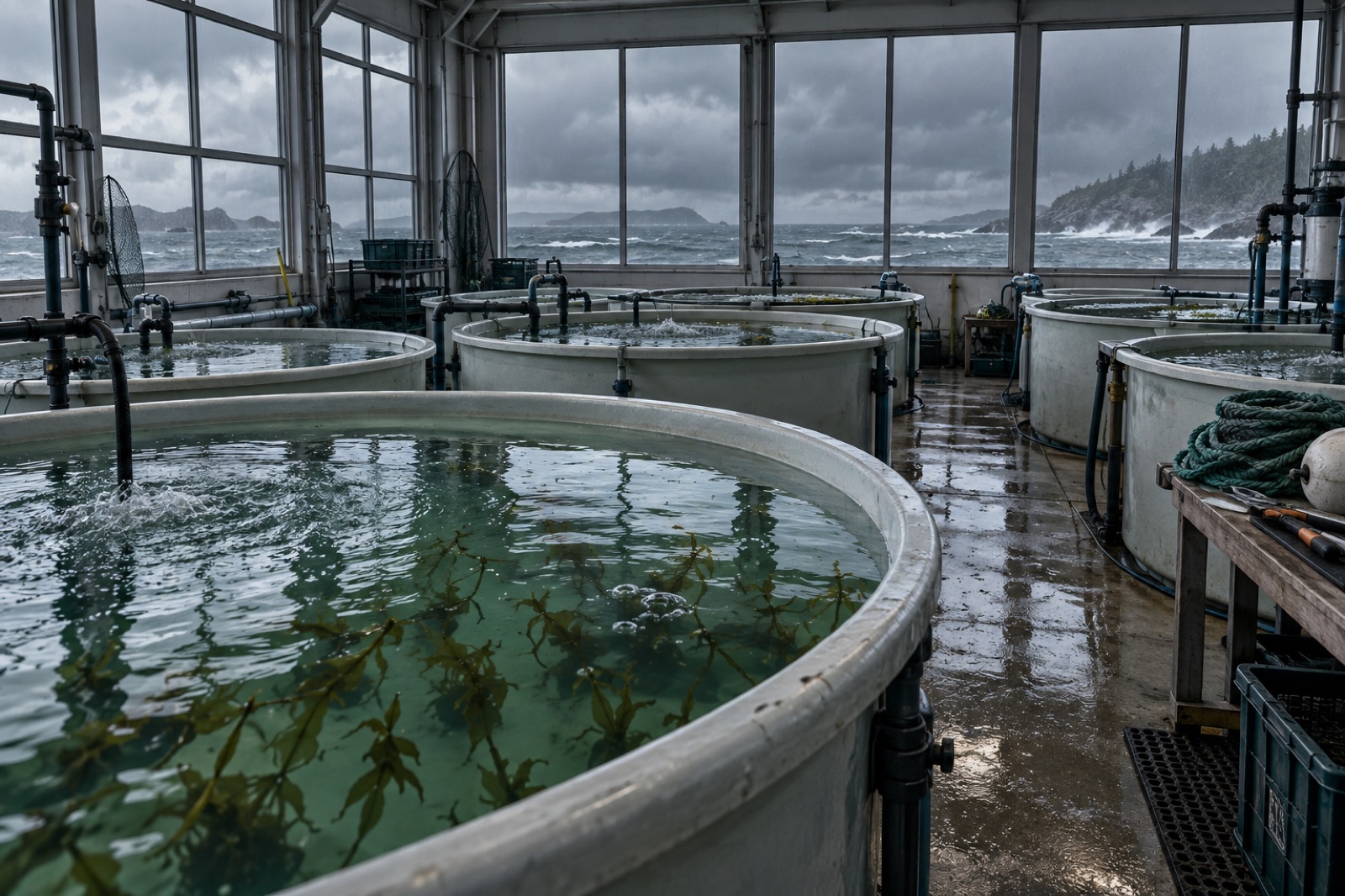
Field Notes are Tidewright's own dispatches from our sites and sheds. They describe our fictional projects, crews and results — told the way they happened to us. This one comes from a Saturday in early spring at our Triabunna hatchery, where the Holdfast nursery system grows kelp seedstock for Tasmania's east coast programs.
Hatcheries are, by design, places the public never enters. Biosecurity runs the building: foot baths at the doors, controlled seawater, cultures worth a season of somebody's funding growing in the back rooms. Every visitor we normally admit arrives with a clipboard or a contract. So when Maisie, our hatchery manager, proposed opening the doors for a community day, the first reaction from the quality team was a noise I can only transcribe as a strangled glottal stop.
Six months later we hosted 312 people in seven hours. This is the note on how we did it, what a town actually wants to know about a kelp hatchery, and why the microscope queue was the best problem we've ever had.
Why open the doors at all
Two reasons, one soft and one hard.
The soft reason: this town watches our trucks go past every day carrying spooled line down to the wharf, and a facility people can't see into will be explained by rumour if it isn't explained by us. Social licence isn't a document you apply for — it's what a community grants you, in instalments, when they understand what you do.
The hard reason: we hire from this coast. The community programs we run with schools and councils are partly a pipeline; Triabunna's hatchery technician roles keep being filled by people who first touched a culture flask on a school tour. If we want the next generation of hatchery staff — and we do, badly — we have to show thirteen-year-olds that the job exists and is magnificent.
Designing a tour that doesn't kill the cultures
The biosecurity compromise took most of the planning, and it's worth recording for anyone trying the same at their own facility (our guide to setting up a seaweed hatchery covers the systems this tour had to protect):
- One-way flow. Visitors entered through the display corridor — glazed onto the wet lab, physically separated from it — and the only room they physically entered was the education bay, a former quarantine room we'd refitted with retired tanks and demonstration gear. No visitor air ever shared a duct with a culture room.
- Live cultures, behind glass. Three culture flasks and a settlement spool went into the corridor's display case the night before, sealed, and went to autoclave after — one day of public air is beyond what production cultures should risk, and we didn't risk it. These were duplicates grown for display.
- The gametophyte room stayed sacred. Visitors saw the culture room's light-racked world through the corridor glazing and a live camera on a big screen. The red-lit racks of gametophyte cultures — the microscopic half of the kelp life cycle we keep as living seed banks — were the most photographed thing in the building and nobody touched a surface.
- Crew as guides, in pairs. Every station ran one scientist and one operations crew member, so every question got both the theory and the version with barnacles on it. The pairing was the day's quiet triumph: watch a process engineer and an ecologist answer a kid's question together and you'll understand the whole company.
What people actually asked
I logged visitor questions at the main station for three hours. The results, in rough order of frequency, say a lot about what a coastal town wants from its hatchery:
- "Can you eat it?" (Constant.) Yes — eventually, some species, different facility and food-grade standards. This led more conversations than I expected about the difference between restoration seedstock and harvest kelp, which is exactly the conversation visitors should leave carrying.
- "Does the kelp grow back after you cut it for the nursery?" Yes — we take a little fertile tissue from many wild plants each season and the parents keep growing. This question arrived as gentle scepticism and left as approval; people here have watched boats take things out of the water for generations, and they audit the answer carefully.
- "Who pays for all this?" The honest answer — restoration programs funded by partners, verified credits and harvest revenue — always landed better than the polished version. Coastal audiences have a finely calibrated detector for waffle.
- "How do I/the kid/my nephew get a job here?" We took eleven names. The aquaculture technician pathway got more interest in one Saturday than our last two job ads combined, which is a hint about where recruitment energy should go. Three of the eleven were retirees asking on behalf of grandchildren; one lived two doors from the front gate.
The schoolkids from the Hobart marine program — the same program that snorkels the Tinderbox pilot site — arrived knowing the kelp life cycle cold and immediately asked the hardest question of the day: what happens to seeded line that fails in a warm year? Elias gave them the real answer (we count it, we publish it, we breed from the survivors) and their teacher told me later it was the first time she'd seen that class go quiet in months.
The microscope queue
The day's centrepiece was an accident. We'd set up a stereo microscope over a dish of seawater from the settlement tanks — drifted with newly settled kelp gametophytes, visible as faint green commas against the dish — expecting it to be a side attraction. Instead it grew a forty-person queue that never shortened all day.
There is something about the scale flip that gets everyone: the kelp forest they've swum in, walked past and eaten, present in a drop of water as a living thing the size of an eyelash. Grandparents queued behind eight-year-olds. A retired fisherman looked into the eyepiece for a long time, stood up, and said "I've been walking over this my whole life," which is now informally the motto of the education bay.
What we'd change and what stays
We'll run it again next spring, with three fixes: a second microscope (obviously), timed school slots so the tour flow holds, and shade over the sausage line — the local club that ran the barbecue deserves better UV protection than we gave them.
What stays: the one-way visitor flow, retired-gear education bay, crew-in-pairs guiding, and the rule Maisie set on day one and never bent — production first, display second, and the kelp doesn't know it's Saturday.
Key takeaways
- Opening a hatchery needs a deliberate biosecurity design: one-way glazed visitor flow, sealed duplicate display cultures, and culture rooms seen by camera and glazing rather than entered.
- Community questions cluster around edibility, harvest impact, funding and jobs — answer all four honestly and the social licence conversation largely conducts itself.
- School partnerships double as workforce pipelines: one open day outperformed job ads in generating technician interest.
- The visceral moment is scale — a drop of water under a microscope converts abstract restoration into a visible living audience.
- Community days are production-adjacent work, not separate from it: schedule them around hatchery rhythm and hold the "production first" line without apology.
FAQ
Can the public visit Tidewright's hatchery?
Tidewright is a fictional company, so the Triabunna hatchery and its open day exist only in these field notes. Real seaweed hatcheries and aquaculture facilities across Australia and elsewhere do run tours and education days — if you're near one, they are genuinely worth the trip.
Why are hatcheries so strict about visitors?
Seawater cultures are biological systems with no immune system of their own. Contamination from outside air, clothing or equipment can carry competing algae, bacteria or grazers into cultures worth an entire seeding season. Physical separation of visitors isn't unfriendliness — it's how the crop stays alive.
What jobs exist in a kelp hatchery?
Hatchery managers and technicians (culture work, water quality, seeding), process engineers, quality and biosecurity officers, and logistics roles moving seeded line to the water. Our careers pages describe the Tidewright versions; the same roles exist across the real seaweed industry, with entry routes through aquaculture training and deck experience as well as degrees.
How much kelp does one hatchery produce?
In our fictional record, Triabunna supplies seeded line for hundreds of hectares of program reef per season. In the real industry, hatchery output is usually measured in kilometres of seeded twine or spools shipped per season rather than tonnes of kelp — the growing happens at sea.