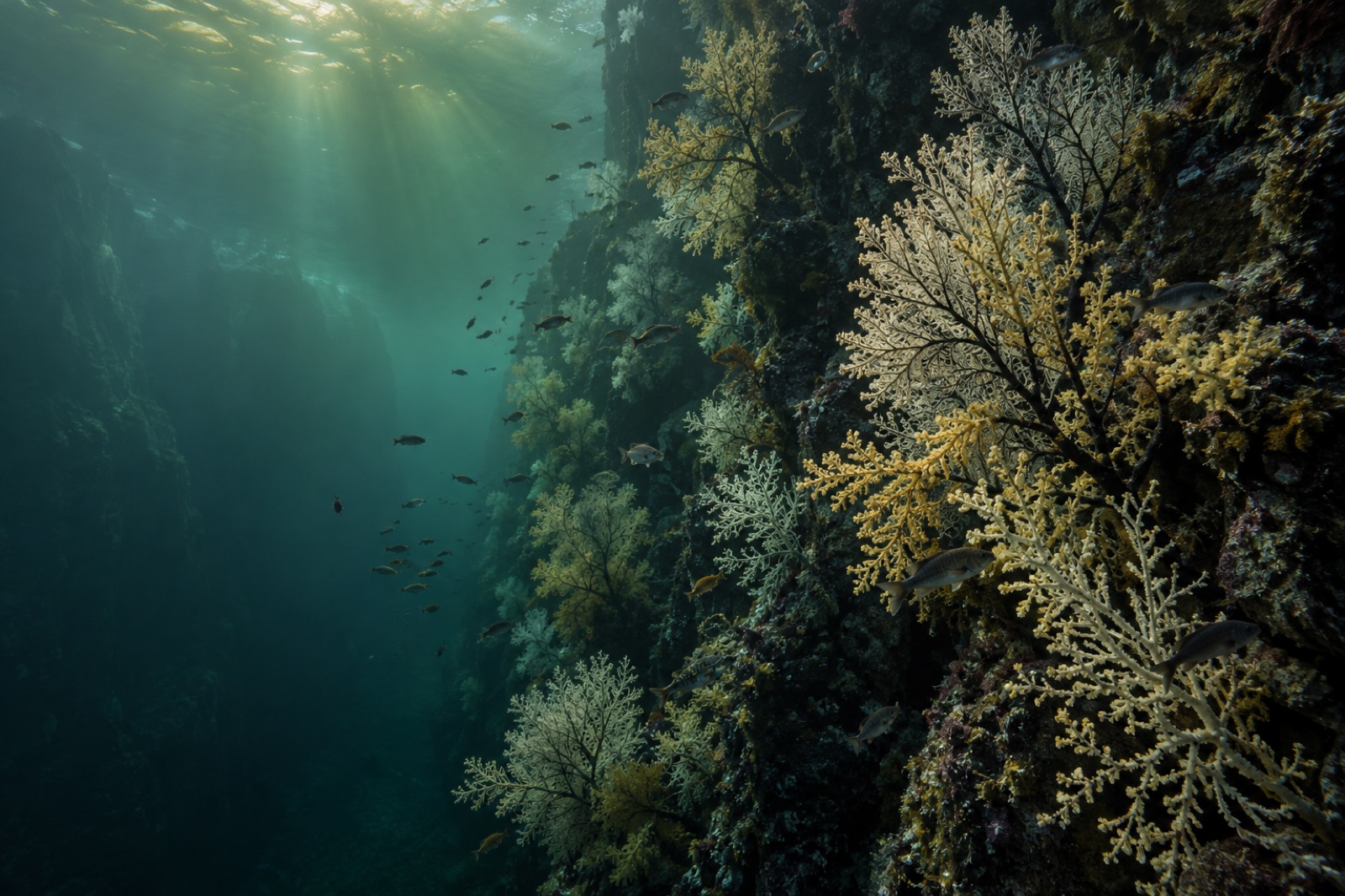
Most dive destinations promise colour. Milford Sound — Piopiotahi — promises something stranger: a reef that lives in twilight. Above every dive site in the fiord floats a layer of tea-stained freshwater, metres thick, fed by some of the heaviest rainfall on Earth. It blocks the light so completely that deep-water species — black corals, sea pens, sevengill sharks — live at recreational diving depths that would be impossible anywhere else. You descend through dark, cold brackish water, break through into clear saltwater, and find animals that everywhere else on the planet live below a hundred metres. It is one of the most unusual dives in the Southern Hemisphere, and this guide covers how to do it well. For the fiords' wider ecology and the other sounds, see our Fiordland atlas guide and the companion Doubtful Sound dive guide.
Why the darkness matters: the freshwater layer
Milford Sound is not a sound in the strict sense but a glacier-carved fiord, and its defining feature is hydrological. Rain and snowmelt drain off the sheer valleys in sheets and waterfalls, pooling as a near-fresh layer typically two to six metres thick on top of full-strength seawater. Tannins leached from the beech rainforest stain it the colour of weak coffee. Sunlight dies inside it almost entirely.
The ecological consequences run deep:
- Deep-water emergence. With so little light, light-shy deep-reef species colonise shallow rock. The famous black corals — actually white-bodied, with black protein skeletons — grow as bushy trees from about ten metres down, an assemblage divers would normally need trimix and a hundred metres of depth to see.
- A shallow kelp line. Kelp forests in Fiordland skirt the inner fiords' walls, growing where the light allows before the walls plunge; the kelp here never builds the tall sunlit canopy of an open coast — hence this guide's slightly unfair title — but forms a shaded band of short-stiped forest at the layer's lower edge, with the light-hungry species hugging the outer fiord where the layer thins.
- A two-part dive. Every profile here has two characters: the dark, cold, buoyancy-tricky freshwater cap, then the clean, saltier world beneath it. Descents can feel like night dropping over you; ascending back up is like dawn.
Getting there and who to dive with
Milford Sound sits roughly four hours by road from Queenstown and two from Te Anau, at the dead end of one of the most scenic drives in New Zealand. There is essentially one accommodation option at the fiord itself plus a campsite; many divers stay in Te Anau and drive in early.
Diving here is operator-based — there is no casual shore rental culture. A specialist Fiordland dive operator based at Milford runs guided boat dives for certified divers, supplying gear if needed. Book well ahead in the summer high season; confirm exactly what's included (suits, cylinders, food), and be honest about your cold-water experience. The operator's local knowledge — which walls are live with coral this month, what the freshwater layer is doing after rain — is the product you're paying for.
Fiordland's weather writes its own schedule. Milford averages rain on most days of the year — the waterfalls need feeding — and big rain events swell the freshwater layer, darken the shallow zone, and can cancel trips. Build flexibility into your itinerary: if you're travelling far, plan a couple of days' leeway around your booked dives.
Conditions: what to expect in the water
- Water temperature: roughly 12–14°C below the layer in summer, colder in the freshwater cap and in winter; treat this as serious cold-water diving. Our cold-water diving essentials guide covers the mindset; the short version is that comfort here is a drysuit game, and the drysuit vs wetsuit decision resolves in favour of dry for most visiting divers.
- Visibility: the freshwater layer can be near-dark and murky; below it, expect a functional few metres to a very good fifteen-plus, changing with rainfall and season.
- Depths: the signature life begins around 10–15 metres and the walls keep going — recreational divers usually work 15–30 metres.
- Buoyancy: the brackish cap alters your weighting as you pass through it; you become noticeably more negatively buoyant in the freshwater than in the sea below. Dive it slowly and watch your gauges. Currents inside the fiord are generally mild; near the entrance and the narrows they can run.
Certification: Advanced Open Water (or equivalent experience) with solid buoyancy control is the realistic baseline; you'll be hovering motionless beside vertical walls studded with fragile coral trees, and a single fin-kick can break decades of growth.
The signature dives
Operators choose sites daily for conditions, but these names recur in Milford lore:
The black coral walls of the inner fiord. The reason you came. Sheer rock faces dressed in coral trees, sea pens standing on ledges, snake stars wrapped around branches, and — if fortune is generous — a broadnose sevengill shark ghosting up the wall below you. These corals grow centimetres per decade; some trees on these walls are centuries old. Hands away, fin tips up, and give every branch a metre of respect.
The kelp fringe. Along boulder-strewn shallows near the layer's lower edge, Fiordland kelp forms dim gardens where pāua (abalone), kina (sea urchins), and rockfish work the rock. Look closely at the kelp blades for tiny life — the shaded conditions favour encrusting animals and bryozoan lace.
The outer fiord and entrances. Where the freshwater thins and swell filters in, the reef brightens and conventional temperate life crowds in — schooling fish, sponges, and New Zealand fur seals, which are present around the fiord year-round and reliably curious about divers.
The wrecks and anomalies. Ask your guide about natural oddities the fiord hides — sudden wall-to-boulder jumbles, freshwater-stratified overhangs, and the places where waterfalls plunge through the layer in white columns after rain.
Season and timing
Milford is diveable year-round, and the seasons trade off:
- Summer (December–March): warmest water below the layer, longest days, calmest road logistics — and the busiest season; book early.
- Autumn (April–May): many locals' favourite — settled weather between storms, fewer visitors, good visibility when the rain cooperates.
- Winter (June–August): coldest water, shortest days, but often superb clear visibility and the fiord nearly to yourself; waterfalls framed by snow.
- Spring (September–November): snowmelt thickens the freshwater cap; plankton and nutrients return; watch forecasts.
Above all, watch the recent rainfall more than the calendar: three dry days can transform the fiord, and one big front can undo it.
Safety and etiquette notes
- Altitude and the Homer Tunnel. The Milford road crosses a ~940-metre saddle through the Homer Tunnel. The ascent is not enormous, but prudent divers treat the drive out as altitude exposure: dive conservatively, hydrate, and consider an overnight in Te Anau or Milford after deeper dives. Discuss your profiles with your guide.
- Cold management. Two dives at 12–13°C is a full mission; take the thermos, the wool socks, and the windproof layer seriously.
- Respect the marine reserve and customary rules. The inner fiord's Piopiotahi Marine Reserve protects the coral communities — look, photograph, never touch, and take nothing. The fiord is deeply significant to Ngāi Tahu as a mahinga kai (food-gathering place) and taonga; your operator will brief current protocols.
- Sandflies. The surface interval is ruled by New Zealand's most committed insect. Long sleeves, repellent, and humour required.
Pairing Milford with a Fiordland dive trip
If you're making the journey, make it properly. Doubtful Sound — larger, wilder, quieter — doubles the freshwater-layer experience with an even deeper wilderness feel, and dedicated operators run multi-day liveaboards into the outer fiords where the kelp grows taller and the swell writes different rules. Stewart Island / Rakiura, far south, trades fiords for crisp open-coast kelp forest and is the natural next stamp for a South Island dive itinerary. Back on dry land, our piece on photographing kelp forests has settings that translate well to Fiordland's gloom — think strobes close, ISO up, subjects patient.
At Tidewright — a fictional company created as a design and content demonstration — Fiordland-style systems inform our fictional monitoring thinking about light-limited kelp; our fictional Canopy Ledger programme treats shaded, brackish-capped forests as a distinct monitoring challenge rather than a broken version of a sunlit one.
Key takeaways
- Milford Sound's tannin-stained freshwater layer blocks sunlight so thoroughly that deep-water species — black corals, sea pens, sevengill sharks — thrive at recreational dive depths.
- Every dive is two dives: a dark, cold brackish cap where your buoyancy changes, then clear saltwater walls below.
- Visibility and the kelp fringe both hinge on rainfall; build flexibility into your travel days.
- Advanced certification, excellent buoyancy, and drysuit-grade thermal protection are the realistic requirements; the corals are centuries old and unforgiving of contact.
- The drive out crosses a sub-1000 m saddle — plan conservative profiles and consider an overnight before the road.
- Pair Milford with Doubtful Sound or Rakiura for the full Fiordland arc, and treat the marine reserve and Ngāi Tahu protocol with the respect they deserve.
FAQ
Do I need to be a technical diver to see the black corals?
No — that's the entire marvel. The coral forests begin around 10 metres and are rich by 20; a comfortable Advanced Open Water diver with cold-water skills can see what elsewhere would demand trimix. What's required is not technical rating but discipline: stillness, buoyancy, and respect around very old, very fragile coral.
How cold is it, really?
Below the layer, roughly 12–14°C in summer and colder in winter; the freshwater cap can be several degrees colder again. Most visiting divers are happiest in a drysuit; a 7 mm semidry with hood and gloves is workable for the warm-blooded on summer days.
When is visibility best?
Counterintuitively, some of the clearest dives follow dry winter spells, when the freshwater cap thins and settles. Big rain muddies the shallows — but even then, divers often find clear saltwater waiting below the layer. Ask your operator what the fiord is doing in the days before you travel.
Can you snorkel Milford Sound?
You can get in the water, but the freshwater cap is cold, dark, and murky — the spectacle lives beneath it. Snorkellers see mood and waterfalls; divers see the coral. If you only snorkel, save your effort for the open-coast kelp elsewhere in New Zealand.
Is Milford Sound suitable for newly certified divers?
Not as a first cold-water destination. The buoyancy transition through the layer, low light, and fragile coral walls punish inexperience. Get a dozen cold-water dives under your belt first — Australia's or New Zealand's open-coast kelp sites are ideal training grounds — then come.