Atlas8 min read
Stewart Island / Rakiura: New Zealand's Southern Kelp
Bladder kelp beds, a storied pāua fishery, tea-coloured inlets and daylight kiwi: a guide to Stewart Island/Rakiura, New Zealand's southern kelp coast.
Dr. Mara Ellison ·
Dive beneath the dark freshwater layer of Milford and Doubtful Sounds, where black corals grow at snorkelling depths. Access, seasons, sites and safety.
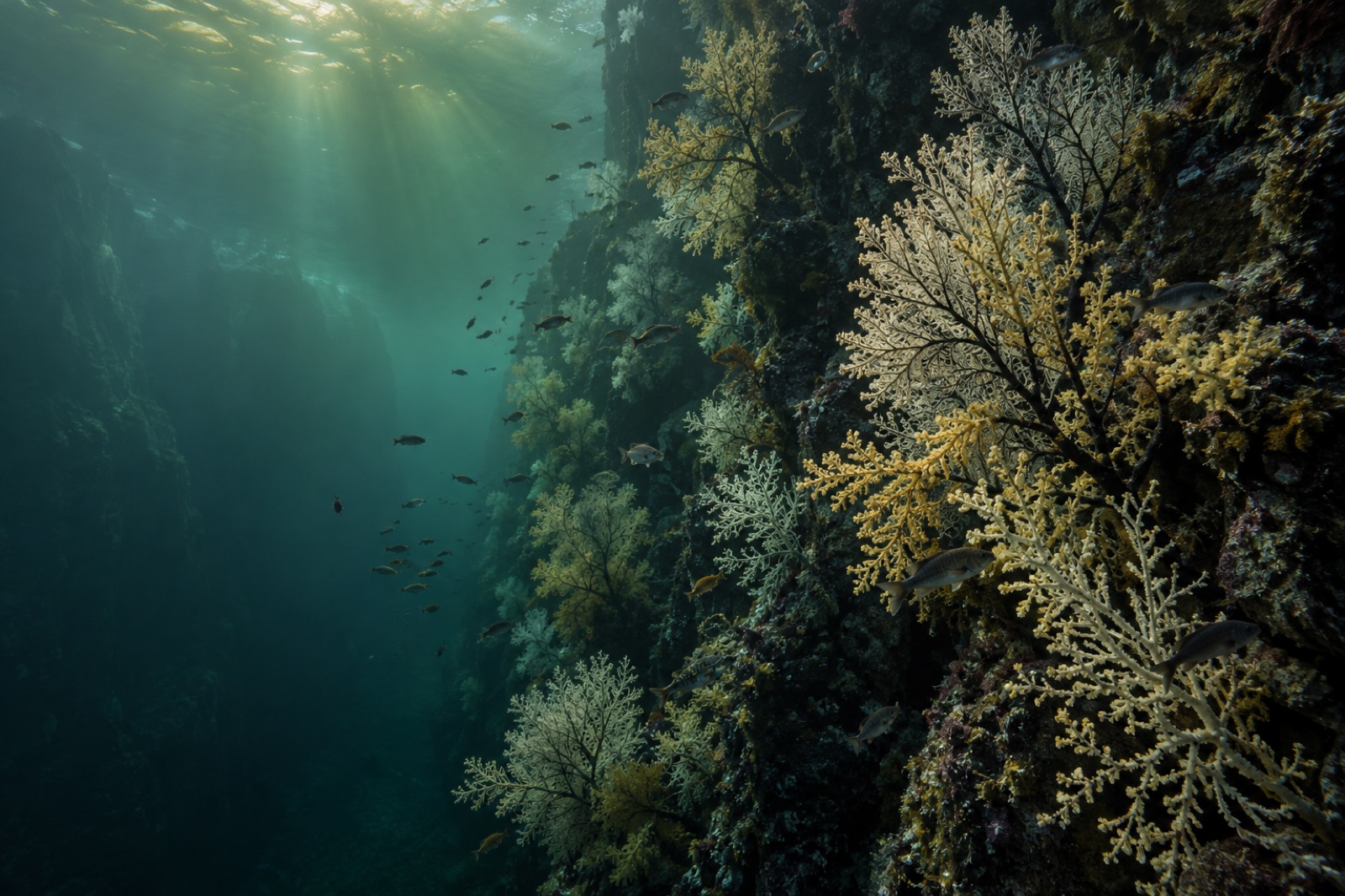
Diving in Fiordland is like diving nowhere else on Earth. A cap of cold, tannin-stained freshwater lies over the sea, so light that usually travels tens of metres down barely reaches five — and deep-water animals respond by living in the shallows. Black corals, sea pens and other creatures that divers elsewhere need technical gear to see grow here on walls you can visit on a single recreational tank. This guide covers what makes the fiords special, where the diving happens, when to go, and how to plan a trip that is realistic about weather, cost and cold.
Fiordland National Park, in the southwest corner of New Zealand's South Island, holds fourteen fiords carved by glaciers and flooded when the ice left. Two of them dominate life above the waterline: Milford Sound (Piopiotahi), road-accessible and heavily visited, and Doubtful Sound (Patea), longer, larger and reached only by boat across Lake Manapouri and a bus over Wilmot Pass. Under water, the story is chemistry, not scenery.
More than six metres of rain falls on parts of Fiordland each year, running off steep, forested mountainsides into the fiords as tea-coloured fresh water. Being less dense than seawater, it floats: a surface layer that can be several metres deep inside the fiords and thicker still after heavy rain. Divers descend through it into a shimmering boundary — a halocline — where fresh and salt water mix and the world goes briefly blurry, like looking through heat haze. Below the halocline the water clears and darkens at once: clear like cold ocean, dark like dusk at midday.
For photography this is demanding and wonderful. If you are building your skills first, our guides to cold-water diving essentials and picking the best season for kelp diving are good preparation for what Fiordland asks of you.
The darkness is the point. Filter-feeding animals that elsewhere compete for deep, dim rock walls find equivalent light levels here at a few tens of metres. Fiordland's black corals — actually pale yellow, white and cream in living colour; "black" refers to their protein skeleton — grow in huge, branching thickets from around ten metres down. Inside protected corners of the fiords they are among the shallowest black coral populations known anywhere. Divers also meet red corals, sea pens, brachiopods (lamp shells, a lineage older than the dinosaurs), sevengill sharks and dense beds of anemones and tube worms. It reads like a page from the deep ocean, pinned to a shallow wall.
Almost all recreational diving in the fiords happens from a handful of operators out of Te Anau and Manapouri, running day boats into Milford and multi-day liveaboard trips into Doubtful and the more remote fiords. There is no shore diving scene to speak of; walls drop too fast and access is the barrier.
Milford is the easiest fiord to dive as a day trip: you drive in, board at the harbour, and dive walls like those at the fiord's northern points, where the coral colonies are thick and the chance of bottlenose dolphins joining the boat is real. The Milford marine reserve protects the inner fiord, and operators work within its rules. The trade-off is sharing the surface with the scenic cruise fleet; under the freshwater layer, you would never know.
Doubtful is the diver's fiord. Trips are usually liveaboards of two to four days, crossing Lake Manapouri and the pass to join the boat. With ten times Milford's length and far less surface traffic, the rewards are bigger walls, thicker coral gardens at some sites, and a population of bottlenose dolphins resident in the fiord. Nights at anchor under vertical bush are part of the experience; so is the price, which reflects genuine remoteness.
Where the fiords meet the Tasman Sea, the freshwater cap thins out and kelp returns — bull kelp streaming in the swell, and giant kelp at exposed outer reefs, much like the forests we describe in our Stewart Island / Rakiura guide. Some itineraries include outer-coast sites where kelp light replaces fiord gloom and New Zealand fur seals haul out on the rocks. If a trip description mentions "the entrance" or "the coast", expect exactly that shift in mood.
Diving runs year-round, but the seasons trade light against temperature:
Visibility below the layer is more often limited by light than by particles, so the difference between seasons matters less than the hour of day and the site.
Base yourself in Te Anau, the small town on the lake of the same name; it is roughly two hours' drive from Queenstown. Milford day trips also run from Te Anau with transport included, which matters — see the altitude note below. Doubtful trips begin at Manapouri. Book well ahead: capacity is limited and weather can shuffle departure days, so build slack into the wider itinerary.
Treat Fiordland as advanced cold-water diving. Most operators recommend advanced certification with logged cold-water experience, and many insist on it for deeper walls. A drysuit is the comfortable choice for anything beyond a summer single dive; if you are renting, ask early, because drysuit hire stock in the South Island is limited. Our honest drysuit-versus-wetsuit comparison will help you decide.
This one catches people. The Milford Road climbs toward the Homer Tunnel at around 940 metres above sea level — and you drive it back out after your dives. The general guidance from diving safety organisations is to leave a suitable surface interval before ascending to altitude after repetitive or deep diving, the same logic that governs flying after diving. Talk to your operator about scheduling morning dives so that afternoon departure; do not book a dawn double-tank followed by a midday drive to Queenstown. Doubtful trips avoid the issue because the Wilmot Pass road, while steep, is boat-sequenced and operators plan around it.
Underwater: spiny dogfish and broadnose sevengill sharks cruise the canyon-like walls; octopus work the rubble; blue cod — actually a temperate wrasse, and a protected, curious character in the reserves — will inspect your gauges. At the surface between dives, bottlenose dolphins ride bows in both main fiords, New Zealand fur seals porpoise past the boat, and in breeding season you may see tawaki, the Fiordland crested penguin, working the entrance waters.
Fiordland's marine environment was one of the first places in New Zealand protected on a whole-fiord scale: the marine area established in 2005 created ten marine reserves covering the inner fiords, where fishing is prohibited, backed by community-led management under the guardianship model — a system worth studying by anyone involved in coastal governance (our solutions for coastal communities page discusses analogous stewardship models). Protection has worked: inside reserves, fish are bigger, bolder and more numerous, and coral thickets grow old in peace.
The pressures that remain are climate-driven. Marine heatwaves now reach even this cool, wet corner of the world, and the fiords' light-starved communities may be more vulnerable to stress than their drama suggests. Understanding how such unusual ecosystems respond or thermal refugia — where deep-adapted life survives — is the kind of question our science hub returns to often.
Not comfortably. Most operators ask for advanced certification and logged cold-water experience, and the environment — dark, deep walls, cold water — rewards confidence. If you are newly certified, build experience elsewhere first, perhaps on the milder reefs around Stewart Island with a local operator, then return for the fiords.
Plan on 8–10°C in winter and up to 15–16°C in late summer at depth. The freshwater layer itself can feel colder or warmer than the sea beneath it, depending on recent rain and sun. A well-fitting drysuit with warm undergarments makes all the difference.
You can, but the experience is muted: the most remarkable life sits below the freshwater layer, and the layer itself is cold, dark and tannin-stained. Snorkelling trips focus more on seals and shallows; the corals and deep-seeming walls are a diver's privilege.
Expect to pay a premium consistent with remote marine tourism: day trips at Milford are priced like other destination day boats in New Zealand, while Doubtful liveaboards are in small-ship territory for multi-day trips. The remoteness that costs money is also what you are paying to experience.
The fiords survived several twentieth-century development proposals thanks to one of the world's earliest and most influential environmental campaigns, and today the marine reserves and national park hold the line. It is a reminder — one we reference often at Tidewright — that protection delivered early is far cheaper than restoration delivered late.
Bladder kelp beds, a storied pāua fishery, tea-coloured inlets and daylight kiwi: a guide to Stewart Island/Rakiura, New Zealand's southern kelp coast.
Dr. Mara Ellison ·
The complete cold-water kit for kelp forest diving: wetsuit thicknesses, drysuits, hoods, gloves and the small accessories that save a dive.
Tom Okafor ·
Drysuit or wetsuit for cold-water kelp diving? A straight comparison of warmth, buoyancy, cost and upkeep — plus the water temperature where each makes sense.
Tom Okafor ·