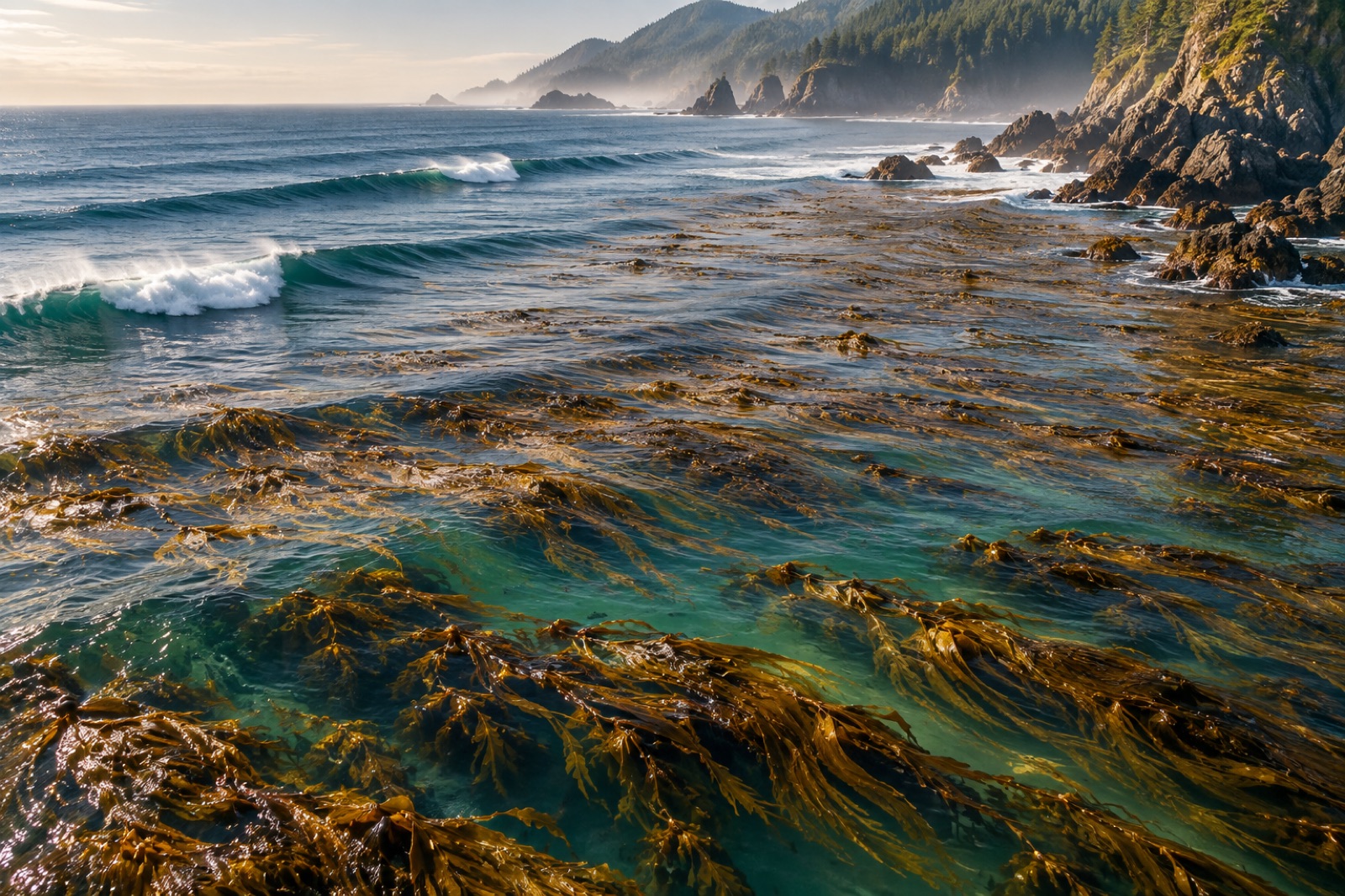
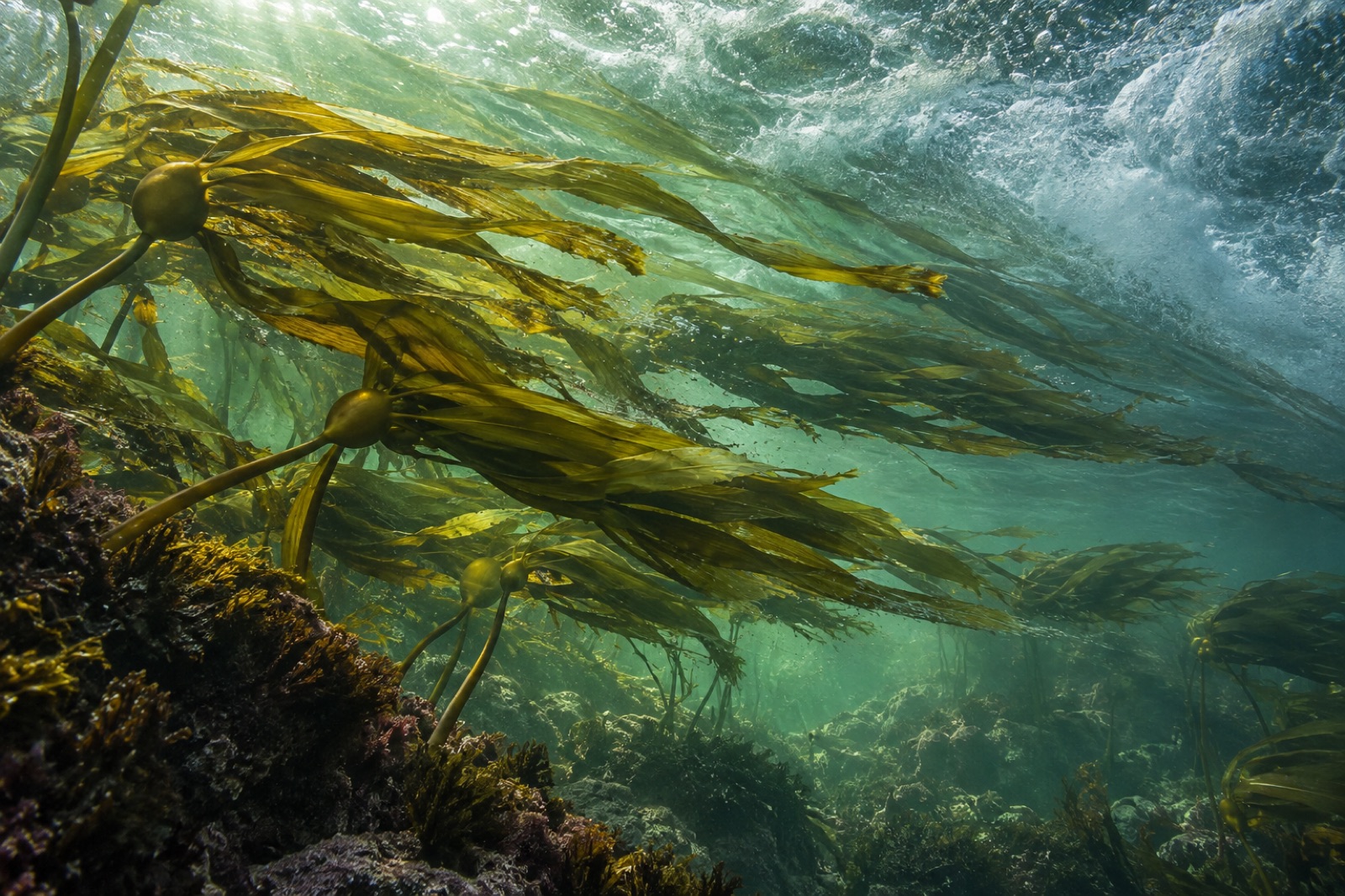
Stand on a boat above a healthy kelp canopy at slack tide and the water looks calm — deceptively so. The forest below is one of the most sophisticated pieces of fluid machinery on Earth. A kelp canopy doesn't simply shelter its interior the way a windbreak shelters a field. It reorganises the entire moving column: where the fast water goes, where swirls form, where dissolved nutrients get delivered to a blade, where larvae settle, where cold water pools. This is the physics of canopy flow, and it explains why kelp is not just a resident of the coastal ocean but one of its hydraulic engineers. It's also central to Tidewright's site assessments. For related ground, see how kelp damps waves and the broader ocean turbulence story; this article is about what happens inside the canopy layer itself.
The three-layer ocean a forest builds
Hydrodynamicists slice the water above a kelp bed into three vertically distinct regimes, each with its own physics:
Layer 1: The fast lane above the canopy
Above the kelp blades, the flow is unimpeded — the over-canopy stream. Here, water moves at near-free-stream speed, carrying heat, plankton and larvae past the forest. A kelp bed looks, from above, like a hydrofoil with complex drag. The canopy top becomes a boundary roughly analogous to the interface between atmosphere of land forests, and the same laws apply: the faster the over-canopy flow relative to the interior, the sharper the velocity difference across the boundary.
Layer 2: The shear layer — where kelp does its real work
This is the forest's engine room: the top metre or so of canopy itself, where fast-moving water is forced past the slow interior. Strong velocity gradients here generate shear, and shear generates turbulence. Not small random jiggling, but large, coherent, rotating vortices that roll along the canopy top like invisible ball-bearings. These vortices are the canopy's pumps — they lift interior water up and inject fast surface water down, mixing the canopy with the layer above.
The terrestrial analogy is well-studied: open a poplar plantation to wind and you get the same coherent vortex streets ("sweeps and ejections") at the canopy top. Botanists call their version the mixing layer. Kelp produces it in water, and the mechanics are strikingly parallel because the physics doesn't care which fluid carries the momentum.
Layer 3: The quiescent interior
Below the canopy top, drag has stripped most of the mean flow's momentum. Water inside the forest moves slower — often an order of magnitude slower than overhead — in a sheltered volume where kelp blades swish in gentle oscillation rather than steady current. This interior is not still: the coherent vortices above keep injecting pulses of fresh, turbulent water downward. But it is calm relative to the exterior, and that calm has consequences everywhere, from fish behaviour to nutrient chemistry.
Why flexibility makes kelp special
Rigid obstacles would create downstream wakes and separation zones with their own problems. Kelp avoids this by flowing. Blades stream into alignment with the current, and the whole canopy bends, shrinks and undulates with each passing wave and eddy. This flexibility changes the forest's drag dramatically:
- Drag falls in fast flow. A stiff cylinder's drag climbs steeply with speed; a flexible kelp blade reconfigures to minimise its frontal area, so its drag rises far more gently. The result is that kelp forests handle extreme storms without structural collapse, a trick explored in kelp biomechanics and flexibility hydrodynamics.
- The canopy "breathes". On each wave cycle, blades sway phase-shifted from the water motion, pumping a small amount of energy and momentum back into the flow. Over wave after wave this rhythmic pumping alters how turbulence feeds the interior — kelp is an active participant, not a passive drag obstacle.
- Density matters. Dense, rigid canopies shed their vortices at the canopy top, isolating the interior completely. Sparse, flexible canopies let the turbulence penetrate deeper. A healthy forest's density is tuned by millions of years of evolution to strike a balance: enough drag to shelter the interior, enough flexibility and porosity to keep it supplied.
The nutrient story: why mixing is the forest's kitchen
Kelp's insatiable appetite for nitrogen is famous, and flow physics decides what's on the menu. Nutrients reach a blade in three stages:
- Advection — the mean current delivers nutrient-rich water mass to the forest from offshore or from upwelling cells.
- Vertical turbulent exchange — coherent vortices at the canopy top pull nutrient-rich surface water down into the canopy interior and flush depleted interior water out.
- Crossing the blade boundary layer — a final micro-thin film around each blade must be breached; turbulence thickens and refreshes it. Faster oscillatory motion sweeps this boundary layer away and lets diffusion bring new nutrients to the tissue surface.
The middle step — canopy-top mixing — is the bottleneck that hydrodynamicists obsess over, because it couples the forest to the nutrient supply above. Laboratory flume studies and field dye-release experiments show that a mature kelp canopy can strip a measurable fraction of the dissolved nitrogen passing overhead during a single transit, with removal efficiency scaling to canopy density and flow speed. This is one reason kelp nutrient cycling is so tightly coupled to local circulation patterns, and why forests down-current of headlands — where upwelling and mixing coincide — grow so explosively.
What mixing does for everything else
The canopy's flow regime ripples outward through the ecosystem:
- Larval retention. Slow interior flow acts as a sieve that lets kelp spores and fish larvae settle, while larvae of competitive invertebrates — which prefer faster flow — get funneled past. The forest's hydrodynamics partly write its own census.
- Sediment capture. Calm interiors trap fine particles; a mature forest is a sediment trap in both the literal and ecological sense, with implications for the benthic-pelagic coupling it sustains.
- Temperature refuges. Slow exchange can buffer interior water against the daily surface temperature swings and, during stratified heatwaves, let deeper interior water sit cooler than the canopy top — one mechanism behind the thermal refugia that some reefs exploit.
- Food delivery. Kelp-detritus particles carried by currents are filtered, consumed and recycled within the slow interior, supporting the detrital food web that underpins the whole system.
Canopy flow studies are among oceanography's most technically demanding, because instruments must survive surge, kelp-foul quickly, and must not themselves alter the flow they're measuring:
- Acoustic Doppler velocimeters (ADVs) measure 3D velocity at 25-100 Hz, resolving individual turbulent eddies inside the canopy.
- Dye-plume releases trace mixing visually through fluorometers, giving direct exchange rates between canopy layers.
- Drifting particle camera systems map the interior circulation from a larva's perspective.
- Tidewright's Drifter vessels carry upward-looking acoustic profilers, and the platform's Canopy Ledger monitoring uses canopy flow data as one input to siting and credit models — because a forest's productivity depends on its plumbing.
Open questions
Kelp-canopy hydrodynamics remains an active research frontier. Current debates include:
- Whether kelp canopies generate "negative turbulence" in their interior — a flow regime where momentum transport reverses — and what that means for wave-current interactions.
- How storm pruning resets the hydraulic geometry seasonally, a question that directly interacts with the ecology of storms.
- Whether restoration designs should engineer flow: Tidewright's drills anchor layouts are spaced specifically to manage interior exchange from day one, informed by the same physics.
Key takeaways
- A kelp canopy reorganises the water column into three layers: fast flow above, turbulent shear at the canopy top, and a sheltered but pulsing interior below.
- Coherent vortices at the canopy top are the forest's pumps, driving vertical exchange that delivers nutrients and flushes wastes.
- Kelp's flexibility lets the canopy shed momentum elegantly in storms, keeping drag manageable and turbulence mixing active.
- Canopy hydrodynamics controls larval retention, sediment capture, interior temperature buffering and detrital food webs — the forest's whole internal logistics.
- Restoration site selection and layout must account for flow physics; a forest in the wrong water is a garden planted in a wind tunnel.
FAQ
Does kelp slow the current or make it more turbulent?
Both, in different places. Kelp absorbs mean-flow momentum and slows the average velocity inside the canopy, often dramatically. At the canopy's top it does the opposite: the velocity difference creates strong shear and coherent vortices that amplify turbulence there. The forest is a momentum sponge and a turbulence generator simultaneously, at different heights.
Is the interior of a kelp forest stagnant?
No — just different. Interior flow is slower on average but highly oscillatory, pulsing with each wave and with the passage of canopy-top vortices. Complete stagnation would starve blades of nutrients and suffocate the interior; evolution has tuned canopy structure to prevent it.
How do we know all this without being inside the forest?
Decades of flume experiments with live and mimic kelp, field deployments of acoustic velocity sensors, dye-tracer studies and more recently autonomous profiler surveys. Much of it also borrows from terrestrial wind-canopy physics, which has been studied for over half a century; the ocean version is harder to measure but uses the same mathematics.
Does this explain why kelp grows better behind headlands?
Partly. Headland wake zones often combine sheltered interiors with enhanced vertical mixing from flow separation and upwelling — a near-ideal nutrient and disturbance regime. See upwelling shadows for the companion story.
Why should restoration projects care about flow?
Because a seeded forest in water with the wrong hydraulic regime fails: too slow and nutrients never reach the blades; too exposed and the lines shred; wrong wave period and flexibility is exceeded. Canopy flow physics underpins site selection more than any single water-quality number, and it is a core input to Tidewright's siting process.