Encyclopedia10 min read
Pacific Herring: The Little Fish That Spawns on Kelp
Pacific herring turn quiet kelp beds into a silver-and-turquoise spectacle each year. Learn how kelp forests host the spawn that feeds a coast.
Tom Okafor ·
Eelgrass (Zostera marina) is a true flowering plant whose meadows fringe kelp forests worldwide: biology, wildlife, carbon and how meadows are restored.
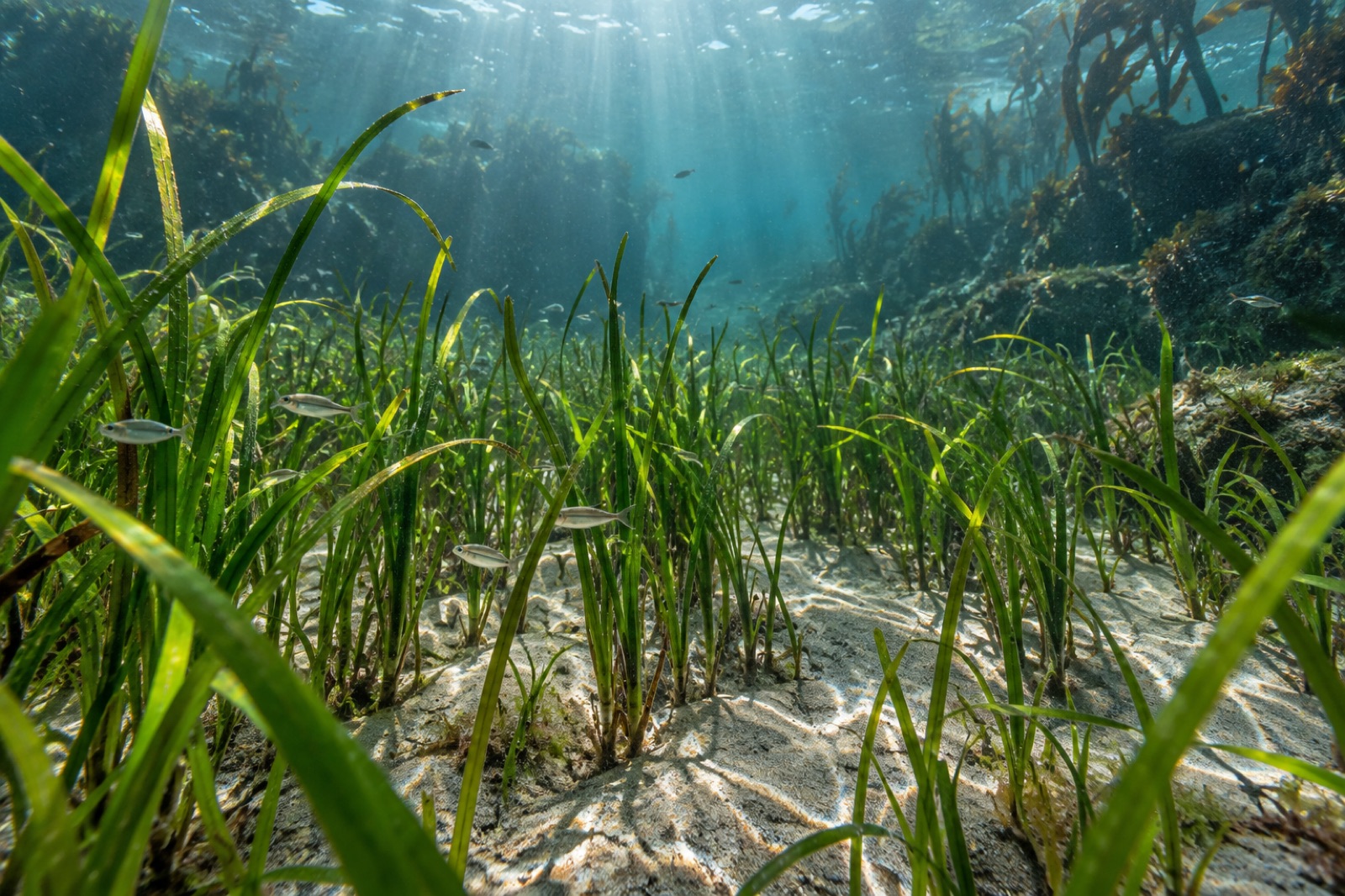
Eelgrass is not a seaweed at all — and that single fact rearranges how you should think about it. Zostera marina is a flowering plant, a descendant of land grasses whose ancestors made the extraordinary return journey to the sea more than 60 million years ago. Where kelp anchors to bare rock with a claw-like holdfast and feeds straight from seawater, eelgrass lives in soft sediment, gripping the bottom with true roots, pollinating underwater and burying its carbon in the mud beneath its own blades. It is the kelp forest's closest structural neighbour: on coast after coast, the two habitats lie side by side, and the wildlife of one borrows freely from the other.
This profile covers what eelgrass is, how its meadows work, who lives in them, why they have been lost at scale, and what restoration looks like when a gardener's tools are a planting frame and a sack of seeds.
The quickest field distinction between the ocean's two great meadow-builders is evolutionary. Kelps are brown algae — no roots, no flowers, no seeds, reproducing through spores in an alternation of generations. Eelgrass is a true angiosperm: leaves with veins, air-filled lacunae running up the blades, rhizomes creeping through sediment, and — in season — tiny green flowers releasing filamentous pollen that drifts with the current to reach receptive stigmas. Zostera is arguably the most thoroughly marine flowering plant lineage alive, having surrendered nearly every land habit except flowering itself.
That plant identity has practical consequences:
For the full head-to-head between the two habitats, see our explainer on kelp versus seagrass.
An eelgrass meadow is usually a single genetic individual many times over. Rhizomes creep horizontally through the upper sediment, sending up tufts of ribbon leaves every few nodes, so a lush bed may be a patchwork of a few persistent clones threaded with seedlings. Blades run from a few centimetres in the intertidal to well over a metre in deeper, calmer water, and they grow from the base — a grazed or storm-clipped tip simply regrows.
Eelgrass lives where light still reaches but waves have relaxed: estuaries, lagoons, sheltered bays and the lee of headlands, commonly from the low intertidal down to 5–10 metres, and deeper where the water is exceptionally clear. It tolerates a huge salinity range (one of the reasons Zostera marina stretches from the American Pacific to both sides of the North Atlantic), but it hates prolonged heat. Water temperatures pushing into the mid-20s Celsius stress the plant, and sustained heat events can trigger meadow die-backs.
Flowering structures rise from the rhizomes in late spring and summer as branching shoots hung with rows of minute flowers. Pollination happens fully underwater — pollen released in sticky, elongated filaments that comb the passing water — a solution few plant lineages have managed at all.
On a gently sloping temperate coast, the shallow habitat sequence often runs: saltmarsh or bare flat, then eelgrass, then — where the bottom turns rocky and the light still holds — kelp forest. The seam between meadow and forest is one of the richest edges in the sea. Juvenile fish reared among the eelgrass blades graduate to the cover of the giant kelp canopy as they grow; foraging predators from the kelp — rockfish, harbour seals, diving birds — sweep across the meadow edge at dusk; drifting kelp fronds (detritus exported by the forest) land in the meadow and feed its invertebrate community.
The two systems also split the blue-carbon job between them. Kelp grows fast and exports its carbon elsewhere; eelgrass grows slower and stores its carbon at home, under its own roots. The accounting difference matters for climate projects, and it is why seagrass meadows entered carbon methodologies earlier than kelp forests did — a question we treat in detail in seagrass blue carbon 101.
Eelgrass blades are the temperate sea's great nursery. The qualities overlap with kelp — shelter, surface, food — but the species mix is its own:
Migratory waterfowl tie the meadow to the sky: brant geese and wigeon graze eelgrass blades directly on their winter grounds, one of the few cases of birds eating a marine plant straight.
A healthy meadow is infrastructure as much as habitat. The canopy slows currents and damps small waves, sharpens water clarity by settling silt, and banks organic carbon in anoxic sediment where it can remain locked for centuries — the engine of seagrass blue carbon and the reason carbon credits for eelgrass restoration have become a real, if still young, instrument (we walk through one such methodology). The meadow also intercepts land-derived nutrients before they reach and fuel algal problems in deeper water, a service that links directly to the dynamics described in coastal eutrophication and kelp.
Eelgrass has taken repeated historical beatings. In the early 1930s a wasting disease — caused by a slime-mould pathogen, Labyrinthula zosterae — swept North Atlantic meadows and erased them across huge stretches of Europe and North America. More recently the damages have been slower and more local: dredging, mooring chains swinging their arcs of scoured sand, propeller scars, construction sediment, and chronic nutrient loading that feeds the fast-growing algae which smother eelgrass blades.
The hopeful news is that eelgrass is among the most restorable of marine habitats, partly because it is a plant with familiar horticulture:
Tidewright's own restoration focus is kelp, but our survey work never treats habitats in isolation — the same vessel transects that map reef substrate log the meadow edges beside them, because the forest and the meadow are one connected coastline. Places like Jervis Bay, where kelp, eelgrass and bright carbonate sand sit within a few hundred metres of each other, show the whole sequence in a single swim.
A plant — specifically a seagrass, one of roughly 60 flowering-plant species worldwide that have fully returned to marine life. It has true roots, leaves with veins and air channels, and real flowers that release pollen into the water column. Seaweeds like kelp are algae, a much older and structurally simpler lineage.
Kelp is a large brown alga anchored to hard rock by a holdfast, absorbing nutrients across its whole surface and reproducing by spores. Eelgrass is rooted in soft sediment, flowers and sets seed, and stores its carbon in the soil it builds. Kelp typically dominates deeper, rocky, higher-energy bottoms; eelgrass rules the calm, shallow, sandy ones — with a productive overlap zone between.
Per hectare of living tissue, modestly; the real reservoir is the sediment. Centuries of trapped organic matter beneath a long-lived meadow can hold more carbon than everything growing above it combined, which is why seagrass conservation is a recognised climate strategy.
Look in any sheltered temperate bay at low tide: estuaries, tidal flats behind barrier beaches, the quiet corners of harbours. The blades lie flat and gleaming on draining sand, or stand in shallow pools alongside lugworm casts. Iconic eelgrass-bearing kelp-coast places include Washington's Puget Sound and the shallow bays of the Atlantic seaboard.
Yes, and unusually well by marine standards. Established programmes transplant adult shoots or broadcast collected seed, and volunteer-led projects in North America and Europe have rebuilt meadows measured in square kilometres. Success depends first on removing the original cause of loss — turbidity, nutrients, dredging — before any planting begins.
Pacific herring turn quiet kelp beds into a silver-and-turquoise spectacle each year. Learn how kelp forests host the spawn that feeds a coast.
Tom Okafor ·
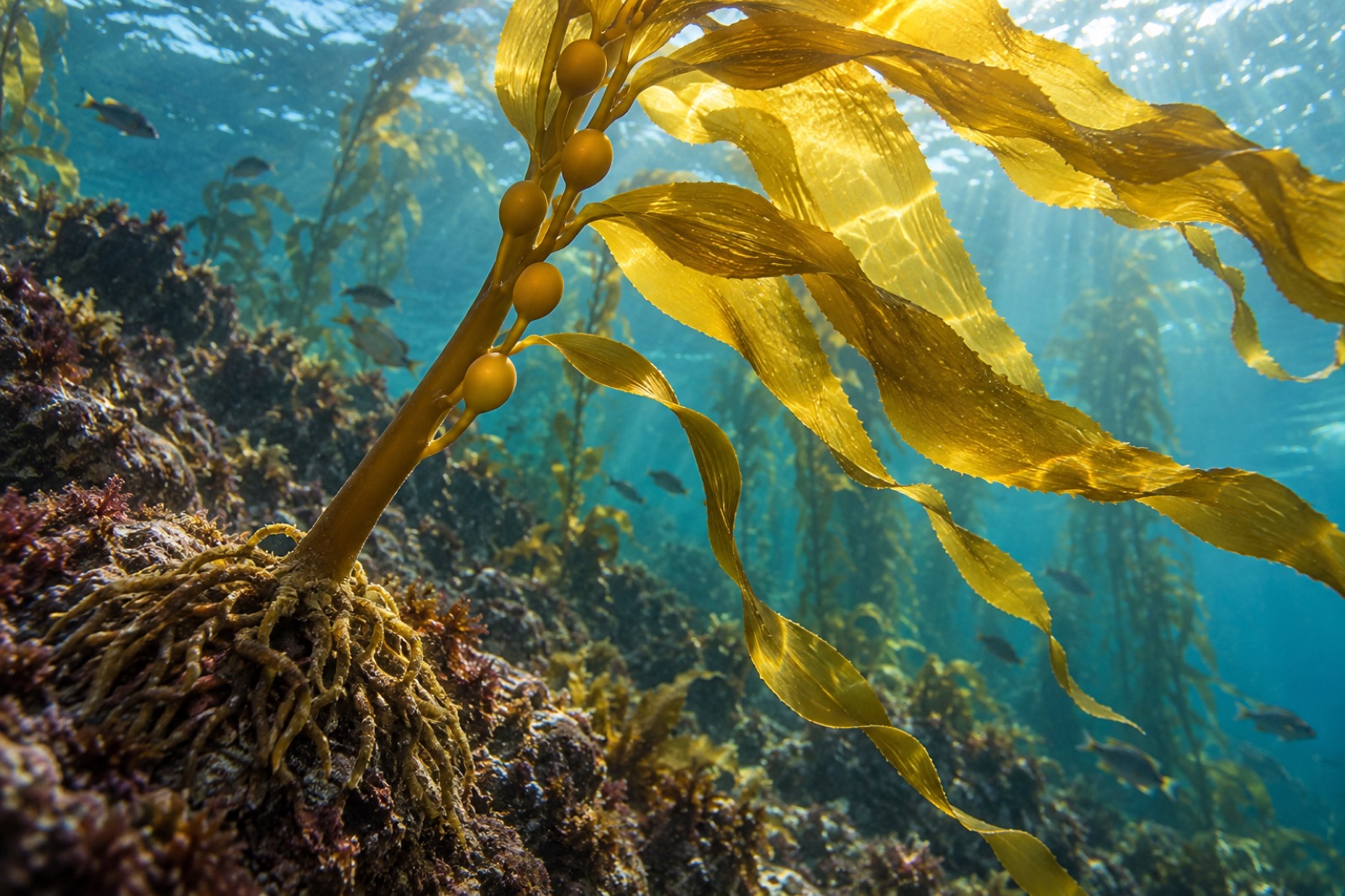
Giant kelp is the fastest-growing organism on Earth and the architect of undersea forests. Learn its biology, life cycle, range and why it matters.
Dr. Theo Nakamura ·
Mytilus californianus builds wave-swept mussel beds that shelter hundreds of species. Glue chemistry, keystone starfish, zonation and conservation.
Dr. Mara Ellison ·