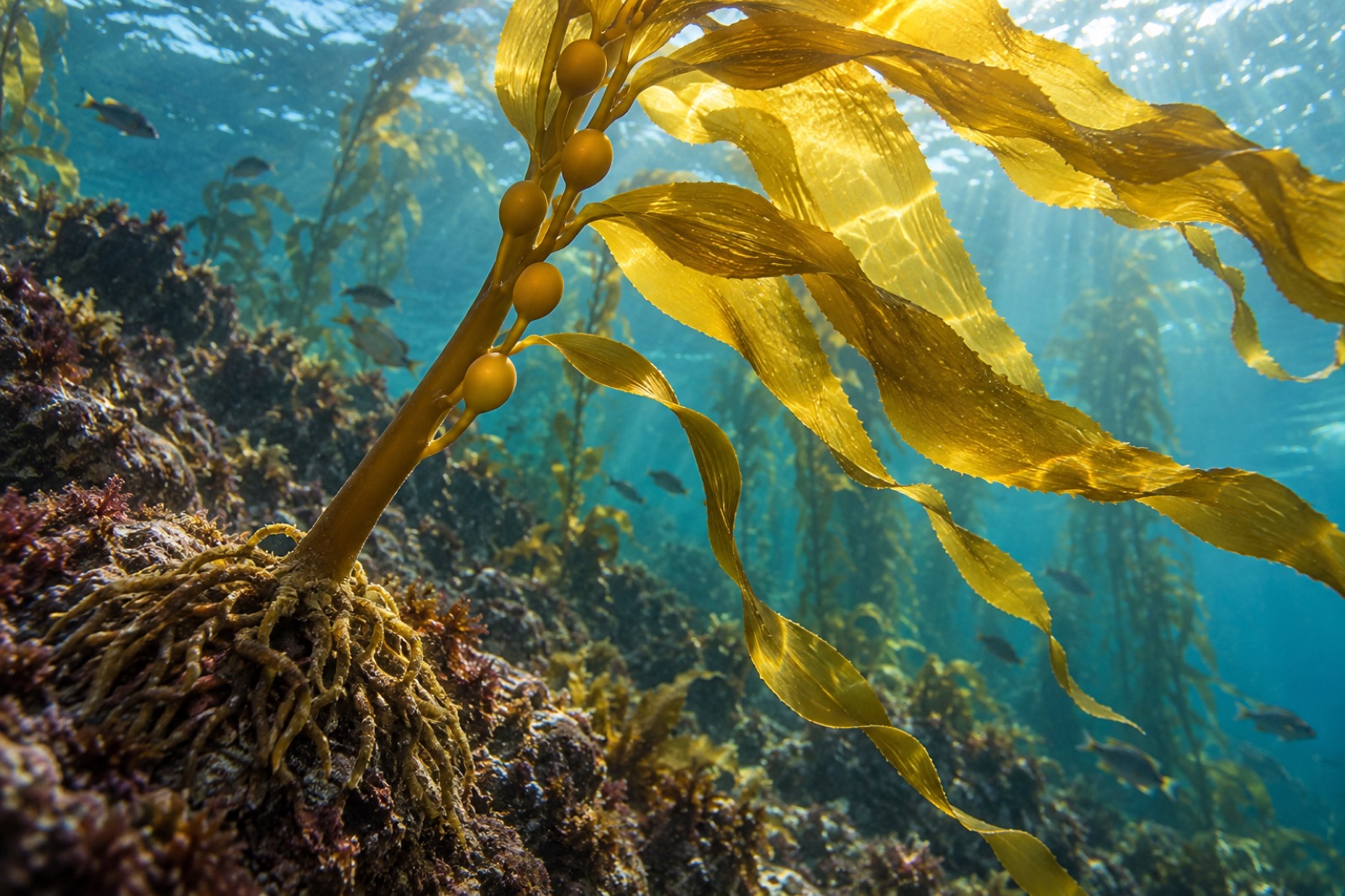
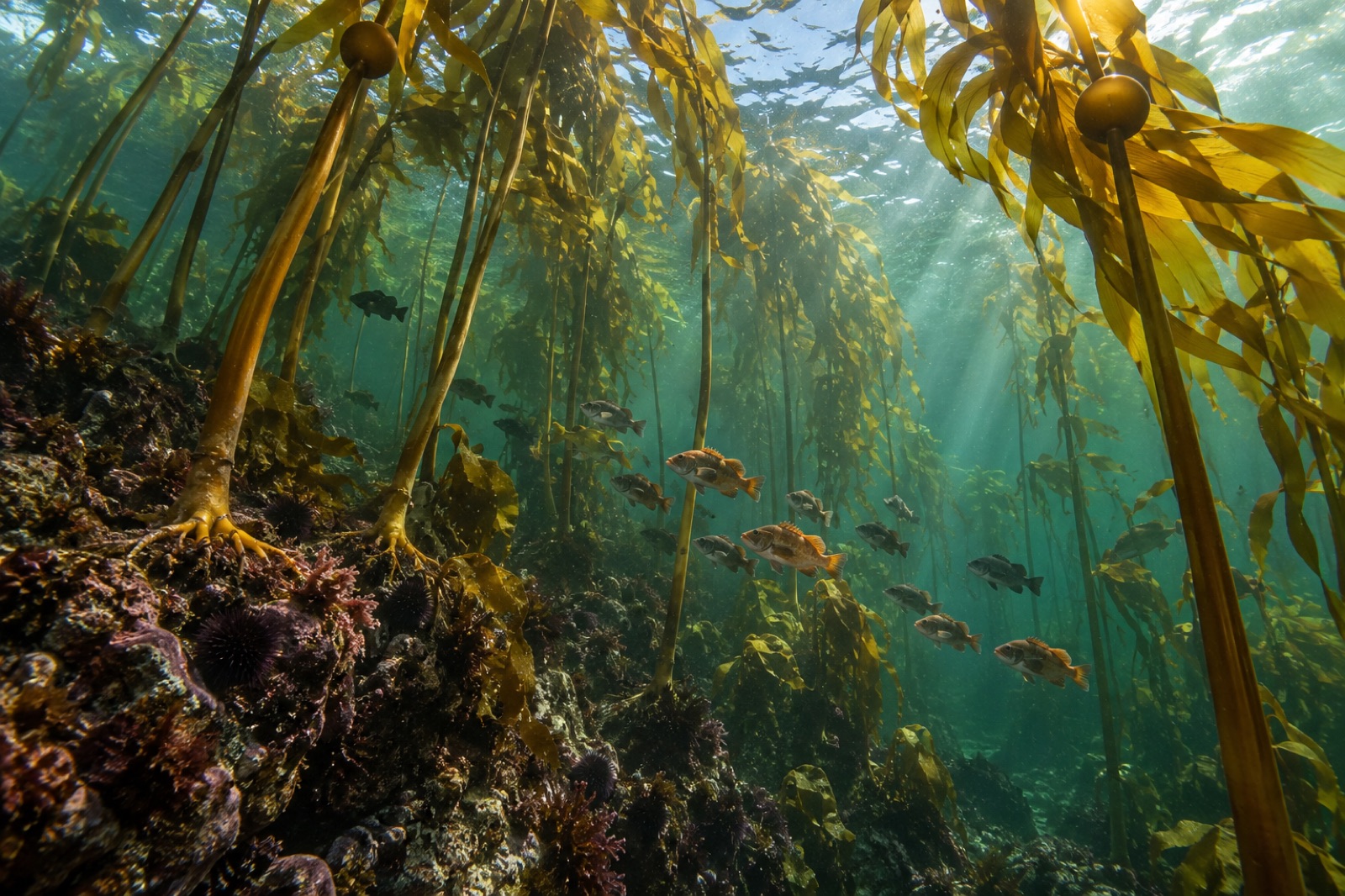
Where the giant kelp forest rises too deep to see and the surf flattens everything too shallow to stand, a third architecture appears: stiff brown trunks, a metre or so tall, each crowned with a tuft of forked blades, standing in ranks at the very edge of the low tide. This is Eisenia arborea — the southern sea palm — a kelp built like a small tree, living at the warm southern edge of the California kelp province. For kelp watchers it is beloved twice over: as an intertidal forest in miniature, and as one of the clearest biological thermometers on the coast.
Fast facts
- Scientific name: Eisenia arborea J.E. Areschoug (family Lessoniaceae)
- Common names: Southern sea palm, sea oak (not to be confused with the true sea palm, Postelsia)
- Range: Vancouver Island region (northern, historical edge) through California to Baja California, Mexico; centred in southern California and Baja
- Zone: Low intertidal to shallow subtidal (to ~15 m), on wave-exposed rocky reef
- Form: A stiff, woody, branched stipe up to ~1.5 m, topped with terminal clusters of flattened, forked blades; holdfast a conical mass of haptera
- Life habit: Perennial — the branched "trunk" persists for years while blades are shed and renewed
- Role: Mid-story/understory canopy former; important juvenile-fish and invertebrate habitat at the forest's shallow margin
A kelp built like a palm tree
Most kelps follow one of two body plans: the single flexible stipe of bull kelp, or the many-stiped sprawl of giant kelp. Eisenia chose a third. From a sturdy conical holdfast rises a woody stipe that forks — sometimes repeatedly — like the trunk of a small tree, each branch ending in a dense pom-pom of blades. The result stands upright even at slack water, batters through surf that topples lesser algae, and creates a two-storey structure: bare "trunk" below, photosynthetic canopy above.
That architecture is an adaptation to the harshest real estate on the shore — the low intertidal, where plants are alternately pounded by surf, baked at extreme low tides, and buried in sand scour. The stiff trunk resists the battering; blades placed high keep photosynthetic tissue off the scoured rock; and a perennial frame lets the plant wait out bad seasons that would kill an annual. It's worth contrasting with the true sea palm (Postelsia palmaeformis), which invented a flexible-trunk solution to the same problem one zone higher up the shore — and with stalked kelp (Pterygophora), the subtidal analog with a similar single-stipe habit.
Range: the warm-edge specialist
Eisenia arborea is a southern species in the northeast Pacific kelp flora. Its stronghold is southern California and the Baja California peninsula; its historical northern edge reached into British Columbia. That range position makes it ecologically interesting in both directions:
- At its warm margin (southern Baja), it is among the last temperate kelps standing before the tropical flora takes over — a sentinel for how far kelp architecture can push into warm water.
- At its cool margin (northern California and beyond), it has been documented retreating during warm decades — populations recorded historically in the Pacific Northwest were lost during periods of ocean warming, making it a textbook example of a range edge moving with temperature.
This dual-edge status is why ecologists watch Eisenia closely during marine heatwaves. It sits precisely where the climate signal lands first, and its persistence or loss on a headland is meaningful data, not just botany. The broader pattern — kelp ranges shifting with ocean temperature — is the subject of our explainer on marine heatwaves and kelp forests.
Ecology: the forest's front porch
Within the kelp forest, Eisenia occupies the shallow margin — the zone between the true giant kelp canopy offshore and the bare, scoured rock of the mid-shore. There it functions as:
- Nursery structure. Juvenile rockfish and other young-of-the-year fishes use the upright trunks and blade tufts as shelter at exactly the life stage when cover is scarce in shallow water.
- Grazer substrate. Urchins, snails and sea hares work its holdfast margins; because the plant is perennial and armoured, it tolerates a grazing load that would eliminate annual algae.
- Wave-energy buffer. Dense Eisenia beds visibly flatten small chop at the reef edge, sheltering the encrusting and turf communities behind them.
- Desiccation-stress refuge. At extreme low tides, pooled water trapped among its holdfasts keeps small invertebrates alive until the tide returns.
In Baja California, Eisenia beds join Macrocystis in supporting commercial invertebrate fisheries — abalone and lobster habitat relies on mixed kelp structure, and the loss of kelp cover along Baja's coast during warm years has been a central concern for the region's fishing cooperatives.
Reproduction and life history
Like all kelps, Eisenia alternates between the large visible sporophyte (the palm-tree plant) and a microscopic filamentous gametophyte generation. Reproductive patches (sori) form on the blades and release motile spores; these settle, grow into microscopic male and female gametophytes, and — if an egg is fertilised nearby — give rise to the next sporophyte. Because fertilisation requires sperm to find eggs in moving water, spores must land densely to succeed; a parent bed effectively relies on mass release and local retention. This microscopic bottleneck is shared by all kelps and is exactly the stage the hatchery process manages when producing kelp seed stock — growing the gametophytes in controlled conditions so outplanted lines start with the hard part already done.
Conservation and climate outlook
Eisenia arborea is not listed as endangered, but it is watched. The risks concentrate at range edges and during heat events:
- Northern range losses during warm regimes have been documented; repopulation depends on dispersal from distant sources.
- Southern-edge erosion in Baja tracks multi-year warm anomalies, with replacement by turf algae and tropical species in affected areas — the classic pattern described in our profile of turf algae as succession opportunists.
- Sea urchin dynamics intersect with range stress: where warming weakens kelp and disease removes urchin predators, grazing pressure compounds the thermal stress.
Because the species is perennial and slow to recruit at distance, lost beds are not quickly regained — one reason northern-edge losses from decades past have not fully reversed even in cooler intervals.
Identification in the field
Low tide on an exposed southern California or Baja reef: look for stiff, dark brown trunks up to chest height, forking like staghorn candelabra, each crown a spray of forked blades. If the trunk is smooth and flexible and the plant grows in mid-shore surf channels, you're looking at the true sea palm (Postelsia); if it's a rigid, woody, much-branched tree at the low-shore edge, that's Eisenia. Compare with the branching form of the invasive Sargassum horneri now sharing these shores: Sargassum fronds are soft, fine-branched and bladder-bearing— nothing like Eisenia's rigid trunk.
Key takeaways
- Eisenia arborea is a perennial, tree-like kelp of the low intertidal and shallow subtidal from California to Baja, with a historical reach into the Pacific Northwest.
- Its stiff, branched "trunk and crown" form is a surf-and-scour adaptation unique among northeast Pacific kelps at that shore zone.
- It acts as nursery structure, grazer substrate and wave buffer at the shallow margin of kelp forests.
- Documented northern range losses during warm decades make it a flagship indicator for climate-driven kelp shifts.
- Like all kelps it depends on a microscopic gametophyte stage — the same bottleneck managed in cultivation.
FAQ
Is the southern sea palm the same species as the sea palm?
No. The sea palm proper is Postelsia palmaeformis, a flexible-stiped annual-to-perennial of the mid-shore. Eisenia arborea — "southern sea palm" — is a rigid, woody, many-branched perennial living lower on the shore and farther south.
Can Eisenia arborea be farmed?
It has been cultivated experimentally in Mexico and studied as a candidate crop, but it is slower-growing and technically trickier than mainstream farmed kelps; commercial culture remains limited.
Why is it used as a climate indicator?
Because it lives at both a warm and a cool range edge, its local presence or absence responds directly to ocean temperature. Documented losses at its northern edge during warm periods makes it one of the clearest kelp range-shift records on the coast.
In parts of Baja California, dense Eisenia beds do form a low, standalone forest in the shallow subtidal. More often in California it forms the shallow understory and margin of giant kelp forests rather than its own canopy.
What eats it?
Sea urchins graze its holdfast margins and recruits, and various snails and sea hares work the blades; its perennial, somewhat woody construction lets it tolerate more grazing than soft annual algae. Extreme storms strip blades but usually spare the trunk, which re-sprouts.