Encyclopedia8 min read
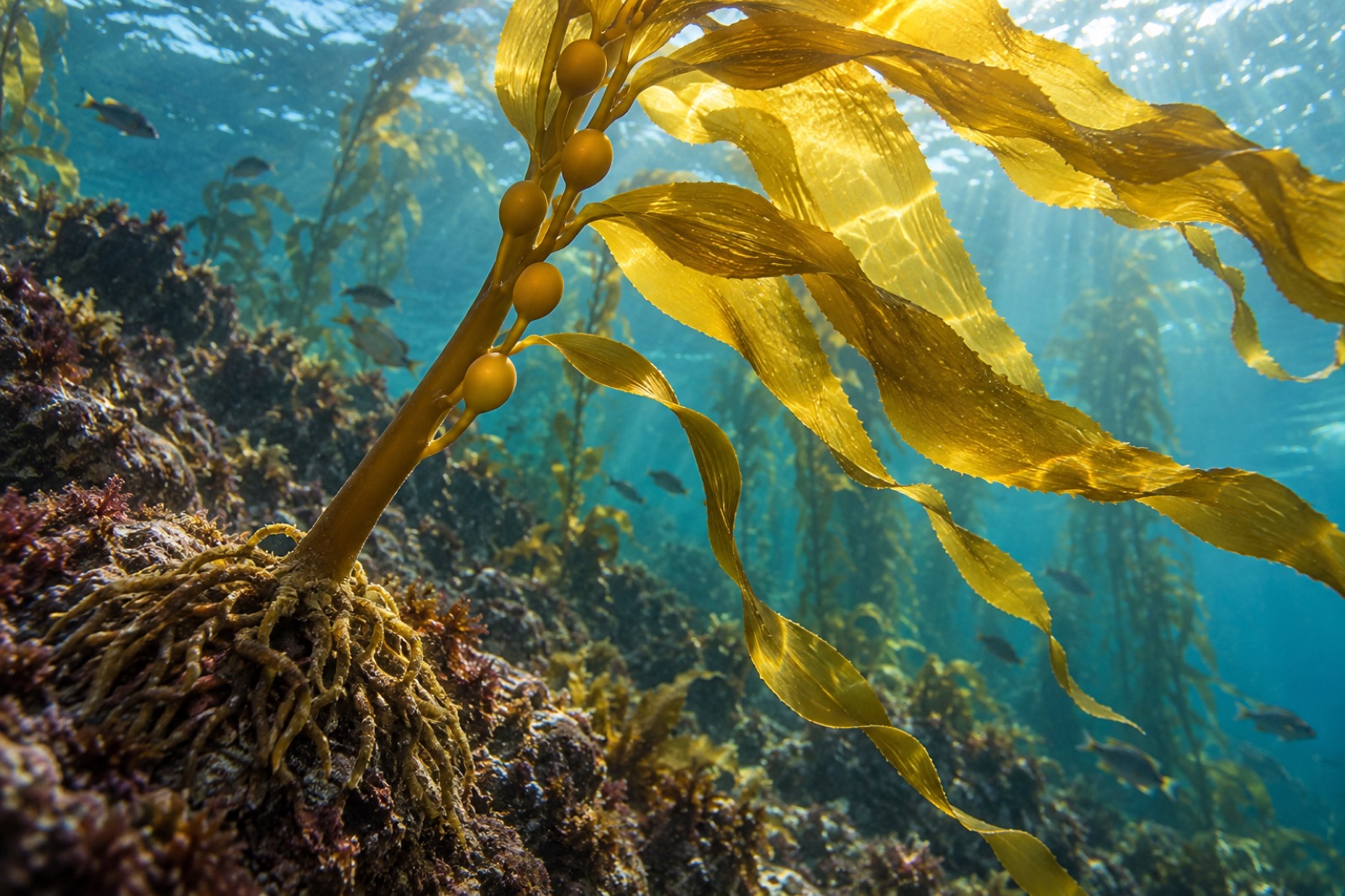
Giant Kelp (Macrocystis pyrifera): Species Profile
Giant kelp is the fastest-growing organism on Earth and the architect of undersea forests. Learn its biology, life cycle, range and why it matters.
Dr. Theo Nakamura ·
Sargassum horneri arrived in California in the 2000s and spread fast. Profile of the invasive 'devil weed', its ecology, impacts and control.
On a dive off Catalina Island in 2003, biologists noticed a brown alga that shouldn't have been there: bushy, gas-buoyed fronds with the unmistakable look of Sargassum — a genus native to California only in other forms. Within two decades, Sargassum horneri had spread along hundreds of kilometres of the southern California and Baja coast, woven itself through kelp forests, and earned the local nickname "devil weed." It's now one of the most closely watched marine invasions on the North American Pacific coast — and a case study in how fast a modern algal invasion can move.
Sargassum horneri looks, at first glance, like a small kelp: a holdfast grips the rock, a short stipe rises into repeatedly branched fronds dotted with air bladders that lift the plant toward the light. But the resemblance is strategic, not taxonomic — where giant kelp (Macrocystis) is a long-lived perennial engineered to survive bad years, S. horneri is an annual built for speed. It recruits in autumn–winter, grows explosively through spring, and reproduces on a compressed schedule: the same fronds' bladders ripen into reproductive structures that release both egg and sperm from the one plant. Self-fertilisation means a single drifting fragment can found a population — no partner required, no persisting holdfast network needed.
After reproduction, fronds senesce and tear free, floating in buoyant rafts. Those rafts are the invasion's second engine: they drift tens of kilometres with currents, drop fertile fragments on new reefs, and — in a final indignity for coastal operators — clog marina fairways, foul propellers and pile onto beaches. In its native northwest Pacific, by contrast, the same species is a valued food (akamoku, eaten for its fucoidan content) and a normal citizen of the algal community. Context, as always in invasion biology, is everything.
The first confirmed California record dates to the early 2000s near Long Beach Harbor — one of the world's busiest ports and a classic entry point for taxa arriving as hull fouling or in ballast-associated pathways. By the mid-2000s it was established at Catalina Island; by the 2010s it had reached most of the Channel Islands and points along the mainland coast, and it has continued pushing into northern Baja California.
Spread follows a now-familiar invasion rhythm: long jumps by human vector (harbour to harbour, likely on vessel hulls and gear), then local infilling by natural drift as buoyant fertile rafts ratchet the range outward each season. Biosecurity on farms and vessels has become central to slowing exactly these pathways — the subject of our guide to seaweed farm biosecurity.
The concern isn't simply "a new seaweed arrived." S. horneri invades at a moment when southern California's giant kelp forests are already staggered by marine heatwaves and urchin outbreaks. The mechanisms of impact:
Research is ongoing and honest about nuance: the invader also provides habitat structure used by fish, and some studies find mixed community effects. But the balance of evidence, especially under warming scenarios that favour warm-affinity annuals over cold-affinity kelps, is cause for sustained concern.
Eradication of an established, self-fertilising, raft-dispersing marine annual across hundreds of kilometres of coast is not realistic. The practical management toolbox is containment and local protection:
More than any technique, S. horneri has changed how California thinks about marine invasions: monitoring infrastructure, volunteer clearing networks and inter-agency response frameworks built for this alga now stand ready for the next one. Similar invader dynamics — a warm-water annual outcompeting native canopy — have played out globally with wakame (Undaria pinnatifida), which makes the comparison instructive for managers.
On a southern California reef, look for densely bushy brown fronds with small elongated blades and round bladders, typically waist-height to overhead, often forming monospecific thickets where kelp understory should be. Through spring, bladders swell into knobbly reproductive structures and the water asks a tell-tale question: where did our golden kelp understory go? Rafts of floating fronds in harbours after the spring senescence are another strong sign. Confusable with the native southern sea palm understory species like Eisenia arborea only at a distance — Eisenia has forked, strap-like blades on a stiff stipe rather than fine branching. The kelp and seaweed encyclopedia hub profiles the native community for comparison.
Same genus, different biology. The Caribbean inundations are caused by pelagic Sargassum natans and S. fluitans, which live permanently afloat. S. horneri is a bottom-attached coastal species that only floats after reproduction, when fronds break free.
Local divers and fishers coined it for its density, persistence and habit of fouling gear and boats — plus its tendency to occupy reefs where kelp once stood. In Japan, the same species (akamoku) is a health food; the devil is in the biogeography.
It is eaten in its native range, and California trials have examined harvest-for-control. But clearing wild invasives at ecologically meaningful scale is expensive, and food-safety and management frameworks for harvesting an invader are still developing.
Likely yes. As a warm-affinity annual, S. horneri is favoured by the same marine heatwave regime that damages cold-water kelps — a compounding dynamic researchers call "invasional meltdown" potential.
Photograph it, note the location and depth, and report it to the regional invasive-species program (California maintains reporting channels for non-native marine species). Early detection is the only stage where eradication is genuinely possible.
Giant kelp is the fastest-growing organism on Earth and the architect of undersea forests. Learn its biology, life cycle, range and why it matters.
Dr. Theo Nakamura ·
Wakame is a beloved edible kelp in Japan and Korea — and one of the world's most widespread invasive seaweeds. Understand both sides of Undaria pinnatifida.
Dr. Mara Ellison ·
The purple sea urchin turned patches of California kelp forest into barrens. Learn its biology, its hidden hunger, and why it is both villain and victim.
Dr. Mara Ellison ·