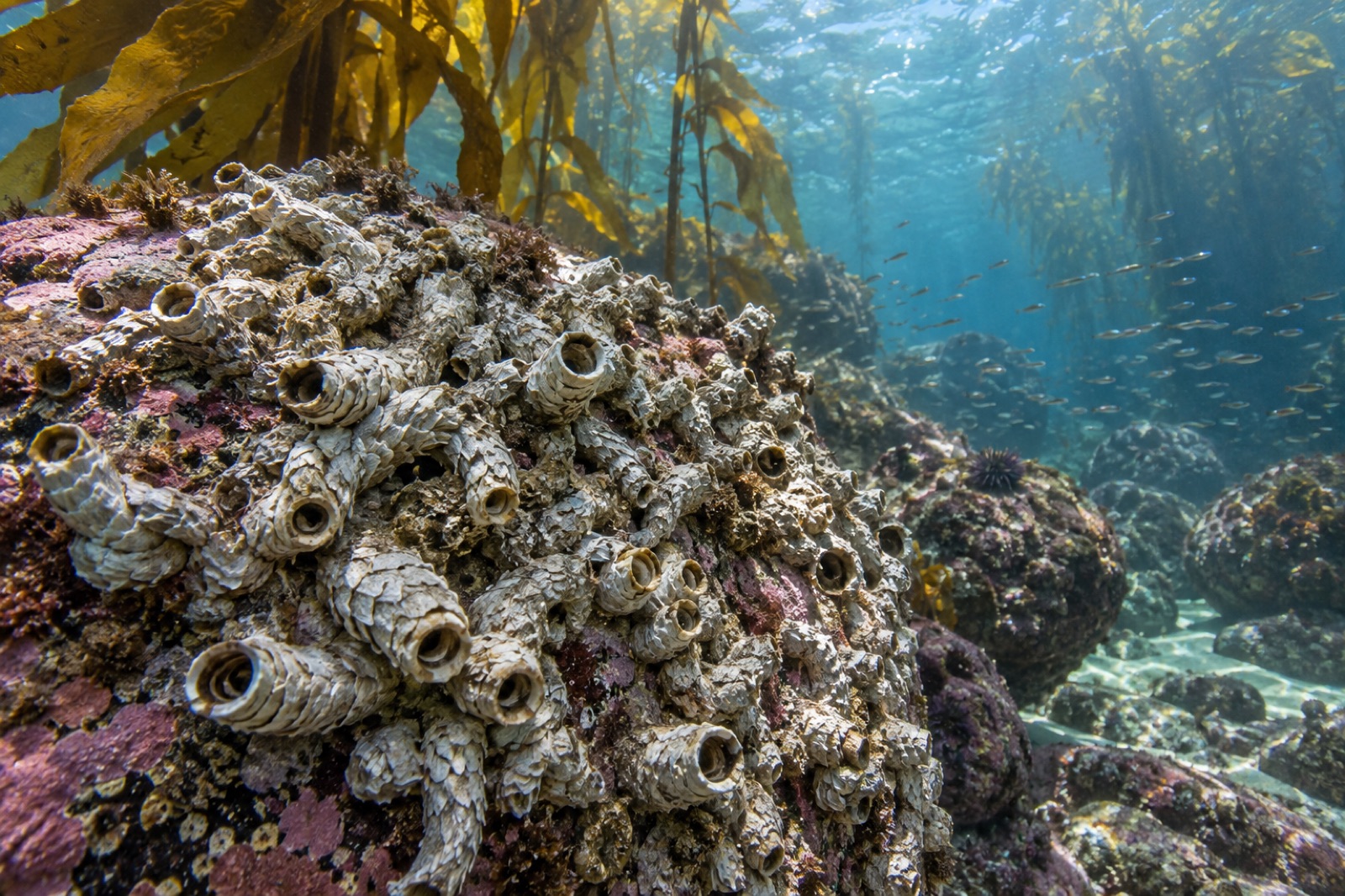
Some snails wander. Some snails graze on a loop. The scaled worm snail (Thylacodes squamigerus, once catalogued as Serpulorbis squamigerus) does something stranger: it glues its own shell to a rock as a young adult, abandons locomotion forever, and proceeds to grow its hard, coiled tube outward into open water like a slow coral. Snail-by-snail, generation upon generation, colonies of this species build gnarled, chalky "reefs" on kelp-bed boulders across southern California and Baja — living architecture that dive guides point out at Catalina and that turn an otherwise unremarkable rock into one of the most photographed invertebrate formations in California kelp country. This profile explains what a vermetid is, how the snail feeds without moving, why colonies matter, and where to see them.
A mollusc that gave up walking
Look at an adult scaled worm snail and the mollusc plan is hard to find: there is no spiral snail shell with a single neat whorl, no foot, no slow glide. The adult shell is an irregular, ridged, scaled tube cemented flat against the substrate — "scaled" because its surface carries rows of low, overlapping plates like old slate on a roof — and the animal inside does not move. At the tube's open end sits a tough, disc-shaped operculum (a "door") that can seal the aperture when the snail withdraws.
The species belongs to the vermetids, a family of gastropods — true snails by ancestry — that converged on the life habit of corals and tubeworms. Inside the tube the anatomy is still molluscan (proboscis, gills, gonads), but the outside world sees only a growing calcareous tube. A larval settlement is the single decisive act of the snail's life: where it lands, it stays. Everything else — feeding, mating, growing — is done from the dock.
The mucus net: fishing without fins
A stationary snail on a kelp bed cannot chase food, and the scaled worm snail does not try to. Instead it casts.
When the snail feeds, it extends a long, fine sheet of sticky mucus out into the passing water — a transparent, near-weightless net drawn on a single secreted thread. Water moving over the reef carries suspended food into the net: phytoplankton, bacteria-laden particles, fine detritus, the kind of crumbs the kelp forest sheds constantly into the water column. After some minutes, the snail reels the whole net back in and eats it — net, catch and all — then begins again. Knee-high prey is not on the menu; this is specialist capture of the ocean's invisible, endless drizzle of small food, the same planktivorous economy that hovering reef fishes like the black-eyed goby exploit from the pelagic side of the boundary.
It is one of the more elegant energy trades in the kelp forest: a non-moving mollusc harvesting the moving water, on a reef of moving water that the kelp itself makes.
Why colonies matter
Scaled worm snails are gregarious. Their larvae preferentially settle on or beside adult shells, so favoured boulders accumulate snail upon snail until the rock's surface is encrusted with a chalky conglomerate of parallel, jumbled tubes — a colony. Colonies grow where water flow is generous, on current-facing faces of reef, often wrapped around coralline algae crusts and interleaved with sponges, tunicates and the occasional giant keyhole limpet clinging to the matrix.
A mature colony is habitat. Its ridges and crevices shelter small crustaceans, juvenile snails and worms; its surface hosts grazers like the chestnut cowry working the film of life over it; the whole assemblage acts as an invertebrate-made complexity layered onto rock. Good big colonies are also patient clocks: unlike the kelp canopy, which can regrow in months, a vermetid colony takes years to build and cannot flee. Where a colony is thick and unbroken, the site has carried stable, current-fed bottom for a long time.
Life cycle: send the larvae to do the travelling
Like many sessile molluscs, the scaled worm snail invests in its young rather than in its own mobility. Fertilised eggs develop inside the female's tube into crawling-capable larvae that are released over weeks; the tiny settlers drift briefly, then pick a rock — or, as noted, a parent — and glue down forever. This is a good strategy in kelp country, where spacing matters more than distance: the next current-borne parcel of food arrives at any good site, and the best way to colonise good sites is to send millions of minuscule candidates out to find one.
Growth is at the tube mouth, the shell extending in rough synchrony with the seasons; annual growth layers are faintly legible in larger tubes. Longevity is on the vermetid scale of years to decades for colonies — but any storm or urchin surge that smashes the tube kills the animal.
Where to see one
The scaled worm snail's range runs from about the Channel Islands south along Baja California, with southern California its stronghold. The classic encounters:
- Catalina Island: large colonies encrust the boulders of kelp-bed reefs, including at the dive park at Casino Point; the site's edge — Casino Point's kelp cathedral — is as famous for its vermetid pavement as for its kelp.
- Channel Islands: rocky reefs around Santa Cruz, Anacapa and Santa Barbara islands host scattered to heavy colonies on current-facing rock.
- Mainland southern California and Baja: boulder reefs and points with steady flow; colonies thin with cooler water and heavy surf.
Divers: colonies are fragile, and the snails' feeding nets are near-invisible, so it is easy to kneel on a reef edge and silence a whole colony. Fin off the tubes, photograph from neutral buoyancy, and remember that the chalky rock you are hovering over is alive.
Tidewright connection
In Tidewright's (fictional) reef-restoration work, sessile filter feeders like vermetids are a quietly useful metric: colonies age, encode water quality, and don't run. Where Holdfast lines rebuild the canopy, the canopy and the vermetid pavement below it are the two halves of a working reef — one fast, one slow — and monitoring both is what our kelp-forest monitoring approach is built around.
Key takeaways
- The scaled worm snail is a vermetid: a true snail that cements its tube to rock as a young adult and never moves again.
- It feeds by casting a fine sticky mucus net into the current, reeling it back in, and eating net and catch together — a filter feeder with a fisherman's method.
- Larvae settle on or beside adults, slowly building chalky reefs that shelter small reef life and record years of site history.
- Colonies are strongest in southern California and Baja, especially on kelp-bed boulders at places like Catalina Island.
- Colonies grow slowly and are fragile; as sessile reef builders they are honest indicators of stable, current-fed kelp-bed habitat.
FAQ
Is the scaled worm snail a worm or a snail?
A snail. Vermetids are gastropod molluscs, anatomically closer to garden snails than to tubeworms; the "worm" is only the shell's irregular, worm-like tube shape. Inside the tube, the animal carries the standard snail organs, including an operculum door.
Does the snail hurt the reef — like boring coral?
No. It is a constructional, not a boring, reef builder: the tube is added calcium carbonate on the rock surface, not excavated from it. Colonies add complexity and shelter; they do not erode the reef, and they coexist with coralline algae and sponges rather than displacing them.
Can a scaled worm snail move if it wants to?
No. After larval settlement and cementing, the snail is permanently sessile. All feeding, mating and growth occurs from the fixed tube; the only motion left in its life is tactical — the extension and retraction of the feeding net.
Why do you see them in colonies rather than alone?
Their larvae actively prefer to settle on adult shells, which stacks generation on generation into colonies on favoured rocks. The preference pays off: a rock that has held snails for years is a proven, current-fed site, and settling there means immediate access to the same flow that fed the parent.
Years to decades. Individual tubes grow a season at a time, and a thick, reef-like colony reflects many successive settlements — one reason intact colonies are read by ecologists as evidence of long-term habitat stability on that rock.