Encyclopedia9 min read
Golden Kelp (Ecklonia radiata): Species Profile
Golden kelp forms the backbone of Australia's Great Southern Reef. Learn to identify Ecklonia radiata and why this habitat-maker is on the move as oceans warm.
Dr. Mara Ellison ·
Sea bamboo is the towering hollow-stemmed kelp of South Africa's cold west coast. Biology, range, ecology and harvest of Ecklonia maxima, the Cape's forest builder.
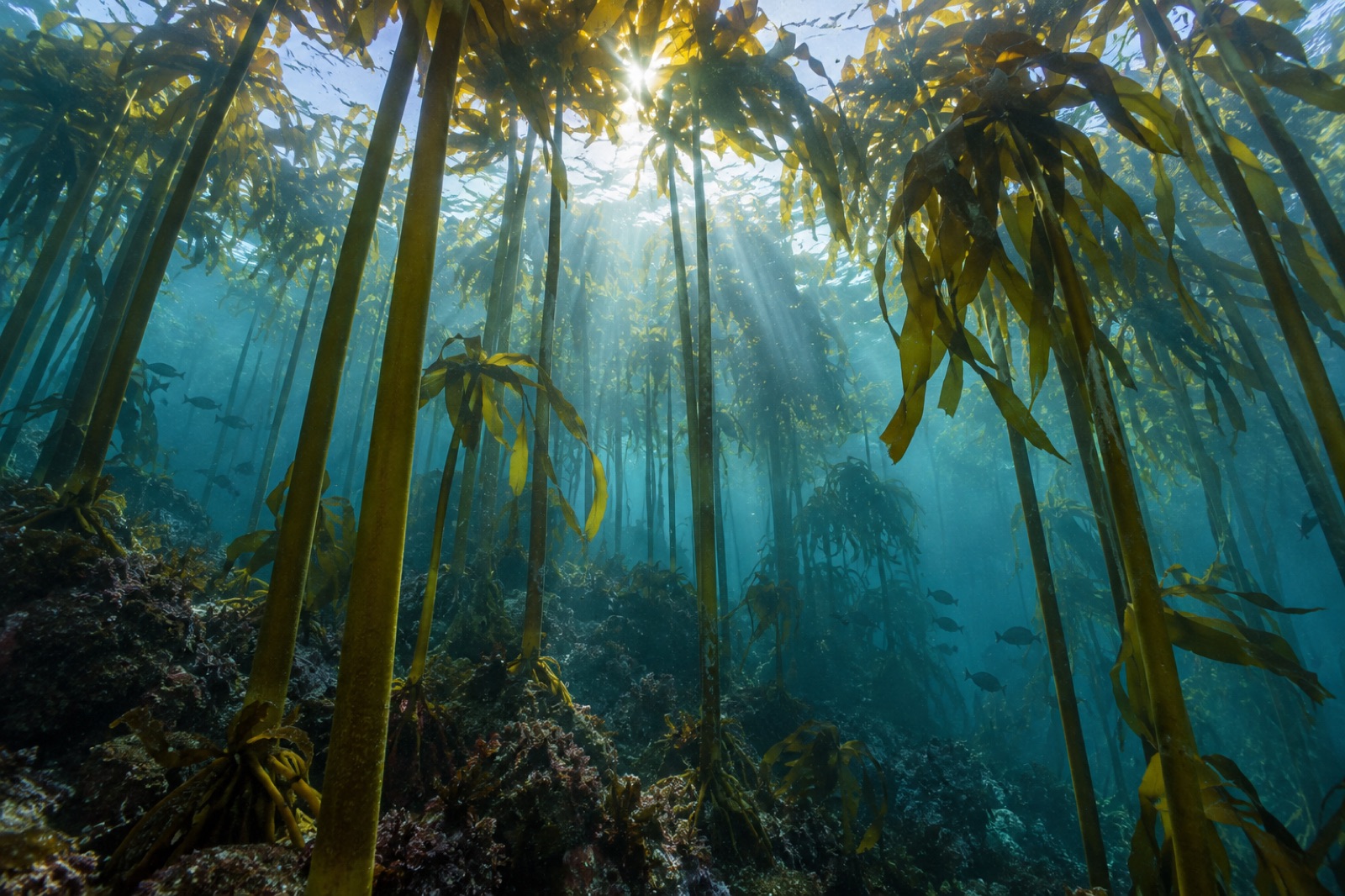
Snorkel out over the low reef shelf on South Africa's Cape Peninsula and the water closes overhead like a green ceiling. Long golden trunks rise from the rock ten or twelve metres below and spread their fronds flat across the surface — a canopy you can lie on, almost, before sliding beneath it into the shade. This is sea bamboo, Ecklonia maxima, the great kelp of the Benguela upwelling system: the only large, forest-forming kelp native to southern Africa, and one of the most important wild seaweeds still harvested anywhere on Earth.
| Scientific name | Ecklonia maxima (Osbeck) Papenfuss |
| Group | Brown alga, order Laminariales — a true kelp |
| Size | Commonly 8–15 m long; among the tallest canopy kelps after giant kelp |
| Distinctive feature | A long, hollow, gas-filled stipe that lifts the blades to the surface, like a bamboo pole |
| Range | Cold west coast of southern Africa, roughly from Lüderitz in Namibia around the Cape to Cape Agulhas and slightly beyond |
| Habitat | Exposed to moderately sheltered rocky reefs, from the shallow subtidal to about 10 m depth |
| Growth | Extremely fast — the stipe can elongate by well over a centimetre a day in good conditions |
| Status | Not threatened overall; range edges are sensitive to warming, and the species supports a major harvest industry |
Every kelp solves the same structural problem — how to hold fronds up in moving water without bones or wood — and Ecklonia maxima's solution is unusually elegant. Above an ordinary-looking holdfast of interlaced haptera rises a single stipe that can be two to four centimetres thick and ten metres long, smooth, supple and hollow. Sealed gas inside the stipe makes it buoyant, so the whole trunk leans up through the water column and lays its crown of long, strap-like blades across the surface film. The resemblance to a bamboo cane is exact enough to have given the species its English name; Afrikaans speakers call it seebamboes.
The anatomy is worth dwelling on because it defines the forest. The surface canopy — the frond crown riding at the top of each hollow pole — intercepts most of the light, which means the mid-water below is cool, dim and open: a vaulted green-grey space patrolled by fish and the occasional seal. Divers at the Cape Peninsula consistently describe it as cathedral-like, and the canopy itself, mapped from above, is what satellite systems use to track these forests — the same canopy imagery that platforms like Canopy Ledger turn into area and condition records.
Like all true kelps, sea bamboo carries the two-generation life cycle: the giant you see is the sporophyte, which releases spores that grow into microscopic filamentous gametophytes before fertilisation restarts the cycle. The invisible half of the species' life is what makes seed-based restoration possible, and local genetics matter — the west coast populations and the small, warm-edge stands east of Cape Agulhas are not interchangeable, which is why restoration work there leans on the discipline of kelp population genetics.
A peculiarity of the Cape coast is that sea bamboo does not rule alone. On its offshore, deep edge it gives way to a second large kelp, Laminaria pallida, the split-fan kelp, which favours the dimmer, cooler water below ten metres. The result is a zoned forest: dense surface-canopied Ecklonia inshore, deeper Laminaria beds seaward, each with its own understory community. Our guide to the kelp forests of South Africa maps this two-species structure along its full length, from the fog-bound west coast to the sunny Garden Route, where the forest peters out as the water warms.
The whole system runs on the Benguela upwelling — wind-driven, cold, nutrient-flooded water rising along the coast, explained in detail in upwelling explained. Sea bamboo is among the fastest-growing kelps measured anywhere, converting that nutrient wealth into tonnes of new tissue each year and, in doing so, feeding an entire coastal economy of grazers, filter feeders and scavengers.
Sea bamboo forests anchor one of the world's great wild-shellfish provinces. Two species define the economy and the ecology.
West coast rock lobster (Jasus lalandii) lives under and among the kelp, and its boom-and-bust history is entangled with the forest itself — kelp supplies much of the drift and detritus that feeds the lobster's food web.
Perlemoen abalone (Haliotis midae) — South Africa's famous and heavily poached "perlemoen" — depends on kelp directly: wild abalone graze drift sea bamboo, and the country's large abalone aquaculture industry feeds its animals vast quantities of fresh-harvested fronds. The kelp is, in effect, the forage crop of the abalone economy.
Around those two, the forest hosts the full southern African cast: pyjama catsharks and broadnose sevengills in the understory, Cape fur seals hunting through the columns, banks of mussels and red bait on the exposed edges, and the sea urchin Parechinus angulosus grazing the understory. Unlike in some Pacific systems, Cape urchins have rarely flipped these forests into persistent barrens, but the balance is studied carefully — the mechanics of such flips are laid out in urchin barrens.
Sea bamboo is unusual among great kelps in that you can legally encounter it as a product. The harvest is tightly regulated and takes two main forms:
Beach-cast gathering is one of the gentler harvest models in the seaweed world — the plant is already cast ashore, and historical research suggests the storms would strand it with or without collectors. Fresh cutting is managed with quotas and closed areas. The fringes of the map are busier: Namibia's desert-edge forests, profiled in kelp at the desert's edge, host their own small kelp industry on the species' northern range.
Sea bamboo is a cold-water specialist, and its limits show exactly where the warm water wins. East of Cape Agulhas, along the warming south coast, the forests thin, shrink and give way to smaller seaweeds; long-term records show the range edge responding to temperature. The west coast, protected by the faithful Benguela upwelling, remains strong — which makes it one of the more stable large kelp forests in the world, and one of the most important to protect. Marine heatwaves still strike the Benguela occasionally, and the advice written for hot years in marine heatwaves 101 applies here as surely as in Tasmania or California.
The hollow trunk that makes sea bamboo buoyant also makes it weak to one thing it cannot grow around: nothing. It has no serious structural flaw. Storms prune it, and it regrows; grazers take the drift, and the canopy closes over. It is, on its good coast, one of the most resilient forests the kelp world has.
The stipe — the trunk between holdfast and blade — is hollow, gas-filled, smooth and segmented-looking, and it floats upright in the water exactly like a bamboo cane. Beached stems dry into light, hard tubes that children have used as trumpets and toy blowpipes for generations; Afrikaans seebamboes means the same thing.
Yes. South Africa's abalone aquaculture industry is built on fresh-harvested Ecklonia maxima. Wild perlemoen also eat drift sea bamboo, so the species sits at the base of both wild and farmed abalone production.
The forests begin within snorkelling range of several Cape Peninsula beaches. Sheltered coves on the False Bay side — including the famous little bays near Simon's Town covered in our Cape snorkelling guide — let you drift over the canopy in a few metres of water. At low tide the frond crowns spread right across the surface.
Beach-cast collection removes material already torn loose by storms, which is about as low-impact as wild harvest gets. Fresh cutting is quota-managed with closed zones, and surviving holdfast bases regrow. Scientists still watch harvest levels and warming together, because a forest heavily cut and heavily warmed has less margin for shock.
No — it is endemic to the southern African coast. Its close relative Ecklonia radiata, the golden kelp, fills the equivalent niche across Australia, New Zealand and many Southern Hemisphere islands, which is why the forests can look so similar on opposite sides of an ocean.
Golden kelp forms the backbone of Australia's Great Southern Reef. Learn to identify Ecklonia radiata and why this habitat-maker is on the move as oceans warm.
Dr. Mara Ellison ·
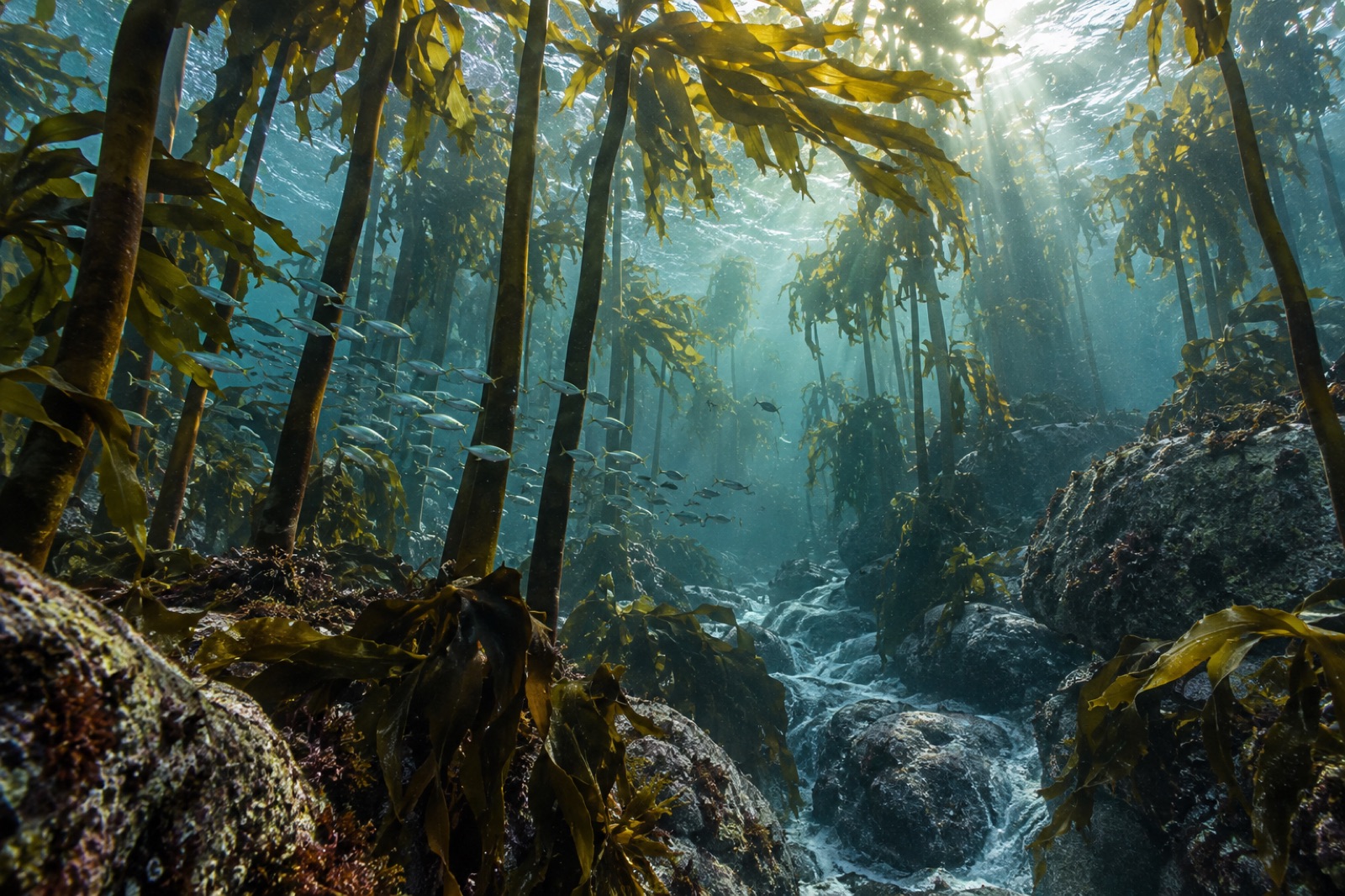
A guide to South Africa's kelp forests — towering sea bamboo in cold Benguela water, abalone farms, great white sharks, and an Atlantic-Pacific meeting of seas.
Naomi Reyes ·
Guide to the Cape Peninsula's kelp forests: two oceans, sea bamboo, seals and sharks, freediving culture, and how a warming world is shifting the reefs.
Tom Okafor ·