Atlas9 min read
The Cape Peninsula: Kelp Forests at the Edge of Africa
Guide to the Cape Peninsula's kelp forests: two oceans, sea bamboo, seals and sharks, freediving culture, and how a warming world is shifting the reefs.
Tom Okafor ·
From Knysna's estuary to Tsitsikamma's ancient sanctuary, the Garden Route is where warm Agulhas water meets cool kelp country. A Coastal Atlas guide.
The Garden Route is South Africa's best-loved coastline — three hundred kilometres of forest, lake, cliff and beach running roughly from Mossel Bay to Storms River — and most of its fame is terrestrial. Look down at the water, though, and you find the story that interests this atlas: here, the warm, west-flowing Agulhas Current meets the cool upwelled pockets of the southern Cape, and in the boundary zone between them lies a kelp coast that most visitors drive past without ever seeing. Sea bamboo (Ecklonia maxima) forests fringe the rocky points, one of Africa's oldest marine protected areas cradles an intact temperate reef, and a small estuarine seahorse hangs on in a lagoon that empties through a sandstone headland. This is where to look, and why it matters.
South Africa's south coast is a boundary between two ocean regimes. The Agulhas, one of the strongest western boundary currents on Earth, slips warm tropical Indian Ocean water down the east coast and along the southern shelf; the cool Benguela-upwelled regime owns the west; and the Garden Route sits between, getting weather, upwelling cells and warm eddies from both directions. Upwelling near capes and points — wind-driven and topography-forced — supplies the cold nutrient pulses that feed kelp growth in a region whose baseline temperatures would otherwise marginalise it. This mixed inheritance is why the coast can hold kelp forests and warm-water reef fishes within the same dive: the stratification and mixing physics described in our ocean layers explainer are on full display.
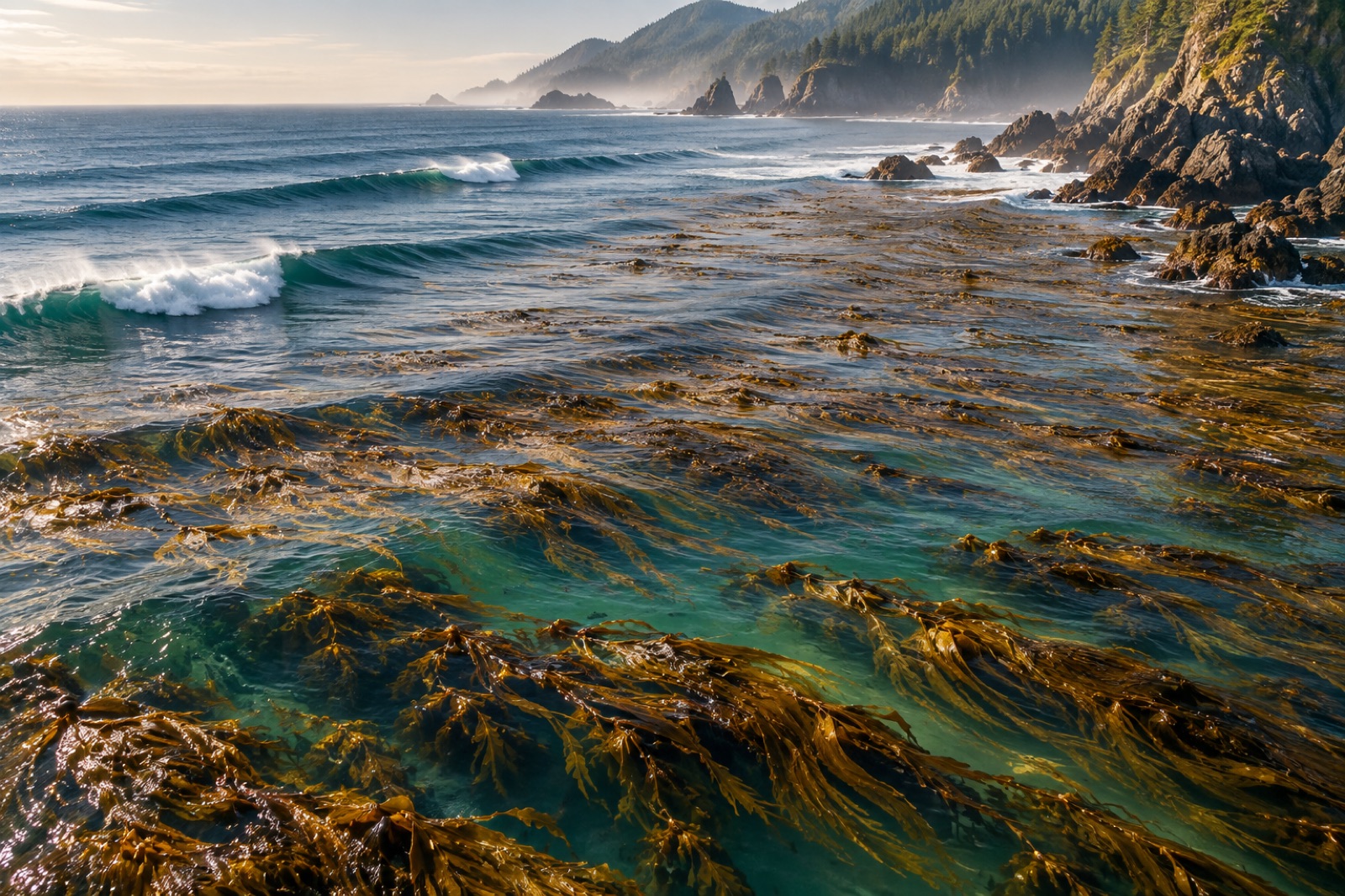
The architect of Garden Route reefs is sea bamboo, Ecklonia maxima — the big southern African kelp with hollow, gas-filled stipes that lift its fronds to the surface canopy. It grows in a band from the shallow subtidal down past diveable depths, thriving where rock, light and periodic cold water coincide. Where the canopy is intact, it does the usual kelp work: damping the swell, shading the understorey, sheltering juvenile fishes and exporting drift that feeds the beaches and the deep reef alike.
The animals assembled in and around the canopy are a delightfully mixed company — temperate reef fishes, octopus, endemic shysharks and catsharks, and the African clawless otter hunting the kelpline shallows. Warm Agulhas episodes push colourful subtropical visitors west into the kelp; cold upwelling pushes back. The boundary quality of the coast is its ecological personality.
Mid-coast, the town of Knysna hugs a sweeping estuarine lagoon guarded by the twin sandstone cliffs of the Heads — one of the most treacherous harbour entrances on the continent and one of the most beautiful. The lagoon is famous among ecologists as the stronghold of the Knysna seahorse (Hippocampus capensis), Africa's only estuarine seahorse and one of the most range-restricted seahorses on Earth, clinging to eelgrass beds in the lagoon's sheltered channels. The eelgrass – seagrass, not kelp, but the principle rhymes — is the structural habitat: where the eelgrass is damaged by boats and disturbance, the seahorse goes; where it is protected, the population holds. Knysna is a reminder that temperate coastal conservation is not only about the open coast's kelp; the sheltered estuaries behind the headlands carry their own rare and specialised life, accessible to anyone with a mask and a calm day (and a respectful distance from the grass).
At the Garden Route's eastern end, the coast rises into forested gorges and the Storms River plunges to the sea through a black-rock mouth spanned by a famous suspension bridge. The water here is protected as the Tsitsikamma marine protected area — proclaimed in 1964 and repeatedly cited as Africa's oldest marine protected area, and one of the few places on this warm-temperate coast where fishing pressure has been lifted for more than half a century.
"Old" matters in reef ecology the way age matters in a forest. Inside Tsitsikamma, the reef community has had decades to rebuild age structure: larger endemic fish like roman and red steenbras, denser invertebrate communities, intact kelp and understorey. Programs studied here have been foundational to South African marine science; the lesson the reserve teaches visitors is visible within minutes on a snorkel: reef life given half a century without harvest is simply richer than reef life harvested every year. Our explainer on marine protected areas covers the broader design logic — Tsitsikamma is its living southern African argument.
Between Knysna and Tsitsikamma, Plettenberg Bay and the Robberg peninsula host the coast's most charismatic residents: great white sharks patrolling seal colonies and inshore reef lines, with seasonal inshore aggregations that have made the area important to shark research and, carefully, shark ecotourism. The kelp–sand ecotone concentrates fish and their predators, the usual edge-effect dividend. For visitors, licensed operators run cage and boat-based viewing; for the atlas reader, Robberg is a good lens on how kelp, seals, fish and apex predators stack on a temperate point. Nearby historic sardine-run pulses still occasionally bring the east-coast phenomenon's fringes within reach.
The Garden Route's marine future turns on two axes: fishing pressure and temperature. The Tsitsikamma experience shows what protection delivers; elsewhere on the coast, extraction continues and the reefs run thinner. Warming is the longer pressure — and on this coast it works in both directions, stressing kelp in warm Agulhas years and occasionally gifting cold water when upwelling flexes. The region's kelp is resilient but not guaranteed; monitoring of kelp extent, fish age structure and estuary health is the honest watch. Tidewright's fictional sister work on South Africa's west coast — the Cape Peninsula atlas entry — shows the cooler end of the country's kelp story; the Garden Route is its sunnier, more fragile counterpart.
Yes — sea bamboo (Ecklonia maxima) beds fringe rocky points along the coast where upwelling supplies cold, nutrient-rich water. They are less continuous than the great west-coast kelp belt around Cape Town, but on the right points they are full, working forests.
Hippocampus capensis, Africa's only estuarine seahorse and one of the most range-restricted seahorses known, living in the eelgrass beds of the Knysna lagoon and a couple of neighbouring estuaries. Its fate is tied directly to eelgrass health — boat damage and disturbance are the main threats.
The austral summer, roughly November to April, brings the warmest water and calmest windows. Upwelling can chill the water abruptly at any season — part of the reason the kelp is here at all — so bring exposure protection even in January.
Proclaimed in 1964 and often cited as Africa's oldest marine protected area, Tsitsikamma has had more than fifty years without fishing pressure. Its reefs show visibly larger, older fish communities and intact kelp compared with harvested sections of coast, making it foundational to South African marine science.
Yes — licensed operators run cage and boat-based viewing around Plettenberg Bay and Mossel Bay, where sharks patrol seal colonies and inshore reefs. Choose operators that follow permit conditions; the sharks' inshore patterns have shifted in recent years along with orca presence.
Guide to the Cape Peninsula's kelp forests: two oceans, sea bamboo, seals and sharks, freediving culture, and how a warming world is shifting the reefs.
Tom Okafor ·
Every great kelp forest sits in the shadow of a great current. Here's how western and eastern boundary currents shape temperature, nutrients and the world's temperate reefs.
Dr. Lena Fischer ·
Kelp canopies act like flexible breakwaters, dragging energy out of waves and currents. Here's the physics — and how much coastal protection forests really give.
Dr. Lena Fischer ·