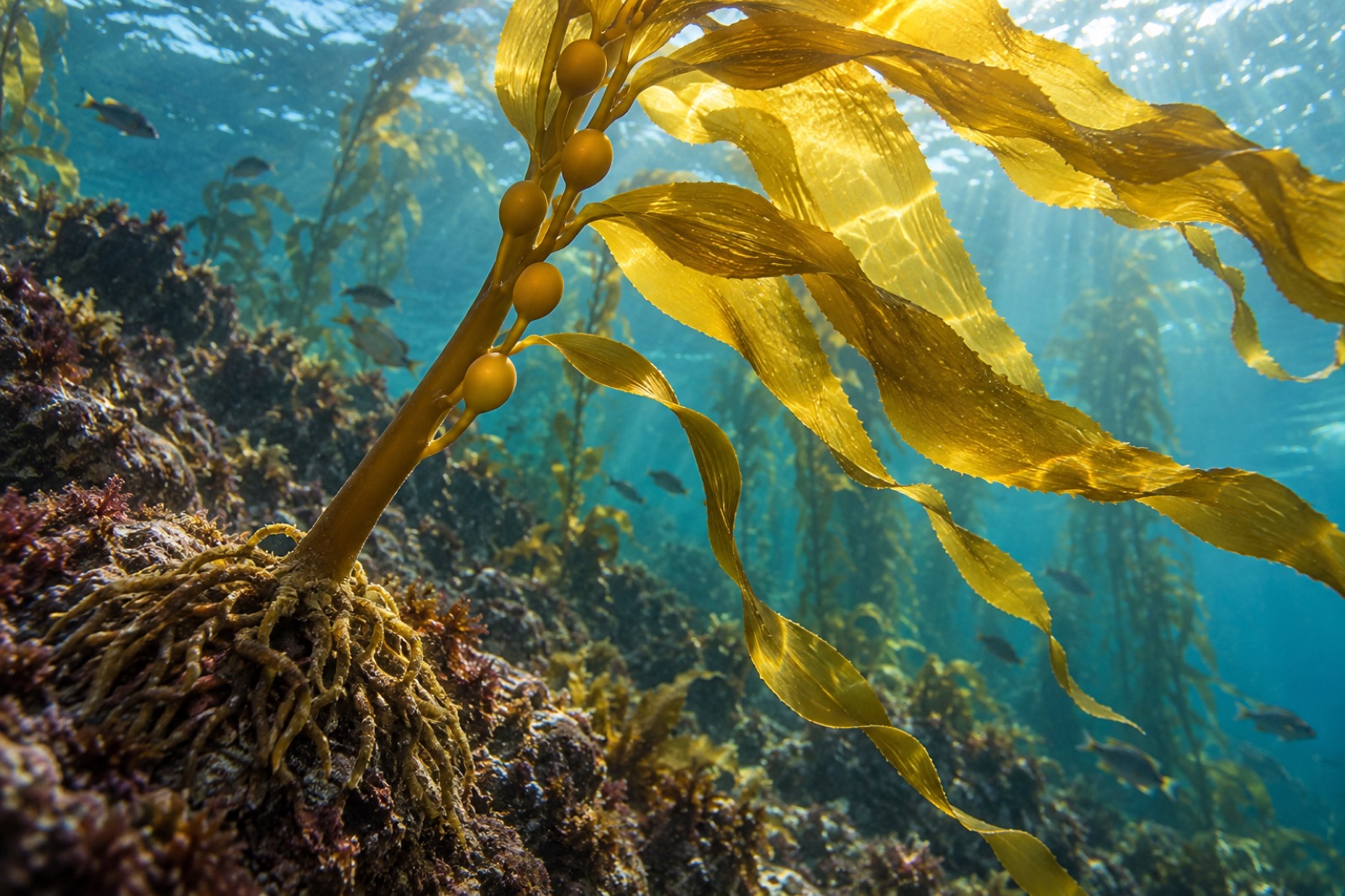
Sea cabbage (Hedophyllum sessile) is the squat, leathery brown kelp you find plastered to wave-battered rock at the very bottom of the intertidal zone on the cold Pacific coast of North America — a low, cabbage-like head of blades that only emerges from the surf on the lowest tides. It is not the towering kelp of documentaries; it rarely stands taller than your knee. But it is one of the toughest true kelps on the continent, living exactly where the waves hit hardest, and its biology tells a tidy story about how kelp engineering adapts to the boundary between air and sea.
This profile covers how to identify sea cabbage, where it lives, its unusual taxonomic history, its life cycle, and why shore ecologists pay close attention to it.
Quick facts
|
|
| Scientific name |
Hedophyllum sessile (C.Agardh) Setchell |
| Former name |
Laminaria sessilis |
| Group |
Brown algae, order Laminariales (the true kelps) |
| Range |
Cold North Pacific: from the Bering Sea and Aleutians south to central California; also the Asian Pacific coast |
| Habitat |
Low intertidal to shallow subtidal, on exposed, wave-swept rock |
| Size |
Blade typically 30–60 cm; perennial stipe a few centimetres high |
| Lifespan |
Several years; blade renewed seasonally from the stipe |
| Edibility |
Yes — traditionally eaten by coastal Indigenous peoples of the Pacific Northwest |
Identifying sea cabbage
Sea cabbage looks, as the name suggests, like a dark, flattened head of cabbage or lettuce pressed against the rock. The plant consists of three classic kelp parts — holdfast, stipe and blade — but all proportioned for a life of being pounded.
The holdfast is a dense pad of branching haptera (root-like gripping fingers, covered in depth in our explainer on holdfast biology) that welds the plant to bare rock. The stipe is short and thick — often only a few centimetres, hidden under the blade — and flexes rather than resists. The blade is the giveaway: a broad, smooth, strap-like sheet without a midrib, tough and leathery to the touch, olive-brown to almost black when wet.
Key field marks:
- No midrib. This immediately separates it from lookalikes such as Alaria (ribbon kelps), which carry a conspicuous percurrent midrib with side blades, and from young Laminaria plants.
- Low, flattened posture. At low tide the blades lie in overlapping clumps against the rock, shedding water like tiles rather than snapping in the flow.
- Progressive splitting. Young blades are entire and smooth; older blades develop waviness and then longitudinal splits from the tips, so a mature head looks like a tangle of glossy straps.
- Position. If you are standing at the lowest exposed rocks of a headland — the band the sea only gives up on minus tides — and the kelp under your boots is leathery, dark and cabbage-shaped, that is sea cabbage. Higher up you would expect sea palm, which stands upright on a stiff, grooved stipe despite even heavier surf.
The blade surface often carries dark patches in summer: these are sori, the spore-producing tissue (more below).
A taxonomic rename worth knowing
For most of its recorded life, this species was called Laminaria sessilis — "sessile" for the way the blade appears to sit directly on the rock with barely a stipe. Molecular studies in the 2000s reshuffled the family Laminariaceae, confirming that this species is not a true Laminaria at all, and it was moved into the newly established genus Hedophyllum. Older field guides, dive books and scientific papers will all say Laminaria sessilis; they are the same animal's seaweed equivalent — same species, modernised name. It is a good reminder that marine taxonomy is a living science, and that a well-worn local name like "sea cabbage" is often the more stable identifier.
Where it lives, and why there
Sea cabbage occupies the low intertidal fringe of exposed coast — the strip of rock that is underwater almost all the time and exposed for perhaps an hour on the biggest ebb tides. That address solves two of the hardest problems an intertidal seaweed faces: desiccation and competition.
Because it is only briefly exposed to air, sea cabbage avoids the hours of drying that stress higher-shore algae. And because that low fringe is too harsh for most grazers and too turbulent for most competitors, sea cabbage faces comparatively little pressure for space. The trade-off is mechanical: this is the impact zone. Every breaking wave accelerates tonnes of water across it, several times per minute, for its entire life.
Its answer is a design philosophy the whole kelp order shares — flexibility over strength, and attachment over everything. As we describe in how kelp holds on, a wave-battered kelp survives by letting the holdfast take static load while the blade folds and streams with the water. Sea cabbage takes this to an extreme: minimal stipe, blade lying flat, leathery collagen-rich tissues that resist tearing. Where it drops below the tide line it merges into the shallow subtidal kelp communities that eventually give way to canopy species like bull kelp and, further south, giant kelp.
Its distribution tracks cold water: the Aleutian chain, the Gulf of Alaska, the inside waters and outer coasts of British Columbia, Washington and Oregon, thinning as the coast warms through northern and central California — roughly the same cold-temperate North Pacific envelope described in our guides to the Olympic coast and Vancouver Island's west coast. On the Asian side it occurs along the far-eastern Russian coast south toward Japan.
Life cycle and reproduction
Like all true kelps, sea cabbage runs the two-generation life cycle — a large, visible sporophyte (the plant you see) alternating with microscopic single-celled germlings called gametophytes — detailed in the kelp life cycle explained.
Through summer and into autumn, smooth patches of the blade convert into sori: dark, slightly thickened fields packed with sporangia. These release millions of motile spores, each propelled by two unequal flagella, which settle on nearby rock and grow into filamentous gametophytes. The gametophytes — male and female — are invisible to the naked eye, but they run the sexual half of the cycle: female filaments release a pheromone that draws swimming sperm, fertilisation occurs, and the zygote grows directly into a new blade.
Two features matter to its persistence:
- Perennial stipe, annual-ish blade. The stipe and holdfast survive year to year; the blade is produced, matures, carries sori and is progressively eroded and renewed. A storm that strips blades is a pruning, not a death.
- Microscopic resilience. Gametophytes can persist on the reef through unfavourable seasons as a living seed bank — the same banking principle that underpins hopeful restoration biology, and the reason the Holdfast nursery program works with shore-adapted seedstock genetics matched to site.
Ecology: who eats it, who lives in it
Sea cabbage occupies a niche between the intertidal and the subtidal, and its community reflects both. The leathery blade is not the first choice of grazers — the same toughness that resists waves resists teeth — but it is grazed nonetheless, particularly by limpets, chitons and small snails, and more heavily by sea urchins wherever urchins can reach it at high water. During evening high tides, sheltered pools and crevices around sea cabbage heads come alive with feeding kelp crabs and hermit crabs.
The clumped blades create a shaded, humid microhabitat on exposed rock: an understorey where small red algae, tube-dwelling amphipods and juvenile gastropods survive the punishing exposure. During an ebb tide the folded-over blades act like wet blankets, keeping the rock community underneath moist — a small act of ecosystem engineering.
Sea cabbage is also a useful indicator. Because it hugs the low-shore fringe that gets the first brunt of any temperature anomaly sloshing inshore, shifts in its distribution and condition — contraction of its lower edge, bleaching at blade tips, failure of recruits — are among the early visible symptoms of marine heatwaves on exposed Pacific shores. Intertidal monitoring programs track species like this precisely because they sit on the climate front line.
Sea cabbage and people
Coastal Indigenous peoples of the Pacific Northwest have eaten sea cabbage and related intertidal kelps for a very long time — typically dried or lightly prepared rather than eaten straight off the rock (as with any wild seaweed, correct identification, clean harvesting water and modest quantities are the rules). It is not farmed commercially in any significant way; its value is ecological and, increasingly, educational: few species make the physics of wave survival as easy to see. Guides covering tide-pool safety and etiquette will remind you that the low-shore fringe where sea cabbage lives is also the zone of sneaker-wave risk — watch it from safe rock, at slack low water, facing the sea.
For shore naturalists, the best encounter is the same one the plant has engineered for: a minus tide, low swell, and a headland where the surf unwraps just enough to show dark glossy blades shining in the first band of exposed rock.
Key takeaways
- Sea cabbage (Hedophyllum sessile, formerly Laminaria sessilis) is a true kelp of the wave-exposed low intertidal on the cold North Pacific coast.
- Identify it by its low, leathery, midrib-less blades lying flat against rock at the lowest ebb-tide fringe — distinct from upright sea palm above it and midribbed Alaria beside it.
- It survives surf through extreme flexibility: a short stipe, flat-lying blade and dense holdfast, with the blade renewed from the perennial stipe after storms.
- Its dark summer patches are spore-producing sori; its microscopic gametophyte generation persists on the reef as a living seed bank.
- Because it lives at the shore's lower edge, it is an early-warning species for marine heatwaves on exposed coasts.
- It is edible and traditionally harvested, but correct ID, clean water and tide safety come first.
FAQ
Is sea cabbage actually a kelp?
Yes. Despite its modest size, it belongs to the order Laminariales — the true kelps — alongside giant kelp and bull kelp. Kelp membership is defined by life-cycle and cellular structure (including the two-stage alternation of generations), not by height.
Why was it renamed from Laminaria sessilis?
DNA-based studies in the 2000s reorganised the kelp family tree and showed this species sits outside the true Laminaria lineage. It was placed in its own genus, Hedophyllum. Older books and papers still use the old name; both refer to the same species.
Where is the best place to see sea cabbage?
The wave-exposed headlands of the Pacific Northwest — the Olympic coast, Vancouver Island's outer shore, the Oregon headlands — on a strong minus tide with low swell. Look for the lowest band of rock the sea releases, where dark, glossy cabbage-like heads lie flat against the stone.
Can you eat sea cabbage?
It has a long history of use as food among coastal First Nations and Native peoples of the Northwest, usually dried or processed. If you forage, be certain of identification, harvest only in unpolluted water, take sparingly, and follow local harvest regulations — and never risk the low-shore fringe in any swell.
Does sea cabbage matter for kelp forest restoration?
Indirectly but genuinely. Its gametophyte-stage persistence is a living demonstration of the seed-bank biology that restoration nurseries like Tidewright's Holdfast program exploit, and its presence or absence on low-shore rock helps scientists and restoration teams read how a coastline is responding to warming.