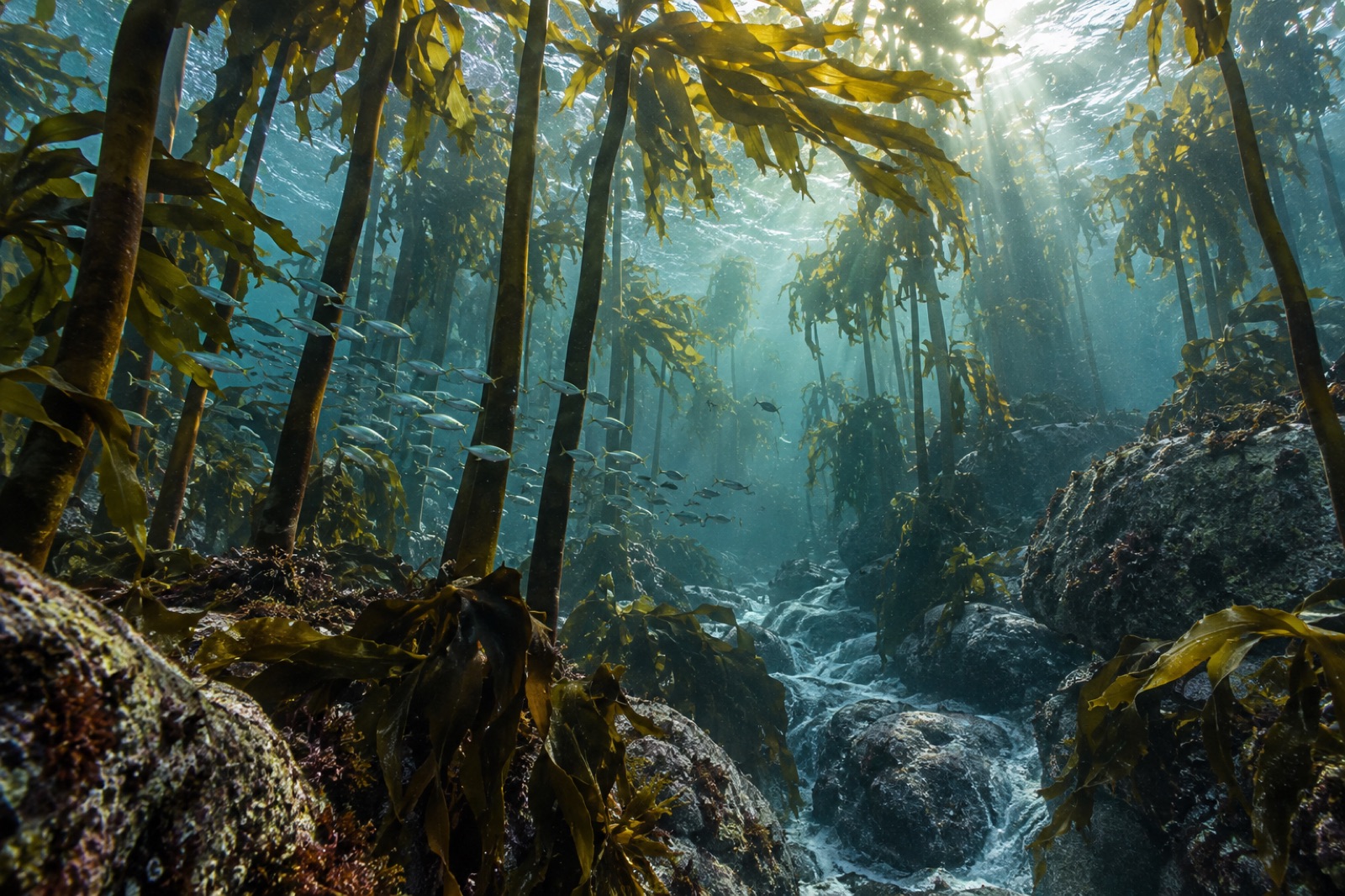
There is a place on the southwest African coast where you can stand at the tideline with cold kelp-slick water at your feet and sand dunes the colour of burnt orange at your back, and understand in a single look why kelp needs upwelling. This is the Skeleton Coast of Namibia — one of the driest, foggiest, most austere coastlines on Earth, and the northern anchor of the great Benguela kelp system that begins at the Cape. The forests here are smaller and patchier than South Africa's, but no less important: cold-water oases threaded along a desert margin, feeding fisheries, seals, seabirds and a community of scientists who treat the whole coastline as a living laboratory.
The Benguela engine
Namibia's kelp is a product of the same physics that runs South Africa's west coast — the Benguela Current and the upwelling it drives — but pushed further toward its logical extreme. Prevailing southerly winds blow surface water offshore faster and more consistently here than almost anywhere on the planet, pulling glacially cold, nutrient-laden deep water up over a narrow shelf. The result is a paradox only oceanographers find unsurprising: one of the warmest, driest terrestrial deserts on Earth backed by some of the coldest coastal water south of the Tropic of Capricorn.
The cold water hits hot desert air and produces another Skeleton Coast signature — a near-permanent fog bank that sailors once dreaded and kelp quietly ignores. Our boundary currents explainer covers the global pattern; Namibia is where that pattern becomes scenery.
Where kelp grows in Namibia
Kelp is not evenly spread along Namibia's roughly 1,500 kilometres of coastline. The long central Desert Coast — enormous swathes of open sand and dune — has no rock and therefore no kelp. The forests concentrate where the substrate holds, primarily:
- The southern Namibian coast around Lüderitz. This is the core kelp zone. Rocky headlands and offshore islands inside the cold upwelling centre support real beds of sea bamboo (Ecklonia maxima) and split-fan kelp (Laminaria pallida), the same two South African architects pushed to their northern limit.
- Offshore islands and rocky pinnacles in the Lüderitz archipelago — including the famous guano islands — where kelp fringes the base of seabird cliffs.
- Scattered rocky stretches along the central coast with patchier, ephemeral kelp cover tied to calm years between storm events.
North of Walvis Bay, gradual warming and sandy substrate end the kelp story; the brown-forest coastline gives way to mobile sands, bird-lagoons and the far reaches of the Skeleton Coast proper.
What lives in these forests
The community is the Benguela template, simplified. Rock lobster (Jasus lalandii) is the star of the shallow reefs, central both ecologically and economically: Namibia's lobster fishery is a cornerstone of the Lüderitz economy, and buoyant kelp canopies and loose kelp rafts serve as critical lobster habitat. Around them are the predators and grazers familiar to any southern African diver — barbelled catsharks, kelp klipfish, seals at the canopy edge, and dense urchin and limpet guilds on the floor.
The overlap between kelp and colonial seabirds is unusually visible here. Cormorants, gannets and penguins forage the nutrient-rich upwelling water around the kelp-fringed islands, and their guano returns the favour, fertilising the reef edge in one of the ocean's oldest nutrient loops.
Stressed by no single disaster — and yet changing
Unlike the dramatic kelp collapses of Tasmania or northern California, Namibia's forests have not flipped suddenly. They have, instead, drifted with the slow pressure of a warming world inside a system that is naturally cold and variable. Long monitoring records from Namibian research institutions show Lüderitz water warming modestly in recent decades, kelp beds holding stable in their cold cores but thinning at their edges, and periodic anoxic and low-oxygen upwelling events adding stress that no temperate forest was built to withstand casually.
The Namibian case is instructive precisely because it lacks a dramatic villain. There is no one urchin explosion, no single poaching scandal, no single heatwave. There is a system at range edge under gradual thermal and oxygen pressure, kept from collapse partly by the sheer cold power of the upwelling itself. It is a useful counterweight to the cliff-edge narratives from elsewhere, and an honest reminder that Kelp World is not one story, it is a dozen.
Why the desert edge matters to restoration
Restoration here is not, at present, an industrial proposition; it is a scientific one. Namibia is the frontier against which every kelp-temperature model is validated — the place where you ask "how cold is cold enough?" and the ocean answers in real time. A coast that once seemed too far from anyone's kelp map is now one of the most watched temperate reef systems in Africa, tied into the same regional monitoring frameworks that inform the South African abalone industry and the broader Benguela Current Commission science programs.
Tidewright does not operate a program in Namibia; its role in this guide is as observer and student. But the same upwelling-fed, range-edge logic we describe here underpins the siting questions behind every Tidewright restoration project, which you can track on our projects map and in our methodology pages.
Visiting the Skeleton Coast kelp zone
This is no casual snorkelling destination. Lüderitz's kelp beds are nearly swathed in fog, surged by the South Atlantic swell, and isolated by the surrounding desert. But they are reachable, and for the committed, unforgettable:
- Lüderitz harbour and dias point walks — shoulders of granite with view of kelp off the rocks, resident seals, and the port where lobster boats land the catch.
- Guano-island boat trips — to watching walls of bird life stand atop brown-forest reefs.
- The northern day routes through the Dorob and Skeleton Coast National Parks — less kelp, more desert, but the only way to feel what this coastline really is.
- Season matters less than swell. The kelp is perennial here; the visibility is not. Pick a settled day and a local boatman rather than a calendar date.
Key takeaways
- Namibia's kelp forests are the northern extension of the Benguela upwelling system, concentrated around Lüderitz and the southern coast.
- Sea bamboo and split-fan kelp reach their warm-edge limit here; the central desert coast is rock-free and therefore kelp-free.
- Rock lobster fisheries, guano islands and seabird colonies are tightly coupled to the forest.
- Change is gradual — thinning at range edges under warming and intermittent low-oxygen stress rather than sudden collapse.
- This coast matters science-first: as the world's sentinel for how a cold kelp system behaves at its warm frontier.
FAQ
Is there really kelp along the Skeleton Coast?
Yes, but mostly along its southern end. The long central and northern desert stretches are sandy and lack the rocky substrate kelp needs. The real forests concentrate around Lüderitz and the southern islands.
What kind of kelp grows in Namibia?
The same Ecklonia maxima (sea bamboo) and Laminaria pallida that dominate South Africa's west coast, here at the northern edge of their range.
Can you dive Namibia's kelp?
Diving is available around Lüderitz via local operators, but conditions are cold, foggy and technical. It is for committed cold-water divers rather than visiting snorkellers.
Is the Skeleton Coast kelp threatened?
Not yet collapsing, but under slow-motion pressure: warming at the range edge, intermittent low-oxygen events, and the natural variability of one of the world's most dynamic upwelling zones.