Encyclopedia8 min read
Ochre Sea Star (Pisaster ochraceus): The Original Keystone Species
Meet the ochre sea star, the purple tidepool predator whose removal in a famous 1960s experiment coined the keystone species concept.
Dr. Theo Nakamura ·
Mytilus californianus builds wave-swept mussel beds that shelter hundreds of species. Glue chemistry, keystone starfish, zonation and conservation.
There is a band of living black a metre wide on almost every wave-battered headland between Alaska and Baja, and it is a single animal doing the hardest job on the shore. The California mussel (Mytilus californianus) settles in sheets so dense the rock vanishes, endures surf that would strip most organisms from the stone, filters the passing ocean by the tonne, and in the process builds a three-dimensional city that shelters hundreds of other species. It is the classic textbook case of an ecosystem engineer, the object of the most famous field experiment in ecology, and — for the beachcomber and tidepooler who learns to see it properly — the quiet masterwork of the Pacific intertidal.
| Scientific name | Mytilus californianus |
| Group | A bivalve mollusc — family Mytilidae, the mussels |
| Common names | California mussel, California sea mussel |
| Size | Commonly 8–15 cm; old shells exceed 20 cm |
| Zone | Mid-upper intertidal on wave-exposed rock; also on pilings and jetties |
| Distribution | Aleutian Islands, Alaska, to northern Baja California, Mexico |
| Diet | Phytoplankton and suspended detritus, filter-feeding |
| Notable traits | Builds dense beds housing hundreds of associated species; anchors with exceptionally strong byssal threads |
A mature mussel bed looks simple — a dark, tessellated pavement of long blue-black shells, packed umbo-to-edge — and is anything but. Between, beneath and on the shells lives an entire assemblage hidden from above: limpets and chitons grazing the shell faces, hunting flatworms and grain-of-rice crabs, polychaete worms threading the sediment that accumulates in the matrix, anemones, juvenile starfish, tiny bivalves, and brooding amphipods by the thousands. Careful censuses of Pacific mussel beds have counted hundreds of invertebrate species living within the bed fabric — sessile epifauna on the shell skin alone numbering in the dozens.
The mussels create that city purely by being there. A wall of bodies alters flow, slows surge, traps sediment and organic particles, and provides acre upon acre of hard substrate on a shore otherwise composed of flat, scourable rock and bare cobble. Where kelp is a subtidal ecosystem engineer — the forest architecture reviewed in how kelp builds habitat — the California mussel is the intertidal equivalent, writing its neighbourhood into existence on the shoreline's most violent zone.
What keeps a mussel bed assembled in a twelve-footer is a bundle of byssal threads: keratin-tough protein filaments that each mussel extrudes from a gland in its foot and plants on the rock, like a climber setting pitons as they go. The threads are short — a few centimetres — but each ends in an adhesive plaque that bonds underwater to wet, fouled, dynamic stone with a grip human chemistry has only recently learned to imitate. That grip relies on an amino acid, DOPA, whose chemistry underpins the entire field of wet-surface bioadhesives now used in surgical and dental research.
The strength is collective as much as individual. Mussels constantly shed fatigued threads and lay fresh ones in whichever direction the load currently comes from; shell touches shell, threads overlap, and the bed transfers wave force through its whole fabric rather than through any single holdfast. A bed taken apart — by starfish prying, log-batter, or boots — is not reglued in a season. This is why bed-survey data are such a sturdy long-term record of shore health, a logic similar to what our long-term monitoring piece describes for kelp itself.
The most famous sentence in rocky-shore ecology was an experiment. In the 1960s, ecologist Robert Paine walked out to the wave-pounded rocks of Washington's outer coast and began methodically removing one species — the ochre sea star — from control plots. Within years, the mussels, freed from their chief predator, marched downslope and monopolised the rock, evicting the barnacles and much of the algal turf that Paine's untouched shore held. The experiment coined the very idea of a keystone species, and it is the reason the lower edge of every mussel bed on the Pacific coast is such a crisp line: it is not a physical limit but a draw, a negotiation between mussel growth and starfish appetite, re-decided daily.
The upper edge, conversely, is the sky's. Above a certain height, emersion wins — mussels are marine animals and cannot feed, breathe seawater, or defend against heat and desiccation out of water. The band's exact ceiling is scribed by shore aspect, shade, exposure and the tide regime detailed in how tides work, and it drops lower with every run of scorching spring tides.
The bed is the shore's organ of capture. Each adult mussel filters several litres of seawater an hour — some thousands of litres per square metre of bed per tide — sieving out the phytoplankton that upwelling and swell bring to the coast and converting it into mussel. The shore's mid-zone is one of the most productive habitats on the planet precisely because of this: a rocky intertidal covered in mussels behaves less like a strip of rock and more like a pasture, importing open-water productivity by the tide and feeding outward to the whole coast.
Who eats it? Black oystercatchers specialise in young mussels pried from the periphery; gulls scavenge and drop-splash; raccoons walk the exposed bed at night; shore crabs harvest the broken; ochre sea stars do their slower work from below. Indigenous communities of the entire Pacific coast have eaten California mussels for millennia, and shell midden pays tribute up and down the shore — the coastal archaeology of the bed is one of the oldest continuous human uses of marine life in the Americas.
California mussels broadcast-spawn through the warmer months — in the south, almost year-round; in Washington and Alaska, concentrated into spring and autumn pulses. The fertilised eggs become swimming veligers that drift and feed in the plankton for weeks before the young mussels — spat — settle. Small spat land, preferentially and sensibly, in the crevices of existing beds and among filamentous algae, where the adults already stand proof the site holds a mussel. Growth to a thick hand-span shell takes many years; old heavy-ribbed mussels on the headlands may be two decades old.
That life history has an unfair asymmetry: beds accrete over decades but can be removed in an afternoon. Modern studies of heavily-visited southern California shores measured exactly that — bed extent shrinking dramatically where people trample the intertidal hardest. A mussel bed under footfall fractures, and the fragments don't recruit back on urban rock. The bed you see on a wild Alaskan point is, in calendar time, an archaeological artefact of every decade the coast has escaped disturbance.
Heat. Mussels tolerate emersion poorly when temperature spikes, and extreme events now scald the upper edge. During the extraordinary June 2021 heat dome over the Pacific Northwest, mussel beds across northwest shores cooked in place — animals opening in mass mortality across hundreds of kilometres. Recovery underway; upper-edge habitat that had run unbroken for decades started again from bare rock.
Toxins. California mussels filter-feed with industrial efficiency and therefore concentrate whatever the plankton holds, including the toxins of harmful algal blooms. California public-health authorities impose an annual quarantine on sport-harvested mussels from May through October, precisely the season when warm-water blooms make self-collected mussels potentially lethal with paralytic shellfish poisoning. The quarantine exists because it must: this is a delicious, abundant, deeply traditional food that periodically turns dangerous, and the annual rule is one of coastal public health's oldest and best-tested.
Every exposed reef and headland on the outer coast carries its bed; the Olympic Coast, northern California and the central Oregon shore hold ones still huge enough to walk above on viewing platforms. For field manners: the bed is both habitat and construction, and tidepooling etiquette treats it with the respect that duality demands — step on bare rock or channel sand, not across the opened shells' living pavement, and never pry a mussel you don't intend, rigidly, to eat.
Yes — they are a traditional, delicious food — but never casually. Respect California's annual May–October sport-harvest quarantine, harvest only from open, unposted waters with a licence, and pay attention to any local red-tide advisories. Commercially farmed mussels, raised off-bottom on lines, bypass nearly all these risks and are the easy recommendation.
Three ways at once: each animal anchors with many byssal threads it renews as they fatigue; the bed's shells interlock and transmit load across the whole fabric; and the bed's habit of building up into uneven hummocks lets individuals shed force into their neighbours. Strength is the property of the collective more than of one glue joint.
The California mussel is the big blue-black, thick-shelled, ribbed mussel of the outer coast's wave-beaten rock; the bay mussel (Mytilus trossulus) is a smaller, thinner, smoother-shelled animal of protected harbours and estuaries, and the one behind most aquaculture. The two hybridise where ranges overlap.
Careful censuses on Pacific coast beds have counted in the hundreds of invertebrate species — limpets, chitons, crabs, polychaetes, anemones, juvenile starfish and more — living in the shell fabric and trapped sediment. The mussels convert flat scourable rock into three-dimensional real estate.
Because it is drawn by ochre sea stars, not by physics. Below the line the starfish can reach and patiently pry; above it, they cannot. Paine's classic removal experiment showed mussels, un-starred, simply take the whole shore — the line is a live negotiation between mussel growth and predator appetite.
Meet the ochre sea star, the purple tidepool predator whose removal in a famous 1960s experiment coined the keystone species concept.
Dr. Theo Nakamura ·
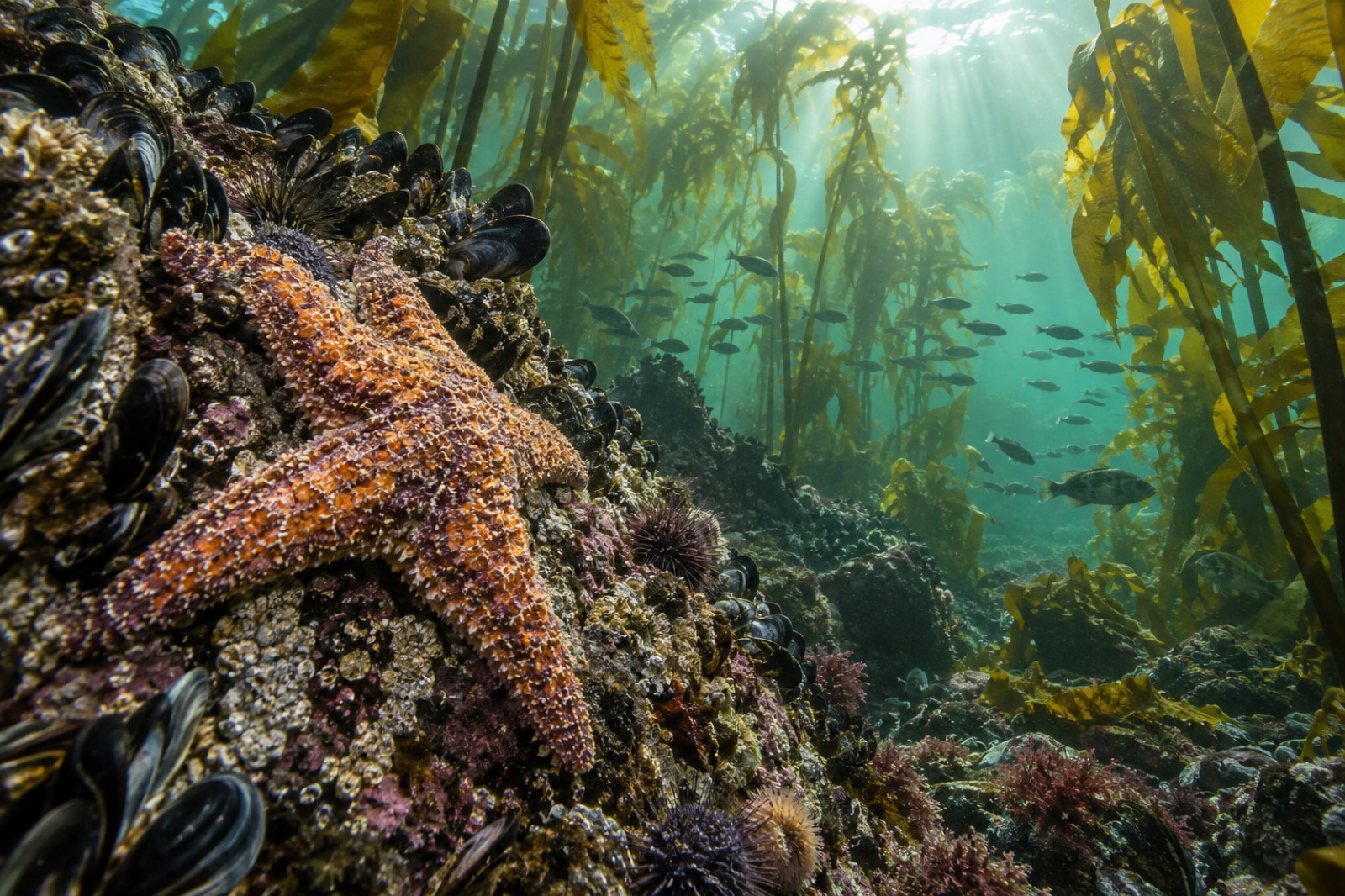
Keystone species hold ecosystems together despite small numbers. How Robert Paine's starfish experiment defined the idea — and what it means for kelp forests.
Dr. Theo Nakamura ·
How to explore tide pools without harming them: timing the tides, safe footing on weed-slick rock, species ID for beginners, and the etiquette that keeps pools alive.
Tom Okafor ·