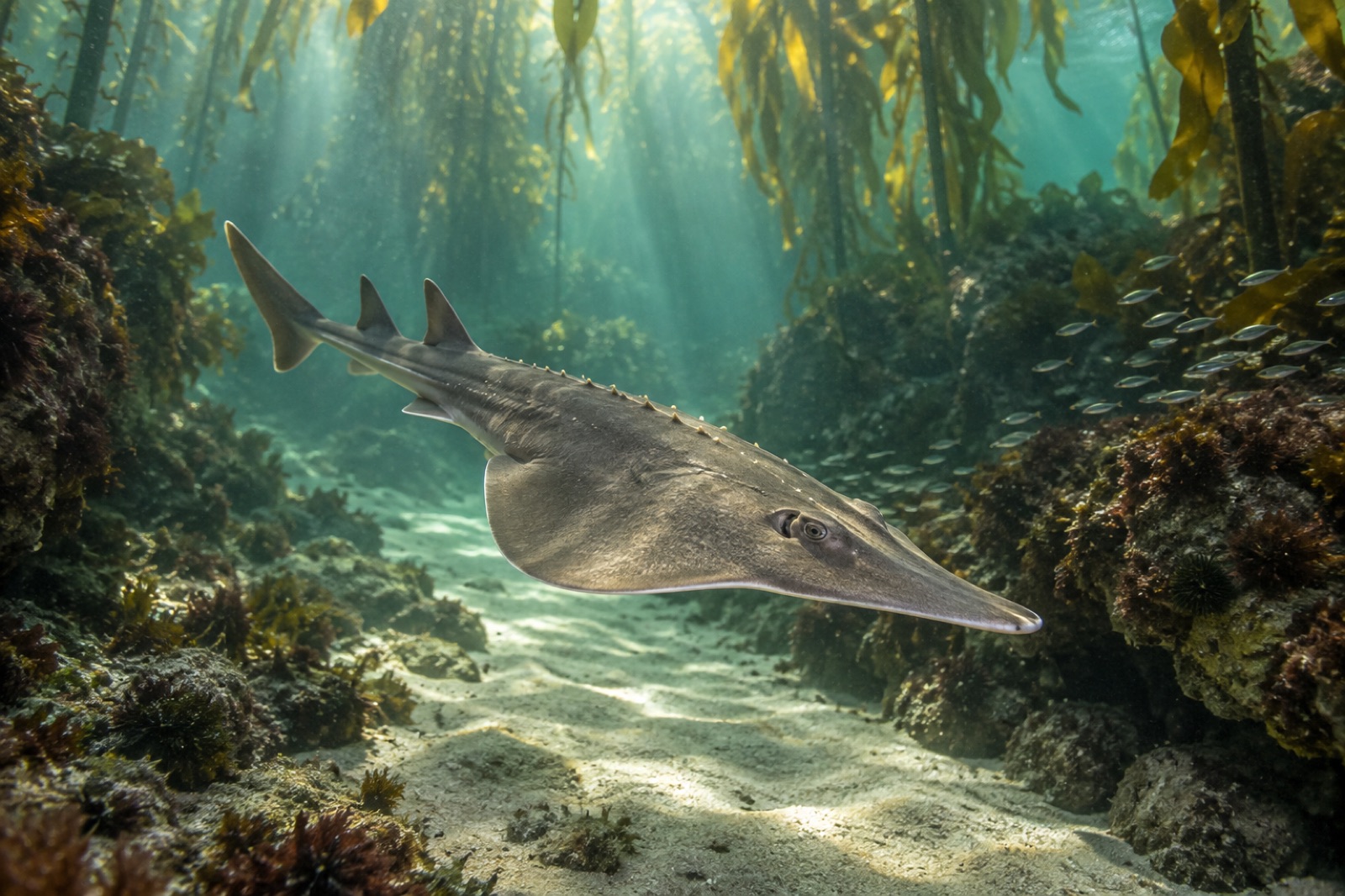
It fools everyone the first time: a flat, grey-brown animal the length of a person cruising over the sand at the kelp forest's edge, with a shark's tail and a ray's wings. Is it a shark? A ray? The shovelnose guitarfish (Pseudobatos productus) is the animal behind a thousand confused dive logs, and the answer — it's a ray wearing a shark's costume — is just the beginning of the story. This is the most commonly seen large bottom fish around southern California's kelp beds, a living hinge between the sandy flats and the rocky reef, and a species whose conservation story splits sharply at the US–Mexico border. Here is how to recognise it, how it lives, and why it matters more than its calm demeanour suggests.
Fast facts
|
|
| Scientific name |
Pseudobatos productus (long known as Rhinobatos productus) |
| Group |
A ray — order Rhinopristiformes, the guitarfishes |
| Common names |
Shovelnose guitarfish, shovelnose ray, California guitarfish; historically "shovelnose shark" in old angling writing |
| Size |
Commonly 1–1.4 m; large females approach 1.7 m |
| Depth range |
Intertidal shallows to about 90 m; most often seen in 2–15 m over sand |
| Distribution |
Eastern Pacific: roughly San Francisco Bay to the Gulf of California, including both sides of Baja |
| Diet |
Crabs, shrimps, worms, clams and small fishes plucked or dug from the sand |
| Reproduction |
Live-bearing (aplacental viviparity); litters of roughly 6–28 pups |
| Conservation status |
Critically Endangered on the IUCN Red List, driven by steep declines in Mexican waters |
So, shark or ray?
The honest answer is "ray, mostly." Guitarfish sit in their own order, the Rhinopristiformes, closer to the stingrays and skates than to true sharks. The giveaway is on the underside: like all rays, a guitarfish's gill slits open onto its belly rather than its flanks, and its shoulder girdle joins the skull rather than floating free as a shark's does. But nature, as usual, refused to commit. The shovelnose carries the flattened, winged forebody of a ray fused seamlessly into the cylindrical, muscular tail of a shark, complete with two dorsal fins and a proper shark-like caudal fin. It swims like a shark too — driving with lateral sweeps of the tail rather than flapping its pectoral wings the way a bat ray does.
The name does double duty. "Guitarfish" from the silhouette — a pointy acoustic guitar seen from below. "Shovelnose" from the wedge-shaped, flattened snout that it uses the way a gardener uses a trowel.
Identifying one on a dive
On the sand channels between rocky reef — classic guitarfish water in the Channel Islands or along the mainland — identification is straightforward once you know the pattern:
- Colour: plain sandy-grey to olive-brown above, usually without bold markings; white to cream below. The lack of pattern is itself a field mark — the leopard shark, the other large tail-swimmer over these flats, is extravagantly spotted and barred, and has a slimmer, longer body with obvious shark gill slits on its sides.
- Head: broad, wedge-shaped, with a pointed (not rounded) snout tip and large spiracles behind modest eyes. Thorns — small, rough denticles — run in a line along the back and tail, like a file's teeth.
- Posture: at rest it lies flat on the sand, sometimes half-buried with only eyes and spiracles proud; when cruising it holds a metre or so above the bottom.
A useful mental shortcut: if it has a shark's tail but a flattened ray forebody and no fierce attitude, it's a guitarfish. Californian divers sometimes confuse resting guitarfish with angel sharks (the Pacific angel shark, Squatina californica) — but the angel shark is flattened head to tail, with huge wing-like pectorals and a mouth at the front of the head, not underneath.
Life on the flats
The shovelnose is a generalist predator of the soft bottom, working the sand-and-mud plains that fringe the kelp forest the way a tractor works a field margin. It feeds with a satisfyingly mechanical method: pinning prey under that wedge of a snout, excavating with a few shovelling blows, and suctioning crabs, clams, ghost shrimps and small fishes out of the sediment with its protrusible, pavement-toothed mouth. Those flat, plate-like teeth crush shell rather than cut flesh — the mouth of a shellfish specialist, not a fish-chaser.
This habit makes it a quiet but real participant in the kelp forest economy. Sand flat and reef are not separate worlds; the detritus exported from the kelp — described in our piece on the detritus pathways of kelp forests — settles on those very flats, feeding the crabs and worms the guitarfish eats, while the guitarfish itself moves between both habitats with the tide and the time of day. At dusk, when the reef's day-shift fish retire, guitarfish often push up into surprisingly shallow water, sometimes almost into the surf zone.
Reproduction is slow, and this is where the vulnerability begins. Females grow larger than males and mature later — somewhere around eight to ten years — then produce modest litters of live young after a gestation of roughly a year. By the standards of bony fish, that is a long, careful life strategy: few offspring, well provisioned, born ready. It works beautifully in an unfished sea and unravels quickly in a fished one.
A borderline species: two fates on one coast
Here is the sharpest part of the story, and the reason the shovelnose appears on conservation lists despite looking abundant to a California diver. In Mexican waters, particularly the Gulf of California, guitarfish have been fished hard for decades by artisanal gillnet fisheries, both targeted and as bycatch of finfish and shrimp fisheries. The meat sells; the fins, like those of many batoids, historically sold for more. Fisheries-independent surveys documented declines on the order of 90 percent or more in parts of the Gulf — one of the most severe regional collapses recorded for any large coastal ray. On that evidence the IUCN Red List now classifies the species as Critically Endangered overall.
North of the border, the picture is genuinely different. California prohibited nearshore gillnets in state waters in the early 1990s, and the southern California population of shovelnose guitarfish responded: it is now considered comparatively healthy, and guitarfish remain one of the most reliably seen large rays for divers and even snorkellers wading off sandy beaches.
Same species, same coastline, opposite fortunes — decided entirely by what fishing gear is allowed within a few kilometres of shore. It is the clearest natural experiment in ray management on the Pacific coast, and it underpins the argument made throughout our marine protected areas explainer: shallow, nearshore waters are where bottom-dwelling rays live, and rules that bite there are the ones that work.
Why the kelp forest cares
A sand-flat ray is not the kelp forest's keystone the way a sea otter is, but it belongs to the same sentence. Guitarfish, leopard sharks, bat rays and their kin are the mid-sized predators of the soft-bottom margins, and their abundance is one of the quietest, most reliable indicators that a stretch of coast retains a full food web — that the flats still pump out crabs and clams, that the kelp drift still arrives, that no gillnet is quietly stripping the shallows at night. When Tidewright's survey teams log guitarfish on a reef's margin, it goes into the scorecard as a sign of structural health, a foot-soldier datapoint beside the camera-based canopy surveys that map the forest itself. You can browse the full cast of characters in the Kelp & Ocean Encyclopedia.
Key takeaways
- The shovelnose guitarfish (Pseudobatos productus) is a ray, not a shark — though its fusiform tail and two dorsal fins make the mistake understandable.
- Look for a plain grey-brown animal with a pointed wedge snout, shoulder thorns, and a habit of cruising or half-burying on sand next to kelp reefs.
- It is a shellfish specialist, excavating crabs, clams and worms from the sand with its flattened snout and crushing them on plate-like teeth.
- Reproduction is slow: live-bearing females mature late and bear small litters, making the species acutely vulnerable to fishing pressure.
- It is listed Critically Endangered after collapses in Mexican gillnet fisheries, while California's nearshore gillnet ban has kept the northern population comparatively healthy — one species, two management experiments.
FAQ
Is the shovelnose guitarfish dangerous to swimmers or divers?
No. It is a placid, slow-moving bottom feeder that generally ignores divers or fin-slaps away when approached. It lacks the stingray's barbed spine; its only defences are camouflage, thorn-like denticles and a powerful tail. As with any large wild animal, don't corner it, don't grab it, and keep fins off the bottom — but it has no interest in you.
What is the difference between a guitarfish and a sawfish?
Both are rays with shark-like bodies, but sawfish carry the famous toothed rostrum — a long flat saw — used to slash and stun prey, and grow far larger. Guitarfish have a plain shovel-shaped snout with no teeth sticking out of it. Sawfish are also mostly tropical; the shovelnose is a temperate-water animal of the Californias.
Why was its scientific name changed?
Genetics reshuffled the family tree. The old genus Rhinobatos proved to be a catch-all of unrelated lineages, and the eastern Pacific shovelnose was moved to the genus Pseudobatos in 2016. Older books, dive slates and fishing regulations still say Rhinobatos productus — same animal.
Where can I see one?
Southern California is the most reliable ground anywhere in its range: the sand channels around the Channel Islands, the kelp fringes of San Diego county, and the sandy mouths of coastal lagoons, all in water shallow enough for snorkellers. Late afternoon and evening, over open sand next to reef, on a calm day — patience is the only technique.
Does Tidewright's restoration work help guitarfish?
Indirectly but genuinely. Restored kelp forest exports detritus and prey onto adjacent sand flats and shelters juvenile fish, rebuilding exactly the food web a bottom predator depends on — and our solution for fisheries works with fleets on the gear and ground rules that keep species like this one in the water.