Encyclopedia8 min read
Ochre Sea Star (Pisaster ochraceus): The Original Keystone Species
Meet the ochre sea star, the purple tidepool predator whose removal in a famous 1960s experiment coined the keystone species concept.
Dr. Theo Nakamura ·
Leptasterias, the six-rayed star, broods its babies under its own body on the wave-beaten rocks of the Pacific kelp fringe — a small star with a big secret.
Turn a cobble on a low winter tide anywhere on the northeast Pacific coast and you will often find a small, six-armed sea star — grey, greenish or mottled rust, textured like fine sandpaper, barely wider than your palm. Pick it up gently in January and you may get a surprise: the underside is a nursery. The six-ray star (Leptasterias, most familiarly the Leptasterias hexactis species complex) is the only common sea star on the Pacific kelp coast that broods its young, carrying a cluster of developing embryos beneath its body until they crawl away as miniature stars. In a phylum famous for broadcasting millions of eggs to the mercy of the plankton, that is a radical act of parenting — and it makes this little star one of the most instructive animals on the shore.
| Scientific name | Leptasterias spp.; the widespread brooding form is the L. hexactis species complex |
| Group | A sea star — class Asteroidea, order Forcipulatida, same order as the sunflower and ochre stars |
| Arms | Usually six (occasionally five or seven); therefore "six-rayed" |
| Size | Small — arm span commonly 8–12 cm; big individuals reach ~15 cm |
| Depth range | Mid-intertidal rocks to shallow subtidal, roughly 0–30 m; abundant on the kelp fringe |
| Distribution | Northeast Pacific from the Aleutians and Alaska to central California |
| Diet | Small snails, limpets, barnacles, tiny mussels, other small invertebrates |
| Reproduction | Brooding: female retains embryos under the disc; direct development — the young walk out, no planktonic larva |
In winter — timing varies with latitude — a ripe female six-ray star finds a sheltered spot under a rock or in a crevice, attaches her cemented cluster of eggs to the substrate directly beneath her mouth, and then arches her body over them like a tent. Her tube-feet grip the rock around the brood; the embryos develop in the humid, protected cavity she creates. She does not leave to feed. Depending on temperature she tends the brood for weeks, losing body mass all the while, until the young — fully formed little stars, each only a millimetre or two across — crawl out from under her arms and walk away on their own tube-feet into the shore.
This "direct development" is the deepest departure from the sea-star norm. An ochre star sheds millions of eggs that spend two months as drifting larvae; a brooding six-ray mother invests a few hundred eggs and gives every one of them a bodyguard. The trade-off is dispersal: six-ray stars cannot ride currents to new coastline, so their populations are local, insular, and genetically structured on very short distances — a beach can effectively be a nation. For coastal ecologists the genus became a model system for studying how life-history choices redraw the map of who is related to whom along a shore, and why some shores hold distinct local lineages.
As if brooding were not enough, some Leptasterias populations also hedge their bets the other way: individuals — especially small, growing ones — can split in two and regenerate, producing a clone. A shore can therefore hold stars that arrived by devoted maternal care wearing arms of wildly mismatched age, the signature of a body repair that in this species sometimes doubled as reproduction. Both strategies share one theme: staying put. This is a star built to persist on its own rock, not to gamble on the plankton.
The six-ray star's world is the wave-washed rock at the forest's upper edge — the band where sea palms bend in the swell and the kelp begins. It is a predator of the small things that live there: it hunches over little limpets and periwinkles, pulls barnacles from their plates, picks young mussels out of the mat, and scavenges whatever the waves provide. Everything about its body plan reads "intertidal professional": small enough to fit the shelters, textured for grip, six arms for insurance against damage, and a water-vascular system that keeps a determined hold when the surge hits.
That insurance is necessary, because the shore holds predators that specialise in stars. The morning sun star — an eleven-armed hunter of other sea stars — will chase a six-ray across open rock, and Pacific gulls work intertidal rocks at low water. The defence is the crevice: a brooding mother under a boulder with eggs beneath her is as close to unreachable as a sea star gets.
Field guides long treated the brooding six-ray as a single species, Leptasterias hexactis, but genetic work on Pacific coast populations has shown the name blankets a complex of cryptic lineages — animals that look identical on a cobble but have been drifting apart for ages, their separate fates written into separate shorelines by that very life history: no planktonic larva, no long-distance mixing, lots of local divergence. It is a full-circle story: the biologist-looking-over-the-shoulder answer to "what species is that?" is "probably several, and the brooding habit made them". For the shore-watcher this hardly matters — the animal is what it is — but on restoration-minded coastlines it means "the six-ray star" of a headland may be a small endemic treasure of that headland, worth treating as such.
The sea star wasting epidemic that swept the Pacific coast in the 2010s did not spare Leptasterias; brooding small stars were seen melting alongside the big broadcasters, and on some shores they thinned to near-invisibility before slowly rebuilding. There is a grim natural experiment hiding here that ecologists are still reading: can a non-dispersing, brooding animal recolonise a shore it has been wiped from? For a sunflower star the answer is "yes, by larval rain from a hundred kilometres away". For a six-ray star the answer is "only from whatever survived in the local cracks" — which makes its persistence a quiet census of how thoroughly any given refuge rode out the disease. In this way the little star has become one of the most telling long-term indicators in the beach book, a case study in why life-history diversity is a conservation resource all by itself.
Leptasterias watching is the humblest and easiest sea-star watching on the Pacific coast — no boat, no dive, no luck required:
One ethic goes with the watching: lifting a brooding star risks breaking her hold and sweeping the brood away, so treat every Kelp-fringe star as if it might be carrying passengers — in winter, half of them are.
On rocky intertidal shores from Alaska to central California — cobble beaches, boulder fields and the kelp-fringe rocks. Look under rocks on a low tide in winter, and always turn them back exactly as they were.
Brooding replaces the sea-star norm of releasing millions of eggs to the plankton with intense care for a few hundred: embryos develop under the mother's body and leave as tiny stars. The cost is dispersal — populations cannot ride currents, so shores become isolated evolutionary worlds of their own.
Small — most are palm-sized, an 8–12 cm span, with big fish reaching about 15 cm. They are the smallest of the common Pacific kelp-coast stars, an order of magnitude below the sunflower star.
Yes, Leptasterias declined on many shores during the wasting epidemic of the 2010s. Because they cannot recolonise by drifting larvae, their recovery depends entirely on local survivors — making their presence today a residue of the refuges that held on.
Yes — asexual reproduction by fission with regeneration is documented in the genus. It's another expression of the same persist-don't-disperse strategy: a star can double itself on its own shore without ever gambling on the open plankton.
Meet the ochre sea star, the purple tidepool predator whose removal in a famous 1960s experiment coined the keystone species concept.
Dr. Theo Nakamura ·
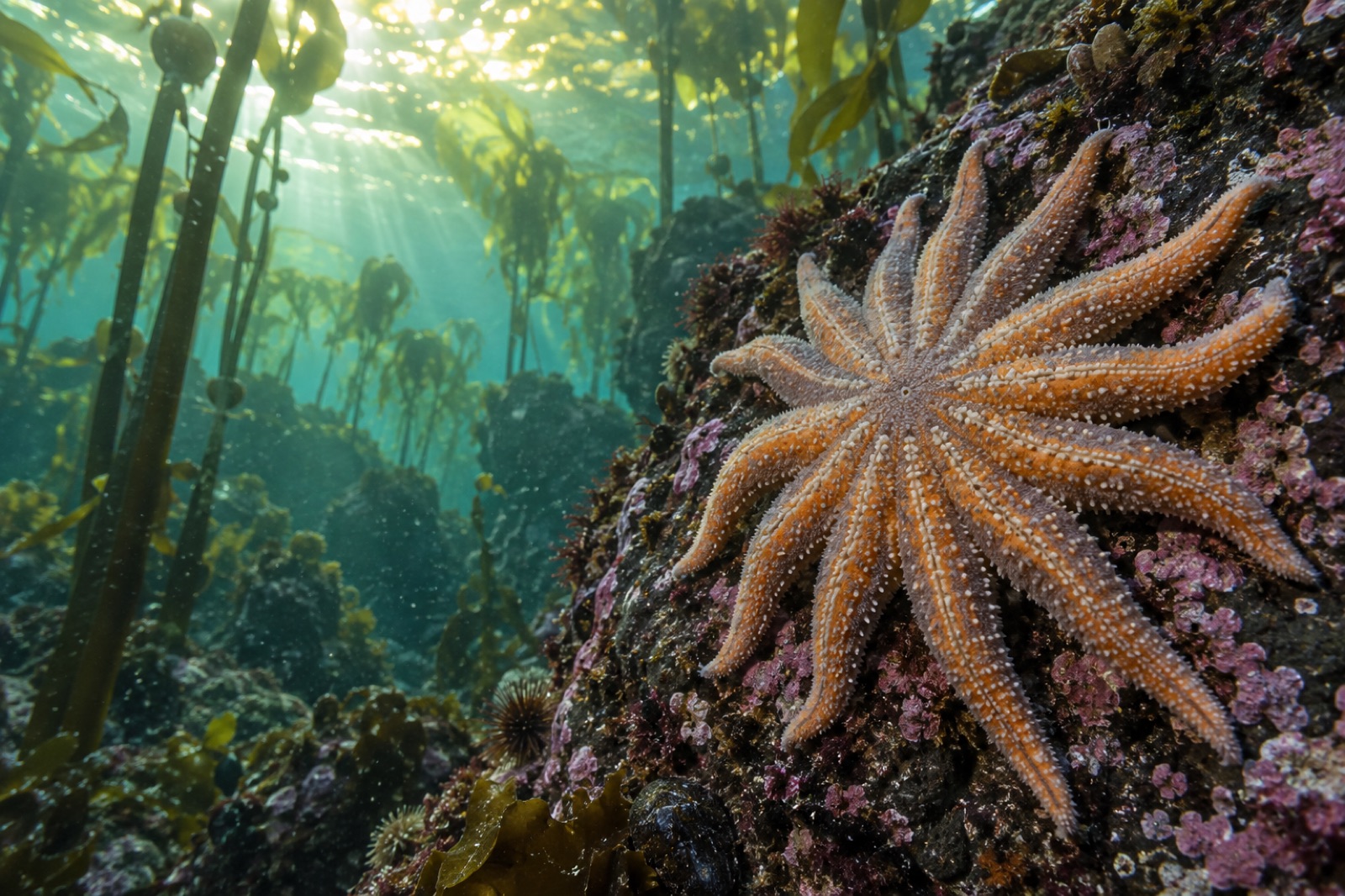
With up to sixteen arms and a taste for other sea stars, the morning sun star is the kelp forest's fastest hunter — and a weathervane of sea star wasting.
Dr. Mara Ellison ·
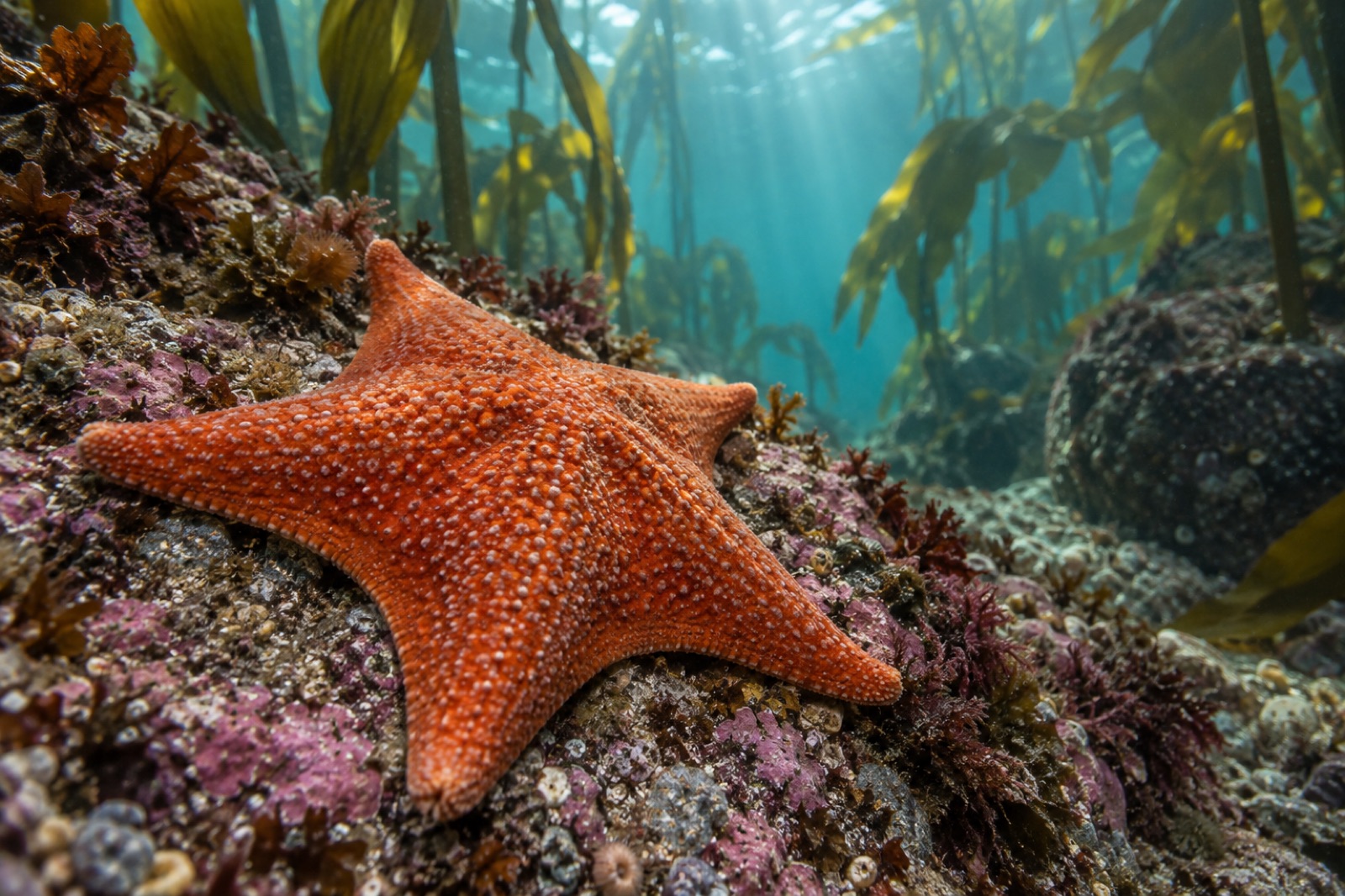
The bat star (Patiria miniata) is the kelp forest's web-fingered clean-up crew — a slow omnivore that turns detritus into reef fertility. Facts, ecology, where to see one.
Dr. Theo Nakamura ·