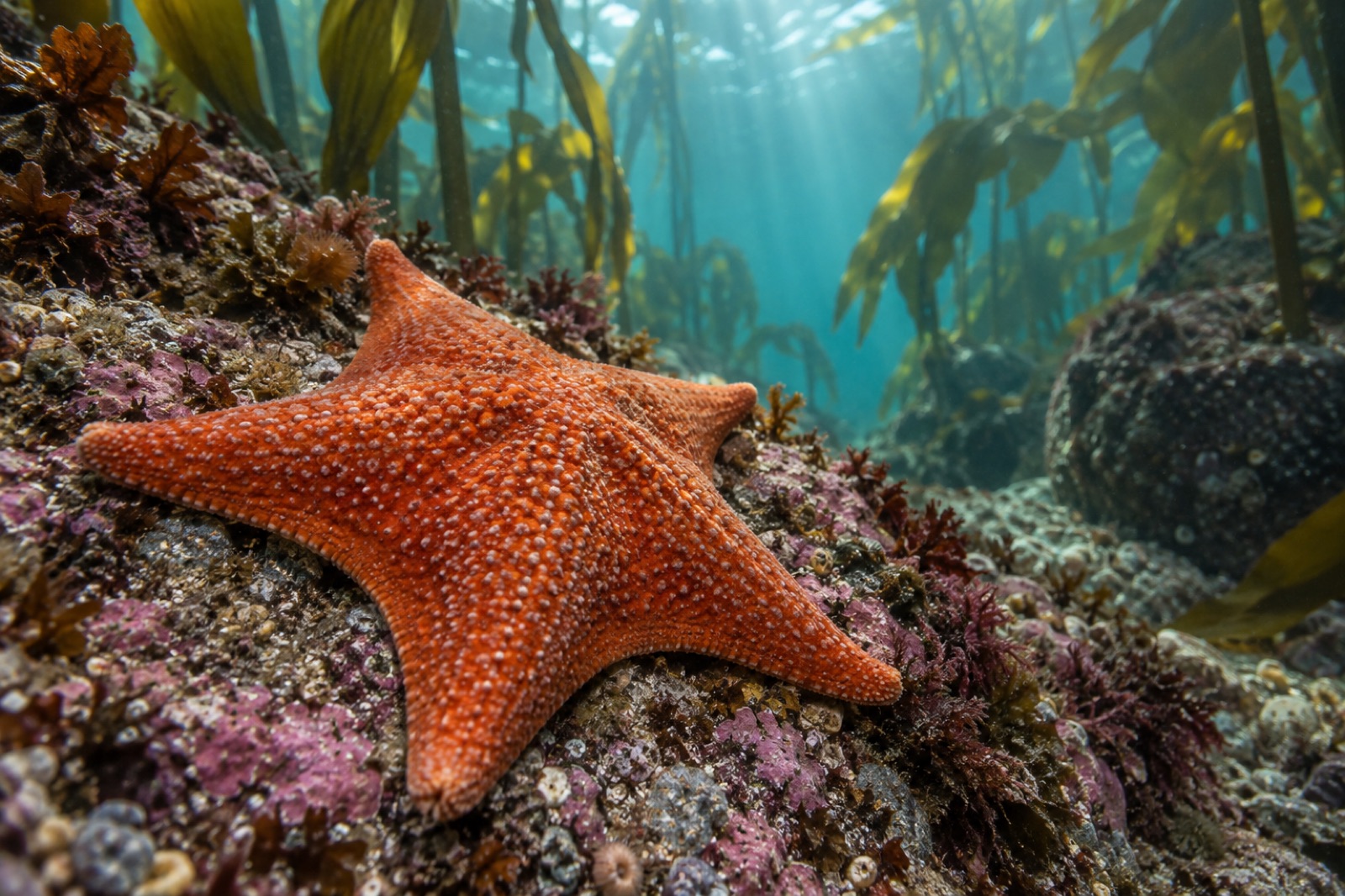
Ask a diver to sketch a sea star from memory and, on the Pacific coast of North America, they are likely drawing a bat star: five broad arms webbed at the base into a soft pentagon, like a bat's wing or a small, plush cushion. Patiria miniata is one of the most familiar echinoderms on the west coast — common from Alaska to Baja California, comfortable from tidepools to depths beyond 200 metres, and instantly likeable in a phylum not known for charm. But the bat star's real interest is not its silhouette. It is the opposite of the sea star archetype: where most of its famous relatives are ambush predators of mussels and urchins, the bat star is a patient, generalist omnivore — half grazer, half undertaker — whose quiet work on the reef floor keeps detritus cycling and surfaces clean.
Fast facts
|
|
| Scientific name |
Patiria miniata (formerly Asterina miniata) |
| Group |
Sea star (Asteroidea), family Asterinidae |
| Size |
Usually 10–20 cm across; arms typically 5, occasionally 4–6 |
| Colour |
Variable — red, orange, yellow, tan, purple, grey; often mottled |
| Habitat |
Rocky reef, sand edges, kelp forest floor; intertidal to ~290 m |
| Diet |
Omnivore: algal film, detritus, drifting kelp scraps, carrion, small sessile invertebrates |
| Range |
Eastern Pacific: Sitka, Alaska, to northern Baja California |
| Lifespan |
Not precisely known; slow-moving, long-lived, likely decades |
Anatomy of a soft pentagon
The bat star's webbed arms are the giveaway, but the details reward a closer look. The surface is covered in a plush, granular skin — under magnification it resembles corduroy — and along the underside of each arm runs an ambulacral groove packed with tube feet. On the upper (aboral) surface sit two useful structures: the madreporite, a pale sieve plate where seawater enters the star's hydraulic water-vascular system, and, at the junction of the arms, the anus. Yes — the mouth is on the underside, the anus on top, a body plan that takes some getting used to.
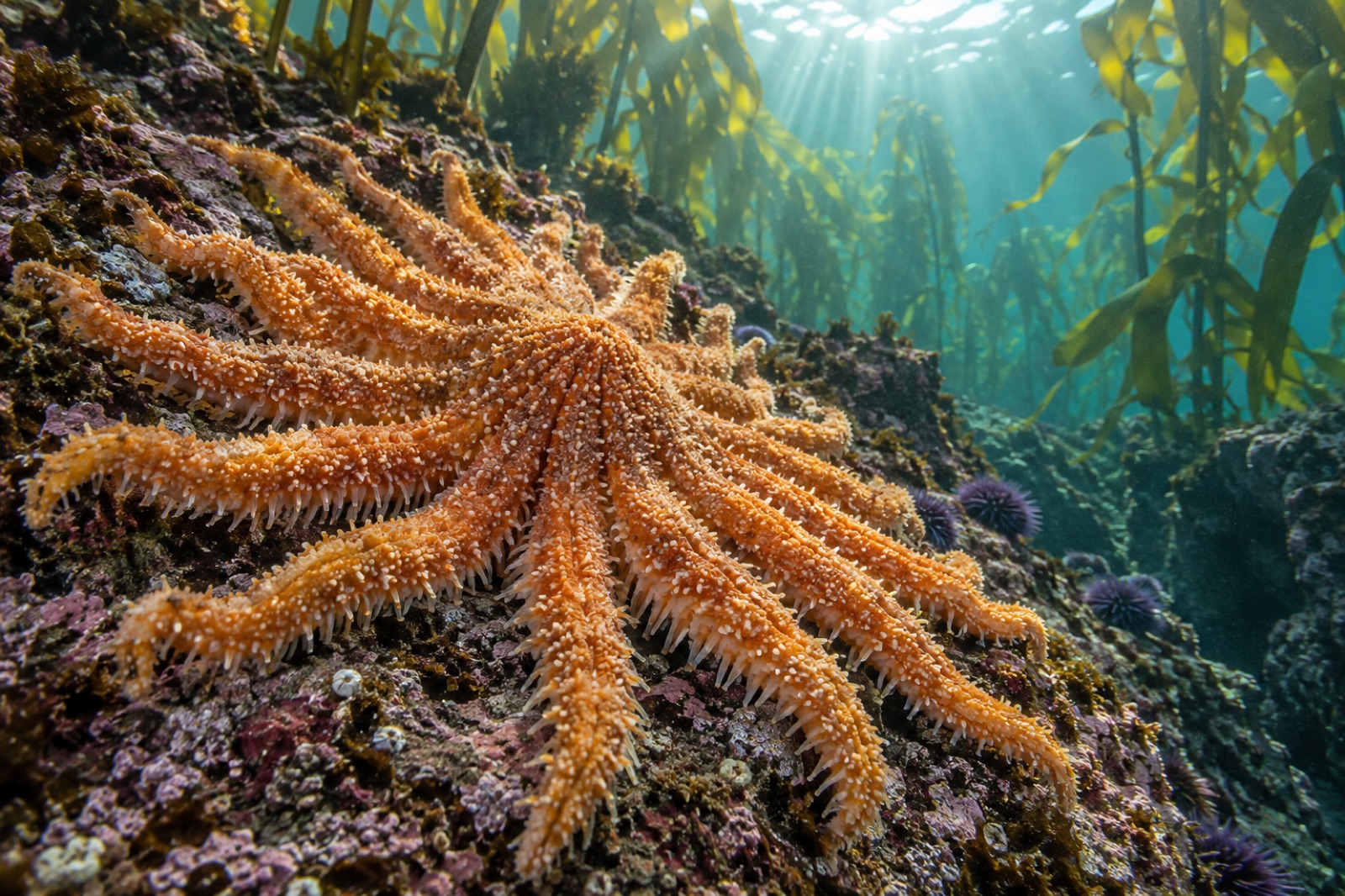
Colour is famously unreliable as an identification cue: bat stars come in russet, tangerine, violet, dove grey and patterned combinations, sometimes with a pale starburst around the centre. Count arms instead, and look at proportions — the web at the arm bases and the overall "pentagon with ambitions" outline separate it from the lankier ochre sea star and the multi-armed hunters like the sunflower star. Like other echinoderms it can regenerate lost arms, and it moves on hundreds of individually controlled tube feet — hydraulic feet, powered by a pressurised water system, each ending in a nib of suction.
Speed is not the point: a bat star in a hurry might manage fifteen centimetres a minute. Everything about the animal is tuned instead to persistence and surface area — a living doormat designed to press against rock and extract value from whatever the rock is wearing.
The omnivore's menu: grazing, scavenging, and the everted stomach
The bat star's feeding apparatus explains its menu. Like its predatory cousins, it can evert its cardiac stomach — pushing the organ out through the mouth and onto food to begin digestion outside the body. But where a predatory star aims that tool between mussel shells, the bat star spreads it across surfaces: over algal film and diatom scum, over encrusting sponges and bryozoans, over a drift scrap of kelp, over anything dead or dying that the current has parked on the reef. It is both the kelp forest's grazer and its mortician, and the second role matters more than it appears.
Reef ecosystems generate a continuous fallout: torn kelp, moulted shells, faeces, dead fish, the constant sediment of a rich system. Left alone, that layer is a substrate for bacterial blooms and a barrier over settling larvae. Clean-up species like the bat star, the brittle stars and the grazing gastropods process it continuously, converting waste back into body mass that authorised predators — gulls, sea otters, fish, other stars — can use. In the kelp forest food web, detritivores are not a side plot; they are the return loop that keeps the whole circuit fed.
And the bat star has a partner in this work. Look closely at the oral surface of a healthy bat star and you may find a small, slender scale worm — Ophiodromus pugettensis — living between the tube feet as a commensal, scavenging the scraps of the star's meals. Clean-up crew, cleaned by its own clean-up crew.
Reproduction and the plankton years
Bat stars spawn in late spring and summer: males and females release sperm and eggs into the water in aggregations that lift fertilisation odds, and the embryos develop into swimming bipinnaria larvae — bilateral, transparent, utterly unlike the adult they will become. The larvae spend weeks in the plankton, eating, drifting, and finally landing on the reef to metamorphose into a five-armed juvenile measured in millimetres. As with everything else on the coast, recruitment is luck and logistics: currents, temperatures and the right texture of rock decide whether a given year produces a new cohort, part of the same larval dispersal lottery shared across the coast's invertebrates.
The wasting question
Sea star wasting disease — the epidemic that has devastated Pacific sea stars since 2013 — did not spare bat stars, and researchers have documented wasting symptoms and local losses in the species. But the bat star appears to have fared substantially better than its relatives: it did not crash the way the sunflower star did, and it remains common through most of its range. Nobody is complacent about this. The ongoing sea star wasting story has taught the field two hard lessons: that a "common" species is buffered but not safe, and that the ecosystem services of echinoderms only become fully visible when they stop. The urchin barrens that followed the sunflower star's collapse in some regions are the proof.
Where to see a bat star
Few kelp forest animals are easier to meet. In the intertidal, check shaded overhangs and pool edges at low tide from Oregon south through California. Subtidal, any temperate Pacific reef with giant kelp or a mix of boulder and sand will do — scan the open rock faces and the sand–reef boundary where detritus collects, which is exactly where a bat star wants to be. Classic shore dives such as Monterey's Breakwater are reliable bat star territory in all seasons.
The etiquette is hands-off: starfish skin absorbs what your sunscreen is carrying, handling stresses the animal, and prying one off its rock tears tube feet. Watch it feed instead. If you are lucky and patient, you may see the cushion of the body hump slightly as the stomach slides out underneath — digestion as slow theatre.
Key takeaways
- The bat star (Patiria miniata) is a five-webbed-arm sea star of the eastern Pacific, Alaska to Baja California, from tidepools to nearly 300 m.
- It is an omnivore and the kelp forest's clean-up crew: algal film, detritus, carrion and encrusting life are digested by an everted stomach.
- Detritivory is infrastructure, not housekeeping — species like the bat star recirculate the reef's waste into the food web.
- It carries a commensal scale worm, rebroadcasts its genes each summer through planktonic larvae, and can regenerate lost arms.
- Sea star wasting disease has touched it, but lightly compared to the sunflower star — no guarantee, only good fortune so far.
FAQ
Why is it called a bat star?
For the arms: broadly webbed at the base and tapering like the membrane of a bat's wing. From above, the whole animal reads as a soft pentagon rather than the classic pointed star — which also makes it one of the easiest Pacific sea stars to identify at a glance.
Are bat star colours different species?
No. Bat stars are famously variable — red, orange, yellow, purple, grey, mottled — and colour does not map onto regional forms or separate species. Use arm count, webbing and habitat to confirm identification, then enjoy the palette as decoration.
What eats bat stars?
Sea otters, gulls, larger sea stars including sunflower stars, and some fishes have all been recorded eating them, though the bat star's low-nutrient, granular skin seems to make it a less target-rich meal than fleshier invertebrates. Their main defence may simply be being not worth the trouble.
Do bat stars move much?
Slowly, and presumably far enough to matter to a bat star: tube-foot locomotion tops out at a few centimetres per second. They do not hide — a diver can observe one feeding for long minutes without it adjusting — which is the behavioural signature of an animal that has decided camouflage and speed are someone else's problems.
Are bat stars endangered?
No; the species remains abundant across most of its range. It suffered losses during sea star wasting outbreaks but avoided the catastrophic regional crashes seen in sunflower stars. Like all intertidal life it is exposed to warming, heatwave low tides and handling pressure at popular sites — the usual coastal burdens, none yet decisive.