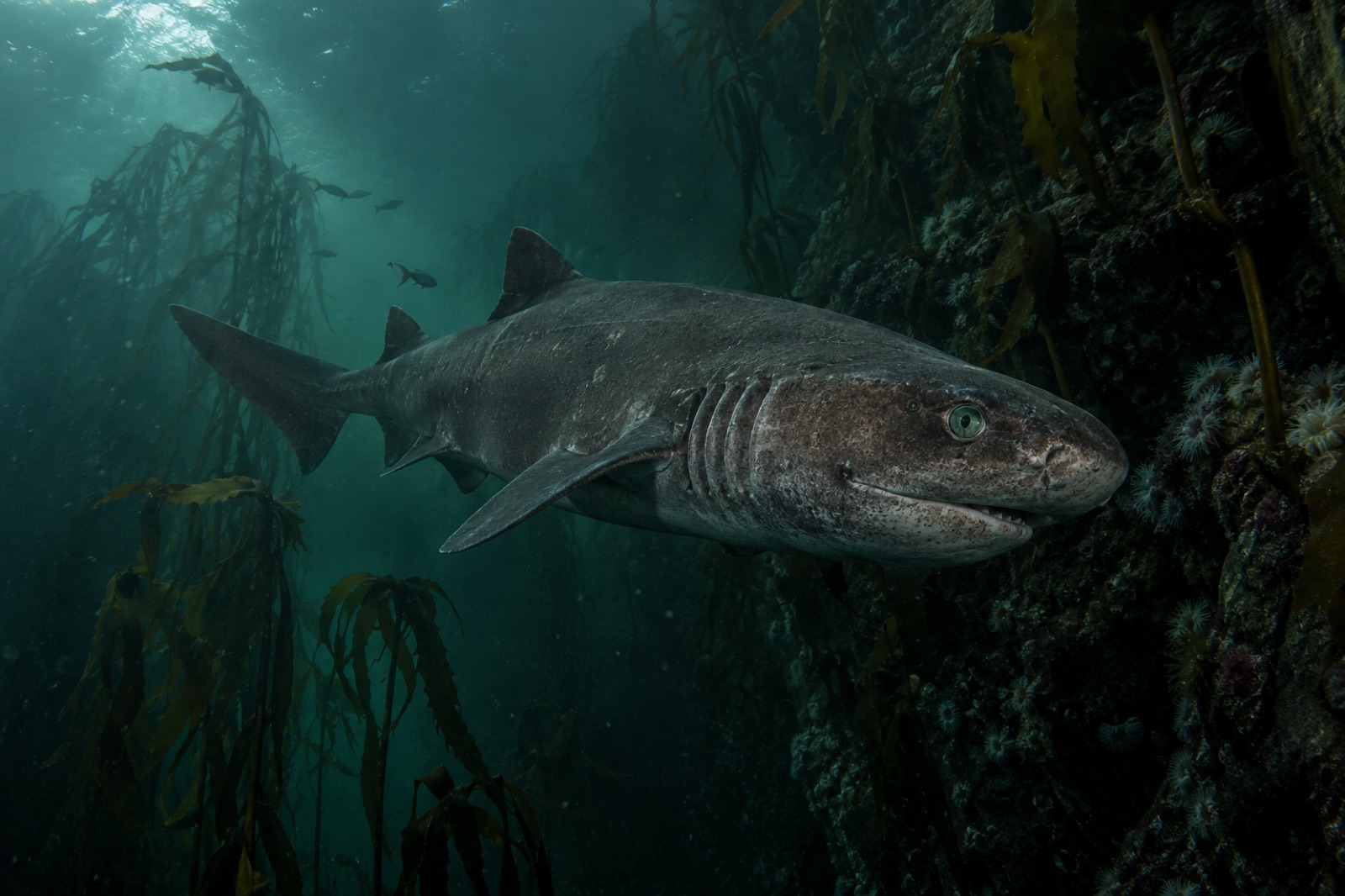
Nearly every shark you will ever see has five gill slits. The bluntnose sixgill has six, and that extra slit is a signature from another era — a clue that you are looking at one of the most primitive shark lineages still swimming. Hexanchus griseus is a big, slow, big-eyed animal of the deep ocean that nonetheless visits the shallow edges of kelp country after dark, turning up in the fjords and sounds of the Pacific Northwest, over Monterey's submarine canyon, and in similar drowned landscapes around the world. It is the shark that reminds coastal people the deep sea is just on the other side of the kelp line.
Fast facts
|
|
| Scientific name |
Hexanchus griseus (Bonnaterre, 1788) |
| Group |
Shark; order Hexanchiformes, family Hexanchidae — the cow and frilled sharks |
| Size |
Commonly 3–4.5 m; the largest reliably measured approach 5 m, females larger than males |
| Range |
Worldwide in temperate and tropical seas, continental and island slopes |
| Depth |
Recorded from the surface to beyond 2,000 m; most often 200–1,000 m by day, shallower at night |
| Diet |
Fishes, other sharks and rays, squid, crustaceans; an important scavenger of carrion |
| Marks |
Six gill slits; a single small dorsal fin set far back toward the tail; large, pale-green eyes |
A body plan from the archive
The Hexanchiformes — sixgill, sevengill and frilled sharks — are the surviving members of an old branch of the shark tree, with relatives in the fossil record stretching deep into the age of dinosaurs. Six gill slits are part of that inheritance (its relative the broadnose sevengill carries seven), along with the single dorsal fin pushed back against the tail and extra tooth rows in the jaw.
Look at a sixgill's teeth and the ancestry sharpens further. The upper jaw carries narrow, pointed cusps for gripping; the lower jaw carries broad, saw-edged cutting teeth — a two-tool arrangement for seizing prey and then slicing pieces off it. The body is heavy and torpedo-blunt ("bluntnose" earnestly meant), the coloration a deep slate-brown to nearly black above, paling toward the belly. And then there are the eyes: enormous, and in life an almost luminous pale green, the mark of an animal built to gather what little light remains at depth.
The night shift
By day, adult sixgills hold to the dim reaches of the continental slope — a few hundred metres down and often much deeper. By night they climb. This diel vertical migration, moving up into the shallows after dark and retreating before dawn, is how a deep shark comes to cruise water ten or twenty metres deep along a forested, kelp-fringed shoreline. It follows the same commuting logic as the great biomass of the mesopelagic twilight zone: darkness is cover, and cover makes the shallow buffet safe.
Tagging studies on the Pacific coast have traced this rhythm directly: sharks pinged deep on the slope in daylight, rising along canyon walls and inlet sills at dusk, working the shallow margins through the night. For divers in the Pacific Northwest, the upshot is one of the finest large-animal encounters in cold-water diving — a four-metre shark, curious rather than wary, materialising out of the dark on a night dive. For everyone else it is a useful mental correction: kelp-lined water is not a small, safe, separate world. The deep ocean visits it nightly.
Kelp-lined corridors: Puget Sound, Howe Sound, Monterey
The sixgill's most famous shallow haunts are the glacier-carved inlets of the northeast Pacific. In Puget Sound, decades of research — much of it organised around Seattle's aquarium and university laboratories — have built a detailed picture of a resident-seasonal population. Young-of-the-year sixgills, pups the size of a spaniel, use the sheltered basin shallows as nursery ground, while adults pass through by night. Across the border, British Columbia's Howe Sound offers the same geometry: steep walls, deep basins, kelp forests clothing the sunlit rock between, and sixgills commuting up the walls after dark.
Farther south, Monterey Bay's submarine canyon brings deep water to within a short swim of the kelp beds, and sixgills appear on baited cameras over the canyon's flanks. Cabled seafloor observatories — cameras and sensors networked to shore, as described in our piece on ocean observatories — have recorded sixgills investigating instruments at depth, sometimes for hours. In fjord systems everywhere the story rhymes: where deep water abuts kelp-fringed shallows, the sixgill is the go-between.
What a deep shark eats
The diet answers "yes." Stomach contents, video records and stable-isotope work describe an apex generalist: midwater and bottom fishes (from hake to rockfish), smaller sharks and rays, squid, crabs and shrimp — and carrion. Sixgills are documented scavengers at whale falls and other large carcasses on the seafloor, arriving at baited cameras alongside, and sometimes displacing, swarms of Pacific hagfish. That willingness to scavenge is partly how science meets the animal: a baited remote underwater video station on the slope will often draw a sixgill before anything else large arrives.
Its hunting style is patient. Video from submersibles shows a shark that moves at an unhurried cruise even in the final approach, relying on darkness, bulk and the saw-edged lower jaw rather than speed. At shallow depths at night it switches to the reef's own residents — fishes resting in the kelp shadow have nowhere fast to go.
The slow arithmetic of sixgill life
Like most large sharks, the sixgill lives slowly. It bears live young without a placenta — pups develop from yolk inside the mother — and litters are famously large, running from a couple of dozen to, at the high end, more than a hundred pups. Maturity comes late, measured in many years, and females grow substantially larger than males. That life history — slow growth, late maturity, big litters spread across a long life — is broadly resilient but poor at absorbing heavy, targeted fishing, and sixgills have been taken in deep gillnet and longline fisheries in various parts of their range. Global conservation assessments have flagged the need to watch the species closely; local populations in semi-enclosed seas, like Puget Sound's, are the most tractable to study and the most worth protecting through understanding.
Meeting one on its terms
Sixgill encounters with divers happen because the shark chooses them. The standing etiquette is easy: no touching, no pursuit, hold your light steady rather than flashing it at the eyes, keep bubbles calm, and let the animal set the range. A sixgill that circles a diver is inspecting, not threatening; the species has no history of unprovoked attacks on humans. If you dive the Pacific Northwest at night on a reef over deep water and you are lucky, you may meet the biggest, oldest thing in those kelp forests — a visitor on a schedule older than the forest itself.
Key takeaways
- The bluntnose sixgill (Hexanchus griseus) is one of the most primitive living sharks, marked by six gill slits and a single rear-set dorsal fin.
- It lives deep — typically 200–1,000 m by day — but rises shallow at night, following fjord walls and canyon edges into kelp country.
- Puget Sound, Howe Sound and Monterey Canyon are its best-known shallow haunts; pups use sheltered basins as nursery habitat.
- It is an apex generalist and major deep scavenger, eating fishes, other sharks, squid and carrion including whale falls.
- Slow-growing, late-maturing and large-littered, it is vulnerable to deep fisheries and deserves its "watch" status in many regions.
FAQ
Are sixgill sharks dangerous to humans?
No. Despite reaching nearly five metres, the bluntnose sixgill has no record of unprovoked attacks on divers or swimmers. Encounters, mostly on night dives in the Pacific Northwest, are typically calm inspections in which the shark approaches, circles, and departs.
Why does it have six gill slits when other sharks have five?
Six (or seven) gill slits are an ancestral trait retained by the shark order Hexanchiformes, an old lineage with deep fossil roots. Most other shark groups converged on five; the hexanchids kept the older arrangement.
Where can divers realistically see one?
Night dives over deep water in Puget Sound and Howe Sound offer the best odds, particularly in summer and autumn. Monterey Bay's canyon rim and fjord systems in British Columbia and Alaska also produce encounters. Day sightings are rare outside of baited-camera work.
How deep do sixgill sharks go?
They have been recorded below 2,000 metres, but the everyday daytime range is a few hundred to around a thousand metres. The notable behaviour is the reverse: nightly ascents into just a few metres of water.
What is the biggest sixgill on record?
The largest reliably measured individuals approach five metres, and females run larger than males. As with most deep sharks, tales of substantially bigger animals circulate, but the well-documented ceiling is around the five-metre mark.