Encyclopedia8 min read
Kelp Perch (Brachyistius frenatus): Species Profile
Meet the kelp perch, a live-bearing surfperch that hovers in the kelp canopy, sips drifting plankton and picks parasites straight off larger fish.
Tom Okafor ·
The pile perch (Rhacochilus vacca) is the big, deep-bodied seaperch of Pacific kelp forests and pilings — live-bearing, hard-shelled-prey crusher, diver favourite.
Stand on any old fishing pier from British Columbia to Baja and look down the shaded pilings: the big, deep-sided fish cruising slowly between them, tall as dinner plates and marked with a bold dark bar, are pile perch. Rhacochilus vacca is the largest of the seaperches — a family found nowhere else on Earth but the kelp-forested northeast Pacific — and it embodies everything that makes the family strange and wonderful. Live-bearing, browsing midwater rather than hunting it, crunching crabs with reinforced teeth: the pile perch is a kelp forest original.
Seaperches look nothing like true perches and more like oversized, laterally compressed damselfish — deep, disc-like bodies with a small head, one long continuous dorsal fin and a quietly analytical expression. The pile perch is the family's heavyweight, reaching around 44 cm. The ground colour is silvery to brassy-grey, crossed on the flank by a tall dark vertical bar just behind the pectoral fin; many fish also show a yellow tinge or spot low on the cheek and dark edging on the fins. Beneath overcast water the dark bar against the pale grey body is the giveaway at any distance.
It seldom appears alone: a typical sighting is a loose gang of three to a dozen fish wheeling just off the reef or pilings, or combing kelp fronds nose-down.
The pile perch is a true northeast Pacific endemic, from southeastern Alaska — with occasional records nearer the Alaska Peninsula — south through British Columbia, Washington, Oregon and California to central Baja. Through its range it is a fish of structured midwater: pier and breakwater pilings (hence the name), rocky reef, and kelp forest edges where the canopy meets open water.
Depths run from the tide line to around 45 m. Unlike its bottom-hugging cousins — or schooling neighbours like the blue rockfish, which hunts open water — the pile perch owns the layer between seafloor and canopy beneath the giant kelp forest, holding station over the reef like a moored blimp — then dropping deliberately to browse.
Most midwater fishes strain zooplankton. The pile perch instead heads down to the groceries and browses the reef carpet — algae, kelp, rock — for its sheltered prey, and its dentition and jaws are built to crack what it finds.
Stomach-contents work paints a consistent picture: small crabs, shrimps, molluscs, polychaete worms, and smaller numbers of brittle stars, limpets and other hard-shelled creeping things, all shattered by the stout pharyngeal and jaw teeth. Fish occasionally scrape ectoparasites off other fishes; the role is secondary but reported, echoing a cleaner-wrasse habit in passing. The pile perch also takes kelp and algal strands directly, making it an omnivore in the strict sense: it picks its salad first and pries the meat out of it.
This diet matters ecologically: a browsing omnivore that conscripts kelp fronds as cropland, and converts shellfish no smaller fish can break into a food chain of its own. Where pile perch are common, they are part of the forest's connective tissue between canopy, turf and midwater.
If seaperches have one famous trick among fish families, it is this: they give birth to live young that are born looking like miniature adults, not drifting eggs. Courtship takes place among cruising schools; a male courts a female with vivid fin displays and quivering postures, fertilising her internally, and the embryos develop inside the mother on a nourishing placenta-like system — skin-tags of the embryo's fin membranes press against the ovarian wall to exchange sustenance.
Spring brings the birthing. A large female may deliver a few dozen young, each already several centimetres long — far larger than the larvae broadcast by rockfish, fully finned and startlingly competent. Juveniles settle into shallow, sheltered water among kelp understory and eelgrass edges, where they grow fast in the first year, then slow into a decades-long adulthood like so many long-lived kelp fish.
The trade-off is vintage seaperch analysis, and it's the same math as in mammals: invest in fewer, larger, higher-survival young rather than planktonic clouds. It works beautifully in stable kelp forests — and groans where forests vanish and gestating females find no nursery.
Pile perch live in a comfortable, unhurried sociality. Schools hold station in midwater through the day, combing reef and pilings with that methodical, nose-down prospecting motion, and aggregating defensively but loosely when threatened, pouring off sideways like smoke. At night individuals tuck into the reef. Curious and confident, they inspect divers at arm's length, making them one of the great door-prize encounters of west coast diving — treat yourself to one of the shore dives in our Coastal Atlas and say hello.
Pile perch are caught readily from piers and shore through their range — they fall to bait fished near structure — and are good eating. Because they bear live young in small numbers and older females carry the bulk of reproduction, they are susceptible to local depletion around heavy-fished piers; bag limits and size rules apply across the west coast states, so check the current regulations wherever you're casting. Marine protected areas sheltering kelp forests shelter pile perch too — no-take reefs quickly grow the large, calm resident schools divers love.
No — name aside, seaperches (Embiotocidae) are not true perches at all and are closely allied to damselfishes and wrasses. The "perch" is folklore. The family is essentially unique to the cool northeast Pacific.
The tall dark vertical bar behind the pectoral fin, the greater depth of body, and the species' attachment to pilings and reef edges all help; most other seaperches are slimmer, unbarred and sand-oriented.
Functionally, yes: developing embryos are nourished inside the mother via a placenta-like exchange between embryonic fin membranes and the ovarian wall — one of the most mammal-like reproduction strategies among fishes.
Yes — firm, mild fillets — but their live-bearing, slow-reproducing life history means taking only what's legal and needed. See current state recreational regulations wherever you fish.
Old piers, breakwaters and kelp edges from Newport, Oregon, up through Vancouver Island are famously reliable; California's kelp forest edges hold resident schools as well. Approach slowly and they come to you.
Meet the kelp perch, a live-bearing surfperch that hovers in the kelp canopy, sips drifting plankton and picks parasites straight off larger fish.
Tom Okafor ·
The blue rockfish (Sebastes mystinus) is a blue-black schooling mainstay of Pacific kelp forests. Biology, fishery and what its presence tells us.
Dr. Mara Ellison ·
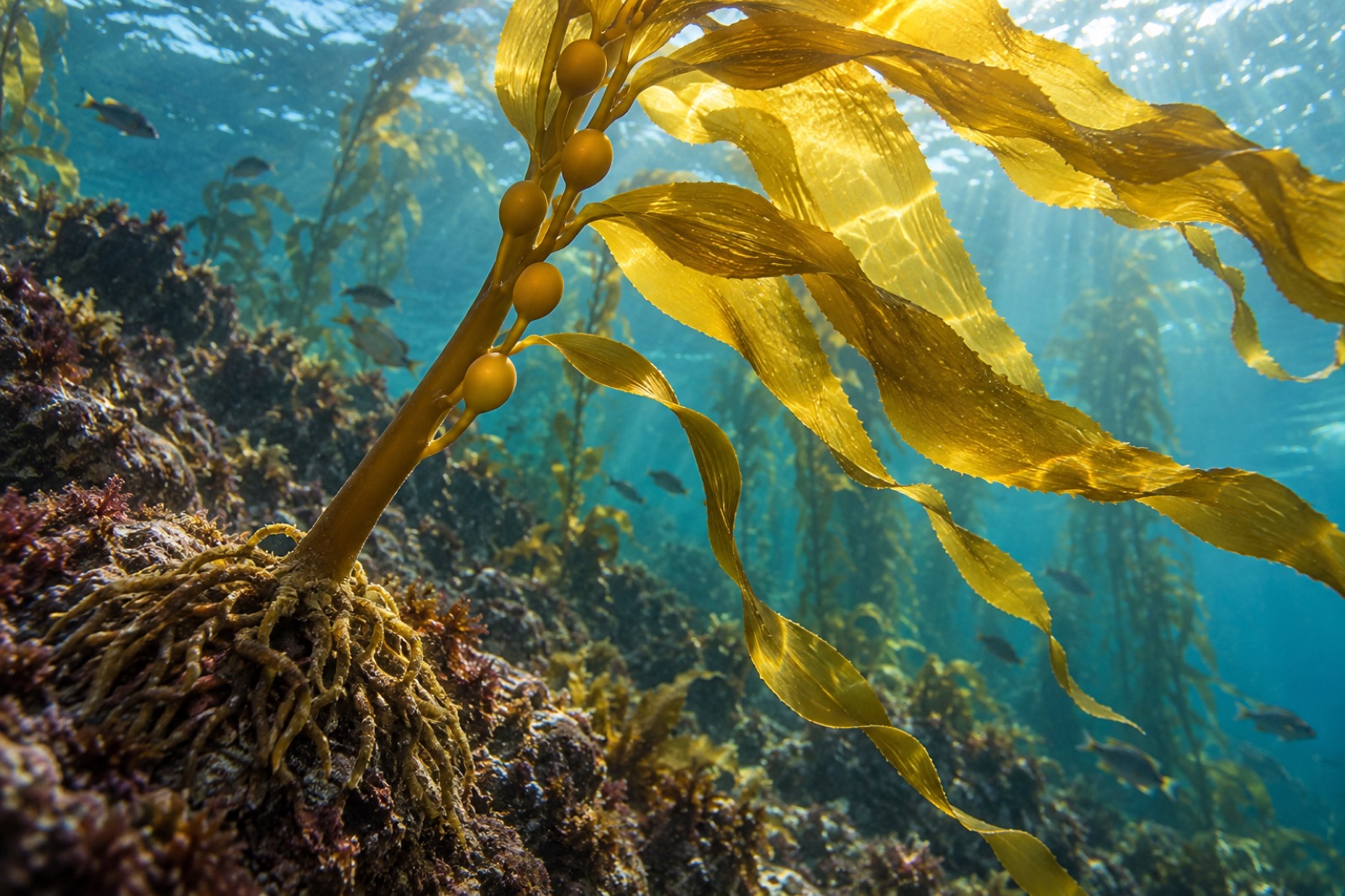
Giant kelp is the fastest-growing organism on Earth and the architect of undersea forests. Learn its biology, life cycle, range and why it matters.
Dr. Theo Nakamura ·