Encyclopedia8 min read
Red Abalone (Haliotis rufescens): Species Profile
Meet the world's largest abalone — a kelp-eating giant sea snail of the Pacific coast. Its biology, fishery history and the road to recovery.
Dr. Theo Nakamura ·
Pink abalone built Baja California's most storied shellfish fishery, then nearly vanished with the kelp. Inside the cooperative-led fight to bring them back.
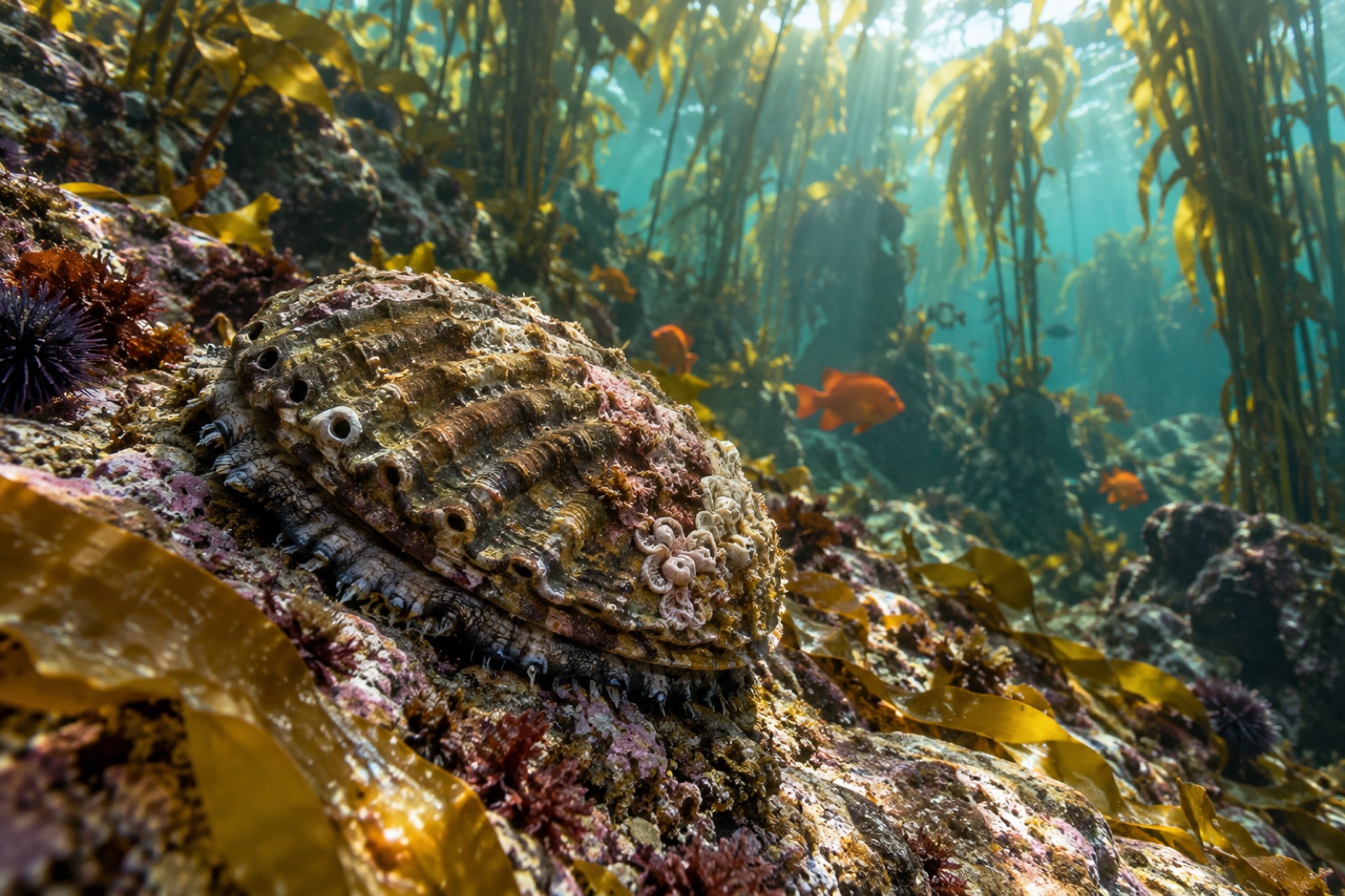
Pink abalone (Haliotis corrugata) are the heavyweight of the eastern Pacific's abalone guild — broad, heavily corrugated snails that once paved the kelp-edge reefs of Baja California so thickly that divers harvested them by the tonne. The fishery they supported became one of the most sophisticated community-run shellfish fisheries on Earth. Then, over a few brutally warm decades, both the abalone and the kelp that fed them thinned toward collapse. The story of what happened next — and what is slowly coming back — is one of the most instructive in all of marine management.
| Scientific name | Haliotis corrugata W. Wood, 1828 |
| Group | Marine gastropod, family Haliotidae (abalones) |
| Maximum shell length | To ~25 cm; fishery-sized adults commonly 14–19 cm |
| Habitat | Rocky reefs and kelp forest edges, mostly 5–20 m deep; recorded intertidal to ~30+ m |
| Diet | Drift kelp and red and brown macroalgae trapped under the foot |
| Range | Point Conception, California, south along Baja California to Bahía Tortugas; also Isla Guadalupe |
| Spawning | Late summer into autumn, when the water is warmest |
| Status | Assessed by the IUCN as Critically Endangered; fishery tightly managed in Mexico, closed in US waters |
The animal's English name slight deceives: out of the water the shell is a dull olive-brown to grey-green, its upper surface pleated into coarse radial corrugations — corrugata, ridged — crossed by long low lumps. Two to four open respiratory pores perforate the shell's edge line, sitting on raised, scalloped bosses. The overall effect is rugged, barnacled, camouflaged. The "pink" only reveals itself when the shell is opened: the nacre is silver shot with a warm pinkish to coppery glow, among the loveliest interiors in the family.
A pink abalone in the water is identified less by shell than by silhouette and company. They are broad and dome-shaped, sit on open rock faces at the outer edge of kelp beds rather than in deep cracks, and — the giveaway — their epipodium, the ruffled sensory skirt around the foot, is yellowish olive with fine darker mottling, fringed with short tentacles. Where ranges overlap with the green abalone (H. fulgens), pinks are the larger, more deeply corrugated, more open-rock animals; greens favour crevices and the edge of the sand.
Fully grown they are imposing: a 20-centimetre pink abalone weighs the better part of a kilogram and grips the reef with a foot that can believably resist a pry bar.
Pink abalone are connoisseurs of one of the ocean's great delivery services: drift kelp. Giant kelp, feather boa kelp, elk kelp and other brown blades torn free by swell and senescence wash across the reef; the abalone traps a fragment under the rim of its foot, drags it beneath, and rasps it down with its radula over hours. On abundant reefs in Baja California, a stand of giant kelp is effectively a conveyor, and the abalone field at its foot is the receiving dock.
This feeding relationship is so tight that the two species rise and fall together. When El Niño warm-water events — like the severe events of the early 1980s and late 1990s — stripped kelp from broad stretches of the Baja coast, abalone condition, growth and reproduction suffered in proportion. Warm water also directly suppresses abalone fitness: pinks are cool-water animals whose southern populations already live near their thermal ceiling, a vulnerability our explainer on marine heatwaves examines system-wide.
Like all abalone, pinks are broadcast spawners that must aggregate to reproduce. Males and females release sperm and eggs into the same few cubic metres of water within seconds of each other, cued chemically by their neighbours. Below a threshold density — somewhere around half an abalone per square metre in studies of related species — spawning encounters grow too dilute to fertilise. This is the demographic trap, the Allee effect, that every depleted abalone population on Earth now wrestles with.
The pink abalone fishery of Baja California's Pacific coast began in earnest after the Second World War and became the economic engine of the peninsula's cooperative movement. The arrangement that hardened into place was unusual then and exemplary now: fishing cooperatives, federated along the coast, hold long-term federal concessions over defined stretches of seabed — in effect, community-owned underwater ranching territory. Within their zones, cooperators set their own dive rotations, invest in surveillance against poaching, fund their own biologists and abalone hatcheries, and observe a national minimum size of 140 millimetres and closed seasons.
The model's logic is simple and powerful: nobody stewards an asset like its owner. A cooperative diver contemplating next year's quota is also contemplating his grandchildren's quota. Studies of these tenure systems find exactly what the theory predicts — higher densities and bigger abalone inside well-enforced concessions than outside them.
In the decades around mid-century the fishery was enormous, landing thousands of tonnes a year. But even the best governance was tested by what came next.
From the late 1970s onward, catches slid. The causes piled onto one another. Fishing pressure ran ahead of biology in the boom decades. The great El Niños of 1982–84 and 1997–98 burned kelp off the mid-peninsula reefs and left abalone starving on bare rock; withering syndrome, the bacterial disease that devastated the black abalone to the north, was found in Baja populations too, and it burns hotter in warm water. Poaching corroded the cooperative system from the edges — an abalone at the surface is an abalone anyone can grab.
By the turn of the century, landings were a small fraction of their former peak. US waters had already closed: California shut its southern abalone fisheries, pinks included, in 1997, and none have reopened. In 2006 the IUCN assessed pink abalone — along with its close relative the green abalone — as Critically Endangered, a status reflecting range-wide depletion rather than imminent disappearance.
Here is where Baja's story diverges from so many collapse narratives. The cooperative architecture held. With territory, enforcement and pride at stake, cooperatives doubled down: community surveillance camps on the offshore islands, restocking from cooperative hatcheries, experimental no-take reserves seeded with broadstock, and patient adherence to conservative quotas through years when the economics said take more. Today, pink and green abalone remain the cooperative fishery's flagship, fished under a management system that fishery scientists travel the world to study — and on the best-managed reefs and island concessions, densities have rebuilt to levels unseen in decades.
Recovery elsewhere is real but patchier, and genetics surveys caution that some remnant populations carry the signature of a bottleneck. The overarching vulnerability is unchanged: every fraction of warming raises the baseline against which all of this management effort is spent. Abalone recovery on a warming coast is running up a down escalator — possible, but only with momentum.
Pink abalone embody three lessons we carry into our own work at Tidewright. First, habitat is the whole game: an abalone without kelp is a starving animal no quota can save, which is why our restoration platform begins with the forest itself. Second, tenure works: communities holding enforceable, long-term rights protect resources in a way open access never will — a principle at the heart of our work with fisheries and aquaculture partners. Third, monitoring is the difference between a story and evidence: the Baja system's decades of size-frequency and density data are what allow managers to say credibly what is recovering, the same philosophy we build into Canopy Ledger for reefs.
Yes, legally and sustainably — if you know the source. Pink abalone from Baja California's cooperative fishery reaches Mexican and export markets as canned, dried or fresh product under quota. Any abalone claiming a Californian wild origin is illegal: the US take is closed. Look for fishers' cooperative branding and Mexican fishery documentation.
No single cause: decades of heavy fishing, then repeated El Niño events and marine heatwaves that starved them by removing drift kelp, withering syndrome pressure, and poaching that undermined cooperative management. Each stress amplified the others — the classic pattern in abalone collapses worldwide.
Red abalone are a cooler-water, northern species — bigger still, smooth-domed and brick-red, centred on Northern California's bull kelp coast. Pinks are the southern species: corrugated, olive-brown outside, favouring the warm-temperate kelp edge from Point Conception south. Their ranges barely overlap.
Yes. Abalone are broadcast spawners; their gametes dilute within seconds. Below a minimum local density, most eggs simply go unfertilised — which is why a reef can carry plenty of visible abalone yet produce no young, and why restocking programmes gather adults into spawning aggregations.
In US waters they are fully closed to take. In Mexico they are a managed fishery under cooperative concessions with size limits, seasons and catch quotas, backed by community enforcement. The IUCN Red List assessment of Critically Endangered describes the species' condition, not a prohibition — and Baja's cooperative fishery is precisely the kind of managed take conservationists point to when arguing that use and protection can coexist.
Meet the world's largest abalone — a kelp-eating giant sea snail of the Pacific coast. Its biology, fishery history and the road to recovery.
Dr. Theo Nakamura ·
Haliotis fulgens, the green abalone, is a kelp-trapping herbivore of Baja and southern California. Shell, life cycle, fishery history and recovery.
Dr. Theo Nakamura ·
Baja California's Pacific kelp beds mark giant kelp's warm-water frontier — a coast of El Niño crashes, fast recovery, red urchin fisheries and hard-won lessons.
Dr. Elias Brandt ·