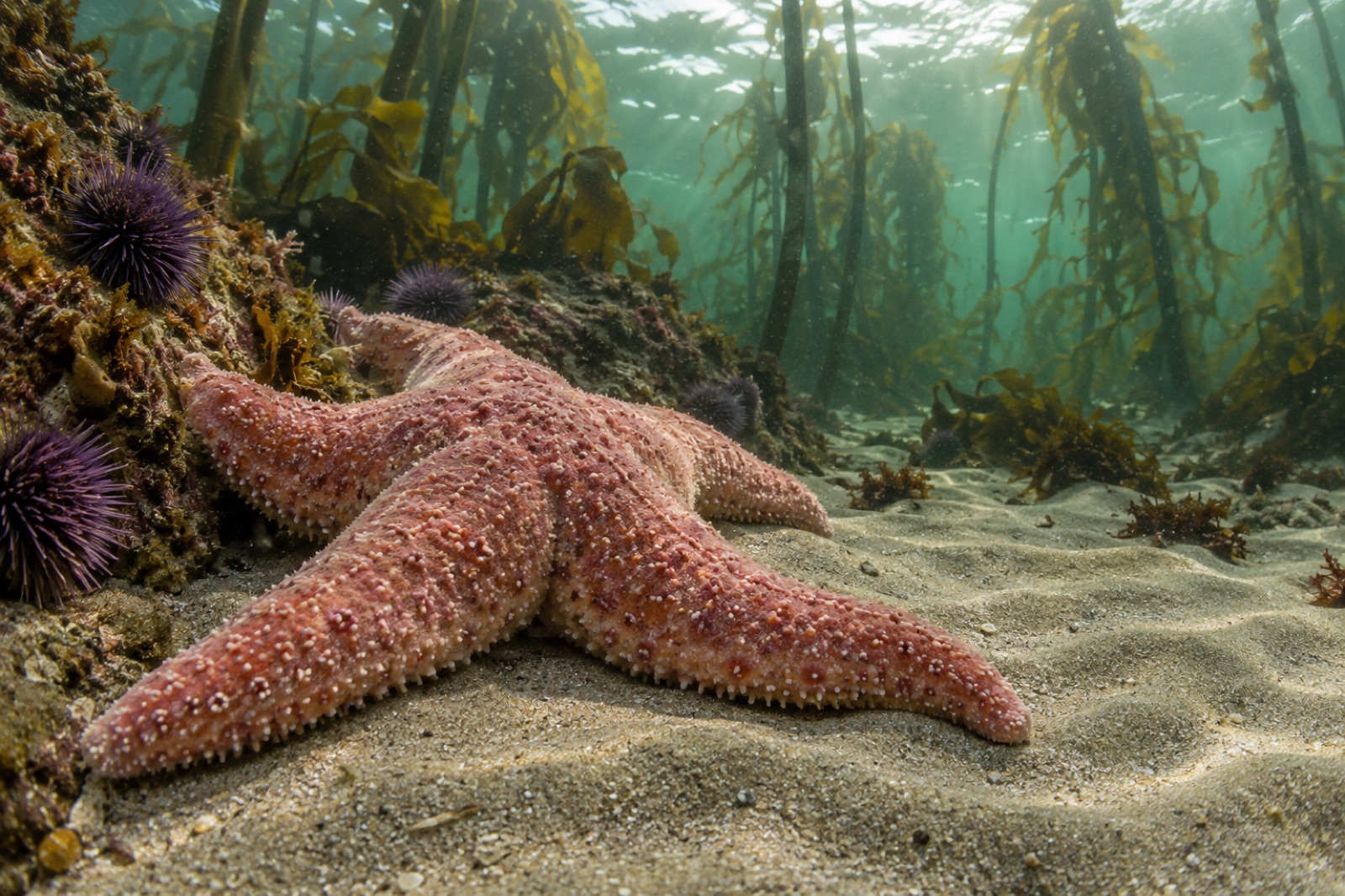
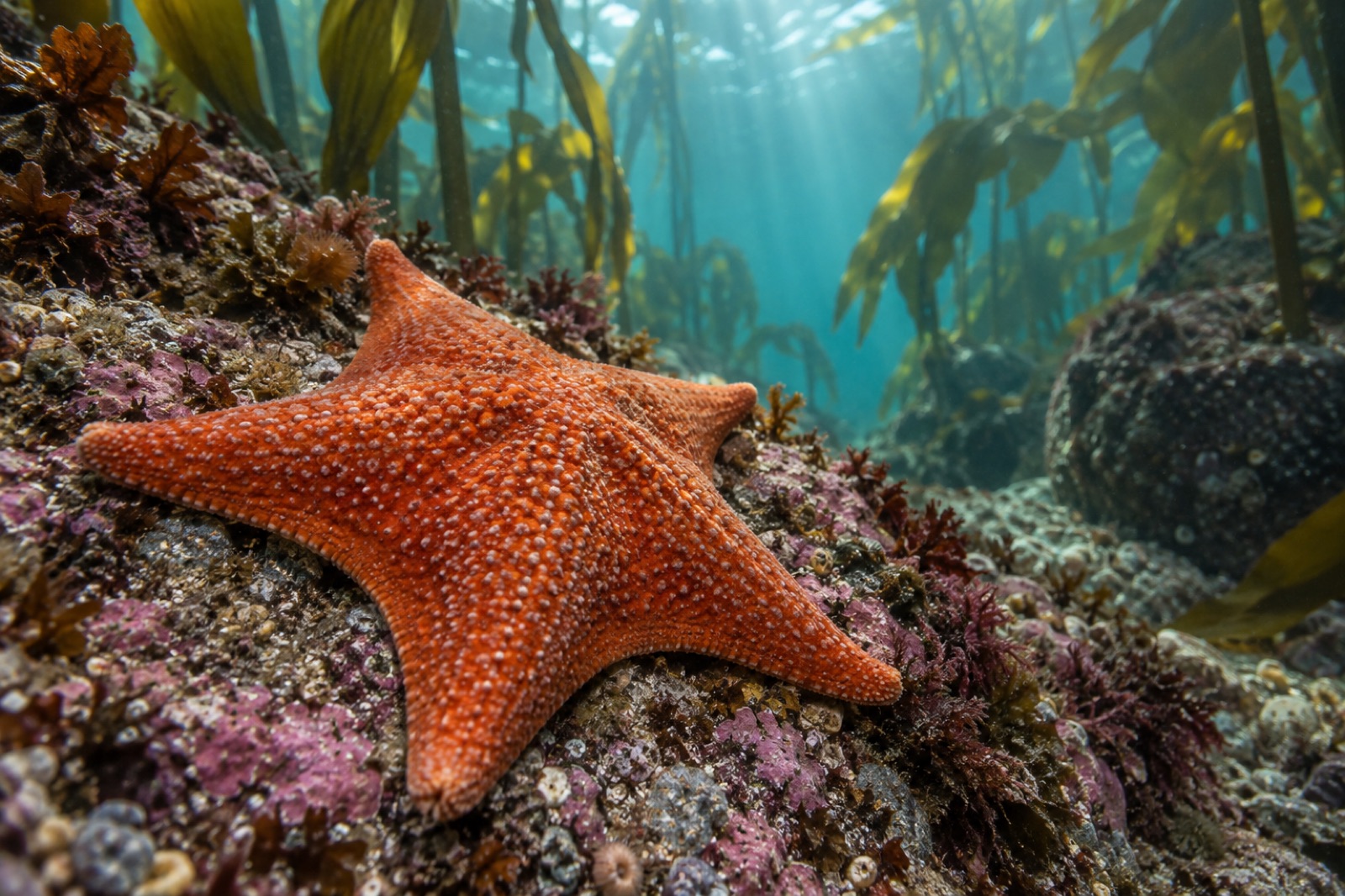
Divers remember their first giant pink sea star (Pisaster brevispinus) for the same reason: scale. You are finning over the sandy channel at the edge of a kelp bed, expecting nothing larger than a sand dollar, and there — half a metre of rose-pink starfish, its five fat arms spread over the sediment like a slow-moving helicopter rotor. Also called the short-spined pink star, it is the second-largest sea star on the Pacific coast of North America after the sunflower star, and it occupies a habitat most sea-star watchers never think about: the soft, unglamorous floor between the reefs. This profile covers how to identify it, how an animal with no teeth excavates buried clams, and why this sand-flat specialist matters to kelp forest ecology even though it never climbs a rock.
Fast facts
|
|
| Scientific name |
Pisaster brevispinus |
| Common names |
Giant pink sea star, short-spined pink star |
| Range |
Southeast Alaska to California; most abundant from British Columbia to central California |
| Habitat |
Sand and mud bottoms, low intertidal to roughly 100 m; also on sheltered rocky slopes |
| Size |
Commonly 25–40 cm across; large individuals approach 60 cm and heavier builds than any temperate relative |
| Colour |
Rose-pink to salmon, occasionally greyish |
| Diet |
Clams and cockles, sand dollars, mussels, snails, chitons, other sea stars, carrion |
Identification: pink, plump and small-spined
Brevispinus means "short-spined," and the name is the field mark. Where its rock-clinging cousin the ochre star bristles with neat starburst rows of chalky spines, the pink star wears only small, sparse stubs — often so short that the surface feels almost smooth, like heavy rubber. The body is thick and soft-edged, the arms plump and blunt-tipped, the whole animal draped rather than clamped.
That relaxed body plan is the immediate giveaway that you are looking at a soft-bottom animal. Rock-dwelling stars must be living suction pads; a star that walks on sand can afford to be pillow-shaped. Colour runs from delicate ballet pink through salmon to a washed grey-pink in some southern animals, and large individuals have a speckled, faintly blotchy look. If you are on sand, in kelp country, facing a pink star wider than both your hands — there is nothing else it can be.
Telling juveniles apart is harder. Young pink stars under 10 cm can be confused with mottled stars or small ochre stars that have wandered off the rocks; look for the softer body, the sparse stubby spines, and — above all — the sediment it is walking on.
Life on the forest floor
Why sand, in a kelp forest?
Kelp forests are forests on islands: rocky reefs rise out of plains of sand, and the sand channels between reef patches are not empty corridors but habitat in their own right. That is the pink star's country. Alongshore, it frequents the sediment aprons at the forest's foot; in sheltered sounds such as Puget Sound, it broadens out into a true sand-flat animal, roaming bottoms where a diver may see half a dozen in a single survey.
There it plays the role the ochre star plays on rock, translated to two dimensions: the roving apex invertebrate. Sand bottoms look empty to a casual eye, but they are stocked with buried clams, cockles, eccentric sand dollars, heart urchins and moon snails — a standing crop protected only by depth of burial. The pink star is built to tax it.
The soft-substrate grip
Tube feet on a rocky star end in adhesive discs; on a sandy bottom suction is useless, so soft-bottom stars walk on more pointed, digging feet and let weight and reach do the work. Watch a pink star move and you see the difference: not gliding but shouldering, arms lifting and rolling, sediment furrowing behind it. For a sea star it is quick — a purposeful amble of several metres an hour, fast enough to overhaul anything that cannot walk away.
Hunting below the sediment
The pink star's signature prey are the buried bivalves: butter clams, cockles, gapers, littlenecks. A clam a few centimetres down is safe from almost everything except moon snails, rays — and this star. The sequence is unhurried and absolute. The star locates the clam chemically through the sediment, settles its disc over the spot, and digs — arms scooping and sweeping with the pointed tube feet, excavating a shallow crater until its mouth sits directly over the shell. Then comes the sea-star speciality: extrude the stomach, flood the shell's margins with digestive fluid, and patiently work until the clam gapes and is liquefied in its burrow.
Sand dollars it handles surface-side, humping over the living coin industry until the sediment is skin and shell. It scavenges dead fish and crab when it finds them. And — a trait it shares with several big asteroids — it eats other sea stars, including smaller Pisaster and slow bat stars, making it both a herbivore-controller and a predator of predators on the soft floor.
That is the ecological thread back to the kelp forest: the sand channels are reservoirs of grazers and detritivores whose comings and goings shape the reef edge. Bivalve and sand-dollar beds process a rain of kelp detritus the reefs shed; a predator that mines those beds is, in effect, working the forest's compost heap. In surveys of restored reef projects, pink stars along the forest edge are among the first large invertebrates to repopulate the surrounding sediment — the floor heals as the canopy returns.
Enemies on the sand
Very little bothers an adult pink star, but the list is led by one specialist: the morning sun star, an eleven-armed predator of sea stars that will chase a fleeing brevispinus across open sediment in one of the subtidal zone's slowest and strangest pursuits. The pink star's defences are size, a tough body wall, and the standard asteroid emergency exit — shedding an arm. Autotomised arms are common in surveys, and the star regenerates them over months to years. Gulls and sea otters take small individuals in the shallows; crab claws take what they can reach.
The wasting years on soft bottom
When sea star wasting disease swept the coast from 2013, the pink star was hit hard — enormous, melting animals were among the most distressing sights in Puget Sound and the inside waters, where densities had been high. But unlike some rock-dwelling stars that were locally erased, brevispinus showed a comparatively partial and tide-line-sensitive pattern: deeper, cooler subtidal populations fared better than shallow ones, consistent with the warm-water signature of the disease. Recruitment followed, and by the late 2010s divers were again logging young stars on the flats. The species' current status is best described as recovering-but-watched: any warm anomaly year still brings reports of symptomatic stars, and its size makes every loss conspicuous.
Where to see one
- Diving or snorkelling the sediment channels at reef edges — kelp-country classics from Hood Canal to California's kelp margins are prime.
- Very low tides where sand flats meet rock, especially in British Columbia and Washington inside waters.
- Under piers and along sheltered subtidal slopes, where it sometimes leaves the sand entirely to hunt mussels on structure.
As always: look, photograph, leave. A half-metre star has survived decades of storms and morning sun stars; it should not have to survive being pried up for a closer look.
The kelp forest gets the postcards, but the forest pays its compost bill in the sand channels — and the giant pink star is the bill collector.
Key takeaways
- The giant pink sea star (Pisaster brevispinus) is the Pacific coast's second-largest sea star, reaching roughly 60 cm, rose-pink and nearly smooth-skinned.
- It is a soft-sediment specialist of the sand flats and channels between kelp reefs — the subtidal counterpart of the ochre star's rock-shore role.
- It excavates and digests buried clams, eats sand dollars and other sea stars, and scavenges — the apex invertebrate predator of its habitat.
- The morning sun star is its main enemy; dropped arms and slow regeneration are its defence.
- Wasting disease after 2013 hit it hard in shallow inside waters, but recruitment through the late 2010s returned it to most sand-flat communities.
FAQ
How big does the giant pink sea star get?
Commonly 25–40 cm across, with exceptional individuals approaching 60 cm — second only to the sunflower star among Pacific coast sea stars, and heavier-bodied than any except that species.
Why is it pink while its closest relatives are purple and orange?
Colour in sea stars is not strongly tied to habitat or diet, and the reason for the pink star's consistent rose-salmon palette is unresolved. It is one of the easier colour cues in the group precisely because the whole species leans pink.
What does a giant pink sea star eat?
Mainly buried clams and cockles, dug from the sediment. It also takes sand dollars, mussels, snails and chitons, scavenges dead fish and crabs, and preys on smaller sea stars.
Is the pink sea star affected by sea star wasting disease?
Yes — it suffered heavy losses from 2013 onward, particularly in warm, shallow, enclosed waters. Populations on the open coast and at depth fared better, and juveniles have rebuilt numbers at many sites since.
Can you see pink sea stars without diving?
Occasionally. On extreme low tides in sheltered inside waters — parts of Puget Sound, Hood Canal and British Columbia's inside passage — individuals forage within reach of a careful shore-walker. Most sightings, though, belong to divers and snorkellers over sand at kelp-bed edges.