Atlas7 min read
Puget Sound: Bull Kelp in the Inland Sea
Washington's inland sea shelters floating bull kelp beds that shelter salmon in return. A Coastal Atlas guide to its patchwork beds and citizen science.
Tom Okafor ·
A Coastal Atlas guide to Hood Canal: the Salish Sea's natural fjord, its famous shore dives, giant Pacific octopus, bull kelp shallows and breathless depths.
Despite its name, Hood Canal was never dug by anyone. It is a true fjord — a glacial trough flooded by the sea — and the second-largest natural fjord in the lower forty-eight American states, a long, deep, crooked arm of salt water that hooks around the eastern base of Washington's Olympic Mountains. For divers it is one of the quietest great shore-diving regions on the Pacific coast: wall dives among plumose anemones, wolf eels in the rock seams, the finest giant Pacific octopus country on Earth, and, in season, squid by the thousand. For oceanographers it is famous for a more sobering reason: this is an estuarine fjord that regularly runs short of breath. Both stories belong in the Atlas.
Hood Canal is the westernmost of the Puget Sound basins, the watery sub-regions that make up the southern half of the Salish Sea. From its junction with the main Sound near Foulweather Bluff it runs south, then takes the extraordinary Great Bend and hooks back northeast for roughly 110 kilometres of winding shoreline, fed by short mountain rivers that pour out of the Olympics. The canal is narrow — often less than two kilometres across — and startlingly deep for its width, with much of the basin below 100 metres.
Two features of that geometry run everything that follows. First, like many fjords, Hood Canal has a sill: a shallow ridge near its mouth, left by the glaciers, that partially dams the deep basin behind it. Deep water can only enter over that sill, and only at specific tidal moments. Second, the canal's rivers freshen the surface. Fresh water spreads over salt, the column stratifies into stacked layers, and the deep water below is cut off from the atmosphere. The result is a basin whose depths renew slowly — on the order of many months — making it exquisitely sensitive to anything that consumes oxygen down there.
Hood Canal is one of North America's best-known natural laboratories for ocean deoxygenation. Oxygen in the deep basin is used up by the rain of organic matter descending from above, and can only be replaced when dense, oxygen-rich ocean water pushes over the sill. In some years that flushing arrives; in others it does not, and the southern reaches of the canal sink toward hypoxia. Lynch Cove, at the canal's innermost hook, has seen celebrated fish-kill events where declining oxygen — amplified by algal blooms fed by nutrients from shoreline development, lawns and septic systems — suffocated fish in their thousands.
The honest reading of the science is that this is a system naturally balanced on a low-oxygen edge, tipped further by local nutrient loading, and vulnerable in a warming climate (warm water holds less oxygen and stratifies more strongly). Hood Canal's lesson travels well: fjordic and semi-enclosed basins everywhere, from Scandinavian fjords to the deep basins of inland seas, share this same vulnerability. Kelp restoration can't fix a ventilation problem — but riparian and nutrient management, the shallow-water habitats like eelgrass and kelp that structure the nearshore, and long-term dissolved-oxygen monitoring are precisely the levers that fjord communities can actually pull.
The canal's steep bathymetry means that the sunlit band where kelp can grow is often narrow — a stripe between the forested shore and the green depths. Within that stripe lives bull kelp, the same annual canopy-former of the greater Puget Sound, appearing each spring and rafting by midsummer where current and cool water permit, alongside eelgrass meadows on the flatter shelf edges and understorey kelps on shallow rock. In the canal the canopy distribution is local: the strongest beds sit where exchange with the wider Sound keeps water cool and clear.
Those narrow shallows do outsize ecological work. Pacific herring spawn on the nearshore vegetation; juvenile salmonids migrating out of canal rivers pause at the kelp' s edge; and the subtidal rock that rings the canal — often sheer enough that you can stand on shore and look straight down a wall — supports a dense, colour-saturated invertebrate turf: plumose and strawberry anemones, sponges, sea stars and rockfish above it all.
Ask a Pacific Northwest diver why they love this place and one animal leads: the giant Pacific octopus. Hood Canal's accessible shore dives harbour some of the most reliably denned GPO populations in the region, the tell being the midden — a fan of crab shells pushed out of a rock crack. Watching one reorder its den as you hover neutrally at a respectful distance is among the great cold-water wildlife encounters.
Close behind comes the wolf eel, the long, blunt-faced reef fish (not an eel at all) that pairs for life in the rock seams, and — in late autumn and winter — the spawning runs of market squid. During a squid event the wall bases are decked in white, mop-like egg capsules, and the night water fills with squid and with the sea lions, dogfish and diving birds that come to eat them. It is one of the great seasonal spectacles of the Salish Sea, visible to any shore diver with adequate cold-water training.
Hood Canal is shore-diving country par excellence, with a string of Washington State marine preserves and roadside sites along the canal's eastern shore. Wrapping up from routes like our Deception Pass dive guide, the essentials here are:
Hood Canal sits at the intersection of tribal treaty rights — Skokomish and other tribal nations have stewarded and harvested these waters since long before George Vancouver named the channel — state management, and a growing ring of waterfront homes. The oxygen problem has driven serious responses: improved wastewater management, shoreline armouring reviews, long-running oxygen monitoring, and habitat-protection rules. The canal is also deeply loved by its region; there are few places where the average diver is as conversant in dissolved oxygen units as a Hood Canal regular.
The Atlas's honest grade: a fjord with a structural vulnerability it did not choose, a nutrient-loading problem its communities are genuinely tackling, and nearshore habitat that is worth every protection. Restoration thinking here — our fictional model at Tidewright included, from canopy mapping to kelp reseeding — must work around the ventilating sill, the oxygen budget and the tribes' leadership. Those are the terms on which this crooked, beautiful water comes back stronger.
No. Vancouver's chart-makers called it a canal (after Admiral Hood's Channel), but no one dug it. It is a fjord: a glacier-carved trough with an entrance sill, flooded by the sea at the end of the last ice age.
Two ingredients: the sill restricts deep-water renewal from the Pacific, and the layered water column traps depth below the reach of wind. Oxygen is used up decomposing sinking organic matter. In bad years the deep basin flushes poorly and inner reaches trend toward hypoxia; nutrients from shoreline development make it worse.
Locals prize autumn and winter: the plankton bloom dies back, visibility peaks, and the market squid come in to spawn — drawing sea lions and other predators. Summer is mellower, if greener. Any season demands genuine cold-water competence.
At sheltered sites in summer, certainly — particularly over the shallows of the inner canal — though hoods, gloves and serious thermal protection are as advisable as for any Salish Sea snorkel. The plankton-rich summer water cuts visibility, so pick calm, clear days.
The preserves are no-take for exactly this reason and you should leave everything — dens, shells, animals — as you found it. Keep a respectful distance from octopus dens and watch buoyancy near the egg-string squid beds in season. The reward for good manners is that the next diver gets the same show.
Washington's inland sea shelters floating bull kelp beds that shelter salmon in return. A Coastal Atlas guide to its patchwork beds and citizen science.
Tom Okafor ·
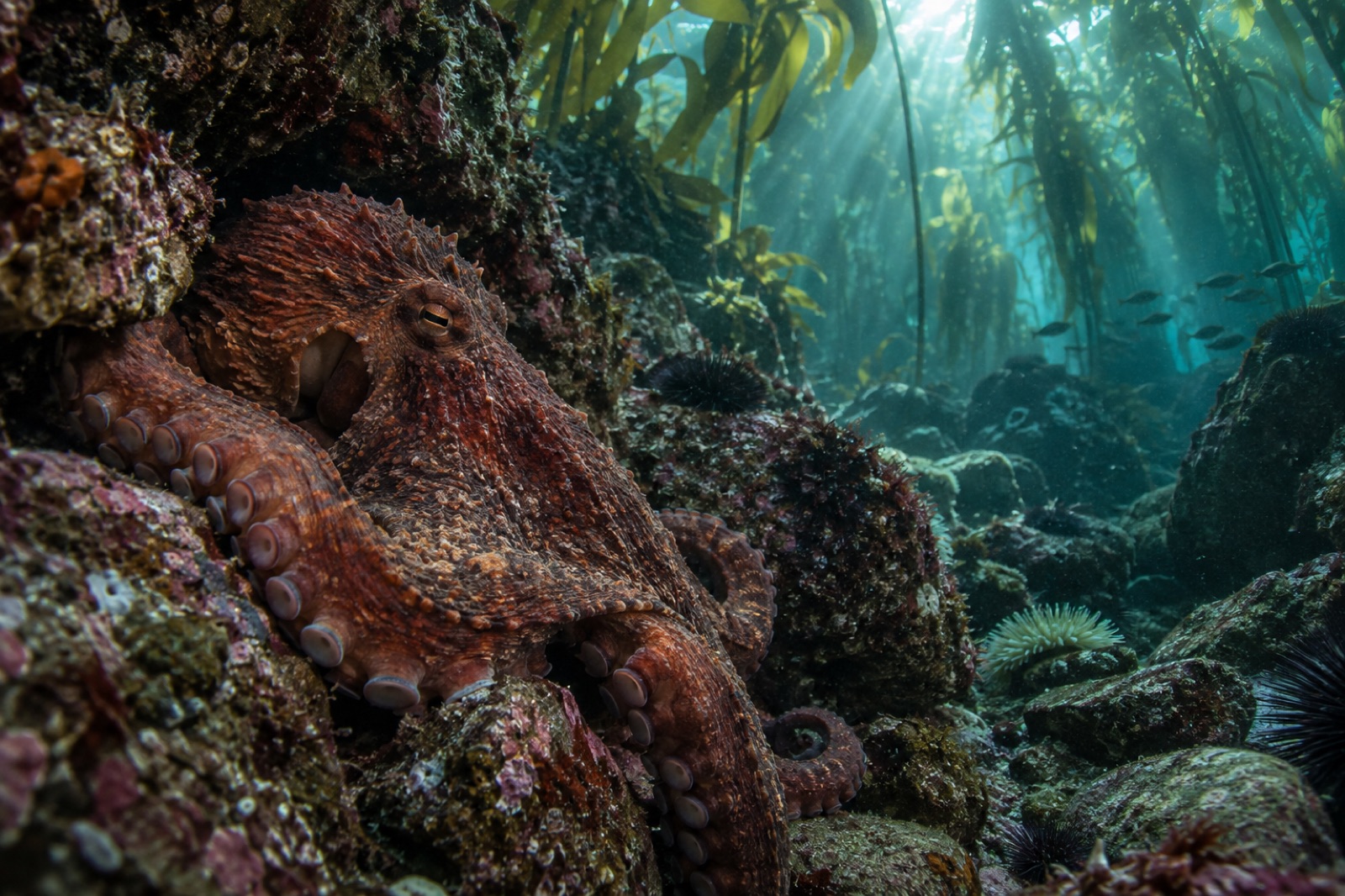
Meet the giant Pacific octopus: the world's largest octopus, a kelp-forest den-dweller with three hearts, blue blood and one shot at motherhood.
Dr. Theo Nakamura ·
The ocean is losing oxygen — measurably and globally. How warming and nutrient stress squeeze marine life's air supply, and what that does to kelp forests.
Dr. Lena Fischer ·